AEO for Real Estate: How Developers and Brokers Get Named in AI Answers
Home buyers now ask AI which projects to shortlist. A practical AEO guide for developers, brokers and property portals: project pages, RERA details, location content, reviews and how to measure progress.
On this page
- Key takeaways
- How buyers use AI to shortlist property
- The questions buyers ask AI about property
- How AI decides which projects to mention
- Build one strong page per project
- Show regulatory details clearly
- Locality guides: the content buyers actually search for
- Developer track record pages
- Portals, listings and Google Business Profile
- Reviews and community discussion
- Content ideas that get real estate brands cited
- A 90-day AEO plan for a developer or brokerage
- How to measure progress
- Common real estate AEO mistakes
- When to bring in specialist help
- Worked example: rewriting a project page
- Brokers and channel partners: own a niche
- Video, virtual tours and images
- Preparing for AI agents that compare and enquire
- A quick checklist before you publish a project page
- Frequently asked questions
- Sources
Last updated: 4 November 2026
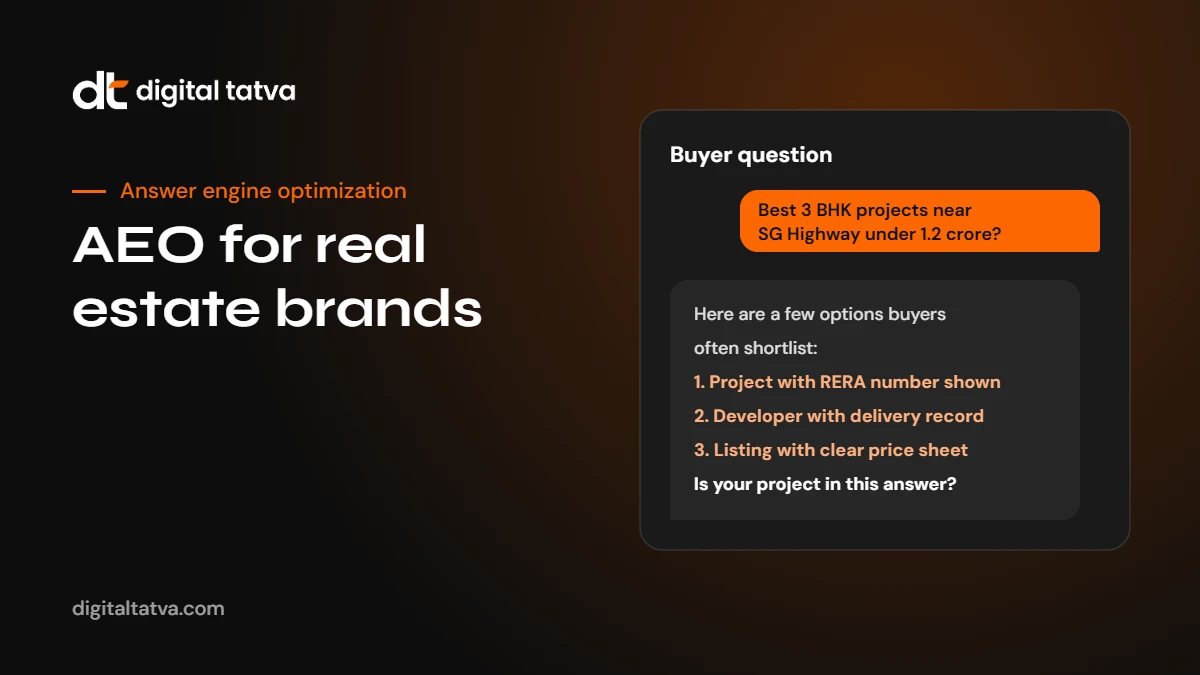
Quick answer: AEO for real estate means making your projects, brokerage or property business easy for AI assistants to find, understand and trust, so you are named when buyers ask questions such as “best 3 BHK projects near SG Highway under 1.2 crore” or “which developers in Pune deliver on time”. AI engines favour sources with complete, consistent and verifiable facts: one detailed page per project, clear price and possession information, regulatory registration details, location guides, reviews and coverage on trusted portals and news sites. Developers and brokers who publish honest, structured project information are the ones AI shortlists.
Key takeaways
- Buyers use AI assistants to shortlist projects, compare localities and check developer track records before they call anyone.
- One detailed page per project, with configurations, sizes, price ranges, possession timeline and registration details, beats a single brochure page.
- Location content (schools, offices, metro, hospitals, commute times) matches how buyers phrase AI questions.
- Consistency across your website, portals and Google Business Profile decides whether AI trusts your facts.
- Track a fixed set of buyer questions monthly; do not judge progress on one chat.
How buyers use AI to shortlist property
Buying a home is one of the biggest financial decisions most families make, and it involves hundreds of small questions. Which locality has good schools? What does a 3 BHK actually cost after parking and club charges? Has this developer delivered projects on time before? Is the project registered? Until recently, buyers answered these questions by visiting property portals, reading forums, asking relatives and calling brokers.
Now many buyers start with an AI assistant. They type a detailed question into ChatGPT, Gemini or Perplexity and get a short answer with a few project names and reasons. Google shows similar summaries in AI Overviews and AI Mode. The buyer then visits two or three of the named projects. If your project is not in that answer, it may not make the shortlist at all.
That is why answer engine optimization matters for real estate. Traditional SEO still helps, because AI engines build answers from search results. But the goal shifts from ranking a page to being the source an assistant trusts enough to name.
The questions buyers ask AI about property
Start by understanding the questions. When we run prompt research for property businesses, the questions fall into six groups.
| Question type | Example | What the AI needs to answer it |
|---|---|---|
| Shortlist | “Best 2 BHK projects in Gota under 70 lakh” | Project pages with location, configurations and price ranges |
| Locality | “Is Shela a good area to buy a flat for a family?” | Locality guides with schools, hospitals, commute and growth facts |
| Developer trust | “Has XYZ Builders delivered projects on time?” | Track record pages, completed projects, news coverage, reviews |
| Cost | “What is the total cost of a 1.2 crore flat including registration?” | Clear cost breakdowns and explainers |
| Regulation | “Is this project RERA registered?” | Registration numbers shown on project pages and portals |
| Comparison | “Project A vs Project B, which is better?” | Fair comparison content and consistent facts on both |
Write down 20 to 30 of these questions for your city and segment before changing anything. They become your baseline and your measuring stick.
How AI decides which projects to mention
AI assistants that answer current, local questions usually search the web, read a set of pages and listings, and summarise what they find. Four factors shape whether your project is named.
Readable pages
Many project websites are built as visual microsites with heavy animation, floor plans inside images and key details in downloadable PDFs. AI crawlers may see very little text on these pages. Put configurations, sizes, amenities and location facts in plain HTML text. Check access with our free AI visibility checker and read can AI crawlers read JavaScript?
Consistent facts
If your website says possession in December 2027, a portal says March 2028 and a news article says 2026, the AI cannot be sure which is correct. It may avoid recommending the project or repeat the wrong date. Keep every listing in sync.
Third-party confirmation
Assistants look beyond your own site. Property portals, regulatory websites, news coverage, review sites and community forums all shape how AI describes a developer. Our guide to brand mentions for AEO explains how to earn this coverage.
Useful, specific answers
An AI answer to “best projects near a metro station in Ahmedabad” is more likely to cite a page that states “the project is a 6-minute walk from the Thaltej metro station” than one that says “excellent connectivity”.
Build one strong page per project
The project page is the foundation of real estate AEO. Each live or upcoming project should have its own page with a stable URL, and that page should contain everything a buyer or an AI system needs. Use this structure.
- Summary at the top. One paragraph: project name, developer, locality, configurations, size range, starting price or price range, possession timeline and registration number.
- Configurations table. Each unit type with carpet area, number of units and price range. Use real text, not an image.
- Location facts. Distances or travel times to metro stations, highways, schools, hospitals, offices and shopping, with the method you used (for example “measured on Google Maps at 9 am on a weekday”).
- Amenities. A plain list, not only icons.
- Construction status. Current stage with a date, updated regularly, ideally with dated photos.
- Cost explainer. What the price includes and excludes: parking, maintenance deposit, club membership, registration and stamp duty, GST where applicable.
- Regulatory details. Registration number and a link to the regulator’s project page.
- FAQ. Real questions buyers ask your sales team, answered plainly.
- Developer section. A short track record with links to completed projects.
Mark the page up with schema: Residence or Accommodation types where they fit, Place for the location, Organization for the developer, and FAQPage for the FAQ. See schema markup for AEO for the details.
Show regulatory details clearly
In India, the Real Estate (Regulation and Development) Act requires registered projects to display their registration number in advertisements, and state regulators publish project details online. Buyers increasingly ask AI whether a project is registered, and assistants look for the number on trusted pages.
- Show the registration number in the project summary, not only in the footer.
- Link to the project’s page on the state regulator’s website.
- Keep quarterly updates and completion details consistent with what you file.
- Do the same on every portal listing.
Watch out: Never publish a possession date or specification that differs from your regulatory filings. Inconsistent claims hurt trust with buyers, regulators and AI engines alike.
Locality guides: the content buyers actually search for
Many buyers start with a locality, not a project. “Is South Bopal good for families?” “Which areas of Bengaluru are close to tech parks and still affordable?” These questions are perfect for locality guides, and very few developers publish good ones.
A strong locality guide includes:
- A short answer at the top: who the locality suits and why.
- Schools, colleges, hospitals and markets with names and distances.
- Commute times to major employment hubs at peak hours.
- Public transport, including current and planned metro lines, with sources for planned infrastructure.
- Typical price ranges per square foot, with the date and source of your figures.
- Pros and cons written honestly. Mention drawbacks such as water supply or traffic where they exist.
- Links to your projects in the area, and fairly, to the types of other options buyers might consider.
Honest guides earn trust and citations. A guide that only praises the area reads as advertising. For structure tips, see 10 types of pages AI assistants cite.
Developer track record pages
“Does this builder deliver on time?” is one of the most common and most important buyer questions. Create a track record page that lists completed projects with location, number of units, launch date, promised possession date and actual possession date. Include occupancy certificates where you can, and photos of completed projects.
If some projects were delayed, say so and explain why. Buyers will find the information anyway on forums and news sites, and AI engines will too. A developer who is open about its record looks more trustworthy than one that hides it.
Portals, listings and Google Business Profile
Property portals are among the most frequently cited sources in real estate AI answers. Make sure:
- Every project is listed with the same name, configurations, prices and possession date as your website.
- Old or sold-out listings are updated or marked clearly.
- Your developer profile on each portal links to your website and lists all projects.
- Your sales office and site office have accurate Google Business Profiles with the right categories, hours and photos.
- Reviews on Google and portals receive polite, factual replies.
For brokers, the same applies to your agency profile. Brokers should also show their own regulatory agent registration where it applies, and list the localities and segments they specialise in. Our local business AEO guide covers listings in more depth.
Reviews and community discussion
Buyers trust other buyers. AI engines reflect that by drawing on reviews and community discussions when they describe a developer. You cannot control what people say, but you can:
- Ask buyers who have taken possession to review you on Google and major portals.
- Reply to complaints publicly with facts and a contact for resolution.
- Fix recurring issues that show up in reviews, and then say what you fixed.
- Take part honestly in community forums where buyers discuss projects, always identifying yourself. See our guide to Reddit for AEO for the rules of community participation.
Content ideas that get real estate brands cited
- Total cost of ownership guides. Stamp duty, registration charges, GST, maintenance and loan costs explained with a worked example and the date of the figures.
- Home loan explainers. How eligibility is calculated and what documents are needed.
- Possession and handover checklists. What buyers should check at handover.
- Comparison pages. “Ready to move vs under construction: which is better for you?” Our guide to comparison pages explains how to keep them fair.
- Construction updates. Monthly dated updates on each project, which signal freshness and accountability.
- Market data. If you have reliable data on enquiries, prices or absorption in your micro-market, publish it with clear methodology. See original research for AEO.
A 90-day AEO plan for a developer or brokerage
| Weeks | Focus | Tasks |
|---|---|---|
| 1 to 2 | Baseline | Write 25 buyer questions; test them in ChatGPT, Gemini, Perplexity and Google; record mentions and cited sources |
| 2 to 4 | Access | Fix crawler access and rendering; move key project facts out of images and PDFs into HTML |
| 3 to 6 | Project pages | Rebuild one page per project with the structure above and schema |
| 4 to 6 | Consistency | Audit and correct every portal listing and Google Business Profile |
| 6 to 10 | Locality and trust | Publish locality guides for your main areas and a track record page |
| 8 to 12 | Third-party coverage | Review requests from past buyers; one news story or data release |
| 12 | Re-test | Run the same questions, compare with the baseline, plan the next quarter |
Set expectations carefully. Access and accuracy fixes can be picked up within weeks of the next crawl. Becoming a regular recommendation in a competitive city usually takes several months. Read how long AEO takes for a realistic timeline.
How to measure progress
Use the same prompt set every month and record:
- How often your projects or brand are named.
- Whether prices, possession dates and locations are described correctly.
- Which pages and portals are cited.
- Which competitors appear instead of you.
- AI referral visits in analytics. Our guide to tracking AI traffic in GA4 shows the setup.
- Site visit bookings where the buyer mentions an AI assistant. Add the option to your enquiry form and train your sales team to ask.
Use our AEO reporting template to present these numbers to management.
Common real estate AEO mistakes
- Brochure-only websites. Beautiful visuals, almost no text. AI has nothing to read.
- PDF floor plans and price sheets only. Put the key facts in HTML too.
- Inconsistent dates and prices across portals and your site.
- Superlatives without evidence. “Most luxurious project in the city” reads as advertising.
- Deleting sold-out project pages. Completed projects prove your track record. Keep them, marked as completed.
- Blocking AI crawlers through security settings without realising it.
When to bring in specialist help
Developers with several projects across cities, or brokerages covering many localities, benefit from a structured audit. At Digital Tatva we test the questions your buyers ask across AI engines, map the sources behind each answer and give you a ranked fix list. Read what our AI visibility audit includes or request one here. We never promise placement in any AI tool, but we do give you a clear, honest picture.
Worked example: rewriting a project page
To make this concrete, here is how a typical project page changes when it is rewritten for AI answers. The project details below are an illustration, not a real development.
Before
“Skyline Residency: an iconic address for those who demand the finest. Experience world-class amenities, premium specifications and unmatched connectivity in the heart of the city. Download the brochure to know more.”
This text contains no facts an AI assistant can use. It does not say where the project is, what is on offer, how much it costs or when it will be ready. A buyer asking “3 BHK under 1.2 crore near Thaltej metro” will never be matched to it.
After
“Skyline Residency is a residential project by Example Developers in Thaltej, Ahmedabad, with 2 and 3 BHK apartments from 1,150 to 1,620 sq ft carpet area. Prices start at 78 lakh for 2 BHK and 1.08 crore for 3 BHK (October 2026, excluding registration and stamp duty). Possession is planned for December 2028 as per the registered timeline. The site is about a 7-minute walk from Thaltej metro station and 10 minutes by car from SG Highway at off-peak times.”
The rewritten summary answers the shortlist question directly, states the date of the price, links facts to the regulator’s timeline and gives measurable location details. Below it, the page adds a configuration table, a cost breakdown, construction updates and an FAQ. Nothing in it is exaggerated, and every fact can be checked.
Brokers and channel partners: own a niche
Brokers often compete with large portals that list every project in a city. Trying to cover everything is a losing strategy. Instead, become the most useful source for a few localities or buyer types.
- Pick localities you know deeply. Publish a guide for each, updated quarterly, with schools, commute times, price trends and honest drawbacks.
- Serve a buyer segment. First-time buyers, NRI buyers, senior citizens or investors each ask different questions. A guide to “buying a flat in Ahmedabad as an NRI: documents, taxes and remote registration” answers questions portals rarely cover well.
- Show your expertise. Agent profiles with years of experience, localities covered, languages spoken and registration details give AI engines reasons to trust your pages.
- Publish transaction-free advice. Explainers on home loan eligibility, legal checks and handover inspections build authority even when they do not mention a specific project.
Video, virtual tours and images
Property buyers love video, and AI engines increasingly draw on video platforms and image descriptions. Make visual content readable:
- Upload walkthrough videos to YouTube with clear titles such as “Skyline Residency 3 BHK sample flat walkthrough, Thaltej”, detailed descriptions and chapters. Our guide to YouTube for AEO explains why this matters.
- Add transcripts or summaries of video tours to the project page.
- Give every image descriptive alt text: “3 BHK living room with balcony facing the east garden” rather than “image1”.
- Date construction progress photos and keep them in order.
Preparing for AI agents that compare and enquire
AI assistants are starting to act on behalf of users: comparing options, filling forms and booking appointments. In real estate, this could soon mean an agent that shortlists five projects, compares total costs and books site visits. Structured, consistent information will matter even more when software, not a person, reads your page first. Clear prices, availability, configuration data and contact options in HTML, plus working enquiry and site visit forms, prepare you for that shift. Our guide to agentic search explains the trend in more detail.
A quick checklist before you publish a project page
- Summary paragraph states developer, locality, configurations, sizes, price range with date, possession timeline and registration number.
- Configuration table in HTML text, not an image.
- Location facts with distances or travel times and the method used.
- Cost explainer listing what is included and excluded.
- Construction status with a date and recent photos.
- Link to the regulator’s project page.
- FAQ built from real sales questions.
- Schema added and validated.
- Same facts on every portal listing and on Google Business Profile.
- Page checked with the free AI visibility checker.
Frequently asked questions
What is AEO for real estate?
AEO for real estate is the work of making property projects, developers and brokers easy for AI assistants to find, understand and trust, so they are named when buyers ask AI to shortlist projects, compare localities or check a developer’s record.
Do property portals help with AI visibility?
Yes. Portals are often cited in AI answers about property. Keeping your portal listings complete and consistent with your website helps AI describe your projects correctly.
Should developers publish prices online?
Publishing price ranges and what they include makes your page far more useful for buyers asking AI about cost. Where exact prices change often, give a dated range and explain what affects the final price.
Does showing the registration number matter for AI?
It helps. Buyers often ask whether a project is registered, and a clearly displayed registration number linked to the regulator’s page gives AI a verifiable answer.
How long until a project appears in ChatGPT answers?
There is no fixed timeline. Technical and listing fixes can be picked up within weeks of the next crawl, while regular recommendations in competitive markets usually take several months of consistent work.
Can a broker do AEO without a developer website?
Yes. Brokers can build locality guides, segment pages and agency profiles that answer buyer questions, and keep their portal and Google profiles consistent. Specialist knowledge of a few localities is a strong advantage.
Sources
- AI features and your website, Google Search Central
- Creating helpful, reliable, people-first content, Google Search Central
- Residence, schema.org
Product details, prices and features are checked at the time of writing and can change. Sources are linked in the text so you can check them yourself.
How does your brand appear in AI answers?
We test the questions your buyers ask across the major AI assistants and search engines, then show you what to fix first.
Get an AI Visibility Audit