AEO for Education: How Schools, Coaching Institutes and Edtech Get Recommended by AI
Parents and students now ask AI which school, coaching class or course to choose. A practical AEO guide for schools, coaching institutes, colleges and edtech brands, with page templates, trust signals and a 90-day plan.
On this page
- Key takeaways
- Why education is shifting to AI answers
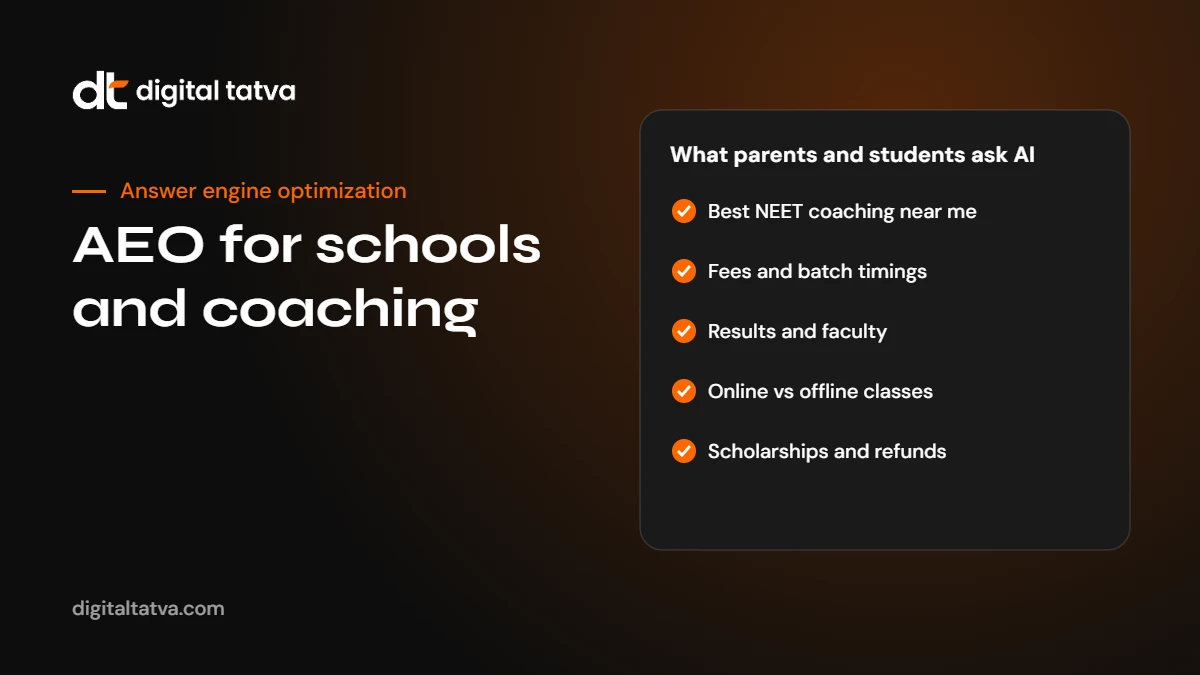
- The questions parents and students ask AI
- How AI engines choose which institutions to name
- Build one page per course or program
- Present results honestly
- Faculty pages that build trust
- Schools: what to publish
- Coaching institutes: what to publish
- Edtech and online courses: what to publish
- Listings, reviews and community presence
- Content that gets education brands cited
- Multilingual content for Indian education brands
- A 90-day AEO plan for an education brand
- Measuring success
- Common mistakes
- Getting help
- Worked example: a coaching institute course page
- Plan around the admissions calendar
- Safety, policies and the questions parents worry about
- Colleges and universities: extra considerations
- Use AI tools carefully for your own content
- When AI describes your institution incorrectly
- A quick checklist for every course page
- Frequently asked questions
- Sources
Last updated: 4 November 2026
Quick answer: AEO for education means making your school, coaching institute, college or edtech platform easy for AI assistants to find, understand and trust, so it is named when parents and students ask questions such as “best NEET coaching in Ahmedabad with small batches” or “which online data science course has the best placement support”. AI engines prefer sources with clear, verifiable facts: one page per course or program with fees, duration, schedule and eligibility; named faculty; results presented honestly with methodology; consistent listings; and genuine reviews. Institutions that publish this information openly are the ones AI recommends.
Key takeaways
- Education decisions involve many detailed questions about fees, schedules, results and faculty, which is exactly what AI assistants are asked.
- One page per course, batch type or program, with plain facts in HTML, is the foundation.
- Results claims need clear methodology; vague “100% selection” claims hurt trust.
- Faculty pages and consistent listings help AI describe you accurately.
- Measure with a fixed set of parent and student questions, tested monthly.
Why education is shifting to AI answers
Choosing a school, coaching class or course is a research-heavy decision. Parents compare fees, distance, board, teaching style and results. Students compare course content, schedules, faculty, placement support and reviews. Until recently they did this on search engines, education portals, WhatsApp groups and word of mouth.
Today, a large share of that research starts in an AI assistant. A parent types: “Which CBSE schools near Bodakdev have good sports facilities and fees under 1.5 lakh a year?” A student asks: “Is offline or online coaching better for JEE, and which institutes in Kota have small batch sizes?” ChatGPT, Gemini and Perplexity reply with a few names and reasons, and Google shows similar summaries in AI Overviews.
The institutions named in those answers get the enquiries. The rest may not be considered at all. That is why answer engine optimization is becoming essential for education marketing.
The questions parents and students ask AI
Different education segments see different questions, but they fall into familiar patterns.
| Segment | Typical AI question | What the answer needs |
|---|---|---|
| Schools | “Best CBSE schools in Satellite with transport facility” | Board, location, transport routes, fees, facilities |
| Coaching | “NEET coaching with batch size under 40 in Ahmedabad” | Batch sizes, schedules, faculty, results with methodology |
| Colleges | “Which colleges in Gujarat offer BBA with good placements?” | Programs, accreditation, placement data, fees |
| Online courses | “Best online UI/UX course for beginners with mentorship” | Curriculum, format, mentor details, outcomes, price |
| Skills training | “Spoken English classes for working professionals on weekends” | Timings, levels, fees, trainer profiles, reviews |
Before changing your website, write 20 to 30 of these questions for your own segment and city. Our guide to AEO prompt research explains how to build a full set, and our step-by-step guide shows how to check if ChatGPT recommends your brand.
How AI engines choose which institutions to name
They need readable facts
Many education websites hide key information in downloadable prospectuses, images of fee charts or slider banners. AI crawlers may see very little. Fees, schedules, eligibility and course content should be in plain HTML text. Run our free AI visibility checker to confirm AI crawlers can reach your site and read its content.
They look for consistency
If your website lists one fee, an education portal another and your Google Business Profile a third phone number, the AI cannot be confident. Consistent information across every listing is the basis of entity SEO.
They weigh third-party evidence
Assistants look at education portals, review sites, news coverage, accreditation bodies and student communities. A coaching institute discussed positively on student forums, featured in local news and reviewed on Google has more evidence behind it than one known only from its own website.
They prefer specific answers
“Classes run Monday to Friday, 4 pm to 7 pm, with a maximum of 35 students per batch” is far more useful to an AI than “flexible timings and personal attention”.
Build one page per course or program
The single most effective step is to create a dedicated page for each course, program, class level or batch type. Each page should answer the questions a parent or student would ask before enquiring.
- Summary first. What the course is, who it is for, duration, format (online, offline or hybrid), location and starting fee.
- Eligibility. Age, class, qualifications or prerequisites.
- Schedule. Days, timings, batch start dates and batch size.
- Curriculum. Modules or subjects covered, in a list or table.
- Fees. Total fee, what it includes, instalment options, refund policy and scholarship options.
- Faculty. Who teaches the course, linked to faculty profiles.
- Outcomes. Results, certifications or placement data, with clear methodology.
- FAQ. The real questions your counsellors hear every day.
Use Course schema with provider, description and offers, and FAQPage schema for genuine FAQs. Our guide to schema markup for AEO explains how to test it, and answer-first content shows how to write the summary.
Present results honestly
Results are the most important and most abused claim in education marketing. Banners such as “100% results” or “1,000 selections” without context are common, and AI engines have little reason to repeat them. Present results in a way that is verifiable.
- State the exam, year and number of students who appeared.
- Explain how you counted a selection or a result.
- Separate long-term classroom students from short crash-course or test-series students.
- Show named toppers only with written consent from students and parents.
- Keep historical results pages, dated by year.
Watch out: In India, regulators have taken action against coaching advertisements with misleading results claims. Honest, well-documented results protect you legally and make your claims more credible to buyers and AI engines.
Faculty pages that build trust
Parents and students often choose a teacher as much as an institution. A faculty page for each teacher should include name, subjects taught, qualifications, years of teaching experience, previous institutions where relevant and a short factual biography. Avoid exaggerated titles. Link faculty pages from course pages and mark them up with Person schema. See author pages and expertise signals for the principles.
Schools: what to publish
For schools, the questions are often practical. Publish clear pages on:
- Admissions: process, age criteria, dates, documents and fees.
- Board and curriculum, with classes offered.
- Transport routes and areas covered, which parents ask about constantly.
- Facilities with real photos and plain descriptions: labs, sports, library, safety measures.
- Teacher to student ratio and class sizes, if you can share them accurately.
- School timings, holidays and after-school activities.
- Policies on fees, refunds, uniforms and safety.
These pages answer exactly the long, specific questions parents type into AI assistants.
Coaching institutes: what to publish
- Separate pages for each exam and batch type (foundation, two-year, repeater, crash course, test series).
- Batch sizes and schedules, including weekend and online options.
- Results by year with methodology.
- Study material and test series details.
- Doubt-solving and mentoring support explained concretely.
- Hostel or accommodation information if you offer it or partner with providers.
- Refund and transfer policies.
Edtech and online courses: what to publish
- Curriculum with modules, hours and projects.
- Format: live, recorded, cohort-based or self-paced.
- Mentor and instructor profiles with real experience.
- Placement or career support details, with honest outcome data and methodology.
- Pricing, financing options and refund policy.
- Comparisons with other learning paths, written fairly. See comparison pages for AEO.
Edtech brands compete nationally, so third-party coverage matters even more. Reviews on course review platforms, mentions in industry publications and community discussions all shape AI descriptions. See AEO for SaaS for tactics that transfer well to online learning brands.
Listings, reviews and community presence
Education portals, Google Business Profile and review platforms are among the sources AI engines cite most for local education questions.
- Claim and complete your Google Business Profile with the right category, accurate hours and real photos.
- Keep the same name, address, phone, fees and courses on every education portal.
- Ask parents and students for reviews at natural moments: after results, after a parent-teacher meeting, at course completion.
- Reply to every review politely and factually.
- Take part honestly in student communities, always identifying yourself.
Our list of review and listing sites for AEO covers the platforms worth claiming.
Content that gets education brands cited
- Exam guides. Syllabus, pattern, important dates and preparation timelines, kept up to date each year with sources.
- Decision guides. “CBSE vs ICSE vs state board: how to choose”, “Online vs offline coaching for NEET”.
- Cost guides. Total cost of a course including materials, tests and travel.
- Parent guides. How to support a child during board exams, how admissions work.
- Original data. Anonymised insights such as average improvement across test series, presented with methodology. See original research for AEO.
- Video explainers. Short lessons and Q and A sessions on YouTube, with good titles and descriptions. Our guide to YouTube for AEO explains why video gets cited.
Multilingual content for Indian education brands
Many parents in India ask questions in Hindi, Gujarati, Marathi, Tamil or a mix of languages. AI assistants handle these well, and they draw on pages in those languages when they exist. Consider:
- Key admissions and fees pages in the main regional language of your audience.
- FAQ sections in both English and the regional language.
- Clear language switch links so crawlers find both versions.
Our guide to AI tools for Indian languages lists tools that help draft translations, which a fluent person should always review.
A 90-day AEO plan for an education brand
| Weeks | Focus | Tasks |
|---|---|---|
| 1 to 2 | Baseline | Write 25 parent and student questions; test them across AI engines; record mentions, accuracy and sources |
| 2 to 4 | Access | Fix crawler access; move fees, schedules and curriculum out of PDFs and images into HTML |
| 3 to 7 | Course pages | Build one page per course or batch type with the structure above and schema |
| 5 to 8 | Faculty and results | Faculty profiles; results pages with methodology |
| 6 to 10 | Listings and reviews | Correct every portal and Google profile; start review requests |
| 8 to 12 | Content | Publish two decision guides and one exam or admissions guide |
| 12 | Re-test | Repeat the question set, compare with baseline, plan the next quarter |
Admission seasons matter. Start the work at least three to four months before your peak enquiry season, because AI engines need time to recrawl and reflect changes. Read how long AEO takes for realistic expectations.
Measuring success
- Mention rate across your question set and engines.
- Accuracy of fees, schedules and course details in AI answers.
- Cited pages from your site.
- AI referral traffic in analytics. See how to track AI traffic in GA4.
- Enquiries mentioning AI. Add “AI assistant (ChatGPT, Gemini etc.)” as a source option in your enquiry form.
Use our AEO reporting template to share results with management or trustees.
Common mistakes
- Prospectus-only information locked in PDFs.
- Unverifiable results banners.
- No fees online, forcing every question into a phone call.
- Outdated exam information from previous years.
- Inconsistent names across branches and portals.
- Ignoring parents’ regional language questions.
Getting help
Many institutions can handle the basics in-house. If you run several branches, compete nationally online or find AI answers describing you incorrectly, a structured audit helps. Digital Tatva tests the questions your parents and students ask, maps the sources behind each answer and gives you a ranked fix list. Read what our audit includes or request one here.
Worked example: a coaching institute course page
Here is how a typical coaching page changes when it is rewritten for AI answers. The institute and figures are an illustration only.
Before
“Join Gujarat’s No.1 NEET coaching! Expert faculty, proven results, personal attention. Limited seats. Call now for fees.”
An AI assistant cannot use any of this. There is no batch size, schedule, fee, faculty name or verifiable result. A parent asking “NEET coaching in Ahmedabad with batch size under 40 and weekend tests” will not be matched to it.
After
“The two-year NEET classroom program at Example Academy, Navrangpura, is for students entering Class 11. Batches have a maximum of 36 students, with classes Monday to Saturday from 4 pm to 8 pm and a full-length mock test every Sunday. The 2026 to 2028 batch fee is 1.65 lakh for two years, payable in four instalments, including study material and the test series. Physics, Chemistry and Biology are taught by three full-time faculty members with between 8 and 15 years of NEET teaching experience. In NEET 2026, 212 of the 340 students who completed this program qualified; methodology is explained on our results page.”
Every sentence answers a real question. The results claim is specific and points to methodology. The page then adds a schedule table, faculty links, refund policy and an FAQ.
Plan around the admissions calendar
Education has strong seasons, and AI answers lag behind changes on your website. Work backwards from your peak enquiry months.
- Four months before: run your baseline, fix access issues and rewrite course pages.
- Three months before: publish fees, dates and eligibility for the new session, clearly marked with the year.
- Two months before: publish decision guides and update listings and portals.
- During admissions: keep seat availability, deadlines and fees current. Remove or clearly mark outdated information from previous sessions.
- After admissions: collect reviews, publish results with methodology and plan the next cycle.
Safety, policies and the questions parents worry about
Parents ask AI assistants about safety and wellbeing as much as about academics: “Is the hostel supervised?”, “How does the school handle bullying?”, “Is there CCTV in the transport buses?” Institutions rarely publish clear answers, so the AI often has nothing to say about them. Publish factual pages on:
- Safety measures on campus and in transport.
- Hostel supervision, meal arrangements and visiting rules, if applicable.
- Counselling and student wellbeing support.
- Anti-bullying and grievance procedures.
- Communication with parents: how often, through which channels.
These pages reassure parents directly and give AI assistants a source for questions most competitors leave unanswered.
Colleges and universities: extra considerations
Higher education institutions face more complex questions because students compare programs across cities and even countries. “Which private universities in Gujarat offer an MBA with an international exchange?” or “Is a BTech in AI from this college recognised for government jobs?” To be named in answers like these, colleges should publish:
- Program pages with recognition details. Affiliation, approvals and accreditation with links to the relevant bodies, so the AI can verify them.
- Admission criteria by program. Entrance exams accepted, cut-offs from previous years with dates, and the selection process.
- Placement reports with methodology. Number of students eligible, number placed, median and range of salaries, list of recruiters, and the year. Median figures are more credible than “highest package” headlines.
- Faculty research and expertise. Department pages listing faculty, their areas of research and publications.
- Campus life and facilities. Hostels, transport, clubs, sports and support services, described plainly.
- International and industry partnerships. Only active, verifiable ones, with partner names and what students actually gain.
Rankings and accreditation results are strong third-party signals. When you receive them, publish the result with a link to the official source rather than a screenshot. Student-run communities and alumni networks also influence how AI describes a college. Encourage alumni to keep LinkedIn profiles that name the institution and program correctly, since consistent naming helps AI connect your graduates to your college.
Use AI tools carefully for your own content
Many education marketers now draft content with AI writing tools. That can save time, but generic AI-written pages rarely get cited because they repeat what thousands of other sites say. Use AI to structure and polish, then add what only you know: your schedules, your teachers’ explanations, your students’ real questions and your results. Have a subject expert review every exam or syllabus page for accuracy. Our guide to AI writing tools for AEO explains how to keep quality high.
When AI describes your institution incorrectly
A common problem is an AI assistant quoting old fees, a closed branch or last year’s results. Usually the error comes from an outdated page on your site, an old portal listing or a news article. Record the wrong answer, check the cited sources, correct the information at the source and re-test after a few weeks. Our guide on what to do when AI gets your brand wrong walks through the full process.
A quick checklist for every course page
- Summary states the course, who it is for, duration, format, location and starting fee.
- Eligibility, schedule and batch size in plain text.
- Curriculum in a list or table.
- Full fee breakdown, instalments, refund and scholarship policies.
- Faculty linked to individual profiles.
- Results or outcomes with year, numbers and methodology.
- FAQ from real counsellor questions, in English and your main regional language where relevant.
- Course and FAQPage schema validated.
- Same details on education portals and Google Business Profile.
- Information from previous sessions removed or clearly dated.
Frequently asked questions
What is AEO for education?
AEO for education is the work of making schools, coaching institutes, colleges and online course providers easy for AI assistants to find, understand and trust, so they are named when parents and students ask AI to recommend institutions or courses.
Should schools publish their fees online?
Publishing fee structures or ranges makes your website far more useful for parents and gives AI assistants a reliable answer. Include what the fees cover and any additional charges.
How should coaching institutes show results for AI?
Show results by exam and year, with the number of students who appeared and how selections were counted. Clear methodology makes claims credible and avoids misleading advertising.
Do education portals matter for AI visibility?
Yes. Education portals and review sites are often used as sources in AI answers. Keep your details consistent across them and your own website.
When should we start AEO before admissions season?
Start three to four months before your peak enquiry period. AI engines need time to recrawl pages and reflect updated information.
Does regional language content help?
It can. Many Indian parents ask questions in regional languages, and pages in those languages give AI engines content to draw on when answering them.
Sources
- Course structured data, Google Search Central
- AI features and your website, Google Search Central
- Course, schema.org
Product details, prices and features are checked at the time of writing and can change. Sources are linked in the text so you can check them yourself.
How does your brand appear in AI answers?
We test the questions your buyers ask across the major AI assistants and search engines, then show you what to fix first.
Get an AI Visibility Audit