AEO for Hotels and Travel: How to Get Recommended When Travellers Ask AI
Travellers now plan trips with ChatGPT, Gemini and Google AI Mode. How hotels, resorts, homestays and travel companies earn a place in AI travel answers, with page templates, review strategy and a 90-day plan.
On this page
- Key takeaways
- How travellers use AI to plan trips
- The questions travellers ask AI
- Where AI travel answers get their information
- Make your website the complete source of truth
- Write destination and experience content
- Booking platforms and listings
- Reviews: the strongest trust signal in travel
- Structured data for hotels
- Media coverage and travel guides
- Tour operators and travel agencies
- A 90-day AEO plan for a hotel or resort
- How to measure progress
- Common mistakes hotels make
- Getting help
- Worked example: before and after
- Food, dietary and accessibility details
- Sustainability claims: be specific or skip them
- Direct bookings and AI answers
- Multi-property groups and chains
- Using AI tools inside your hotel marketing
- When AI describes your property incorrectly
- A quick checklist for hotel AEO
- Frequently asked questions
- Sources
Last updated: 4 November 2026
Quick answer: AEO for hotels means making your property or travel business easy for AI assistants to find, understand and trust, so it is recommended when travellers ask questions such as “quiet boutique hotel in Udaipur with a lake view under 8,000 a night” or “family resort near Lonavala with a pool and good food”. AI engines favour properties with specific, verifiable details on their own site (rooms, amenities, policies, location facts), consistent information on booking platforms and maps, steady recent reviews, and mentions in travel guides and local media. Hotels that describe themselves precisely and honestly get named more often than those that rely on vague marketing language.
Key takeaways
- Travel planning is moving into AI chats, where travellers describe exactly what they want in long, specific questions.
- Specific facts beat adjectives: “8-minute walk to the City Palace” is more useful than “prime location”.
- Booking platforms, maps and reviews are major sources for AI travel answers, so keep them accurate and active.
- Your own website should still be the most complete, structured source of truth about the property.
- Track a fixed set of traveller questions monthly across AI engines to measure progress.
How travellers use AI to plan trips
Travel is one of the most natural uses of AI assistants. A traveller can describe dates, budget, group, interests and constraints in one message and get a shortlist in seconds. Instead of opening ten tabs, they ask: “We are a family of four with a toddler visiting Goa in December. Suggest beach hotels in South Goa with a kids pool, under 12,000 a night, not too crowded.” ChatGPT, Gemini and Perplexity answer with a few properties and reasons. Google AI Mode and AI Overviews show similar summaries, often with map results.
The properties named in those answers get the clicks and bookings. Others may never be considered. That is why answer engine optimization has become a practical concern for hotels, resorts, homestays and tour operators. Our earlier guide to agentic search explains how AI agents are starting to compare and even book on behalf of travellers, which makes accurate, structured information even more important.
The questions travellers ask AI
| Type | Example | What the answer needs |
|---|---|---|
| Shortlist | “Best heritage hotels in Jaipur under 10,000” | Property type, price range, location, style |
| Fit | “Pet-friendly resorts near Mumbai for a weekend” | Clear policies on pets, children, accessibility |
| Location | “Hotels walking distance from the Kochi Biennale venues” | Distances and travel times to landmarks |
| Comparison | “Stay in Manali town or Old Manali?” | Area guides with honest pros and cons |
| Practical | “Does this hotel have airport pickup and early check-in?” | Policies, services and fees listed plainly |
| Experience | “Resorts in Coorg with plantation walks and good vegetarian food” | Specific experiences, food options, activities |
Build your own list of 25 to 30 questions for your destination and segment. These become your baseline for measuring AEO progress. Our guide to prompt research shows how.
Where AI travel answers get their information
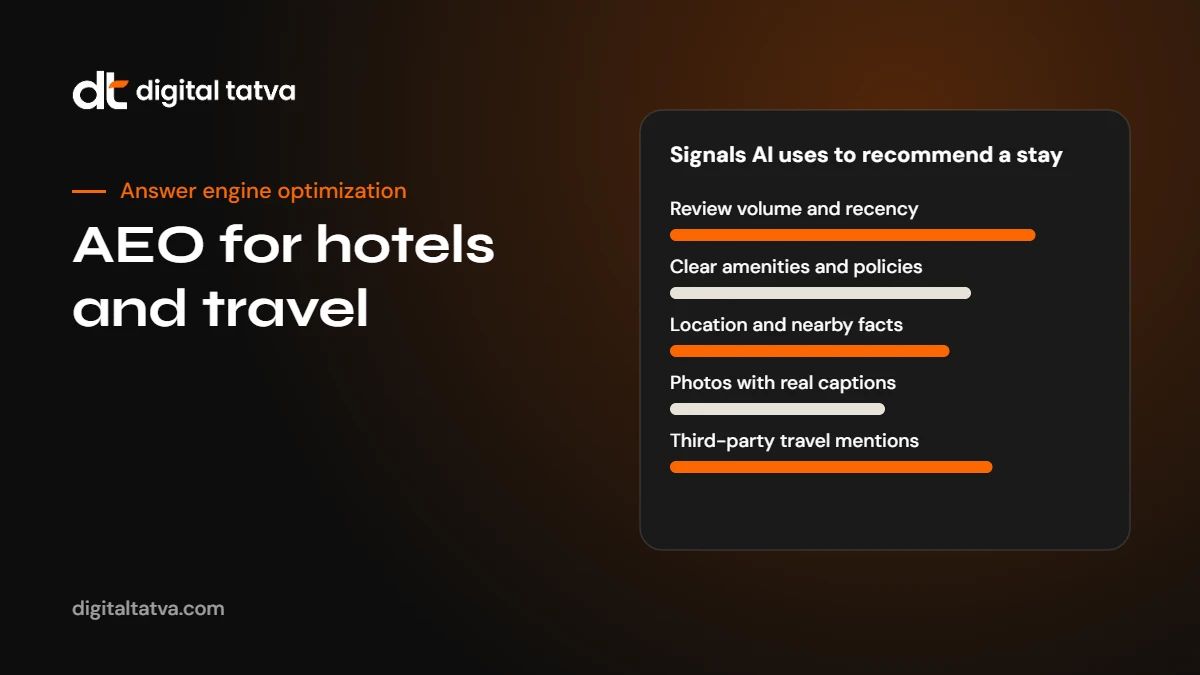
For travel questions, AI assistants typically draw on a mix of sources:
- Map and business listings, especially Google Business Profile, with categories, hours, photos and reviews.
- Online travel agencies and booking platforms, which provide room types, amenities, prices and review scores.
- Review platforms and traveller forums.
- Travel guides, blogs and media coverage that list and describe properties.
- The property’s own website, for detailed and authoritative facts.
This means AEO for hotels is not only about your website. It is about making every source tell the same accurate story. When sources disagree, assistants may avoid recommending you or repeat outdated details.
Make your website the complete source of truth
Booking platforms show structured data, but they rarely capture what makes a property special. Your website should be the most complete and accurate description of your property, written so both travellers and AI systems can use it.
Homepage summary
Open with a short paragraph that answers: what kind of property this is, where it is, who it suits, and what it is known for. For example: “A 24-room heritage haveli in the old city of Jaipur, a 10-minute walk from Hawa Mahal, popular with couples and culture travellers, with a rooftop restaurant serving Rajasthani vegetarian food.” That one paragraph is far more quotable than “Experience timeless luxury in the Pink City.”
Room pages
Create a page or clear section for each room type with size, bed configuration, maximum occupancy, view, bathroom type, key amenities and accessibility features. Use plain text, not only icons.
Amenities and services
List amenities with real details: pool size and timings, gym equipment, spa services, restaurant hours and cuisine, Wi-Fi speed if reliable, parking availability and charges, airport transfer options and fees.
Policies
Travellers and AI assistants both look for clear policies: check-in and check-out times, early check-in and late check-out, children and extra beds, pets, smoking, cancellation, ID requirements and payment methods. These answer many of the practical questions travellers ask AI.
Location facts
Give distances and travel times to the airport, railway station, main attractions, beaches, markets and hospitals. Say how you measured them. Mention the realistic downsides too, such as steep access roads or limited parking, because travellers appreciate honesty and it reduces bad reviews.
Write destination and experience content
Many travellers start with the destination, not the hotel. Local guides written by people who actually live and work there are valuable and often cited.
- Area guides: “Where to stay in Udaipur: lakeside vs old city vs Fateh Sagar”, with honest pros and cons.
- Itineraries: “Two days in Hampi without a car”, including your property only where it naturally fits.
- Seasonal guides: what the weather, crowds and prices are like by month.
- Experience pages: cooking classes, guided walks, safaris or workshops you offer, with duration, price and booking details.
- Practical guides: getting there, local transport, what to pack.
Keep these pages factual, dated and updated each season. Our guide to the types of pages AI assistants cite explains why guides like these earn citations, and answer-first content shows how to structure them.
Booking platforms and listings
Online travel agencies and booking platforms are major data sources for AI answers. Treat their listings as part of your AEO work.
- Use the same property name, address, star category, room names and amenities on every platform.
- Keep photos current and captioned accurately.
- Fill every amenity field. Missing fields can mean your property is left out of filtered answers such as “pet-friendly” or “with a pool”.
- Update policies when they change.
- Check that your Google Business Profile has the correct category (hotel, resort, homestay, guest house), accurate hours for reception and restaurant, and real photos.
For more on maps and listings, see our guide to AEO for local businesses and the list of review and listing sites.
Reviews: the strongest trust signal in travel
Travel decisions rely heavily on reviews, and AI answers reflect that. Assistants often summarise review themes: “guests praise the breakfast and the staff, but some mention road noise.” To manage this:
- Ask every guest for a review at checkout and in a follow-up message, without incentives.
- Reply to reviews on all major platforms, especially negative ones, calmly and specifically.
- Look for recurring complaints and fix the underlying issue.
- Once fixed, mention the improvement on your website, for example “new double-glazed windows on street-facing rooms since March 2026”.
- Never buy reviews or post fake ones. Platforms detect them and they damage trust permanently.
Our list of the best review management software can help if you manage many properties.
Structured data for hotels
Schema markup helps AI engines read your facts without guessing. Useful types include:
- Hotel, Resort, BedAndBreakfast or LodgingBusiness with name, address, geo coordinates, phone, star rating if official, check-in and check-out times, amenities and sameAs links to your official profiles.
- HotelRoom with occupancy, bed details and amenities.
- FAQPage for genuine questions and answers.
- Event for events you host, with dates and booking details.
Keep schema consistent with what the page shows and validate it regularly. See schema markup for AEO.
Media coverage and travel guides
Travel media, local news and respected travel blogs are frequent sources for AI travel answers, especially for “best” style questions. Practical ways to earn coverage:
- Offer something genuinely new: a restored heritage wing, a farm-to-table menu, a sustainability initiative with real numbers.
- Host local events and publish them with details.
- Work with credible travel writers who disclose any hosted stays.
- Submit your property to official tourism board listings where available.
Our guide to brand mentions for AEO covers digital PR in more depth.
Tour operators and travel agencies
For tour operators, the same principles apply with a different focus:
- One page per tour with itinerary by day, inclusions, exclusions, group size, price and departure dates.
- Guide profiles with experience and languages.
- Clear policies on cancellation, refunds and safety.
- Honest destination guides that help travellers choose between options.
- Registration with official tourism bodies where relevant, shown on your website.
A 90-day AEO plan for a hotel or resort
| Weeks | Focus | Tasks |
|---|---|---|
| 1 to 2 | Baseline | Write 25 traveller questions; test across ChatGPT, Gemini, Perplexity and Google; record mentions and sources |
| 2 to 4 | Website facts | Rewrite homepage summary; build room, amenities and policies pages in HTML |
| 3 to 5 | Listings | Align Google Business Profile and every booking platform; fill all amenity fields |
| 4 to 6 | Schema | Add Hotel, HotelRoom and FAQPage schema; validate |
| 5 to 10 | Content | Publish one area guide, one seasonal guide and experience pages |
| 6 to 12 | Reviews and media | Review request process; fix recurring complaints; one media pitch |
| 12 | Re-test | Repeat the question set and compare |
Plan around your seasons. Travellers research weeks or months ahead, so start well before peak season. Our guide to how long AEO takes explains realistic timelines.
How to measure progress
- Mention rate across your traveller questions.
- Accuracy of descriptions: price band, location, amenities and policies.
- Sources cited: your site, booking platforms, guides.
- Direct bookings and enquiries where guests mention AI. Ask at check-in and add an option to your booking form.
- AI referral traffic in analytics. See tracking AI traffic in GA4.
Our AEO reporting template shows how to present these monthly.
Common mistakes hotels make
- Vague, adjective-heavy descriptions with no hard facts.
- Missing amenity fields on booking platforms.
- Different room names on the website and on platforms.
- Outdated photos that do not match the property.
- Ignoring negative reviews.
- Policies hidden in booking confirmations instead of on the website.
- Website content loaded only through heavy scripts that crawlers cannot read. Check with the free AI visibility checker.
Getting help
Independent hotels and small groups can do most of this in-house with a clear plan. If you manage several properties, compete in crowded destinations or see AI describing you incorrectly, a structured audit saves time. Digital Tatva tests the questions your guests ask, maps the sources AI relies on and gives you a ranked fix list. Read what our audit includes or request one.
Worked example: before and after
Here is how a property description changes when it is written for AI answers. The resort is an illustration, not a real property.
Before
“Escape to paradise at Green Valley Resort, where luxury meets nature. Indulge in world-class hospitality, breathtaking views and unforgettable experiences for the whole family.”
There is nothing here an AI assistant can match to a traveller’s question. No location, room types, price band, facilities or policies.
After
“Green Valley Resort is a 32-cottage family resort 6 km from Lonavala town, about 2 hours by road from Mumbai and 1.5 hours from Pune. It has a 20-metre outdoor pool with a separate kids pool, a play area, indoor games room and a vegetarian and Jain-friendly restaurant open from 7 am to 11 pm. Cottages sleep up to four, and two cottages are wheelchair accessible. Pets are welcome in garden cottages for a fee. Typical weekend rates range from 9,000 to 14,000 a night for two adults with breakfast (2026 season).”
Each sentence answers a question travellers actually type: distance from cities, facilities for children, food, accessibility, pets and budget. The same facts then appear on booking platforms and in schema.
Food, dietary and accessibility details
Travellers often ask very specific questions: “resort with Jain food near Udaipur”, “hotel in Rishikesh with wheelchair access”, “vegan-friendly stay in Goa”. These questions are hard for AI to answer because most properties never state the details. Publish:
- Cuisines served, meal timings and whether meals are included.
- Dietary options available on request: vegetarian, Jain, vegan, gluten-free, diabetic-friendly.
- Accessibility features: step-free access, lifts, accessible bathrooms, ground-floor rooms.
- Facilities for infants and children: cots, high chairs, babysitting.
- Facilities for older guests: rooms near the lobby, help with luggage, medical support nearby.
Answering these niche questions is one of the fastest ways for a smaller property to become the best answer.
Sustainability claims: be specific or skip them
Many travellers ask about eco-friendly stays. Vague claims such as “eco-conscious luxury” carry little weight. Specific, verifiable facts do: “solar panels supply around 60% of our electricity”, “we compost kitchen waste on site”, “drinking water is filtered and served in glass bottles”. If you hold a recognised certification, name it and link to the certifying body. If you do not have data, describe what you actually do and avoid broad claims.
Direct bookings and AI answers
Many hotels worry that AI answers will send travellers to booking platforms rather than direct. In practice, AI answers often name the property and let the traveller choose where to book. Make direct booking attractive and easy: a clear “book direct” option, transparent rates, the same or better terms than platforms where your contracts allow, and fast replies on WhatsApp or phone. When the AI names your property, the traveller who visits your website should find it the easiest place to book.
Multi-property groups and chains
Hotel groups face an extra challenge: AI assistants must understand both the brand and each individual property. If the group website has one generic page per hotel, while booking platforms carry the detail, the AI may describe properties inconsistently or confuse them with each other.
- One full page per property, with its own summary, rooms, amenities, policies, location facts and FAQ, not a shared template with only the address changed.
- Clear naming. Use the same property name everywhere, including the city or area, for example “Example Hotels, Ahmedabad Riverfront” rather than “Example Hotels Ahmedabad” in one place and “Example Riverfront” in another.
- Group-level pages that explain the brand, its standards and loyalty program, linking to every property.
- Schema per property, with each hotel marked up as its own business connected to the parent organisation.
- Local content per destination, written by the local team where possible, so each property has its own area guide and experiences.
Groups should also track AI visibility per property, not only per brand. One hotel may be named often while another is never mentioned, and the fixes will differ.
Using AI tools inside your hotel marketing
AI tools can help hotel teams work faster on the tasks behind AEO: drafting room descriptions from a fact sheet, summarising review themes, replying to reviews in a consistent tone and translating guides for international guests. Keep a person in charge of facts and tone, and never let an AI tool invent amenities or policies. Our guides to the best AI marketing tools and training AI to write in your brand voice are good starting points.
When AI describes your property incorrectly
AI assistants sometimes repeat outdated details: a pool that is closed for renovation, old prices or amenities you no longer offer. The cause is usually an outdated listing or article. Find the source, correct it, update your website with the current facts and re-test after a few weeks. Our guide to fixing wrong AI answers about your brand explains the process step by step.
A quick checklist for hotel AEO
- Homepage summary states property type, location, who it suits and what it is known for.
- A page or section for every room type with size, beds, occupancy, view and accessibility.
- Amenities listed with real details: timings, sizes, charges.
- Policies for check-in, children, pets, cancellation, ID and payment on the website.
- Distances to airport, station and key attractions with the method used.
- Food and dietary options and accessibility features stated clearly.
- Same property name, room names and amenities on every booking platform.
- Google Business Profile complete, with recent photos and replies to reviews.
- Hotel, HotelRoom and FAQPage schema validated.
- One area or seasonal guide published and dated.
Work through the list once, then review it every season, because prices, menus, amenities and policies change more often in hospitality than in most industries.
Frequently asked questions
What is AEO for hotels?
AEO for hotels is the work of making a hotel, resort or travel business easy for AI assistants to find, understand and trust, so it is recommended when travellers ask AI for places to stay or things to do.
Do booking platforms affect AI recommendations?
Yes. Booking platforms and maps are common sources for AI travel answers. Complete, consistent listings help AI describe your property correctly and include it in filtered answers.
How important are reviews for AI travel answers?
Very important. AI assistants often summarise review themes when describing a property, and steady, recent reviews provide strong third-party evidence.
Should hotels publish prices on their website?
Publishing typical rate ranges by season helps travellers asking AI about budget. Where rates change daily, give a dated range and link to live availability.
Can small homestays compete with big hotels in AI answers?
Yes. Specific, honest descriptions, strong reviews and a clear niche, such as plantation stays or pet-friendly cottages, can make a small property the best answer to a specific question.
Does schema markup help hotels with AI?
Schema helps AI read facts such as location, amenities and check-in times accurately. It works best alongside clear on-page content and consistent listings.
Sources
- AI features and your website, Google Search Central
- Hotel, schema.org
- Guidelines for representing your business on Google, Google Business Profile Help
Product details, prices and features are checked at the time of writing and can change. Sources are linked in the text so you can check them yourself.
How does your brand appear in AI answers?
We test the questions your buyers ask across the major AI assistants and search engines, then show you what to fix first.
Get an AI Visibility Audit