AEO for Lawyers, CAs and Consultants: How Professional Firms Get Named by AI
Clients now ask AI which lawyer, chartered accountant or consultant to trust. How professional services firms can earn a place in AI answers within their professional rules, with expertise pages, explainers and a 90-day plan.
On this page
- Key takeaways
- Why professional services are changing
- First, respect the professional rules
- How AI decides which firms to name
- Build professional profile pages
- Write practice area pages that explain, not sell
- Explainers: the content AI quotes most
- Directories and professional listings
- Thought leadership that earns third-party mentions
- Reviews and client feedback within the rules
- Structured data for professional firms
- Worked example: a practice area page
- Specialise to be the obvious answer
- Answering questions clients ask before they hire
- Multi-office firms and networks
- A 90-day AEO plan for a professional firm
- Measuring results
- Common mistakes
- Getting help
- Languages and regional clients
- A quick checklist for professional firms
- Frequently asked questions
- Sources
Last updated: 4 November 2026
Quick answer: AEO for professional services means making a law firm, chartered accountancy practice or consultancy easy for AI assistants to find, understand and trust, so it is named when clients ask questions such as “which CA firms in Ahmedabad handle GST audits for exporters” or “how do I find a trademark lawyer in Mumbai”. Because many professions restrict advertising, the safest and most effective approach is informational: clear practice area pages, named professionals with verifiable credentials, plain-language explainers of common client problems, consistent firm details on every listing and genuine third-party mentions. Firms that explain their expertise helpfully, without solicitation or guarantees, are the ones AI tends to describe accurately and recommend.
Key takeaways
- Clients increasingly ask AI assistants to explain a legal, tax or business problem and suggest who can help.
- Professional rules on advertising differ by profession and country; informational content is usually the safest route.
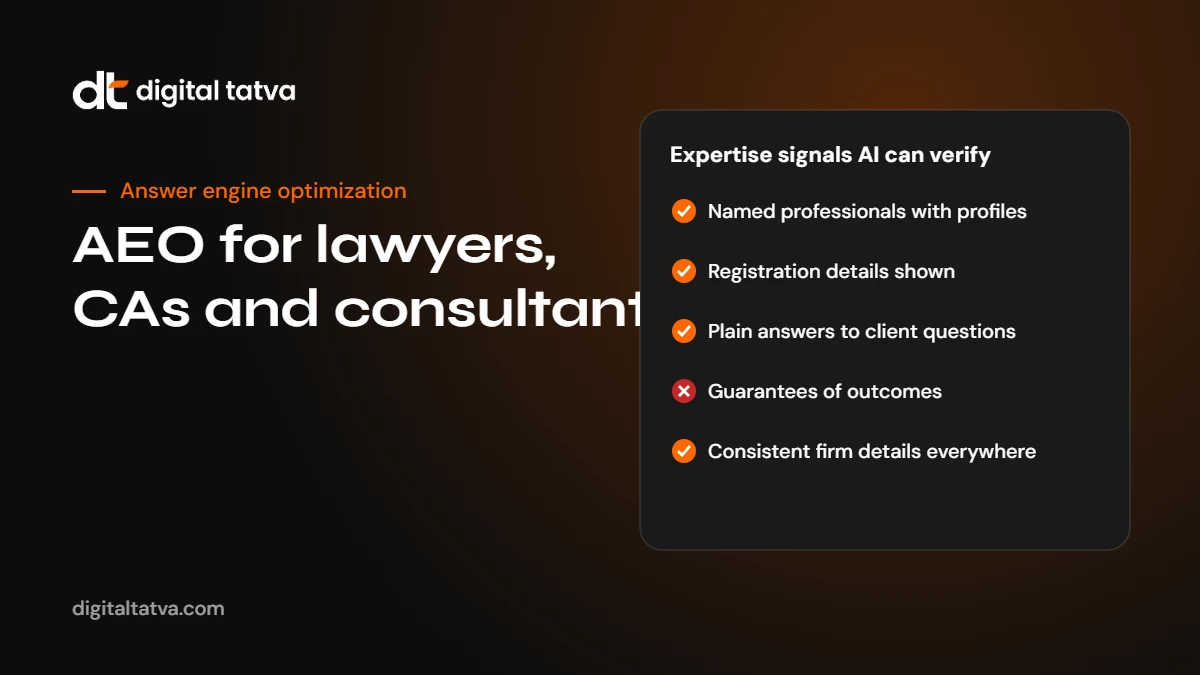
- Named professionals with credentials, practice areas and experience matter more than slogans.
- Plain-language explainers of common client questions are what AI engines quote.
- Consistency across directories, professional body listings and your website decides whether AI trusts your details.
Why professional services are changing
Choosing a lawyer, chartered accountant, company secretary, tax adviser or management consultant has always relied on referrals. A business owner asks a friend, a banker or another professional for a name. That has not disappeared, but a new step now sits in front of it. Before calling anyone, many clients ask an AI assistant to explain their problem: “My company received a GST notice for mismatched input tax credit. What should I do and who can help?” The assistant explains the situation and often names types of professionals or specific firms.
When the assistant names firms, it draws on what it can find and trust: firm websites, professional directories, news coverage, published articles and reviews. A firm that has clearly explained GST notices on its website, with a named partner who handles them, is far more likely to be mentioned than a firm whose website simply says “We provide end-to-end taxation services.” This is the core of answer engine optimization applied to professional services.
First, respect the professional rules
Before any marketing activity, check the rules that govern your profession. This guide is not legal advice, and rules change, but a few general points are widely relevant.
- Lawyers in India are restricted from advertising and soliciting work under Bar Council of India rules. Limited information on a website, such as name, contact details, enrolment, qualifications and areas of practice, is generally permitted. Many firms therefore focus on factual profiles and educational content rather than promotion.
- Chartered accountants in India are subject to the Institute of Chartered Accountants of India’s code of ethics and guidelines on websites and publicity, which restrict solicitation and certain claims.
- Consultants and other advisers often have fewer formal restrictions, but consumer protection law still prohibits misleading claims.
- Everywhere, avoid guaranteed outcomes, testimonials that breach confidentiality, comparisons that disparage other professionals and any claim you cannot substantiate.
Watch out: Check your professional body’s current rules before publishing case results, client names or testimonials. When in doubt, keep content informational and factual.
The good news is that the things professional rules allow are exactly the things AI engines value: factual credentials, clear practice information and genuinely helpful explanations.
How AI decides which firms to name
Can the AI read your website?
Many professional websites are old, slow or built on templates that load content with scripts. Key details may sit in PDFs or images. Make sure AI crawlers can access and read your pages. Our free AI visibility checker shows in a minute whether AI search crawlers are allowed, whether your firewall blocks them and how much content is readable without JavaScript.
Is your firm one clear entity?
Law and accountancy firms often change names when partners join or leave, merge with other practices or operate under several brand names. Old names linger on directories, professional body listings and news articles. AI engines then struggle to know which name is current. Our guide to entity SEO for AEO explains how to consolidate this.
Do others confirm your expertise?
Articles you have written for professional journals, quotes in business news, speaking at chambers of commerce, listings in legal or accounting directories and reviews all act as independent confirmation.
Do you answer client questions clearly?
AI engines prefer passages that answer a question directly in plain language. A firm that publishes clear explainers on the questions clients actually ask gives the AI something to quote and a reason to mention the firm.
Build professional profile pages
Each partner or senior professional should have a dedicated profile page. This is usually permitted under professional rules and is the single most valuable page type for professional services AEO.
- Full name, designation and the professional body membership or enrolment details where your rules allow them to be shown.
- Qualifications with institutions and years.
- Practice areas, described specifically: not “corporate law” but “shareholder agreements, private equity investments and joint ventures for mid-sized companies”.
- Years of practice, industries served and languages spoken.
- Published articles, talks and books, with links.
- A short, factual biography without superlatives.
- Office location and contact route.
Mark profiles up with Person schema linked to the firm’s Organization or LegalService schema. Our guide to author pages and expertise signals explains the details.
Write practice area pages that explain, not sell
Practice area pages are where most firms waste their best opportunity. A typical page lists services in bullet points. A useful page explains a client’s situation and how the firm approaches it.
- Start with the client’s question. “What happens if my company receives a GST show cause notice?”
- Answer it in plain language. Two or three sentences a business owner can understand.
- Explain the process. The typical steps, timelines and documents involved.
- Explain the factors that matter. What makes a case simpler or more complex.
- Describe how the firm helps. Factually, without guarantees.
- Name who handles it. Link to the relevant profiles.
- Add an FAQ. Real questions clients ask, answered briefly.
- Date it. Laws and tax rules change; show when the page was last reviewed.
This structure follows our guide to answer-first content and fits well within professional rules because it is educational.
Explainers: the content AI quotes most
For professional services, the most cited content is usually a clear explainer of a common problem. Ideas for each profession:
| Profession | Explainer ideas |
|---|---|
| Lawyers | How to register a trademark in India, step by step; what to do if you receive a legal notice; how property due diligence works; difference between an LLP and a private limited company |
| Chartered accountants | How to respond to an income tax notice; GST registration thresholds explained; tax audit requirements; documents needed for a home loan as a self-employed person |
| Company secretaries | Annual compliance calendar for private companies; how to change a company’s registered office; director KYC requirements |
| Management consultants | How to prepare a business for investment; how to set up an ESOP; how to choose an ERP system for a mid-sized manufacturer |
| HR and payroll advisers | Statutory deductions explained; gratuity calculation; how to draft a leave policy |
Each explainer should cite primary sources such as the relevant act, rules, circulars or official portals, name the professional who wrote or reviewed it and show the date. Laws change, so set a review cycle.
Directories and professional listings
Professional directories and listings are frequent sources for AI answers about who to hire. Check:
- Your professional body’s member directory, where applicable, shows current details.
- Google Business Profile for each office, with the right category (law firm, accountant, consultant), hours and real photos.
- Reputable legal, accounting and business directories in your market, with the same name, address and phone everywhere.
- LinkedIn company page and partner profiles with consistent firm names and practice areas.
- Chamber of commerce and industry association memberships, which are often listed publicly.
Our list of review and listing sites for AEO helps you decide which to prioritise, and AEO for local businesses covers Google Business Profile in detail.
Thought leadership that earns third-party mentions
Professional services firms have a natural advantage: their expertise is valuable to journalists, industry bodies and other professionals. Use it.
- Write for professional journals and business publications. Bylined articles build authority and are often cited.
- Comment on regulatory changes. When a new rule or budget announcement lands, publish a clear explainer quickly and offer comment to journalists.
- Speak at events. Chambers of commerce, industry associations and professional bodies publish speaker lists and session summaries.
- Publish original insight. Aggregated, anonymised observations, such as “the most common reasons GST refund claims are delayed, based on cases we handled this year”, can be quotable when presented responsibly. See original research for AEO.
- Answer questions on LinkedIn. Thoughtful posts by partners are increasingly visible to AI systems. Our guide to the best AI tools for LinkedIn can help you work faster.
Our guide to brand mentions for AEO explains how digital PR turns expertise into citations.
Reviews and client feedback within the rules
Reviews are powerful trust signals, but professional rules and confidentiality limit how firms can use them. A careful approach:
- Where your rules allow, let clients leave reviews on Google naturally, and reply politely without revealing any matter details.
- Never offer incentives for reviews.
- Do not republish testimonials on your website if your professional rules prohibit them.
- Focus on independent recognition you can cite, such as directory rankings, awards from credible bodies or published articles.
Structured data for professional firms
Useful schema types include Organization or more specific types such as LegalService, AccountingService or ProfessionalService; Person for each professional with jobTitle, alumniOf and worksFor; FAQPage for genuine FAQs; and Article for explainers with author and dateModified. Link the Person and Organization entities with sameAs links to LinkedIn and professional directories. Our guide to schema markup for AEO explains how to test it.
Worked example: a practice area page
Here is how a typical page changes. The firm is an illustration.
Before
“Example and Associates provides comprehensive taxation services including GST, income tax, international taxation and litigation support with a client-centric approach.”
After
“If your business receives a GST show cause notice, you usually have a fixed period, stated in the notice, to reply with your explanation and supporting documents. Common reasons include mismatches between the input tax credit you claimed and what your suppliers reported, and differences between your returns and e-way bill data. At Example and Associates, GST notices are handled by CA Priya Shah, who has advised manufacturers and exporters on GST disputes since 2017. We review the notice, reconcile your data, draft the reply and represent you at hearings where needed. This page was last reviewed in October 2026.”
The rewrite answers the client’s question, explains common causes, names the responsible professional and stays factual, which suits both professional rules and AI engines.
Specialise to be the obvious answer
A general “full-service” firm is hard for an AI assistant to recommend for a specific problem. A firm that is clearly known for one area is much easier to name. When a client asks “which CA firms in Ahmedabad specialise in export incentives and GST refunds for manufacturers?”, the AI looks for pages, articles and mentions that connect a firm to that exact niche.
You do not have to give up other work. But for AEO purposes, decide which three to five specialisms you want to be known for and build depth around them:
- A dedicated practice page for each specialism, written answer first.
- At least three explainers per specialism covering the most common client questions.
- Named professionals who lead each area, with profiles that mention it specifically.
- Articles, talks and comments in the media focused on that area.
- Industry-specific pages where you serve particular sectors, for example “GST and customs advice for textile exporters in Surat”.
Depth in a few areas beats thin coverage of everything. It also makes your firm easier to describe accurately, which reduces the risk of AI attributing services you do not offer.
Answering questions clients ask before they hire
Beyond the legal or tax problem itself, clients ask practical questions about working with a professional. These are rarely answered on firm websites, which means AI assistants have little to say and the firm that answers them stands out.
- How fees work. Whether you charge fixed fees, hourly rates or retainers, and what affects the cost. A typical range for common engagements, where your rules allow.
- What to bring to a first meeting. Documents and information that help you assess the matter.
- How long common matters take. Realistic ranges, such as typical timelines for trademark registration or company incorporation.
- How you communicate. Response times, reporting and who the client deals with.
- Who you work best with. Business size, industries and situations.
- Confidentiality. How client information is protected.
A “Working with us” page that covers these honestly helps clients decide faster and gives AI engines a clear, factual source.
Multi-office firms and networks
Firms with several offices or network memberships should give each office its own page with address, hours, partners based there and practice areas available, plus its own Google Business Profile. Explain network relationships clearly, for example “member firm of Example Network, an association of independent firms”, so AI does not confuse independent firms with branches. Use one consistent firm name across all offices.
A 90-day AEO plan for a professional firm
| Weeks | Focus | Tasks |
|---|---|---|
| 1 to 2 | Rules and baseline | Confirm professional rules; write 25 client questions; test across AI engines; record mentions and sources |
| 2 to 4 | Access and entity | Fix crawler access; consolidate firm name across directories and listings |
| 3 to 6 | Profiles | Build a profile page for every partner and senior professional with schema |
| 5 to 9 | Practice areas | Rewrite the top 8 to 10 practice area pages answer first |
| 6 to 12 | Explainers and mentions | Publish four explainers; pitch one bylined article or comment |
| 12 | Re-test | Repeat the question set and compare with the baseline |
For realistic timelines, read how long AEO takes. For a B2B angle, see AEO for B2B companies.
Measuring results
- Mention rate across client questions and engines.
- Accuracy of how the firm and professionals are described.
- Cited pages: which explainers and profiles appear as sources.
- Enquiries that mention finding the firm through AI. Ask new clients how they found you.
- AI referral traffic in analytics. See how to track AI traffic in GA4.
Use our AEO reporting template to share results with partners.
Common mistakes
- Generic service lists with no explanation.
- Anonymous websites that never name the professionals.
- Old firm names left on directories after a rebrand or merger.
- Outdated explainers that describe superseded rules.
- Claims that breach professional rules, such as “guaranteed refund” or “best lawyer in the city”.
- Copying generic legal or tax articles from elsewhere, which adds nothing and can introduce errors.
Getting help
Many firms can handle the basics with a partner who owns the project and a junior professional who drafts explainers. Bring in specialist support when you have several offices or practice areas, when AI describes your firm inaccurately or when you need structured tracking. Digital Tatva runs AI visibility audits that test the questions your clients ask and give you a ranked plan that respects your professional rules. Request an audit when you are ready.
Languages and regional clients
Many clients of Indian professional firms prefer to discuss legal and tax matters in Hindi, Gujarati, Marathi or another regional language. If your professionals serve clients in these languages, say so on their profiles, and consider publishing your most important explainers in those languages too. AI assistants can answer questions in regional languages and will draw on pages written in them when available.
A quick checklist for professional firms
- Professional rules on publicity checked and documented.
- One profile page per partner or senior professional, with qualifications, practice areas, languages and published work.
- Practice area pages that start with the client’s question and answer it plainly.
- At least three explainers per core specialism, citing primary sources and dated.
- A “working with us” page covering fees, timelines, documents and communication.
- Consistent firm name across professional body listings, directories, Google Business Profile and LinkedIn.
- Person, Organization and FAQPage schema validated.
- No guarantees, testimonials or comparisons that your rules prohibit.
- Explainers reviewed whenever the underlying law or rules change.
Firms that complete this list usually find that AI assistants describe them more accurately within a few months, even before mention rate rises, because the facts about who they are and what they do become easy to find.
Frequently asked questions
What is AEO for professional services?
AEO for professional services is the work of making law firms, accountancy practices and consultancies easy for AI assistants to find, understand and trust, so they are named and described accurately when clients ask AI about problems the firm handles.
Can lawyers in India do AEO?
Lawyers in India face restrictions on advertising and solicitation, but factual information such as names, qualifications, enrolment and areas of practice, plus educational content, is generally a safer route. Check the current Bar Council rules before publishing.
What content helps a CA firm appear in AI answers?
Clear explainers of common tax and compliance questions, named professional profiles, practice area pages that explain the process, and consistent listings tend to help most. Every explainer should cite primary sources and show a review date.
Do reviews matter for professional firms?
Reviews can help as third-party confirmation, but professional rules and confidentiality limit how they can be requested and used. Focus on independent recognition you can cite and reply to reviews without revealing client details.
How often should explainers be updated?
Review them whenever the underlying law or rules change and at least once a year. Show the last reviewed date on the page.
Is AEO the same as advertising?
No. AEO focuses on making accurate information easy for AI systems to find and understand. For professional firms, most of the work is educational content and accurate profiles rather than promotion.
Sources
- Bar Council of India
- The Institute of Chartered Accountants of India
- LegalService, schema.org
- AI features and your website, Google Search Central
Product details, prices and features are checked at the time of writing and can change. Sources are linked in the text so you can check them yourself.
How does your brand appear in AI answers?
We test the questions your buyers ask across the major AI assistants and search engines, then show you what to fix first.
Get an AI Visibility Audit