Inside a Digital Tatva AI Visibility Audit: What We Check and What You Get
What happens in a Digital Tatva AI visibility audit, from the free first look to the full report: the prompt set, engines, competitor comparison, source map, technical checks, accuracy log and ranked fix list.
On this page
- Key takeaways
- Why an AI visibility audit
- Step 1: The free first look
- Step 2: Scoping and agreement
- Step 3: Building the prompt set
- Step 4: Testing across engines
- Step 5: Analysis across the five layers
- What you receive
- How the ranked fix list works
- Example findings
- How we keep the audit fair and reliable
- Questions clients often ask during the walkthrough
- What a section of the report looks like
- After the audit
- Audit depth by business size
- Audit timeline
- How the audit connects to ongoing work
- Signs you need an audit now
- Common findings by industry
- Who the audit is for
- What the audit is not
- How to prepare
- A note on confidentiality
- In summary
- Frequently asked questions
- Sources
Last updated: 4 November 2026
Quick answer: A Digital Tatva AI visibility audit shows how your brand appears when buyers ask AI assistants about your category, and what to fix first. It starts with a free first look: a person reviews your site, runs a small set of questions through the main AI assistants and replies with what we found. If you want the full picture, we agree a prompt set, engines and competitors with you, quote a fixed fee in writing, then test every question across ChatGPT, Google AI Overviews and AI Mode, Gemini, Perplexity and Copilot. You receive baseline visibility and share of voice, an accuracy log, a map of the sources AI cites, technical and content findings across the five layers of AI visibility, and a ranked fix list, walked through on a call. We never promise placement in any AI tool.
Key takeaways
- The audit is built around your buyers’ real questions, agreed with you before testing.
- Every question is tested across the AI engines your customers use, with a consistent method.
- You see who is named instead of you, how you are described and which sources AI relies on.
- Findings are organised by the five layers: readable, answerable, trusted, visible and defined.
- The output is a ranked fix list with effort and likely impact, not a generic checklist.
Why an AI visibility audit
Most businesses we speak to have the same starting question: “Does ChatGPT recommend us?” Usually they have tried a few prompts themselves and seen mixed results. Sometimes they appear, sometimes a competitor appears, sometimes the answer describes them with wrong facts. They do not know whether what they saw is typical, why it happens or what to do about it.
An audit answers those questions systematically. It replaces a handful of screenshots with a structured baseline, explains the causes behind the answers and turns findings into a plan. It is also the foundation for measuring progress later. Without a baseline, you cannot tell whether any AEO work is working. If you want to try a lightweight version yourself first, our AI visibility audit checklist lists 20 checks you can run, and the free AI visibility checker covers the technical basics in 30 seconds.
Step 1: The free first look
Every audit begins with a free first look. You send your website and main objective through our audit request form. Sending the form does not start an automated scan and does not commit you to anything.
A person then:
- Reviews your website and the pages most relevant to your objective.
- Checks basic AI crawler access and readability.
- Runs a small set of questions about your category through the main AI assistants.
- Replies by email with what we found and what we would examine in a full audit.
Many businesses find the first look useful on its own. If a full audit makes sense, we move to scoping.
Step 2: Scoping and agreement
Before any paid work, we agree the scope with you and confirm a fixed fee in writing. Scoping covers:
- Objectives: what you want AI assistants to know and say about you, and which buyer decisions matter most.
- Markets and languages: for example India in English and Hindi, or the UAE and UK in English.
- Engines: usually ChatGPT, Google AI Overviews and AI Mode, Gemini, Perplexity and Copilot.
- Competitors: three to eight brands you want to be compared with.
- Prompt set size: typically 30 to 100 questions, depending on the breadth of your offer.
- Key pages: the service, product, pricing and comparison pages most important to your business.
For pricing context, our guide to AEO pricing explains how audit and ongoing AEO costs typically vary.
Step 3: Building the prompt set
The prompt set is the heart of the audit. It is a list of the questions your buyers actually ask, written in their words. We build it from:
- Conversations with your sales and support teams.
- Enquiry forms, emails and chat logs, where you can share them.
- Search Console queries and keyword data.
- Community discussions and review platforms in your category.
- AI assistants’ own suggestions and follow-up questions.
We group prompts into themes so results can be analysed meaningfully:
| Theme | Example | What it reveals |
|---|---|---|
| Category | “Best AEO consultancy in India” | Whether AI recommends you without being asked about you |
| Problem | “How do I get my brand cited by ChatGPT?” | Whether your content answers the problem your service solves |
| Comparison | “AEO agency vs in-house team” | How you are positioned against alternatives |
| Cost | “How much does AEO cost in India?” | Whether your pricing information is found and accurate |
| Brand | “Is Digital Tatva good?” | How accurately AI describes you when asked directly |
You review and approve the final set. Our guide to AEO prompt research explains the method in more depth.
Step 4: Testing across engines
We run every prompt across every agreed engine using a consistent method: logged-out or clean sessions where possible, the agreed location and language settings, and repeated runs for important prompts, because AI answers vary between runs. For each answer we record:
- Whether your brand is mentioned, and in what position.
- Which competitors are mentioned.
- How your brand is described, and whether the description is accurate.
- Which sources are cited, where the engine shows them.
- Whether the engine appears to have searched the web or answered from its own knowledge.
We use tools to collect data efficiently, but a person reviews the results. Nothing in the report comes from estimates.
Step 5: Analysis across the five layers
Results show what AI says. Analysis explains why. We organise findings by the five elements of AI visibility.
Readable
- robots.txt rules for AI search and training crawlers.
- Server, CDN and firewall behaviour towards AI crawlers.
- Content in the initial HTML versus content that needs JavaScript.
- Indexability, canonicals, sitemaps and status codes on key pages.
- Structured data on key pages.
Answerable
- Whether key pages answer buyer questions directly and early.
- Gaps: buyer questions with no page that answers them.
- Quality of comparison, pricing and FAQ content.
- Outdated content that may feed wrong answers.
Trusted
- The domains AI cites most for your category, and whether you appear on them.
- Reviews and listings on the platforms that matter.
- Expert and author signals on your site.
- Original data or research others can quote.
Visible
- Mention rate and share of voice by engine and theme.
- Differences between engines, markets and languages.
- AI referral traffic in your analytics, if you share access.
Defined
- Consistency of your name, description and contact details across the web.
- Organization schema and sameAs links.
- Entity confusion with similarly named businesses.
- Accuracy errors and their likely sources.
What you receive
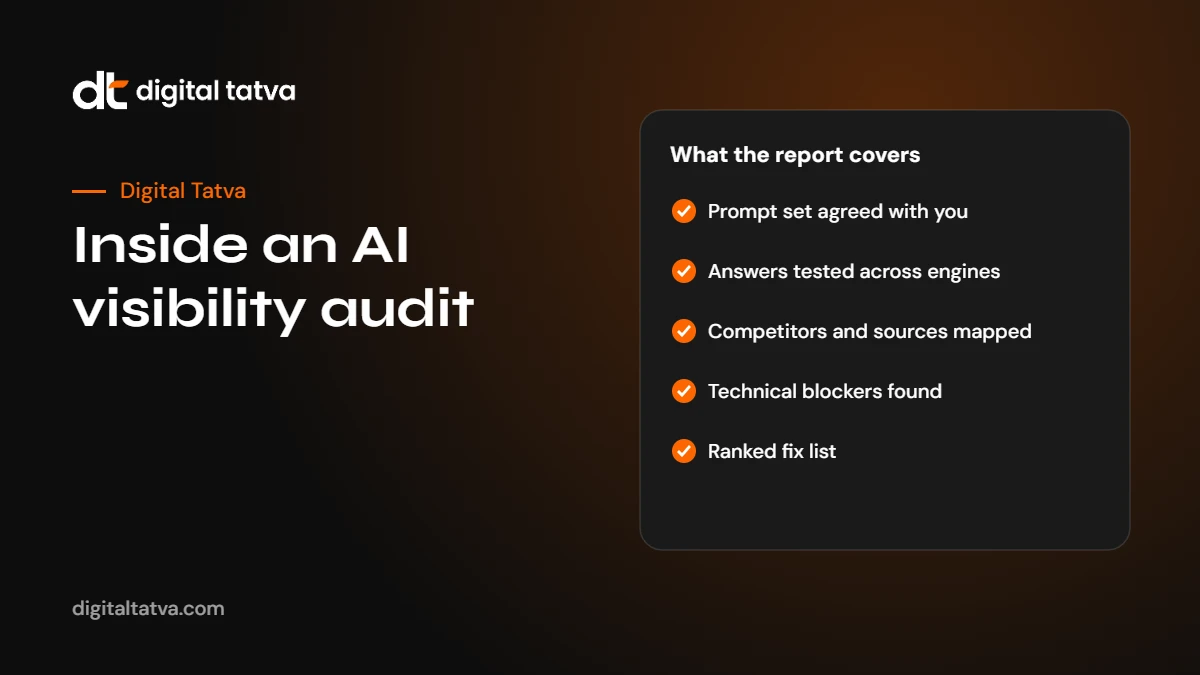
The audit report is written in plain language and walked through on a call. It includes:
- Executive summary. The five or six things that matter most, in one page.
- Baseline visibility. Mention rate for you and each competitor, by engine and theme.
- Share of voice. How often each brand is named across the full set.
- Accuracy log. Every error found in AI descriptions of your brand, with the likely source and suggested fix.
- Source map. The domains and pages AI cites most for your category, with your presence on each.
- Five-layer findings. Technical, content, trust, visibility and entity issues, each with evidence.
- Ranked fix list. Every recommendation with effort, likely impact and suggested owner, in priority order.
- Raw data. Every prompt, engine, answer and cited source, in a spreadsheet you keep.
How the ranked fix list works
An audit that lists 80 issues with equal weight is hard to act on. We rank every recommendation using two questions: how likely is it to improve visibility or accuracy for your important prompts, and how much effort will it take?
| Typical recommendation | Likely impact | Effort |
|---|---|---|
| Unblock AI search crawlers in robots.txt or firewall | High | Low |
| Correct outdated prices on a frequently cited listing | High | Low |
| Rewrite top service pages answer first | High | Medium |
| Add Organization schema with sameAs links | Medium | Low |
| Earn mentions on three frequently cited industry sites | High | High |
| Publish a comparison guide for a common buyer question | Medium | Medium |
High impact, low effort items come first. We also mark which items your team can handle, which need a developer and which we can implement.
Example findings
To give you a sense of what an audit typically uncovers, here are patterns we see often. These are general examples, not results from a specific client.
- A security plugin returned errors to AI crawlers, so the brand’s pages were never cited despite good content.
- AI assistants quoted a price from a two-year-old comparison article because the brand’s own pricing was only in a PDF.
- Competitors were named for category questions because they appeared on review platforms and directories the brand had never claimed.
- AI confused the brand with a similarly named company in another city because of inconsistent names on listings.
- The brand appeared for brand-name questions but almost never for problem questions, because it had no content explaining the problems its service solves.
How we keep the audit fair and reliable
AI answers are variable, so method matters. A few practices keep audit results trustworthy.
- Clean sessions. We avoid personalised sessions where history or memory could change answers.
- Repeated runs. Important prompts are run more than once, and results are reported as rates rather than single outcomes.
- Consistent settings. The same location, language and mode are used for every run, and recorded.
- Neutral prompts. Category and problem questions do not mention your brand, so we see whether AI recommends you unprompted.
- Dated evidence. Every answer is stored with its date and sources, so findings can be checked later.
- Human review. A person reads the answers and the cited pages before drawing conclusions.
Questions clients often ask during the walkthrough
- “Why is our competitor named and not us?” The source map usually answers this: the competitor appears on several domains AI cites, has clearer pages for the question, or both.
- “Can we just fix the technical issues and be done?” Technical fixes are essential but rarely enough on their own. They make the other layers possible.
- “What should we do first if we only have a small budget?” The top of the ranked fix list, which is usually low-effort technical and accuracy fixes, followed by rewriting the two or three most important pages.
- “How will we know it is working?” By rerunning the same prompt set monthly and tracking mention rate, accuracy, citations and AI-sourced enquiries against the baseline.
- “Will our SEO suffer?” No. The recommendations follow search engine guidelines, and most of them strengthen SEO as well.
What a section of the report looks like
Here is an illustration of how a single finding is presented in the report. Each finding follows the same structure so it is easy to act on.
| Field | Example |
|---|---|
| Finding | Pricing page content is inside a PDF; no prices in HTML |
| Layer | Answerable |
| Evidence | Cost prompts in three engines cite a 2024 comparison article instead of your site |
| Why it matters | Buyers asking about cost see outdated figures attributed to you |
| Recommendation | Publish an HTML pricing page with a dated table and FAQ; ask the article’s publisher to update |
| Effort and impact | Medium effort, high impact |
| Owner | Your marketing team, with a content brief from us |
| Prompts affected | Cost theme prompts 12 to 18 |
After the audit
You own the report and the data. From there, you can:
- Implement in-house. Many teams work through the fix list themselves, with the report as their guide.
- Get advisory support. We review your progress and answer questions as you go.
- Work with us on implementation and tracking. We ship fixes, measure monthly with the same prompt set and review strategy quarterly. See how we work and the reporting structure we use.
For realistic expectations on timing, see how long AEO takes.
Audit depth by business size
| Business | Typical prompt set | Engines | Focus |
|---|---|---|---|
| Local business, one location | 20 to 30 prompts | 3 to 4 | Maps, reviews, listings, service pages |
| Regional service business | 30 to 50 prompts | 4 to 5 | Locations, comparisons, pricing, third-party coverage |
| National B2B or SaaS | 50 to 100 prompts | 5 | Category, comparison and use case prompts; source map |
| Multi-market exporter or brand | 50 to 100 prompts per market | 5, plus local engines where relevant | Markets, languages, distributors and international sources |
A larger prompt set gives a more reliable picture but takes longer to test and analyse. We agree the right size with you during scoping.
Audit timeline
- Day 1: scoping call; access to analytics and Search Console where available.
- Days 2 to 4: prompt set drafted and approved.
- Days 4 to 10: testing across engines; technical, content and listing checks.
- Days 10 to 14: analysis, source map, accuracy log and ranked fix list.
- Days 14 to 18: report delivered and walked through on a call.
Larger or multi-market audits take longer, and we confirm the timeline in writing during scoping.
How the audit connects to ongoing work
The audit is designed so that its outputs feed directly into ongoing AEO work, whether you do it yourself or with us.
- The prompt set becomes your monthly tracking set, so every future report compares with the same baseline.
- The ranked fix list becomes your task list for the next three to six months.
- The source map becomes your digital PR and listings plan.
- The accuracy log becomes your error tracker, re-tested monthly.
- The raw data lets anyone on your team check findings and repeat tests.
This is why we spend time agreeing the prompt set and method at the start. A good baseline is worth more than a long report, because it makes every later decision measurable.
Signs you need an audit now
- Competitors are named in AI answers for questions your business should own.
- Customers mention that ChatGPT or Google’s AI told them something wrong about you.
- Your website has had a recent redesign, migration or change of security provider.
- You are about to invest in content or PR and want to know where it will matter most.
- Leadership is asking whether AI search is a threat or an opportunity, and you need evidence.
- Your organic traffic is falling while search impressions hold steady, which can indicate more answers being given without clicks.
Common findings by industry
Patterns differ by sector, which is why the audit adapts to each business. In healthcare, the most common gaps are anonymous doctors and inconsistent clinic listings. In real estate, project facts locked in brochures and PDFs. In education, unverifiable results claims and missing fee information. In manufacturing, specifications in catalogues instead of HTML and certifications shown only as logos. In professional services, generic practice pages that never answer a client’s question. In hospitality, vague descriptions and missing amenity fields on booking platforms. Our industry guides for healthcare, real estate, education, manufacturers, professional services and hotels explain how to fix each one.
Who the audit is for
- Businesses whose buyers research with AI before they enquire: B2B services, SaaS, healthcare, education, real estate, travel, professional services, manufacturing and ecommerce.
- Brands that see competitors named in AI answers and want to understand why.
- Companies that suspect AI describes them inaccurately.
- Marketing teams that need a baseline before investing in AEO.
- Agencies that want an independent view for a client.
What the audit is not
- It is not an automated scan with a generic score.
- It is not a promise of placement. Nobody can guarantee what AI assistants will say.
- It is not a sales pitch disguised as a report. Findings stand on evidence, whether or not you hire us afterwards.
- It does not involve any charge you have not agreed in writing.
How to prepare
- List the products or services that matter most and the buyers you want.
- Name the competitors you lose deals to.
- Gather common questions from sales and support.
- Arrange read-only access to analytics and Search Console if you can.
- Run the free checker and note any red results. Our guide on reading the checker results explains each one.
A note on confidentiality
Audits involve looking closely at your website, analytics and sometimes sales or support data. We treat everything you share as confidential, use read-only access wherever possible and remove personal customer information from any material we analyse. Findings about your competitors are based only on public information, such as their websites, listings and the AI answers anyone can see. You decide who in your organisation receives the report, and we never publish client findings or use your name as a reference without written permission.
In summary
A Digital Tatva AI visibility audit starts with a free first look and, if you want the full picture, moves to an agreed scope and fixed fee. We build a prompt set from your buyers’ real questions, test it across the AI engines your customers use with a consistent method, and analyse the results across the five layers of AI visibility. You receive a baseline, share of voice, an accuracy log, a source map, evidence-based findings and a ranked fix list, all walked through on a call, plus the raw data to keep. It is designed to be useful whether you implement the plan yourself or work with us afterwards.
Frequently asked questions
What is an AI visibility audit?
It is a structured review of how your brand appears when buyers ask AI assistants about your category, why it appears that way, and what to fix first, based on a fixed set of buyer questions tested across several AI engines.
Is the first look really free?
Yes. A person reviews your site, runs a small set of questions and replies with what we found. You are not charged for anything you have not agreed in writing.
Which AI engines does the audit cover?
Usually ChatGPT, Google AI Overviews and AI Mode, Gemini, Perplexity and Microsoft Copilot, agreed with you during scoping.
How long does a full audit take?
Typically one to three weeks after scoping, depending on the size of the prompt set, the number of markets and the number of key pages.
Do I need to hire you after the audit?
No. You own the report and raw data and can implement the fix list yourself, with advisory support if you want it.
Will the audit guarantee that ChatGPT recommends us?
No. Nobody can honestly guarantee AI placement. The audit shows where you stand and what is most likely to improve your visibility and accuracy.
Sources
- AI features and your website, Google Search Central
- Overview of OpenAI crawlers, OpenAI
Product details, prices and features are checked at the time of writing and can change. Sources are linked in the text so you can check them yourself.
How does your brand appear in AI answers?
We test the questions your buyers ask across the major AI assistants and search engines, then show you what to fix first.
Get an AI Visibility Audit