AEO for Healthcare: How Clinics and Hospitals Get Recommended by AI
Patients now ask ChatGPT and Google's AI which clinic to visit. Here is how clinics, hospitals and healthcare brands earn a place in those answers safely, with trust signals, content rules and a 90-day plan.
On this page
- Key takeaways
- Why AI answers now matter for clinics and hospitals
- How AI assistants choose which clinic to mention
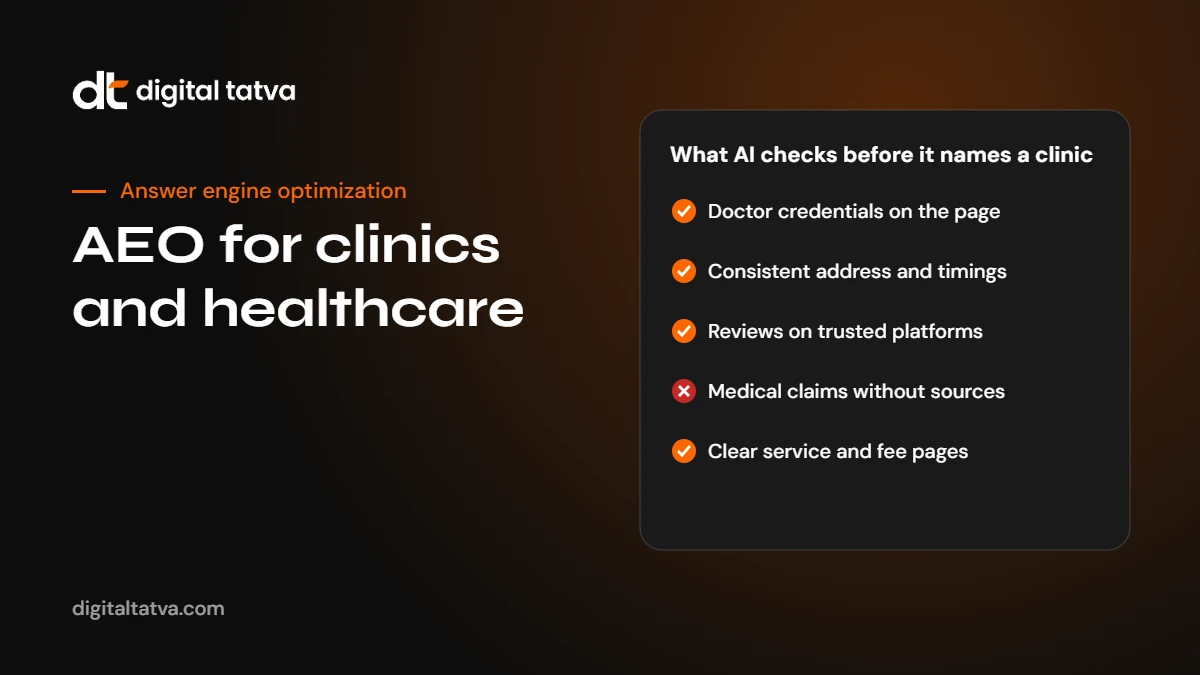
- The healthcare trust signals AI engines look for
- Build doctor profile pages that AI can trust
- Write service pages patients and AI can both use
- Health content rules: safe, accurate and compliant
- Google Business Profile and local listings
- Structured data for healthcare websites
- Reviews: how to earn them ethically
- Content that earns citations: what to publish
- A 90-day AEO plan for a clinic or hospital
- How to measure AEO for healthcare
- Common mistakes healthcare brands make
- When to get help
- Frequently asked questions
- Sources
Last updated: 4 November 2026
Quick answer: AEO for healthcare means making your clinic, hospital or health brand easy for AI assistants to find, understand and trust, so it appears when patients ask questions such as “best dermatologist near me” or “which hospital is good for knee replacement in Ahmedabad”. Because health is a high-stakes topic, AI engines lean heavily on verifiable signals: named doctors with real credentials, consistent clinic details, reviews on trusted platforms, medically accurate content reviewed by qualified people, and structured data. Clinics that publish clear, honest, well-sourced information and keep their profiles consistent are the ones AI names.
Key takeaways
- Patients now ask AI assistants which doctor or hospital to choose, not just what a symptom means.
- Health is treated as a sensitive topic, so AI engines favour sources with clear expertise, authorship and accountability.
- Doctor profile pages, service pages with honest fee and process information, and consistent clinic listings matter more than blog volume.
- Never publish guarantees or unsupported claims; they can break medical advertising rules and they reduce trust.
- Measure progress with a fixed set of patient questions tested monthly across ChatGPT, Gemini, Perplexity and Google AI Overviews.
Why AI answers now matter for clinics and hospitals
For years, a patient looking for a specialist would search Google, open three or four websites, read reviews on a directory and maybe ask a friend. That journey is changing. Many patients now type a full question into ChatGPT, Gemini or Perplexity: “Which pediatrician in Satellite, Ahmedabad is good for newborn care and open on Sundays?” The assistant replies with a short paragraph and two or three names. Google shows a similar summary at the top of the results page through AI Overviews and AI Mode.
If your clinic is not in that paragraph, the patient may never visit your website at all. That is the core of answer engine optimization (AEO): earning a place inside the answer, not only a ranking below it. For healthcare providers this shift is bigger than for most industries, for three reasons.
- Health questions are conversational. Patients describe symptoms, worries and constraints in long questions. AI assistants are built for exactly this kind of query.
- Trust is the deciding factor. A patient is not choosing a pair of shoes. They want reassurance that a doctor is qualified and that the hospital is reliable, and AI answers try to provide that reassurance in one place.
- Local intent is strong. Most healthcare decisions are local. AI engines combine map data, reviews and website content to recommend nearby providers.
This guide explains how AI engines decide which healthcare providers to mention, what to fix on your website and profiles, how to write medical content that is safe and useful, and how to measure whether it is working.
How AI assistants choose which clinic to mention
No AI company publishes a full list of ranking factors, and nobody can guarantee placement. But the way these systems work is well understood. When a patient asks a question that needs current, local information, the assistant usually searches the web, reads a set of pages and listings, weighs what it finds and writes an answer. Google’s AI features are built on Google Search, and ChatGPT search and Copilot use web search results too. In practice, four groups of signals shape whether your clinic is named.
1. Can the AI read and understand your website?
If AI crawlers are blocked, or if your doctor and service information only appears after JavaScript runs, the assistant may not see it. Many clinic websites are built on page builders that load content slowly or hide key details inside sliders and tabs. Start with our technical AEO checklist and the guide to AI crawlers and robots.txt. You can also run the free AI visibility checker to see in about 30 seconds whether OAI-SearchBot, PerplexityBot and Googlebot can reach your homepage.
2. Is your clinic one clear, consistent entity?
AI engines try to work out which clinic you are. If your Google Business Profile says “Shree Skin Clinic”, your website says “Shree Skin and Hair Care Centre”, a directory lists an old phone number and Practo shows a different address, the engines cannot be sure these refer to the same place. When they are unsure, they play safe and mention someone else. This is why entity SEO matters so much for healthcare.
3. Do trusted sources back you up?
Assistants look for confirmation beyond your own website: reviews on Google and healthcare platforms, listings on hospital association or insurance network pages, mentions in local news, doctor profiles on professional bodies and medical college alumni pages. Our guide to review and listing sites for AEO lists the platforms that tend to be cited.
4. Does your content answer patient questions clearly and accurately?
Assistants lift short, clear passages that answer a question directly. A page that explains “how long does recovery from cataract surgery take” in plain language, reviewed by a named ophthalmologist and dated, is much more useful to an AI system than a generic “Our Services” page with stock photos.
Important: Health content is treated as high stakes by search engines. Google’s guidance on helpful content asks whether content shows clear expertise and whether it is written or reviewed by people who know the topic well. AI answers built on Google Search inherit that preference.
The healthcare trust signals AI engines look for
Here is a practical list of the signals that most often decide whether a clinic or hospital is trusted enough to be named. Treat it as a checklist for your next website update.
| Signal | What good looks like | Common problem |
|---|---|---|
| Doctor profiles | One page per doctor with full name, qualifications, registration details where appropriate, specialties, experience, languages and timings | A single “Our Team” page with first names and photos only |
| Clinic details | Same name, address, phone and hours on the website, Google Business Profile and directories | Old numbers and addresses left on directories after a move |
| Service pages | A page per treatment explaining who it is for, the process, recovery, typical cost range and when to see a doctor urgently | One page listing 40 treatments with no detail |
| Medical review | Health articles show “Medically reviewed by Dr. Name, qualification” and a review date | Anonymous blog posts written by a marketing agency |
| Reviews | Steady, recent reviews on Google and healthcare platforms, with polite replies | A burst of reviews two years ago and nothing since |
| Structured data | MedicalClinic or Hospital schema, Physician schema for doctors, consistent sameAs links | No schema, or schema that lists the wrong address |
| Policies | Clear pages on appointments, cancellations, insurance and cashless facilities | Patients have to call to find out basic information |
Build doctor profile pages that AI can trust
If you only do one thing after reading this guide, build proper doctor profile pages. Patients increasingly ask for doctors by name and specialty, and AI engines need a reliable page to describe each doctor. A strong profile includes:
- Full name as it appears on professional registrations, plus any common short form.
- Qualifications with the institutions and years, written in plain text, not only inside an image.
- Specialties and the conditions or procedures the doctor focuses on.
- Years of practice and hospital affiliations.
- Languages spoken, which matters a lot in India where patients may prefer Gujarati, Hindi or Marathi.
- Consultation days and times, and how to book.
- Links to the doctor’s profiles on trusted platforms and professional bodies.
- A short, factual biography. Avoid superlatives such as “best surgeon in the city”.
Mark each profile up with Physician schema and link it from the relevant service pages. Our guide to author pages and expertise signals covers the same principles for writers, and they apply equally to doctors.
Write service pages patients and AI can both use
Most clinic websites describe services in two lines: “We offer world-class laser hair removal using the latest technology.” That sentence tells a patient almost nothing and gives an AI engine nothing to quote. A useful service page answers the questions patients actually ask before they book.
- What is it and who is it for? One or two sentences in plain language, placed at the top of the page.
- How does the process work? Consultation, tests, the procedure itself, follow up.
- How long does it take and what is recovery like? Typical ranges, with a note that individual cases vary.
- What does it cost? A typical range or starting price where you are comfortable sharing it, and what affects the final cost. Patients ask AI about cost constantly, and pages that answer it honestly are more likely to be cited.
- Is it covered by insurance? Which insurers or cashless arrangements apply, if any.
- When should someone see a doctor urgently? Clear warning signs.
- Who performs it? Link to the doctor profiles.
This answer-first structure is explained in detail in our guide to answer-first content. For healthcare, add a medical reviewer line and a “last reviewed” date to every page.
Health content rules: safe, accurate and compliant
Healthcare marketing carries extra responsibilities. The rules differ by country and profession, so check with your professional council or legal adviser, but these principles apply almost everywhere.
- No guarantees. Do not promise outcomes such as “100% success” or “permanent cure”. Many medical councils restrict this kind of claim, and AI engines tend to avoid repeating sources that sound like advertising.
- Cite reliable sources. When you state a medical fact, link to a recognised source such as a national health authority, a professional society guideline or a peer-reviewed study.
- Show who reviewed it. Every health article should name the qualified person who wrote or reviewed it.
- Date it. Medical guidance changes. Show when each page was last reviewed and set a review cycle, at least once a year.
- Protect patient privacy. Never publish patient details, photos or testimonials without explicit written consent, and follow the data protection law that applies to you.
- Separate information from advice. Make it clear that online content does not replace a consultation.
Watch out: Doctors in India should check the National Medical Commission’s professional conduct rules on publicity before running any promotional content. When in doubt, keep pages factual and informational.
Google Business Profile and local listings
For local healthcare queries, Google Business Profile is one of the strongest signals for both Google AI Overviews and other assistants that draw on map and review data. Make sure:
- The primary category is specific (for example “Dermatologist” rather than “Medical clinic”).
- Opening hours are accurate, including holidays and Sunday timings.
- Each doctor who sees patients independently has the right listing set-up, following Google’s guidelines for practitioners.
- Services are listed with short, factual descriptions.
- Photos show the real clinic, team and facilities.
- Questions and answers are monitored, and common questions are answered by the clinic.
- Every review gets a polite reply that does not reveal any patient information.
Then check the healthcare platforms patients use in your market, such as appointment booking sites, insurance network directories and hospital association listings, and make sure every one shows the same details. Our guide to AEO for local businesses has a full listing workflow.
Structured data for healthcare websites
Schema markup does not guarantee AI visibility, but it removes ambiguity. For healthcare, the most useful schema.org types are:
- MedicalClinic, Hospital, Dentist or Physician for the organisation and doctors, with name, address, phone, opening hours, medical specialty and sameAs links.
- MedicalProcedure or MedicalTherapy where it fits the service pages.
- FAQPage for genuine question and answer sections.
- BreadcrumbList so the site structure is clear.
Keep schema consistent with what the page shows. Schema that claims an address or rating the page does not display can do more harm than good. See schema markup for AEO for testing steps.
Reviews: how to earn them ethically
Reviews matter because they are third-party confirmation that real patients trust you. They also give AI engines language to describe you: “known for gentle care with children” or “short waiting times”. To build reviews ethically:
- Ask every patient, not only happy ones, using a simple link sent after the visit.
- Never pay for reviews or offer discounts in exchange for them.
- Reply to every review, including negative ones, calmly and without discussing medical details in public.
- Track themes. If several reviews mention long waiting times, fix the process, then mention the improvement on your website.
Content that earns citations: what to publish
Healthcare blogs often publish generic articles copied from other sites: “10 benefits of drinking water”. These rarely get cited because hundreds of better sources exist. Focus instead on content only you can publish.
- Local patient guides. “What to expect on your first visit”, “How to prepare for an MRI at our centre”, “Parking and access for wheelchair users”.
- Cost and insurance explainers. Honest ranges and the factors that change the cost.
- Procedure FAQs answered by your doctors. Take real questions from patients and answer them in your doctors’ words.
- Comparison guides. “Laser vs traditional cataract surgery: which is right for you?” Written fairly, these match how patients ask AI. See our guide to comparison pages for AEO.
- Original data, carefully. Aggregated, anonymised data such as “average waiting time for appointments this year” can be quotable, as long as it is accurate and privacy safe. Our guide to original research for AEO explains how.
A 90-day AEO plan for a clinic or hospital
Here is a realistic plan for a single clinic or a small hospital. Larger hospital groups can run the same plan per specialty.
| Weeks | Focus | Tasks |
|---|---|---|
| 1 to 2 | Baseline | Write 20 to 30 patient questions, test them in ChatGPT, Gemini, Perplexity and Google, record who is named and which sources are cited |
| 2 to 4 | Access and accuracy | Fix crawler access, rendering and indexing issues; correct clinic details on every listing |
| 3 to 6 | Doctor profiles | Build or rewrite one profile per doctor with Physician schema |
| 5 to 9 | Service pages | Rewrite the top 10 service pages answer first, with medical review and dates |
| 6 to 12 | Reviews and mentions | Start a review request process; claim healthcare platform profiles; pitch one local story |
| 12 | Re-test | Run the same questions, compare with the baseline, plan the next quarter |
Results vary. Technical and listing fixes can show up within weeks of the next crawl, while changes in how often assistants recommend you usually take several months. Read how long AEO takes for realistic expectations, and our 90-day AEO strategy for a broader version of this plan.
How to measure AEO for healthcare
Do not judge success on a single ChatGPT check. Answers vary between sessions and change with model updates. Instead, track these numbers each month against the same prompt set:
- Mention rate: the share of patient questions where your clinic or doctors are named.
- Accuracy: whether the description is correct (specialties, location, timings).
- Cited pages: which of your pages, if any, appear as sources.
- Competitors named: who appears instead of you.
- AI referral traffic: visits from ChatGPT, Perplexity, Gemini and Copilot in GA4. See how to track AI traffic in GA4.
- Appointment enquiries that mention finding you through an AI assistant. Add “How did you hear about us?” with an AI option to your booking form.
Our guide to AEO KPIs and the new AEO reporting template show how to present these to clinic owners or hospital management.
Common mistakes healthcare brands make
- Hiding doctors. Patients choose doctors, not logos. Anonymous websites lose.
- Copying generic health content. It adds nothing and can introduce errors.
- Letting listings drift. A wrong phone number on one directory can confuse AI descriptions for months.
- Overclaiming. “Best hospital in Gujarat” without evidence reads as advertising and may breach rules.
- Ignoring Indian languages. Many patients ask questions in Hindi, Gujarati or mixed language. Short FAQ sections in the languages your patients use can help.
- Blocking AI crawlers by accident. Security plugins and CDN settings sometimes block them. Check with the free checker.
For a wider list, see 12 AEO mistakes that keep brands out of AI answers.
When to get help
Many clinics can complete the basics in-house: fix listings, build doctor pages and collect reviews. Bring in specialist help when you have several locations or specialties, when AI answers describe you incorrectly and you cannot find the source, or when you need a structured prompt set and monthly tracking. At Digital Tatva we run AI visibility audits that test the questions your patients ask and give you a ranked fix list. We never promise placement, because nobody honestly can, but we do give you a clear picture and a plan. You can request an audit here.
Next step: Write down ten questions a new patient would ask before booking with you, test them in ChatGPT and Google today, and note who is named. That single exercise usually shows exactly where to start.
Frequently asked questions
What is AEO for healthcare?
AEO for healthcare is the work of making a clinic, hospital or health brand easy for AI assistants such as ChatGPT, Gemini, Perplexity and Google AI Overviews to find, understand and trust, so it is mentioned when patients ask questions about doctors, treatments and providers.
Can a clinic pay to be recommended by ChatGPT?
No organic method guarantees a recommendation. Some AI platforms are testing advertising, but organic answers are based on the sources the assistant finds and trusts. Treat any promise of guaranteed placement with suspicion.
Do doctors need individual pages?
Yes, ideally. Patients often ask for doctors by specialty and name, and a dedicated profile with qualifications, specialties, timings and languages gives AI engines a reliable source to describe each doctor accurately.
Should a clinic publish prices?
Where your rules and business model allow, publishing typical cost ranges and the factors that change them is helpful. Patients ask AI about cost constantly, and honest ranges make your page more useful and more likely to be cited.
How long does AEO take for a hospital?
Technical and listing fixes can be picked up within weeks of the next crawl. Changes in how often assistants recommend you for competitive specialties usually take several months of steady work on content, profiles and reviews.
Is health content risky for AEO?
It is sensitive rather than risky. Content that is accurate, reviewed by qualified people, dated and sourced is exactly what AI engines prefer. The risk comes from unsupported claims, copied content and outdated advice.
Sources
- AI features and your website, Google Search Central
- Creating helpful, reliable, people-first content, Google Search Central
- MedicalClinic, schema.org
- Overview of OpenAI crawlers, OpenAI
Product details, prices and features are checked at the time of writing and can change. Sources are linked in the text so you can check them yourself.
How does your brand appear in AI answers?
We test the questions your buyers ask across the major AI assistants and search engines, then show you what to fix first.
Get an AI Visibility Audit