The Five Elements of AI Visibility: The Digital Tatva Framework Explained
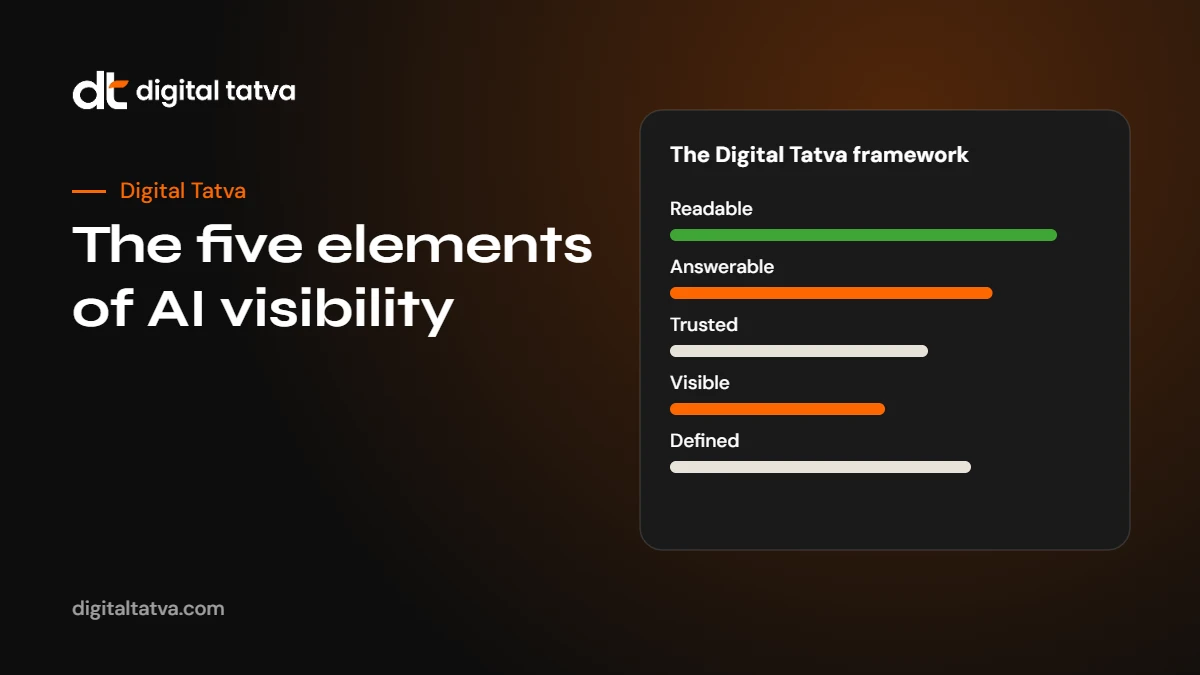
Tatva is Sanskrit for element. Digital Tatva's framework treats AI visibility as five layers: readable, answerable, trusted, visible and defined. What each layer means, how to check it and how to strengthen it.
On this page
- Key takeaways
- Where the framework comes from
- The five elements at a glance
- Prithvi: Readable
- Jala: Answerable
- Agni: Trusted
- Vayu: Visible
- Akasha: Defined
- How the five elements work together
- A quick self-assessment
- Worked example: one brand through the five elements
- Measuring each element
- Where to start if you have one day
- How the elements change over time
- The framework and traditional SEO
- Common misunderstandings about the framework
- Applying the framework by industry
- Work with us
- Questions to discuss with your team
- In summary
- Frequently asked questions
- Sources
Last updated: 4 November 2026
Quick answer: The Digital Tatva framework describes AI visibility as five layers that work together, named after the five classical elements of Indian philosophy. Readable (Prithvi, earth): can AI crawlers fetch, render and parse your pages? Answerable (Jala, water): do your pages answer real buyer questions in clear passages AI can lift? Trusted (Agni, fire): do original data, named experts and third-party sources back you up? Visible (Vayu, air): are you tracked and present across AI engines and prompts? Defined (Akasha, space): is your brand one clear, consistent entity that AI cannot mix up? A weakness in any one layer limits the others. When all five are in place, an AI assistant can find you, understand you, trust you and name you.
Key takeaways
- AI visibility is not one tactic; it is five layers that support each other.
- Readable is the foundation: if AI cannot read your site, nothing else counts.
- Answerable and Trusted decide whether your content is quoted and believed.
- Visible is about measurement and presence across many engines and prompts.
- Defined is about identity: consistent facts that make your brand unmistakable.
Where the framework comes from
Tatva is a Sanskrit word for element or essence. Indian philosophy describes the world as made of five great elements, the pancha mahabhuta: earth (Prithvi), water (Jala), fire (Agni), air (Vayu) and space (Akasha). Each has its own nature, and together they form everything that exists.
When we started Digital Tatva, we noticed that AI visibility works in a similar way. Brands that appear in ChatGPT, Gemini, Perplexity, Copilot and Google AI Overviews rarely get there through one trick. They get there because several distinct layers are in place at once. A brand with brilliant content but blocked crawlers is invisible. A brand with perfect technical setup but no third-party trust is rarely recommended. A brand that is mentioned often but described inconsistently gets confused with others.
So we organised our work around five layers, one for each element. The names are a reminder of balance: each layer matters, and none is enough on its own. You will see the framework across our services and our six-step process.
The five elements at a glance
| Element | Layer | The question it answers | Related service |
|---|---|---|---|
| Prithvi (earth) | Readable | Can AI read your site? | Technical AEO |
| Jala (water) | Answerable | Can AI lift your answer? | Generative Engine Optimization |
| Agni (fire) | Trusted | Can AI trust you? | AI Citation Optimization |
| Vayu (air) | Visible | Where does AI mention you? | AI Search Visibility |
| Akasha (space) | Defined | Does AI know who you are? | Entity SEO and AEO |
Prithvi: Readable
The question: can AI crawlers fetch, render and parse your pages?
Earth is the ground everything else stands on. In AI visibility, the ground is access. Before any model can quote your page, a crawler has to request it, receive it, read its content and understand its structure. Many websites fail here without knowing it.
What Readable includes
- Crawler access: robots.txt allows the AI search crawlers that matter, such as OAI-SearchBot, PerplexityBot, Googlebot and Bingbot. See AI crawlers and robots.txt.
- Server and firewall behaviour: security tools do not silently reject AI crawlers.
- Content in HTML: key text is present in the initial HTML, not only after JavaScript runs. See can AI crawlers read JavaScript?
- Indexability: no accidental noindex tags, correct canonicals, working sitemaps.
- Structured data: schema that clarifies what each page is.
- Speed and stability: pages that load reliably without errors.
Signs of a weak Readable layer
- AI assistants never cite your pages even for questions about your own business.
- Your homepage shows very little text when viewed without JavaScript.
- Your firewall or CDN blocks unknown bots by default.
How to check it
Run the free AI visibility checker. It tests robots.txt rules, firewall responses, content in HTML, indexability, schema and sitemaps in about 30 seconds. For a deeper review, follow the technical AEO checklist.
Jala: Answerable
The question: can AI lift your answer?
Water flows and takes the shape of its container. In AI visibility, your content needs to flow into the short passages AI engines use to build answers. Search and retrieval systems break pages into chunks and look for the passages that best answer a question. Pages that bury the answer under long introductions, vague marketing language or images give them little to work with.
What Answerable includes
- Answer-first writing: each page and section states the answer clearly at the start. See answer-first content.
- Question-shaped headings: headings that match how buyers ask, so each section can stand on its own.
- Specific facts: prices, timelines, specifications, steps and examples rather than adjectives.
- Tables and lists: comparisons and processes presented in clear structures.
- FAQs from real questions: drawn from sales, support and prompt research. See FAQ page best practices.
- Coverage of buyer questions: pages for the comparisons, costs and problems your buyers ask about. See comparison pages.
Signs of a weak Answerable layer
- AI answers your buyers’ questions using competitors’ or publishers’ pages, even when you have pages on the topic.
- Your service pages describe what you do in one or two generic sentences.
- Important information lives in PDFs or images.
How to strengthen it
Start with your ten most valuable pages: services, pricing, comparisons and FAQs. Rewrite them answer first, add specific facts and an FAQ. Then refresh older content using our content refresh process.
Agni: Trusted
The question: can AI trust you?
Fire transforms and proves. In AI visibility, trust is proof. AI engines prefer claims they can confirm in more than one place, stated clearly by sources they consider reliable. Your own website saying you are excellent is not enough. Original data, named experts and mentions on the sources AI already cites are what make you believable.
What Trusted includes
- Original data and research that others quote. See original research for AEO.
- Named experts with real, checkable experience. See author pages and expertise signals.
- Third-party mentions on the domains AI engines cite in your category. See brand mentions for AEO.
- Reviews on the platforms your buyers and AI engines use. See review and listing sites.
- Community presence in forums and discussions, done honestly. See Reddit for AEO.
- Sources and citations on your own pages, linking to primary evidence.
Signs of a weak Trusted layer
- AI mentions you only when asked about your brand by name, never for category questions.
- The sources cited for your category are all third-party sites where you do not appear.
- Your content contains claims without evidence.
How to strengthen it
Map the domains AI cites for your top buyer questions, then work out how to earn accurate mentions on them: reviews, directory listings, expert commentary, data releases and partnerships. Our guide to getting cited by AI explains the method.
Vayu: Visible
The question: where does AI mention you?
Air moves and reaches everywhere. In AI visibility, presence must be measured across many engines and many prompts, because it changes all the time. A brand might appear in Perplexity but not Gemini, for comparison questions but not cost questions, in English but not Hindi. Without tracking, you are guessing.
What Visible includes
- A fixed prompt set built from real buyer questions. See AEO prompt research.
- Tracking across engines: ChatGPT, Google AI Overviews and AI Mode, Gemini, Perplexity and Copilot, plus others relevant to your market.
- Share of voice against competitors. See AI share of voice.
- AI referral traffic in analytics. See tracking AI traffic in GA4.
- Regular, honest reporting. See the AEO reporting template.
- Presence on the surfaces AI draws from: video, social platforms, marketplaces and maps where your buyers are.
Signs of a weak Visible layer
- You have no idea how often AI mentions you.
- You judge progress by a single ChatGPT check.
- You track one engine and ignore the others your buyers use.
How to strengthen it
Build a prompt set of 20 to 100 questions, test it monthly across your chosen engines and record mentions, accuracy and sources. Tools can automate this; see the best AI visibility tools.
Akasha: Defined
The question: does AI know who you are?
Space contains and connects everything. In AI visibility, definition is identity: one clear version of your brand, linked to your services, people and places, that AI cannot confuse with anyone else. Search engines and AI systems think in entities, meaning things with stable identities and relationships. If your brand appears with different names, addresses and descriptions across the web, the systems are unsure whether these are one entity. When unsure, they avoid naming you or describe you wrongly.
What Defined includes
- A consistent name and description across your website, profiles and listings.
- A thorough About page with founding date, founders, locations, services and what you do not do.
- Organization schema with sameAs links to your official profiles.
- Knowledge sources such as Google Business Profile, Wikidata where appropriate and industry directories. See Wikipedia and Wikidata for AEO and getting a Google knowledge panel.
- Clear relationships between your brand, your people, your products and your locations.
Signs of a weak Defined layer
- AI mixes you up with a similarly named company.
- AI quotes old addresses, services or leaders.
- Your brand name appears in several different forms online.
How to strengthen it
Create a single source of truth for your brand facts, update every profile to match, add accurate Organization schema and fix errors at their source. Our guides to entity SEO for AEO and fixing wrong AI answers walk through the steps.
How the five elements work together
The layers are not independent. They reinforce or limit each other.
- Great answerable content is wasted if the readable layer is broken.
- Strong trust signals help less if AI cannot tell which entity they refer to.
- Visibility tracking tells you where you stand, but improvement comes from the other four layers.
- A well-defined entity with no answerable content is known but not recommended.
That is why we audit all five before recommending any work, and why we usually fix them in a particular order: Readable first, then Defined and Answerable, then Trusted, with Visible running throughout as measurement.
A quick self-assessment
Score each layer from 1 (weak) to 5 (strong) using these questions.
| Layer | Ask yourself |
|---|---|
| Readable | Does the free checker show green for access, content and schema? Are key pages in HTML? |
| Answerable | Do our top 10 pages answer buyer questions in the first two sentences? Do we have pages for costs, comparisons and FAQs? |
| Trusted | Are we mentioned on the sites AI cites for our category? Do we publish original data or expert content? |
| Visible | Do we track a fixed prompt set monthly across several engines? Do we know our share of voice? |
| Defined | Is our name, description and contact information identical everywhere? Does AI describe us correctly? |
The lowest score is usually the best place to start.
Worked example: one brand through the five elements
Here is an illustration of how the framework guides decisions. Imagine a mid-sized interior design studio in Ahmedabad that wants to be recommended when people ask AI assistants for interior designers in the city.
- Readable: the free checker shows the site is built with a heavy page builder; only about 80 words appear in the HTML, and a security plugin blocks PerplexityBot. These are fixed first: the developer adds server-rendered text and allows verified AI crawlers.
- Defined: the studio appears as “Example Interiors”, “Example Interior Studio” and “Example Design House” across listings, with two old addresses. The team settles on one name, updates every listing, rewrites the About page and adds Organization schema with sameAs links.
- Answerable: service pages say only “We create beautiful spaces”. They are rewritten answer first: services offered, typical project types, budget ranges per square foot with dates, timelines, process and FAQs. A guide on “how much does interior design cost in Ahmedabad” is published.
- Trusted: the source map shows AI cites a few home design platforms, a local magazine and Google reviews. The studio claims and completes its platform profiles, asks recent clients for reviews and pitches a project story to the magazine.
- Visible: a set of 30 buyer questions is tested monthly across ChatGPT, Google AI Overviews, Gemini and Perplexity. Mention rate, accuracy and cited sources are reported every month.
The framework stops the studio from jumping straight to “write more blog posts”, which would have done little while the site was unreadable and the brand inconsistent.
Measuring each element
| Element | Useful measures |
|---|---|
| Readable | Checker score; share of key pages with content in HTML; crawler errors in server logs |
| Answerable | Number of priority buyer questions with a dedicated answer; pages cited by AI engines |
| Trusted | Mentions on frequently cited domains; review count and recency; original data published |
| Visible | Mention rate and share of voice across engines; AI referral traffic |
| Defined | Accuracy of AI descriptions; consistency score across listings; errors open versus resolved |
Our reporting template shows how to bring these together in one monthly report.
Where to start if you have one day
If you only have a day to spend on AI visibility, use it this way:
- Morning, Readable: run the free checker and fix any red results with your developer.
- Late morning, Defined: write a one-paragraph brand description and update your website About page, Google Business Profile and main social profiles to match.
- Afternoon, Answerable: rewrite the opening of your most important service or product page so it answers the main buyer question in two sentences, and add a five-question FAQ.
- Late afternoon, Visible: write 20 buyer questions and test them in two AI engines; record who is named.
- End of day, Trusted: list the third-party sites cited in those answers. That list is your trust plan for the next month.
One focused day across all five elements usually achieves more than a week spent on only one.
How the elements change over time
Each element needs attention at a different rhythm.
| Element | Typical review rhythm | What usually breaks it |
|---|---|---|
| Readable | After every site change, and monthly | New plugins, security rules, redesigns, migrations |
| Answerable | Quarterly for key pages | Outdated prices, new products, stale guides |
| Trusted | Ongoing, reviewed quarterly | Competitors earning new coverage; review gaps |
| Visible | Monthly | Model updates, new engines, new buyer questions |
| Defined | Whenever facts change | Moves, rebrands, new leaders, forgotten listings |
Building these rhythms into your marketing calendar keeps all five elements healthy without a big project every year.
The framework and traditional SEO
If you already invest in SEO, much of that work supports the five elements. Technical SEO strengthens Readable. Good content strategy strengthens Answerable. Link building and digital PR contribute to Trusted. Local SEO and consistent citations strengthen Defined. What the framework adds is a sharper focus on how AI systems read, trust and describe brands, and on measuring presence inside AI answers rather than only rankings. Our guide to AEO vs SEO explains the overlap and the differences in detail, and our SEO consulting service covers the traditional side.
Common misunderstandings about the framework
- “It is just SEO renamed.” SEO covers much of the Readable and Answerable work, but AI visibility also depends heavily on Trusted and Defined signals beyond your website, and on measuring presence across several AI engines.
- “One element is enough.” A brand that is very strong in one layer and weak in others rarely gets consistent recommendations.
- “It is a one-time project.” Each layer can decay: plugins break access, content goes stale, listings drift and competitors earn new coverage. The framework is a cycle, not a checklist you finish.
Applying the framework by industry
The five elements apply to every business, but the emphasis shifts. Healthcare and professional services lean heavily on Trusted and Defined, because expertise and identity matter most. Manufacturers often need the most work on Answerable, moving specifications out of PDFs. Hotels and local businesses depend on Defined and Trusted through maps and reviews. See our industry guides for healthcare, real estate, education, hotels, professional services and manufacturers.
Work with us
Our AI visibility audit assesses all five layers for your brand, tests your buyers’ questions across AI engines and gives you a ranked plan. We never promise placement, because nobody can, but we do give you a clear picture of each element and what to fix first. Request an audit or read more about Digital Tatva.
Questions to discuss with your team
- Which of the five elements do we think is weakest today, and what evidence do we have?
- Who owns each element in our team, and who reviews it?
- Which buyer questions matter most to us, and are we named for them?
- What facts about our business change most often, and how do we keep them consistent online?
- Which third-party sites do our buyers and AI assistants trust most in our category?
In summary
The five elements give you a simple way to think about a complex problem. Readable asks whether AI can reach and parse your site. Answerable asks whether your pages give AI clear passages to lift. Trusted asks whether others confirm what you say. Visible asks where and how often AI mentions you. Defined asks whether AI knows exactly who you are. Score each one, start with the weakest, review them on a regular rhythm and remember that none of them works alone. Balance across all five is what turns a website into a brand AI can confidently name.
Frequently asked questions
What are the five elements of AI visibility?
Readable, Answerable, Trusted, Visible and Defined. They describe whether AI can read your site, lift your answers, trust your claims, mention you across engines and recognise your brand as one clear entity.
Why is the framework named after the five elements?
Tatva is Sanskrit for element. The five classical elements of Indian philosophy, earth, water, fire, air and space, are a reminder that AI visibility depends on several distinct layers in balance.
Which element should I fix first?
Usually Readable, because nothing else works if AI cannot access and read your site. After that, the weakest layer in your self-assessment is the best place to focus.
Is this framework the same as AEO?
It is a way of organising AEO work. Answer engine optimization covers all five layers; the framework helps make sure none is forgotten.
Can I use the framework without hiring an agency?
Yes. The self-assessment and linked guides are designed so any team can use them. Many businesses fix the Readable and Defined layers in-house.
Does strengthening all five guarantee AI recommendations?
No. Nothing guarantees placement in AI answers. Strengthening all five layers improves the odds and makes your brand easier to find, understand, trust and name.
Sources
- AI features and your website, Google Search Central
- Creating helpful, reliable, people-first content, Google Search Central
- Organization, schema.org
Product details, prices and features are checked at the time of writing and can change. Sources are linked in the text so you can check them yourself.
How does your brand appear in AI answers?
We test the questions your buyers ask across the major AI assistants and search engines, then show you what to fix first.
Get an AI Visibility Audit