AEO for Manufacturers and Exporters: How B2B Suppliers Get Shortlisted by AI
Industrial buyers and importers now ask AI to find suppliers. How manufacturers and exporters get named in ChatGPT, Gemini and Perplexity answers with product pages, specifications, certifications and a 90-day plan.
On this page
- Key takeaways
- How industrial buying is changing
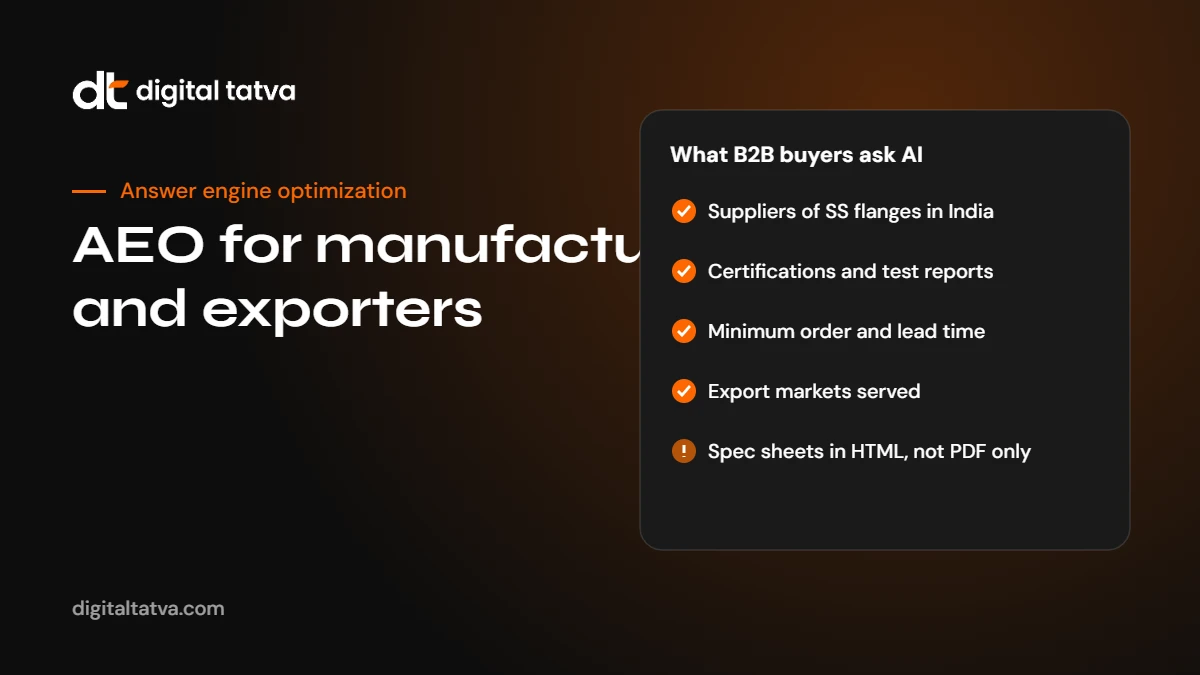
- The questions B2B buyers ask AI
- Why manufacturer websites often fail in AI answers
- Build specification-rich product pages
- Use the buyer’s vocabulary
- Show your factory and capabilities
- Technical guides that earn citations
- B2B directories, trade bodies and marketplaces
- LinkedIn and people signals
- Multilingual content for export markets
- Worked example: a product page rewrite
- Contract manufacturing and private label
- Distributors and dealers
- Trade fairs and events as AEO assets
- Answering buyer due diligence questions
- Using AI tools inside your sales and marketing
- A 90-day AEO plan for a manufacturer
- Measuring results
- Common mistakes
- Getting help
- How to handle confidential customers and projects
- Questions to ask before you start
- Responding to AI-driven enquiries
- A quick checklist for manufacturer AEO
- Frequently asked questions
- Sources
Last updated: 4 November 2026
Quick answer: AEO for manufacturers means making your factory, products and capabilities easy for AI assistants to find, understand and trust, so you are named when buyers ask questions such as “stainless steel flange manufacturers in India with PED certification” or “contract manufacturers for ayurvedic capsules in Gujarat”. AI engines shortlist suppliers whose websites state products, grades, standards, capacities, certifications, minimum order quantities, lead times and export markets clearly in HTML, and whose details are confirmed by B2B directories, trade bodies and industry coverage. Manufacturers that publish specific, technical, verifiable information get shortlisted; those with brochure websites and PDF catalogues usually do not.
Key takeaways
- Procurement teams and importers increasingly use AI assistants for early supplier research and shortlisting.
- Technical detail is your advantage: grades, standards, tolerances, capacities and certifications are what AI matches to buyer questions.
- PDF catalogues alone are a weak source; key specifications must also be in HTML pages.
- B2B marketplaces, trade associations and export promotion bodies act as third-party confirmation.
- Track a set of buyer questions in several markets and languages, because exporters are compared globally.
How industrial buying is changing
Industrial purchasing used to start with trade fairs, directories, distributor networks and search engines. A procurement manager in Germany looking for a new forging supplier would search, browse marketplaces, request quotes and visit factories. A distributor in the Gulf looking for food-grade packaging would ask contacts and attend expos.
Those channels still matter, but an extra step now sits at the start of many searches. Buyers ask AI assistants to summarise the supplier landscape: “List manufacturers of API grade valves in India with ISO 9001 and API 6D certification, and explain what to check before ordering.” ChatGPT, Gemini, Perplexity and Copilot answer with a few names and buying criteria. Google AI Overviews summarise the same kind of query. The suppliers named in those answers get the first enquiries.
This is where answer engine optimization becomes a practical sales tool for manufacturers. For many Indian manufacturers and exporters, it is also a chance to compete with larger global suppliers on clarity and detail rather than advertising budgets. Our guide to AEO for Indian businesses and exporters covers the wider picture.
The questions B2B buyers ask AI
| Question type | Example | What the answer needs |
|---|---|---|
| Supplier discovery | “Manufacturers of HDPE pipes in Gujarat for agriculture” | Product pages with application, grades and location |
| Specification match | “Suppliers of SS 316L seamless tubes to ASTM A213” | Grades, standards and size ranges in HTML |
| Compliance | “Indian food packaging suppliers with BRCGS certification” | Certification names, scopes and validity |
| Capability | “Contract manufacturers that can do 1 lakh units a month” | Capacity, machinery, minimum order quantities |
| Export | “Indian suppliers exporting castings to Europe” | Export markets, Incoterms, documentation support |
| Comparison | “Forged vs cast flanges: which is better for high pressure?” | Technical explainers and guides |
Write 25 to 30 of these questions for your products and target markets. Include the same questions phrased the way buyers in each export market would ask them. Our guide to prompt research explains how.
Why manufacturer websites often fail in AI answers
Most manufacturer websites were built as digital brochures. They have a homepage slider, an “About Us” page with the founder’s story, a products page with photos and a “Download Catalogue” button. When an AI assistant reads such a site, it finds almost no specific facts.
- Specifications live in PDFs. AI systems can sometimes read PDFs, but HTML pages are easier to parse, link and cite.
- Products are listed by trade names only. A buyer searches for “ASTM A105 flanges” while your page says “Premium Flanges Range”.
- Certifications appear as logos. An image of a certificate badge tells an AI nothing unless the certification is also named in text.
- No capacity or MOQ information. Buyers want to know whether you can handle their volume.
- Content blocked or hidden. Some sites block crawlers or load content through scripts. Check yours with our free AI visibility checker.
Build specification-rich product pages
Each product or product family should have its own page with a stable URL and a structure that answers buyer questions directly.
- Summary first. What the product is, materials or grades, standards, size range, main applications and the industries you supply.
- Specification table. Grades, dimensions, pressure ratings, tolerances, finishes and testing, in an HTML table.
- Standards and certifications. Named in text, with scope and validity where relevant, for example “ISO 9001:2015 certified for design and manufacture of forged flanges”.
- Applications. Specific uses and industries, written in the buyer’s terms.
- Capacity and lead times. Monthly capacity, typical lead times and minimum order quantities, or the factors that determine them.
- Quality and testing. In-house testing, third-party inspection options and documents supplied (mill test certificates, inspection reports).
- Export information. Markets served, Incoterms offered, packing standards and documentation support.
- Downloads. Catalogue and datasheets as PDFs, as a supplement to the HTML.
- FAQ. The questions your sales team answers every week.
Mark product pages up with Product schema (name, material, description, manufacturer) and FAQPage where appropriate. See schema markup for AEO.
Use the buyer’s vocabulary
One of the simplest and most effective changes is to describe products using the terms buyers actually use: standard numbers, grade names, common abbreviations and application names. Include alternative names used in different markets, for example “SS 304 / AISI 304 / 1.4301”. Keep your trade names, but never rely on them alone. If a buyer’s AI question includes “EN 1092-1 Type 11 weld neck flange”, your page should contain those words where they are accurate.
Show your factory and capabilities
Buyers want evidence that you can deliver. A capabilities page should include:
- Factory locations, area and year established.
- Key machinery and processes, with capacities.
- Quality control steps and testing equipment.
- Certifications with scope and validity.
- Industries and types of customers served, within confidentiality limits.
- Photos and video of real operations with descriptive captions.
Short factory tour videos on YouTube, with clear titles and descriptions, are useful supporting evidence. Our guide to YouTube for AEO explains why.
Technical guides that earn citations
Manufacturers have deep technical knowledge that buyers need. Publishing it is one of the most effective ways to be cited, because few competitors do it well.
- Selection guides: “How to choose the right flange type for your pipeline”, “Choosing between HDPE and PVC pipes for irrigation”.
- Standards explainers: “ASTM vs EN standards for stainless steel tubes explained”.
- Comparison pages: “Forged vs cast components”, written fairly. See comparison pages for AEO.
- Buying checklists: “What to check before ordering from a new casting supplier”.
- Export guides: “How we pack and document shipments to the EU”.
- Data: testing results or performance data you can share responsibly. See original research for AEO.
Have an engineer or quality manager review every technical page, name them and show the date.
B2B directories, trade bodies and marketplaces
AI engines look for confirmation from sources beyond your website. For manufacturers, the most useful usually include:
- B2B marketplaces and directories relevant to your sector and export markets.
- Export promotion councils and industry associations, many of which publish member lists.
- Certification bodies’ public registers of certified companies, where available.
- Trade fair exhibitor lists and catalogues.
- Industry publications and trade news.
- Government supplier registrations and portals relevant to your business.
Keep your company name, address, products and certifications consistent across all of them. Our guide to entity SEO explains why consistency matters so much.
LinkedIn and people signals
In B2B, buyers often research the people behind a supplier. Make sure your company page and key people (founders, sales heads, quality heads) have complete LinkedIn profiles that name the company consistently and describe products specifically. Posts about real projects, factory upgrades and certifications build a public record that AI systems can draw on. See the best AI tools for LinkedIn to save time.
Multilingual content for export markets
If you export to non-English markets, buyers may ask AI assistants in German, Spanish, Arabic or French. Translated product summaries and key specification pages, reviewed by a fluent speaker, give AI engines content to cite in those languages. Start with your top two export markets and your best-selling product families.
Worked example: a product page rewrite
The company and figures below are an illustration.
Before
“Example Forge offers a premium range of flanges manufactured with state-of-the-art technology, trusted by clients worldwide. Download our catalogue.”
After
“Example Forge manufactures forged stainless steel and carbon steel flanges at its plant in Rajkot, Gujarat. We produce weld neck, slip-on, blind and socket weld flanges from 1/2 inch to 24 inches, in grades including ASTM A182 F304/F316L and ASTM A105, to ASME B16.5 and EN 1092-1. Monthly capacity is about 60 tonnes. The plant is ISO 9001:2015 certified, and we supply EN 10204 3.1 mill test certificates with every order, with third-party inspection available on request. We export to the UAE, Saudi Arabia and the EU, typically on FOB Mundra or CIF terms.”
The rewrite contains the exact terms buyers type into AI assistants, verifiable certifications and the practical information procurement teams need.
Contract manufacturing and private label
Contract manufacturers face a different set of buyer questions. A brand looking for a partner asks: “Which contract manufacturers in India can produce herbal supplements in capsule form with a minimum order of 10,000 units?” or “Private label cosmetics manufacturers with FDA-registered facilities”. To be named in these answers, publish:
- Product formats you can produce: tablets, capsules, powders, liquids, creams, sachets, and so on.
- Minimum order quantities by format, or the factors that determine them.
- Formulation support: whether you develop formulas, work from client formulas or both.
- Regulatory and quality approvals relevant to your products and markets, named clearly with scope.
- Packaging options and whether you handle labelling and artwork.
- The onboarding process: enquiry, samples, pricing, pilot batch, production, dispatch, with typical timelines.
- Confidentiality and IP protection for client formulations.
Brands rarely know which questions to ask a manufacturer the first time. A clear “How to start a private label product with us” guide answers them and gives AI assistants a structured source.
Distributors and dealers
Many buyers search for local availability: “Where can I buy Example brand pumps in Nairobi?” or “Authorised dealers of Example valves in Pune”. If you sell through distributors, publish a dealer or distributor locator page with names, cities and contact details, kept current. Encourage distributors to describe your products with the same names and specifications you use. Inconsistent product names across dealer websites confuse AI engines and buyers alike.
Trade fairs and events as AEO assets
Trade fairs generate public records that AI systems can read: exhibitor lists, catalogue entries, press releases and coverage. Make the most of each event:
- Use your exact company name and product categories in exhibitor listings.
- Publish a page about each major event you attend, with your stall number, products shown and any launches.
- Issue a short press release for real news such as a new product line, capacity expansion or certification.
- After the event, publish a summary with photos and descriptive captions.
Over time, this builds a dated record of activity that supports your credibility.
Answering buyer due diligence questions
Before placing an order with a new supplier, especially across borders, buyers run due diligence. Increasingly they ask AI assistants: “Is Example Forge a reliable supplier?” or “How long has Example Forge been in business?” The AI looks for verifiable facts. Help it with:
- Year of establishment and ownership, stated clearly.
- Company registration details where appropriate.
- Number of employees and plant locations.
- Major certifications with validity dates.
- Industry memberships and export council registrations.
- A dated timeline of milestones: plant expansions, new certifications, new markets.
Avoid inflated claims such as “leading manufacturer” or “largest exporter” unless you can cite an independent source. Buyers and AI engines both discount unsupported superlatives.
Using AI tools inside your sales and marketing
AI tools can help small marketing teams produce better technical content faster: drafting product summaries from datasheets, turning engineer notes into readable guides, translating pages for export markets and preparing quotation emails. Keep an engineer responsible for technical accuracy and never let an AI tool invent specifications or certifications. Our guide to AI tools for MSMEs in India covers practical tools for these jobs.
A 90-day AEO plan for a manufacturer
| Weeks | Focus | Tasks |
|---|---|---|
| 1 to 2 | Baseline | Write 25 buyer questions per target market; test across AI engines; record suppliers named and sources |
| 2 to 4 | Access | Fix crawler access and rendering; move key specs from PDFs into HTML |
| 3 to 7 | Product pages | Rebuild the top 10 product family pages with the structure above and schema |
| 5 to 8 | Capabilities | Capabilities and quality page; certifications named in text |
| 6 to 10 | Listings | Align B2B directories, association listings and LinkedIn |
| 8 to 12 | Guides | Publish two technical guides and one buying checklist |
| 12 | Re-test | Repeat the question set and compare |
Industrial categories can move slowly. See how long AEO takes for realistic expectations and AEO for B2B for broader B2B tactics.
Measuring results
- How often you are named for your buyer questions, by market.
- Accuracy of how your products, grades and certifications are described.
- Pages and directories cited.
- Enquiries that mention AI. Add the option to your enquiry form and ask on calls.
- AI referral traffic by country. See tracking AI traffic in GA4.
Our AEO reporting template makes monthly reporting simple.
Common mistakes
- Catalogue-only websites.
- Trade names without standard terms.
- Certification logos without text.
- No capacity, MOQ or lead time information.
- Different company names on directories, certificates and the website.
- Outdated product pages for discontinued lines.
Getting help
Manufacturers with large product ranges or several export markets benefit from a structured audit. Digital Tatva tests the questions your buyers ask in each market, maps the suppliers and sources AI relies on, and gives you a ranked fix list. Read what our audit includes or request one here.
How to handle confidential customers and projects
Many manufacturers cannot name their customers because of confidentiality agreements. That is fine. AI engines do not need customer names to trust you; they need verifiable facts about what you make and how. Instead of logos, describe the type of work: “We supply forged flanges for desalination plants in the Gulf region” or “We manufacture private label capsules for three nutraceutical brands selling in the UK.” Publish case studies that focus on the technical challenge and solution with the customer anonymised, and only with permission. Where a customer is happy to be named, a short, factual case study with their approval is one of the strongest trust signals you can publish.
Questions to ask before you start
Before investing time in AEO, a manufacturer’s leadership team should be able to answer a few questions clearly, because the answers decide where to focus.
- Which products do we most want to sell more of? Start AEO with these, not with the whole catalogue.
- Which markets matter most? Domestic buyers and export buyers ask different questions in different places.
- Who are our buyers? Procurement managers, design engineers, distributors and importers each research differently.
- What makes us different? Certifications, capacity, speed, customisation, price or quality. If the team cannot agree, AI engines will not find a clear answer either.
- What can we publish? Agree in advance which specifications, capacities and customer types can be shared publicly.
- Who will own it? A marketing person with access to an engineer for technical review is usually enough to start.
Responding to AI-driven enquiries
Buyers who find you through an AI assistant often arrive well informed and ready to compare. Reply quickly, answer their specific technical questions, and confirm the details the AI may have summarised, such as grades, certifications and lead times. If an enquiry mentions a fact about your company that is wrong, correct it politely and check where the error came from. Ask every new buyer how they found you, and record AI assistants as a source so you can measure the channel over time.
Over time, those answers become one of the most practical ways to see whether your AEO work is reaching real buyers, not just improving test results.
A quick checklist for manufacturer AEO
- One page per product family with a summary, specification table, standards, applications, capacity, lead times and export information in HTML.
- Buyer vocabulary used: standard numbers, grades, common abbreviations and alternative names.
- Certifications named in text with scope and validity.
- Capabilities and quality page with machinery, processes and testing.
- Company facts for due diligence: year established, locations, team size, registrations and memberships.
- Technical guides and buying checklists reviewed by an engineer and dated.
- Consistent company name and product names on B2B platforms, directories, trade fair listings and LinkedIn.
- Dealer or distributor locator kept current, if you sell through partners.
- Product and FAQPage schema validated.
- Crawler access confirmed with the free AI visibility checker.
Frequently asked questions
What is AEO for manufacturers?
AEO for manufacturers is the work of making a factory’s products, capabilities and certifications easy for AI assistants to find, understand and trust, so the company is named when buyers ask AI to find or compare suppliers.
Can AI read PDF catalogues?
Some AI systems can read PDFs, but HTML pages are easier to crawl, understand and cite. Keep your PDFs, and put key specifications on product pages as text and tables too.
Do B2B marketplaces help with AI visibility?
They can. Marketplaces and directories act as third-party confirmation of your products and location. Keep listings complete and consistent with your website.
How should certifications be shown?
Name each certification in text with its scope and validity, and link to the certifier’s register where available. Logos alone are not readable facts.
Is AEO useful for exporters?
Yes. Importers increasingly use AI assistants for early supplier research. Specific, multilingual product information helps exporters compete on clarity rather than advertising budgets.
How long does AEO take for a manufacturer?
Access and content fixes can be picked up within weeks of the next crawl. Becoming a regular recommendation for competitive products typically takes several months of steady work.
Sources
- AI features and your website, Google Search Central
- Product structured data, Google Search Central
- Product, schema.org
Product details, prices and features are checked at the time of writing and can change. Sources are linked in the text so you can check them yourself.
How does your brand appear in AI answers?
We test the questions your buyers ask across the major AI assistants and search engines, then show you what to fix first.
Get an AI Visibility Audit