Google AI Mode vs AI Overviews: What Is the Difference for SEO?
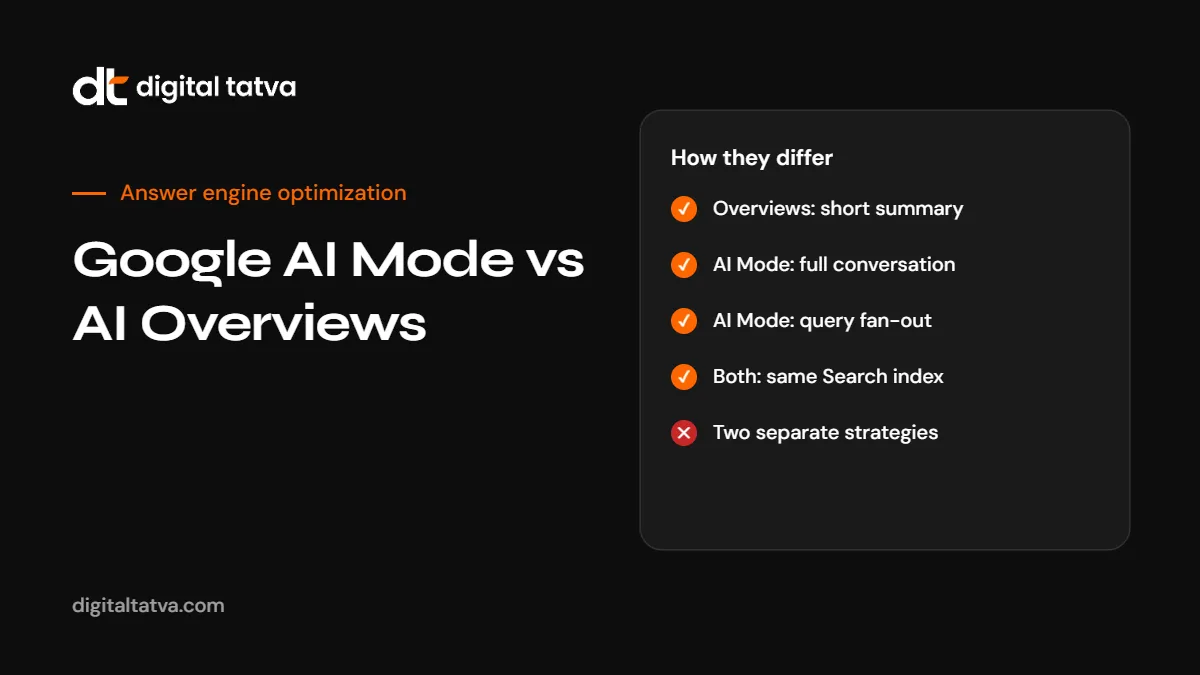
AI Overviews summarise on the normal results page. AI Mode is a full conversation with query fan-out. Here is how they differ, what stays the same for SEO and how to plan content for both.
On this page
- Key takeaways
- What AI Overviews are
- What AI Mode is
- AI Mode vs AI Overviews at a glance
- What stays the same for SEO
- What is different for SEO
- How to optimize for AI Overviews
- How to optimize for AI Mode
- Example: one question, two features
- Is your content ready for AI Mode? A quick audit
- Local and language considerations
- One content plan for both
- Measuring AI Overviews and AI Mode
- Which matters more for your business?
- Common mistakes
- What about Gemini and other AI assistants?
- How Digital Tatva can help
- Frequently asked questions
Last updated: 7 November 2026
Quick answer: Google AI Overviews are short AI-written summaries that appear at the top of a normal Google results page for some searches. Google AI Mode is a separate, conversational search experience where the whole answer is AI-generated, users can ask follow-up questions, and Google runs many related searches in the background before answering. For SEO, both draw on Google’s index and quality systems, so the foundations are the same. The differences are in the type of questions, the depth of answers, how many sources get cited and how traffic behaves. AI Overviews reward clear, direct answers to common questions. AI Mode rewards depth, specific facts and pages that cover a topic from several angles.
Key takeaways
- AI Overviews sit inside the normal results page. AI Mode replaces the results page with a conversation.
- AI Mode breaks a question into many sub-questions, so pages that answer specific sub-topics can be cited even if they do not rank for the main query.
- Google says both are included in the general performance report in Search Console, not as separate filters.
- You do not need two different strategies. You need strong SEO foundations plus content that answers both short and deep questions.
- No one can guarantee a citation in either. Measure with prompt tests and Search Console trends.
What AI Overviews are
AI Overviews appear above or among the regular results on a Google search page. When Google decides an AI summary would help, it writes a short answer and shows links to a few supporting pages. Users can expand the overview to see more, but the standard blue links remain on the page below it.
AI Overviews typically appear for informational questions, how-to queries, comparisons and explanations. They are less common on simple navigational searches, such as a brand name, or on many highly commercial queries where Google prefers to show shopping or local results.
What AI Mode is
AI Mode is a separate way to search. Users reach it through an AI Mode tab or button, and instead of a list of results they get a full AI-written answer, often with sections, bullet points, tables and links to sources. They can then ask follow-up questions in the same conversation, much like a chat assistant.
Google has described a technique it calls query fan-out: AI Mode breaks a question into related sub-questions, runs many searches at once, reads the results and combines them into one answer. A question such as “best running shoes for flat feet under a budget for a beginner training for a half marathon” might be split into searches about flat feet support, budget ranges, beginner cushioning and half marathon training.
AI Mode vs AI Overviews at a glance
| Aspect | AI Overviews | AI Mode |
|---|---|---|
| Where it appears | On the standard Google results page | A separate AI Mode experience |
| How it is triggered | Google decides per query | User chooses AI Mode |
| Answer length | Short summary, expandable | Longer, structured answer |
| Follow-up questions | No, a new search is needed | Yes, conversational |
| How sources are found | Results related to the query | Query fan-out across many related searches |
| Typical questions | Common informational queries | Complex, multi-part and comparison questions |
| Links shown | A few supporting links | Often more links spread through the answer |
| Blue links on the page | Yes, below the overview | Not as the main format |
| Search Console reporting | Included in the general performance report | Included in the general performance report |
What stays the same for SEO
Before looking at differences, it helps to be clear about what does not change. Google’s documentation on AI features says the same SEO best practices apply. Both AI Overviews and AI Mode draw on Google’s index, and pages need to be eligible to appear in Search to be used as sources. That means:
- Crawlable and indexable pages. Googlebot must reach your pages and they must be indexed. Google-Extended, the token that controls use of content for Gemini training and grounding, does not control AI Overviews or AI Mode.
- Helpful, people-first content. Google’s quality systems still decide which pages are trusted.
- Good page experience. Fast, mobile-friendly pages without intrusive interstitials.
- Structured data that matches visible content. It helps Google understand the page, though it is not a special ticket into AI features.
- Clear entity signals. Google needs to understand who you are and what you do.
If those foundations are weak, neither AI Overviews nor AI Mode will help you. Our technical AEO checklist covers them.
What is different for SEO
1. Query types
AI Overviews often answer common, well-defined questions: “what is”, “how to”, “why does”. AI Mode attracts longer, more specific and more conversational questions, often with personal context. Content that only answers the short version of a question may appear in AI Overviews but miss AI Mode’s deeper sub-questions.
2. Sub-topic coverage
Because of query fan-out, AI Mode can cite a page that answers one specific part of a complex question, even if that page does not rank highly for the full question. This rewards sites with depth: a well-organised set of pages covering a topic from several angles, each answering a specific sub-question clearly.
3. Depth of answer
AI Overviews favour short, direct statements that can be summarised in a sentence or two. AI Mode answers are longer and often include comparisons, pros and cons, steps and tables. Pages with specific facts, worked examples, comparison tables and clear criteria give AI Mode more to use.
4. Follow-up questions
In AI Mode, a user’s follow-up question is essentially a new query. That means one session can touch many related questions. Pages that anticipate natural follow-ups, such as cost after features, or setup after selection, are more likely to be cited across the conversation.
5. Traffic patterns
Both features answer questions on the results page, so some searches no longer need a click. Clicks from AI features tend to come from people who want detail, proof or a specific product. Expect fewer but often better-qualified visits, and measure leads, not just sessions. Our guide to zero-click search covers this shift.
How to optimize for AI Overviews
- Answer the question in the first lines. Under a heading that matches the query, give a clear one or two sentence answer before any background.
- Target common questions in your niche. Use Search Console queries, People Also Ask and customer questions to find them.
- Use simple formats. Short paragraphs, numbered steps for processes and bullet lists for options.
- Add definitions and key facts. AI Overviews often explain a term or state a number. Make yours easy to find.
- Keep facts current. Show a visible updated date on time-sensitive pages.
- Strengthen trust signals. Named authors, a clear about page and consistent brand details.
Our full guide to Google AI Overviews optimization goes step by step.
How to optimize for AI Mode
- Map the sub-questions. For each important topic, list the questions a buyer asks on the way to a decision: what it is, who it is for, how much it costs, how it compares, how to set it up, what can go wrong.
- Cover each sub-question clearly. Either in sections of one strong page or in a cluster of linked pages, each with a direct answer at the top.
- Add comparison tables. AI Mode frequently compares options. Fair, specific tables make your page useful.
- Include specific scenarios. “For a team of five”, “under a budget of…”, “for beginners”. These match the context people add in AI Mode.
- Link related pages. Internal links help Google understand your topic coverage. See internal linking for AEO.
- Publish original detail. Your own data, pricing explanations, case examples and expert views give AI Mode something it cannot find elsewhere. See original research for AEO.
Our Google AI Mode SEO guide covers more tactics.
Example: one question, two features
Take a buyer who wants accounting software. Here is how the same need can play out in each feature. This is an illustration of typical behaviour, not a recorded result.
In AI Overviews
The buyer searches “best accounting software for small business”. Google shows a short AI Overview naming a few well-known options with one-line reasons and three or four links, followed by the usual results. Pages that win here tend to have a clear list near the top with short, specific reasons for each option.
In AI Mode
The buyer opens AI Mode and asks: “I run a small trading business in Gujarat with GST filings and two staff. Which accounting software is easiest, and what will it cost?” AI Mode breaks this into searches about GST support, ease of use for small teams, pricing and local support. The answer covers several options with a comparison table and cost ranges, citing a wider range of pages. The buyer then asks, “Which one works best with my bank?”, and AI Mode runs new searches.
A software company that wants to appear in both needs a page with a clear summary for the short query, plus detailed pages on GST features, pricing by business size, bank integrations and setup. That combination of a direct answer and deep coverage is the core of optimizing for both.
Is your content ready for AI Mode? A quick audit
Pick one of your most important topics and check:
- Does a single page answer the core question directly in its first lines?
- Have you listed the five to ten sub-questions a buyer asks on this topic?
- Is each sub-question answered clearly somewhere on your site?
- Do those pages link to each other with descriptive anchor text?
- Is there at least one fair comparison table?
- Are costs, ranges or pricing factors explained?
- Do you cover common situations, such as size, budget, location or experience level?
- Are facts dated and current?
- Is the author or organisation clearly identified?
- Are there genuine mentions of your brand on other trusted sites?
Every “no” is a content task. Start with the topics closest to revenue.
Local and language considerations
Both features respond to location and language. A question asked in India may surface different sources from the same question asked in the US. If you serve specific cities or regions, make sure your local pages, Google Business Profile and directory listings are accurate and consistent. If your customers search in Hindi or other languages, consider whether key pages should exist in those languages too. Our guide to AEO for local business covers local signals in more detail.
One content plan for both
You do not need separate teams or separate pages for each feature. A single topic cluster can serve both:
| Page type | Serves AI Overviews by | Serves AI Mode by |
|---|---|---|
| Pillar guide | Direct definition and summary at the top | Covering the topic from several angles |
| How-to pages | Clear numbered steps | Covering setup sub-questions and edge cases |
| Comparison pages | Short “which is better for” answers | Detailed tables and scenario advice |
| Pricing pages | A clear cost range | What affects cost and examples by size |
| FAQ sections | Short answers to common questions | Answers to likely follow-up questions |
Write each page so its opening answers the short question and its body answers the deeper ones. That structure is described in our guide to answer-first content.
Measuring AI Overviews and AI Mode
Search Console
Google’s John Mueller has said that Search Console includes AI Overviews and AI Mode in the general performance report. There is no dedicated filter that separates queries from each feature, so look for patterns instead: rising impressions with falling click-through on informational queries can indicate AI Overviews, and long, conversational queries or short follow-up style queries can indicate AI Mode. Our guide to the Search Console AI performance report explains what the newer generative AI reports show and what they leave out.
Prompt testing
Search your priority queries in normal Google and in AI Mode, in a clean browser session, and record whether you are cited and who else is. Repeat monthly. Results vary by location and over time, so look at trends across many queries rather than single results. See AI share of voice.
Analytics
Traffic from AI Overviews and AI Mode usually arrives as Google organic traffic, so it is hard to separate in GA4. Watch conversions from organic search alongside Search Console trends.
Which matters more for your business?
| Business type | AI Overviews impact | AI Mode impact |
|---|---|---|
| Publishers and blogs | High: informational queries are heavily affected | Medium to high |
| B2B and SaaS | Medium: research queries | High: complex comparison and shortlist questions |
| Ecommerce | Medium: buying guides and product questions | High: detailed product comparisons |
| Local services | Lower: local packs still dominate | Medium: “best provider for my situation” questions |
| Healthcare, finance and legal | Medium, with high trust requirements | Medium to high for complex questions |
Common mistakes
- Treating AI features as a separate channel. They depend on the same index and quality systems as Search.
- Blocking Googlebot resources. Blocked CSS, JavaScript or images can stop Google understanding pages.
- Blocking Google-Extended expecting to leave AI Overviews. It controls Gemini training and grounding, not AI Overviews or AI Mode.
- Writing only short answers. Fine for AI Overviews, weak for AI Mode’s deeper questions.
- Writing only long essays. Without a direct answer at the top, AI Overviews have nothing quick to use.
- Chasing tricks. Hidden text and keyword stuffing break Google’s spam policies and hurt rankings.
More in AEO mistakes to avoid.
What about Gemini and other AI assistants?
Gemini is Google’s separate AI assistant app. It is related to Google’s AI search features but not the same product, and content use in Gemini is affected by the Google-Extended setting. For optimizing there, see our Gemini SEO guide. Outside Google, ChatGPT, Perplexity and Copilot each have their own crawlers and sources. See ChatGPT SEO and Perplexity SEO.
How Digital Tatva can help
Digital Tatva helps businesses appear in Google’s AI Overviews and AI Mode as part of our answer engine optimization service. We map the questions your buyers ask, test how Google’s AI features answer them today, fix technical and content gaps, build topic clusters that serve both short and deep questions, and measure the change every month. We do not promise placement, because no one controls Google’s AI answers. We do show you exactly what changes.
See where you stand in Google’s AI answers. Request an AI visibility audit covering AI Overviews, AI Mode, Gemini, ChatGPT, Perplexity and Copilot, or run our free AI visibility checker for a quick technical check.
Frequently asked questions
What is the difference between Google AI Mode and AI Overviews?
AI Overviews are short AI summaries on the normal results page. AI Mode is a separate conversational search experience with longer AI-written answers and follow-up questions.
Do AI Mode and AI Overviews use the same sources?
Both draw on Google’s search index. AI Mode runs many related searches through query fan-out, so it often draws on a wider range of pages for one answer.
Do I need different SEO for AI Mode and AI Overviews?
The foundations are the same. AI Overviews reward direct answers to common questions, while AI Mode rewards depth and coverage of sub-topics. One well-structured content plan can serve both.
Can I see AI Mode traffic in Search Console?
Google says AI Mode and AI Overviews data is included in the general performance report. There is no separate filter for each, so you need to infer from query patterns and trends.
Does blocking Google-Extended remove my site from AI Overviews?
No. Google-Extended controls use of content for Gemini models and grounding. AI Overviews and AI Mode are part of Google Search.
Which is more important for my business?
It depends on your category. Publishers feel AI Overviews strongly, while B2B, SaaS and ecommerce brands often see more impact from AI Mode’s detailed comparison questions.
Can anyone guarantee a citation in AI Overviews or AI Mode?
No. Google decides which sources to use, and results vary. Good SEO and content improve your chances, and measurement shows progress.
Does Digital Tatva optimize for AI Mode and AI Overviews?
Yes. Optimizing for Google’s AI features is part of our answer engine optimization service, starting with an AI visibility audit.
Product details, prices and features are checked at the time of writing and can change. Sources are linked in the text so you can check them yourself.
How does your brand appear in AI answers?
We test the questions your buyers ask across the major AI assistants and search engines, then show you what to fix first.
Get an AI Visibility Audit