How to Write Product Descriptions With AI That Sell and Get Cited
A practical workflow for writing product descriptions with ChatGPT, Claude or Gemini that convert shoppers and give AI shopping answers accurate facts to quote, with prompts, templates, bulk methods and quality checks.
On this page
- Key takeaways
- Why product descriptions matter more now
- What a great product description contains
- Step 1: Build a product fact sheet
- Step 2: Define your brand voice
- Step 3: Write the prompt
- Step 4: Review every description
- Bulk descriptions for large catalogues
- Making descriptions work for SEO and AI shopping answers
- Examples: before and after
- Choosing an AI tool
- Measuring results
- Descriptions for different product types
- Writing for marketplaces
- Multilingual descriptions
- Using customer reviews and questions as input
- Testing descriptions properly
- A quick quality checklist
- Building a description system for your team
- Keeping descriptions up to date
- Common mistakes
- Images and alt text
- In summary
- Frequently asked questions
- Sources
Last updated: 4 November 2026
Quick answer: To write good product descriptions with AI, start from a verified fact sheet for each product (materials, sizes, specifications, care, use cases and real customer questions), give the AI a clear template and your brand voice, and ask it to write only from those facts. A strong description opens with who the product is for and the main benefit, explains key features in plain language, puts specifications in a table, answers common questions and avoids claims you cannot prove. This structure converts shoppers and gives AI shopping assistants such as ChatGPT, Gemini and Google AI Mode accurate facts to quote. Always have a person check every description before it goes live.
Key takeaways
- AI writes good product copy only when you give it accurate product facts; without them it invents.
- A consistent template makes descriptions easier to scan, compare and cite.
- Specifications belong in HTML tables, not only in images or PDFs.
- Answering common buyer questions on the product page helps both conversion and AI shopping answers.
- Bulk generation works for large catalogues if you build in review steps and spot checks.
Why product descriptions matter more now
Product descriptions have always influenced conversion and search rankings. Two changes make them even more important today.
First, shoppers increasingly ask AI assistants for product recommendations: “best cotton bedsheets for hot weather under 2,000 rupees”, “waterproof hiking shoes with wide toe box”, “which mixer grinder is best for idli batter”. ChatGPT, Gemini, Perplexity, Copilot and Google AI Mode answer with a few products and reasons. They draw on product pages, marketplaces, reviews and comparison articles. A product page that clearly states who the product is for, what it is made of and how it performs is far more likely to be used than one with three lines of generic copy. Our guide to AEO for ecommerce covers this shift in depth.
Second, AI writing tools now make it possible to write or rewrite thousands of descriptions quickly. That is an opportunity, and a risk. Badly prompted AI produces generic, repetitive copy full of invented claims. Well-prompted AI, working from good data, produces clear, consistent descriptions at a scale small teams could never manage by hand.
What a great product description contains
Before using AI, decide what every description should include. Here is a structure that works for most products.
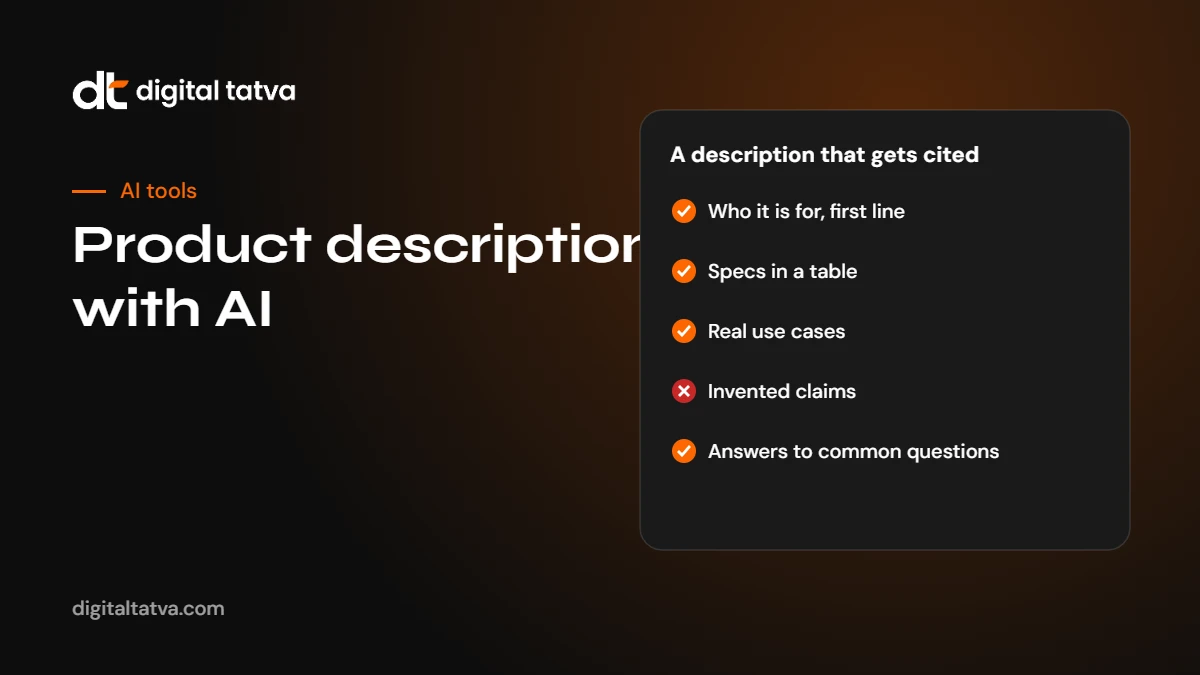
- Opening line: who the product is for and the main benefit, in one sentence.
- Short paragraph: what it is, what makes it different and the situations it suits.
- Key features: three to six bullet points, each with a feature and why it matters.
- Specifications table: dimensions, materials, weight, capacity, compatibility, certifications.
- Use and care: how to use it, care instructions, what is in the box.
- Who it is not for: an honest note where relevant, which reduces returns.
- FAQ: three to five questions shoppers actually ask.
This structure follows the same answer-first principles we recommend for all content: the most useful information comes first, and every section can stand on its own.
Step 1: Build a product fact sheet
The quality of AI-written descriptions depends almost entirely on the input. Before you write a single prompt, collect accurate facts for each product. A fact sheet can be a spreadsheet row or a short document.
| Field | Example |
|---|---|
| Product name | Example Cotton Percale Bedsheet Set, King |
| Category | Bedsheets |
| Target customer | Households in hot, humid climates who prefer crisp, breathable sheets |
| Materials | 100% cotton, 200 thread count percale weave |
| Dimensions | Flat sheet 274 x 274 cm; 2 pillow covers 46 x 69 cm |
| Colours | White, sky blue, sage |
| Care | Machine wash cold, tumble dry low, do not bleach |
| Certifications | Only those you can document |
| Differentiators | Pre-washed for softness; deep fitted corners up to 30 cm mattresses |
| Common questions | Does it shrink? Is it see-through? Will it fit a 10-inch mattress? |
| Not suitable for | People who prefer silky sateen feel |
Pull facts from your supplier specifications, quality team, packaging, customer service logs and reviews. If a fact is uncertain, leave it out rather than letting the AI guess.
Step 2: Define your brand voice
Give the AI a short voice guide so every description sounds like your brand. Include:
- Three adjectives that describe your tone, for example “warm, practical, confident”.
- Words to use and avoid. Many brands ban “elevate”, “unleash”, “game-changer” and similar clichés.
- Sentence length and reading level.
- Two or three of your best existing descriptions as examples.
- Formatting rules: units, capitalisation, how to write prices.
Our guide to training AI to write in your brand voice explains how to build and test a voice guide.
Step 3: Write the prompt
A good product description prompt has four parts: role and goal, the facts, the template and the rules. Here is a prompt you can adapt.
Prompt: “You write product descriptions for [brand], a [type of business] selling to [customers]. Write a description for the product below using only the facts provided. Do not add features, materials, certifications, results or claims that are not in the facts. If something important is missing, list it at the end under ‘Missing information’.
Structure: 1) One-sentence opening that states who it is for and the main benefit. 2) A 60 to 90 word paragraph. 3) Four to six feature bullets, each ‘Feature: why it matters’. 4) A specifications table. 5) Care instructions. 6) One sentence on who it is not ideal for, if relevant. 7) Three FAQs based on the common questions.
Voice: [voice guide]. Avoid these words: [list]. Use metric units.
Facts: [paste fact sheet]”
The instruction to use only the provided facts, and to list missing information instead of guessing, is the single most important line in the prompt.
Step 4: Review every description
Even with a strict prompt, AI can slip in small inaccuracies, exaggerations or repeated phrases. Review each description against the fact sheet.
- Facts: does every specification match the fact sheet exactly?
- Claims: are there any health, performance, environmental or comparative claims you cannot prove?
- Tone: does it sound like your brand?
- Repetition: are descriptions across a category too similar?
- Readability: is the opening clear and the paragraph short?
- Compliance: does it meet rules for your category, such as labelling requirements for cosmetics, food or electronics?
Watch out: Claims such as “eco-friendly”, “dermatologically tested”, “clinically proven” or “best in class” need evidence. Consumer protection rules in many countries, including India, treat misleading product claims seriously.
Bulk descriptions for large catalogues
For catalogues with hundreds or thousands of products, writing descriptions one by one is impractical. A bulk workflow combines a spreadsheet of facts, an AI tool and review steps.
- Clean your product data. One row per product, one column per fact. Fill gaps before generating.
- Write one prompt template with placeholders for each column.
- Test on 20 products across categories. Review carefully and refine the prompt.
- Generate in batches using a spreadsheet AI feature, an automation tool or an API. See automating tasks with Zapier and AI and batch APIs for cost-efficient processing.
- Run automated checks: word count, banned words, required sections present, units correct.
- Spot-check a sample of each batch manually, more for high-value products.
- Publish in stages and monitor conversion and returns.
For API costs, see how to estimate AI API costs and our LLM API pricing comparison. Most product description jobs can use smaller, cheaper models once the prompt is well tested. See the cheapest AI model for each task.
Making descriptions work for SEO and AI shopping answers
A description that converts shoppers usually also helps search engines and AI assistants, as long as the facts are readable.
- Use the words shoppers use. Include common search terms naturally: “king size bedsheet”, “percale cotton”, “fits deep mattresses”.
- Put specifications in HTML text and tables. AI assistants read text far more reliably than images.
- Add Product schema with name, description, brand, price, availability and reviews where genuine. See schema markup for AEO.
- Answer buyer questions on the page. FAQs capture exactly the questions shoppers ask AI.
- Be specific about who it suits. AI shopping answers often match products to needs: “for hot climates”, “for small kitchens”, “for beginners”.
- Keep marketplaces consistent. If you sell on Amazon, Flipkart or other marketplaces, use the same core facts there.
- Collect real reviews. AI answers often summarise review themes.
Check that AI crawlers can actually reach your product pages with our free AI visibility checker.
Examples: before and after
The products below are illustrations.
Mixer grinder
Before: “Experience the power of perfection with our premium mixer grinder. Elevate your cooking to the next level!”
After: “A 750-watt mixer grinder for Indian kitchens that grind idli and dosa batter, chutneys and dry masalas every week. It comes with three stainless steel jars (1.5 litre wet, 1 litre dry, 0.4 litre chutney) and a 2-year warranty on the motor. The motor has overload protection and three speed settings plus pulse. Best for families of three to five; very large households may prefer a wet grinder for batter.”
Running shoe
Before: “Unleash your inner athlete with revolutionary comfort technology.”
After: “A cushioned daily running shoe for road runners who want comfort over long, easy miles. It has a breathable mesh upper, a foam midsole with an 8 mm heel-to-toe drop and a rubber outsole with extra grip at the forefoot. The regular fit suits average-width feet; runners with wide feet should choose the wide version. Weight is about 260 grams for a UK size 8.”
The rewrites are specific, honest and useful, and every claim comes from the product facts.
Choosing an AI tool
| Option | Best for | Notes |
|---|---|---|
| ChatGPT, Claude or Gemini | Small catalogues, testing prompts | Use a project or custom instructions to store your voice guide |
| Spreadsheet AI (Sheets, Excel) | Hundreds of products | Generate a column of descriptions from fact columns |
| Ecommerce platform AI | Shopify, WooCommerce and others with built-in writers | Convenient, but check how much control you have over prompts |
| Automation tools and APIs | Thousands of products, regular updates | Most control and lowest unit cost; needs setup |
| Dedicated copywriting tools | Marketing teams wanting templates | See our best AI writing tools list |
WordPress and WooCommerce users can also look at our list of the best AI plugins for WordPress.
Measuring results
- Conversion rate on product pages before and after new descriptions.
- Return rate and reasons, which often fall when descriptions set clearer expectations.
- Search impressions and clicks for product pages in Search Console.
- AI referral traffic to product pages. See tracking AI traffic in GA4.
- AI shopping answers: test buyer questions in ChatGPT, Gemini and Google AI Mode and note whether your products are named.
Run changes on a subset first if you can, so you can compare against unchanged products.
Descriptions for different product types
The core structure works for most products, but the emphasis changes by category.
| Category | What to emphasise | Watch out for |
|---|---|---|
| Fashion and apparel | Fabric, fit, size guide, care, how it looks on different body types | Inaccurate colour descriptions; missing size charts |
| Electronics | Specifications, compatibility, warranty, what is in the box | Wrong technical figures; unverified performance claims |
| Beauty and personal care | Ingredients, skin or hair type, how to use, patch test advice | Medical or clinical claims without evidence |
| Food and grocery | Ingredients, allergens, nutrition, shelf life, origin | Allergen errors; health claims that breach rules |
| Home and furniture | Dimensions, materials, assembly, weight limits, care | Missing measurements that cause returns |
| Industrial and B2B | Grades, standards, tolerances, capacity, certifications | Trade names without standard terms. See AEO for manufacturers |
Writing for marketplaces
If you sell on Amazon, Flipkart, Meesho or other marketplaces, each platform has its own rules for titles, bullet points, descriptions and prohibited claims. Use AI to adapt your master description to each format, but keep the core facts identical everywhere. Inconsistent sizes, materials or specifications across your website and marketplaces confuse shoppers and AI assistants alike. Check each marketplace’s current style guide and character limits before generating in bulk.
Multilingual descriptions
For Indian and international audiences, descriptions in more than one language can widen your reach. Ask AI to translate the description naturally rather than word for word, keep product names and units consistent, and have a fluent person review your best sellers. See AI tools for Indian languages and the best AI translation tools.
Using customer reviews and questions as input
Your best source of description ideas is what customers already say. Reviews, return reasons, support tickets and pre-sale questions reveal what shoppers care about and what confuses them. Use AI to mine them.
Prompt: “Here are 150 reviews and 40 customer questions for this product. List the five benefits customers mention most, the three most common concerns or complaints, and the questions asked more than twice. Quote examples. Do not invent anything.”
- Benefits customers mention often make better opening lines than anything your team writes, because they use the shopper’s own words.
- Concerns and complaints show what to clarify. If several reviews say “smaller than expected”, add clear dimensions and a size comparison.
- Repeated questions belong in the product FAQ.
- Return reasons show where descriptions set the wrong expectations.
Never copy individual reviews into descriptions without permission, and never write fake reviews. Use themes, not invented testimonials.
Testing descriptions properly
If your platform supports it, run a simple test before rolling out new descriptions across the catalogue.
- Pick a category with steady traffic and sales.
- Rewrite half the products with the new approach and leave the other half unchanged.
- Run for four to six weeks, long enough to smooth out daily swings.
- Compare conversion rate, add-to-cart rate, return rate and customer questions between the two groups.
- Roll out the winning approach and refine the prompt based on what you learned.
Even without a formal test, compare a product’s performance for a month before and after the change, noting any promotions or seasonal effects that could explain differences.
A quick quality checklist
- Opening line says who it is for and the main benefit.
- Every fact matches the fact sheet.
- No unverified claims about health, performance, sustainability or superiority.
- Specifications in an HTML table with correct units.
- Care, use and what is in the box included.
- Honest note on who it is not ideal for, where relevant.
- Three to five FAQs from real questions.
- Brand voice consistent; banned words absent.
- Not near-identical to other products in the category.
- Product schema present and accurate.
- Marketplace listings updated with the same facts.
Print this list for whoever reviews AI drafts. A consistent review standard matters more than which AI tool you use.
Building a description system for your team
For teams that add new products every week, the goal is a repeatable system rather than one-off rewrites. Store the voice guide, banned words list and prompt template in one shared place. Make the product fact sheet a required step before any product goes live, owned by whoever knows the product best. Let a marketing person generate and edit the description, then have a second person check facts against the fact sheet. Track common errors the AI makes in your category and add instructions to the prompt to prevent them. After a few weeks, the system becomes fast and consistent, and new team members can follow it without long training.
Keeping descriptions up to date
Products change: new colours, updated specifications, new packaging or a price change. Outdated descriptions lead to returns, complaints and wrong AI answers. Set a simple process:
- Keep the fact sheet as the single source of truth; update it first when something changes.
- Regenerate or edit the description from the updated fact sheet.
- Update marketplaces on the same day.
- Review best sellers every quarter and the full catalogue at least once a year.
Our guide to refreshing content for AEO covers the same principles for other pages.
Common mistakes
- Letting AI write without a fact sheet.
- Publishing without review.
- Using the same opening line for every product.
- Stuffing keywords unnaturally.
- Putting key specifications only in images.
- Making claims you cannot prove.
- Forgetting to update descriptions when products change.
Images and alt text
Descriptions and images work together. Use AI to draft descriptive alt text for each product image from the fact sheet, for example “king size white percale bedsheet set on a wooden bed, with two pillow covers”. Good alt text helps accessibility, image search and AI systems that read pages. Keep image file names descriptive too, and never let AI-generated product images misrepresent the real item’s colour, size or finish.
In summary
AI can write excellent product descriptions at scale, but only when it works from accurate facts. Build a fact sheet for every product, define your brand voice, use a structured template and a strict prompt that forbids invented claims, then review every output against the facts. Put specifications in HTML tables, answer real buyer questions on the page, keep marketplaces consistent and update descriptions when products change. The result is copy that converts shoppers, reduces returns and gives AI shopping assistants reliable information to recommend your products.
Frequently asked questions
Can I use ChatGPT to write product descriptions?
Yes. ChatGPT, Claude and Gemini all write good product descriptions when you give them accurate product facts, a clear template and your brand voice, and when a person reviews the output.
Will AI-written product descriptions hurt SEO?
Not if they are accurate, useful and original to your products. Search engines focus on helpfulness, not on whether AI helped write the text. Generic, duplicated copy is the real risk.
How long should a product description be?
Long enough to answer the main buyer questions. For most products, an opening line, a short paragraph, feature bullets, a specifications table and a short FAQ work well.
How do I stop AI inventing product features?
Instruct it to use only the facts you provide and to list missing information instead of guessing, then check every description against the fact sheet.
Can AI write descriptions for thousands of products?
Yes, using spreadsheets, automation tools or APIs with a tested prompt template, automated checks and manual spot checks on each batch.
Do product descriptions affect AI shopping recommendations?
They help. AI assistants draw on product pages, marketplaces and reviews. Clear, specific, consistent product facts make it easier for them to match your products to shoppers’ needs.
Sources
- Product structured data, Google Search Central
- Google Search guidance on generative AI content, Google Search Central
Product details, prices and features are checked at the time of writing and can change. Sources are linked in the text so you can check them yourself.
How does your brand appear in AI answers?
We test the questions your buyers ask across the major AI assistants and search engines, then show you what to fix first.
Get an AI Visibility Audit