Brave Search Index and AI Answers: What Website Owners Should Know
Brave sells access to its 30 billion page search index to AI companies, and it is now facing lawsuits from major publishers. Here is how Brave's index works, why there is no simple opt-out, and what it means for your AI visibility.
On this page
- Key takeaways
- Why Brave’s index matters for AI answers
- How Brave builds its index
- The lawsuits
- Can you block Brave?
- Is being in Brave’s index good or bad for you?
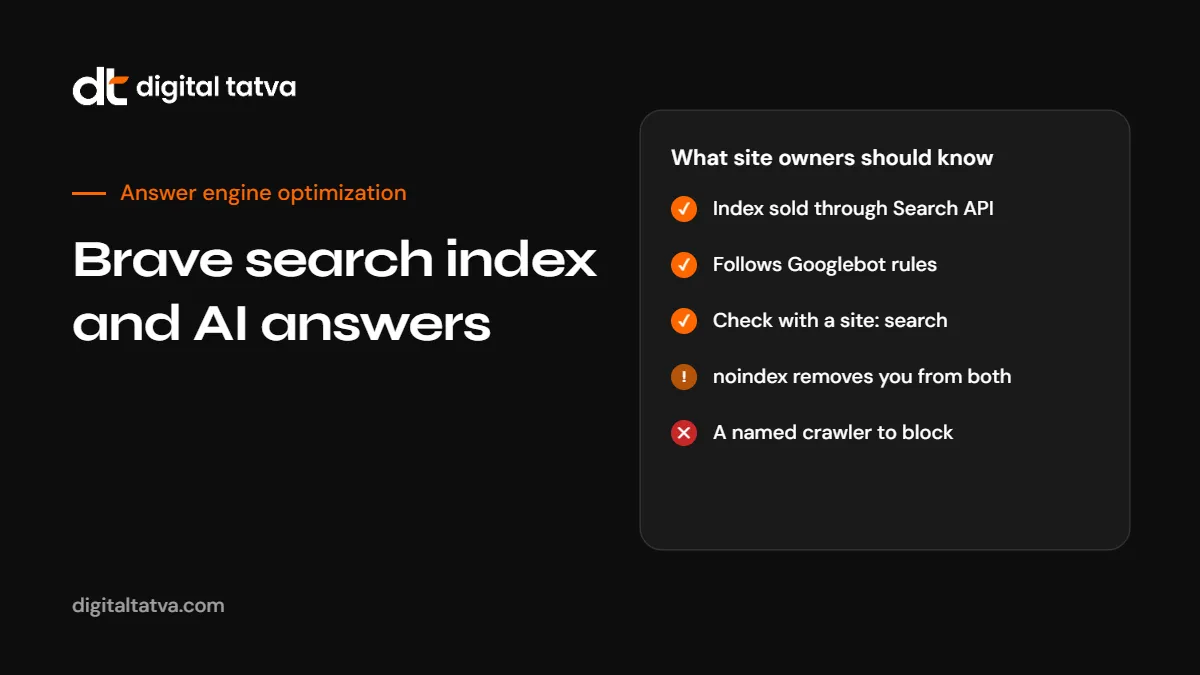
- How to check whether you are in Brave’s index
- What this means for your AI visibility strategy
- Freshness and stored copies
- What publishers can do
- Where AI answer engines get their web data
- A quick visibility audit across indexes
- What could change next
- How Digital Tatva can help
- Frequently asked questions
Last updated: 9 November 2026
Quick answer: Brave runs one of the few independent web search indexes, with more than 30 billion pages, and sells access to it through the Brave Search API. Brave says the API is used by AI companies including Cohere, Mistral, Perplexity and You.com, which means pages in Brave’s index can feed AI answers. Brave’s crawler does not use a distinct user agent and says it follows Googlebot’s robots.txt rules, so you cannot block Brave without also blocking Google. In November 2026 The New York Times and other publishers sued Brave over this. For most businesses that want AI visibility, being in Brave’s index is useful, not harmful. If you want to check, run a site:yourdomain.com search on search.brave.com.
Key takeaways
- Brave’s index is a data source for several AI answer engines through its paid Search API.
- Brave says it follows Googlebot’s crawl rules. Pages Googlebot cannot crawl, Brave also will not.
- There is no Brave-specific robots.txt rule, because the crawler does not identify itself by name.
- A noindex tag removes a page from Brave’s index, but also from Google.
- Publishers’ lawsuits filed on 2 November 2026 may change how Brave operates. Watch the outcome.
Why Brave’s index matters for AI answers
AI answer engines need a way to find current web pages. Some build their own indexes, some use Bing or Google-based sources, and some buy access to independent indexes. Brave is one of the few companies outside Google and Microsoft that maintains a large index of its own.
Brave sells access to that index through the Brave Search API, and its own materials say the API is used by AI companies including Cohere, Mistral, Perplexity and You.com. A lawsuit filed against Brave in November 2026 also names Anthropic, Perplexity, Mistral, xAI and Cohere as customers, though none of those companies is a defendant and not every relationship has been confirmed publicly. Anthropic listed Brave Search as a subprocessor in 2025.
The practical point: if your page is in Brave’s index, it may be among the candidates that some AI tools see when they answer a question. That makes Brave part of the AI visibility picture, alongside Google and Bing.
How Brave builds its index
| Aspect | What is known |
|---|---|
| Size | More than 30 billion pages, with millions added daily, according to reporting on Brave’s figures |
| Crawler identity | Brave’s crawler does not use a distinct, named user agent |
| Crawl rules | Brave says it follows the rules websites set for Googlebot |
| Stored content | Reporting found Brave’s results show stored copies of pages rather than live content |
| Products | Brave Search (consumer), Ask Brave (AI answers), Brave Search API and an LLM context product that supplies page extracts and source data to AI systems |
The lawsuits
Brave’s approach has drawn legal challenges from publishers:
- July 2026: News Corp sued Brave, alleging it hides its crawlers from publishers. Brave had earlier sued News Corp after a cease-and-desist, arguing it only indexes the web.
- 2 November 2026: The New York Times sued Brave, alleging copyright infringement and paywall circumvention, and saying Brave copied more than 30 billion pages without identifying its crawler or offering a way to block it. The Daily News, Chicago Tribune and Orlando Sentinel filed a separate case the same day.
As of early November 2026, Brave had not publicly responded to the latest suits. These cases are ongoing, and nothing has been decided. They may lead to changes such as a named crawler or an opt-out mechanism, but that is speculation until the courts or Brave act.
Can you block Brave?
| Method | Does it work for Brave? | Side effect |
|---|---|---|
| robots.txt rule for Brave | No named user agent to target | Not possible |
| Block Googlebot in robots.txt | Brave says it follows Googlebot’s rules | Removes you from Google Search. Almost never worth it. |
| noindex meta tag | Brave’s help says this removes the page from its index | Also removes the page from Google and other engines |
| Authentication or paywall | Protects content from crawlers generally | Content is no longer public |
For most businesses, blocking Brave is neither practical nor desirable. The trade-offs only make sense for publishers whose content itself is the product. If that is you, take legal advice and follow the outcome of the publisher cases.
Is being in Brave’s index good or bad for you?
For most businesses: good
If you want your brand cited in AI answers, being in an index that AI tools use is an advantage. It is one more route by which Perplexity, Mistral’s Le Chat or other tools may find your pages. Service businesses, software companies, ecommerce brands and local businesses generally benefit from being findable everywhere.
For publishers selling content: a real concern
Publishers whose revenue depends on subscriptions or licensing have reason to worry about their content being supplied to AI companies without a licence. That is exactly what the lawsuits are about.
How to check whether you are in Brave’s index
- Go to search.brave.com.
- Search
site:yourdomain.com. - Note how many pages appear and whether your important pages are there.
- Search for your brand name and your main service to see what Brave shows.
- Check whether the snippets are current. If Brave shows an old version, update the page and give it time.
What this means for your AI visibility strategy
The Brave story is a reminder that AI answers draw on more than Google. A complete AI visibility strategy considers several indexes and crawlers:
| Source | Feeds | How to stay visible |
|---|---|---|
| Google index | Google Search, AI Overviews, AI Mode, Gemini | Strong SEO. See Google’s AI optimization guide |
| Bing index | Bing, Copilot and reportedly ChatGPT search | Bing Webmaster Tools and IndexNow. See ChatGPT indexing |
| Brave index | Brave Search and AI companies using its API | Be crawlable by Googlebot rules, keep pages fresh |
| AI companies’ own crawlers | ChatGPT, Claude, Perplexity and others | Allow their search crawlers. See AI crawlers list |
Because Brave follows Googlebot’s rules, a site that is open to Googlebot is, in practice, open to Brave. Your main lever is quality: clear, current, useful pages that any index will want to keep and any AI tool will want to cite.
Freshness and stored copies
If Brave serves stored copies rather than live pages, an AI tool using Brave’s data may see an older version of your content. That makes freshness discipline more important:
- Update key pages when facts change, and show a visible updated date.
- Keep prices, features and policies consistent across your site and profiles.
- Avoid moving content to new URLs, which can leave old copies circulating.
- Redirect retired pages to their replacements.
What publishers can do
If your content is your product:
- Keep premium content behind authentication. robots.txt does not protect content.
- Review your AI crawler policy for the bots that do identify themselves. See AI crawler robots.txt and AI training opt-out.
- Monitor your server logs for unusual automated traffic.
- Follow the outcome of the publisher cases and take legal advice on licensing options.
Where AI answer engines get their web data
The Brave story highlights a question many businesses never ask: where does each AI tool actually find web pages? The picture is a mix of sources, and it changes over time.
| Approach | How it works | Examples |
|---|---|---|
| Own crawler and index | The AI company crawls and indexes pages itself | OpenAI’s OAI-SearchBot, PerplexityBot, Claude-SearchBot |
| Search engine index | Uses a major search engine’s results | Google’s AI features use Google’s index; Copilot uses Bing |
| Licensed independent index | Buys access to another company’s index through an API | Brave Search API customers |
| Live fetch | Opens a specific page when a user’s question needs it | ChatGPT-User, Claude-User, Perplexity-User |
Most AI tools combine several of these. That is why AI visibility work checks more than one index and more than one crawler.
A quick visibility audit across indexes
- Google: use Search Console’s page indexing report for key pages.
- Bing: use Bing Webmaster Tools URL inspection and submit a sitemap.
- Brave: run a site: search on search.brave.com.
- AI crawlers: check server logs for OAI-SearchBot, PerplexityBot, Claude-SearchBot and others.
- AI answers: ask ChatGPT, Perplexity, Gemini and Copilot your buyers’ questions and note which of your pages they cite.
Pages that are indexed everywhere but never cited usually have a content or reputation problem, not a crawling problem. See how to get cited by ChatGPT.
What could change next
The publisher cases against Brave may lead to outcomes such as licensing agreements, a named crawler that sites can block, or changes to how stored copies are used. Similar debates are running across the AI industry, including a pending EU court case on news content and chatbots. For businesses, the practical advice stays the same while the law develops: keep public pages accurate and useful, protect premium content with authentication, and review your crawler policy twice a year. See AI crawlers list.
How Digital Tatva can help
Digital Tatva maps where AI engines get their information and makes sure your site is visible, accurate and current across all of them. Our answer engine optimization service covers Google, Bing, independent indexes like Brave and the AI companies’ own crawlers, and tracks how AI answers describe you. We never promise AI placement.
See where AI engines find your brand. Request an AI visibility audit or run our free AI visibility checker.
Frequently asked questions
Does Brave sell its search index to AI companies?
Brave sells access to its index through the Brave Search API, which it says is used by AI companies including Cohere, Mistral, Perplexity and You.com.
Can I block Brave’s crawler in robots.txt?
Not specifically. Brave’s crawler does not use a named user agent and says it follows Googlebot’s rules, so blocking it would also block Google.
How do I remove my page from Brave?
Brave says a noindex tag removes a page from its index, but that also removes it from Google and other search engines.
Is my website in Brave’s index?
Search site:yourdomain.com on search.brave.com to check which of your pages appear.
Why is The New York Times suing Brave?
The Times alleges copyright infringement and paywall circumvention, saying Brave copied pages without identifying its crawler or offering a way to block it. The case is ongoing.
Should my business worry about Brave?
Most businesses benefit from being in indexes that AI tools use. Publishers whose content is the product have more reason for concern.
Does Brave’s index affect ChatGPT?
ChatGPT search uses OpenAI’s own crawler and third-party providers, with Bing widely reported among them. Brave’s known customers are other AI companies.
Can Digital Tatva check my visibility across AI sources?
Yes. Our AI visibility audit covers crawler access and visibility across Google, Bing, Brave and AI engines.
Product details, prices and features are checked at the time of writing and can change. Sources are linked in the text so you can check them yourself.
How does your brand appear in AI answers?
We test the questions your buyers ask across the major AI assistants and search engines, then show you what to fix first.
Get an AI Visibility Audit