Is SEO Dead in 2026? What Actually Changed (and What Didn’t)
AI Overviews, ChatGPT and zero-click searches have people asking if SEO is dead. It is not, but it has changed. Here is an honest look at what still works, what stopped working, and how to adapt your search strategy for 2026 and beyond.
On this page
- Key takeaways
- Why people are asking “is SEO dead?”
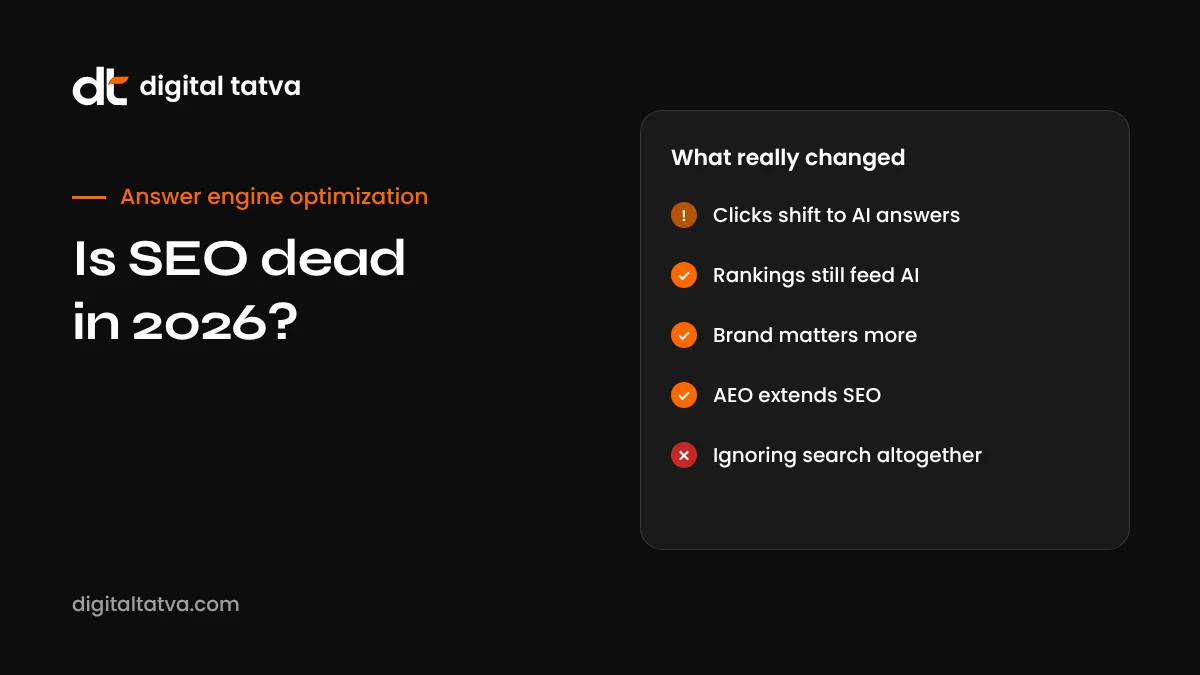
- What has actually changed
- What has not changed
- What is genuinely dying
- SEO vs AEO: evolution, not replacement
- Who is most affected, and who is not
- How to adapt your SEO strategy for 2026
- The traffic question: should you worry?
- A balanced view from the field
- Is SEO still worth investing in?
- A short history of “SEO is dead”
- What AI cannot easily replace
- SEO skills that matter more than ever
- How to explain this shift to your boss or clients
- A 90-day plan to future-proof your search visibility
- What the next few years probably look like
- How Digital Tatva can help
- SEO metrics that still matter, and new ones to add
- What small businesses should do differently
- Questions to ask any SEO provider in 2026
- The bottom line
- Frequently asked questions
Last updated: 13 November 2026
Quick answer: No, SEO is not dead in 2026, but the old version of it is fading. People still search billions of times a day, and AI tools like Google AI Overviews, AI Mode, ChatGPT search, Perplexity and Copilot build their answers from web content that search engines index and rank. What has changed is how people get answers: more questions are resolved without a click, AI names a few brands instead of listing ten links, and visibility now depends on being cited and recommended, not just ranked. SEO has expanded into answer engine optimization. Businesses that adapt keep growing; those chasing old tactics are seeing traffic fall.
Key takeaways
- “SEO is dead” has been claimed for over a decade. Each time, SEO changed rather than disappeared.
- AI search is built on search indexes and rankings, so the foundations of SEO still matter.
- Clicks from informational searches are under real pressure from AI answers.
- Brand visibility, mentions and trust now matter as much as rankings.
- The winning approach combines strong SEO with answer engine optimization (AEO).
Why people are asking “is SEO dead?”
The question is not silly. Several big shifts have happened at once:
- AI answers at the top of Google. AI Overviews now appear on a large share of searches, often answering the question before any link is visible.
- AI Mode and conversational search. Google’s AI Mode lets people have a full conversation with search, with fewer reasons to click out.
- ChatGPT, Gemini and Perplexity. Many people now ask AI assistants first, especially for research, comparisons and how-to questions.
- Falling clicks for some sites. Publishers and content-heavy sites have reported traffic drops, particularly on informational queries.
- AI-generated content floods. Easy content generation has made generic articles worth less than ever.
Put those together and it is understandable that business owners wonder whether investing in SEO still makes sense. Our post on zero-click search looks at the click problem in detail.
What has actually changed
| Area | Before | Now |
|---|---|---|
| Search results | Ten blue links plus some features | AI answer first, links below or alongside |
| What you compete for | Ranking positions | Being cited and recommended in AI answers, plus rankings |
| Unit of content | The page | The passage within the page |
| Traffic from informational queries | Large and reliable | Lower, as AI answers many simple questions directly |
| Role of brand | Helpful | Central, because AI recommends brands it trusts |
| Where people search | Mainly Google | Google, ChatGPT, Gemini, Perplexity, Copilot, YouTube, social platforms |
| Generic content | Could rank with enough links | Easily replaced by AI summaries |
What has not changed
Here is the part the “SEO is dead” headlines usually skip.
Search engines are still the backbone
Google AI Overviews and AI Mode are built on Google’s index and ranking systems. Copilot and Bing AI use Bing. ChatGPT search and Perplexity run their own retrieval over web content. Every one of them needs pages to be crawlable, indexable and relevant. If your site is technically broken or thin, you are not in the pool AI draws from. Our guide to how AI search engines work shows exactly where search fits.
Commercial and local searches still drive clicks
When someone wants to buy, book or visit, they still need to click. AI can shortlist options, but the purchase, enquiry or booking usually happens on a website or app. Local searches still lead people to Google Business Profiles, maps and websites.
Quality still wins
Useful, accurate, experience-based content has always been the long-term winner. AI systems are, if anything, stricter about this than classic search, because they only quote a few sources. See E-E-A-T for AI search.
Technical health still matters
Speed, crawlability, clean HTML, sensible site structure and schema still help. They now help in two places: classic rankings and AI retrieval. Our technical AEO checklist covers both.
What is genuinely dying
Some SEO tactics really are on their way out. If your strategy relies on these, it is time to change.
- Mass-producing generic informational articles just to capture traffic. AI answers these questions directly.
- Thin pages targeting minor keyword variations. AI understands meaning, not exact phrasing.
- Keyword stuffing and exact-match obsession. Modern systems reward natural, complete answers.
- Buying low-quality links at scale. Link spam is increasingly filtered and does little for AI visibility.
- Measuring success by rankings alone. A number-one ranking below an AI answer may bring far fewer clicks than it used to.
SEO vs AEO: evolution, not replacement
Answer engine optimization is the practice of making your brand easy for AI assistants to find, understand, trust and recommend. It builds directly on SEO.
| SEO focus | AEO adds |
|---|---|
| Rank pages for keywords | Get passages cited and brands mentioned in AI answers |
| Technical crawlability for Googlebot | Access for AI crawlers such as OAI-SearchBot and PerplexityBot |
| Keyword research | Prompt research: the full questions people ask AI |
| On-page optimisation | Answer-first, chunked content that is easy to quote |
| Link building | Mentions and reviews on sources AI trusts, with or without links |
| Rank tracking | Prompt tracking and AI share of voice |
Read our full comparison of AEO vs SEO and the related piece on GEO vs AEO.
Who is most affected, and who is not
| Type of business | Impact of AI search | What to do |
|---|---|---|
| Publishers relying on informational traffic | High, as AI answers simple questions | Original reporting, expertise, community and direct audience |
| Affiliate and comparison sites | High for thin sites, lower for genuinely tested reviews | First-hand testing, data and clear methodology |
| B2B and SaaS | Moderate, with big opportunity in AI recommendations | Comparison pages, case studies, third-party reviews |
| Ecommerce | Mixed: product research shifts to AI, buying still needs your store | Product data, reviews, AI shopping visibility |
| Local services | Lower, as people still need to call, book or visit | Business profiles, reviews, local pages |
How to adapt your SEO strategy for 2026
- Keep the foundations strong. Technical health, site structure, speed and indexing still come first.
- Open the doors to AI crawlers. Check robots.txt and firewall settings for AI bots. Our AI crawlers list explains which to allow.
- Shift from keywords to questions. Research the real questions buyers ask AI. See AEO prompt research.
- Write answer-first, quotable content. Clear headings, direct answers and tables. See content chunking for AI.
- Build topical depth. Own specific subjects through topic clusters. See topical authority in AI search.
- Invest in brand and mentions. Reviews, PR, partnerships and industry presence feed AI recommendations. See brand mentions for AEO.
- Focus content on what AI cannot easily replace. Original data, first-hand experience, tools, expert opinions and local knowledge.
- Measure what matters now. Track AI mentions and citations, AI referral traffic, branded search and conversions alongside rankings. See AEO KPIs.
The traffic question: should you worry?
Some businesses will see fewer clicks from informational searches. That is real. But two things soften the blow.
First, visitors who do arrive from AI answers often arrive better informed. They have already read a summary and chosen to learn more about you specifically. Many businesses report that AI-referred visitors convert well, although results vary by industry and are worth measuring for yourself.
Second, being named in an AI answer has value even without a click. It builds awareness and trust, and often leads to a later branded search or direct visit. That is why we recommend tracking branded search volume and direct traffic alongside AI referrals. Our guide to tracking AI traffic in GA4 shows the setup, and recovering from AI Overviews traffic drops covers what to do if you have already lost clicks.
A balanced view from the field
In our client work across ecommerce, SaaS and services, the pattern is consistent. Sites that relied on broad informational content have felt the most pressure. Sites with strong commercial pages, clear expertise, good reviews and a recognisable brand have held up much better, and many are now picking up mentions in AI answers that bring in high-intent visitors.
The businesses that struggle most are those that keep doing 2019-style SEO and measure it with 2019-style metrics. The ones that do well treat search as a broader visibility discipline: be findable, be quotable, be trusted.
Is SEO still worth investing in?
For most businesses, yes, provided the investment goes into the right work. A sensible split for 2026:
- Technical foundations and AI crawler access.
- Commercial and comparison pages that support buying decisions.
- Expert, experience-led content that AI cannot easily replicate.
- Brand building through reviews, PR and industry presence.
- Measurement across both search and AI answers.
If you are deciding whether to invest specifically in AEO, our guide on whether AEO is worth it helps you weigh it up.
A short history of “SEO is dead”
If the headline feels familiar, that is because it has been written many times before. Each time, SEO changed shape rather than disappearing.
| Period | What triggered the claim | What actually happened |
|---|---|---|
| Early 2010s | Google’s Panda and Penguin updates hit content farms and link schemes | Quality content and genuine links became the core of SEO |
| Mid 2010s | Social media seemed to replace search for discovery | Search kept growing alongside social |
| Late 2010s | Featured snippets and zero-click results | SEO adapted to answer formats and structured data |
| Around 2020 | Voice assistants were expected to replace typed search | Voice became a niche channel; typed search stayed dominant |
| 2023 to now | Generative AI answers in Google and chat assistants | SEO is expanding into AEO and GEO |
The pattern is consistent. The tactics that relied on gaming the system died. The underlying goal, being the best answer for the people you want to reach, did not.
What AI cannot easily replace
If AI can summarise generic information instantly, the content worth creating is the content AI cannot produce on its own. That is where SEO investment now pays off best:
- First-hand experience. Real tests, real projects, real photos and real lessons. See E-E-A-T for AI search.
- Original data. Surveys, benchmarks and analysis that create new facts. See original research for AEO.
- Tools and calculators. Interactive resources people use repeatedly.
- Local knowledge. Detailed, current information about specific places and communities.
- Strong opinions from credible people. Expert takes that go beyond summarising what everyone else says.
- Products, services and transactions. AI can recommend, but buying still happens with you.
SEO skills that matter more than ever
For marketers and SEO professionals, the job is not disappearing, but the skill mix is changing.
| Skill | Why it matters more now |
|---|---|
| Technical SEO | AI crawlers add new access and rendering challenges |
| Entity and schema work | AI systems reason in entities and facts |
| Content strategy | Topic coverage and answer-first structure decide citations |
| Digital PR | Third-party mentions shape AI recommendations |
| Analytics | Measuring AI visibility and AI referral traffic needs new methods |
| Prompt research | Understanding how people ask AI, not just what they type into Google |
If you are building a career in this area, our guide on how to become an AEO specialist lays out a learning path.
How to explain this shift to your boss or clients
Many marketers are being asked a blunt question by leadership: “Should we still pay for SEO?” Here is a simple way to frame the answer.
- Show where buyers now ask questions. Run a handful of real buyer questions in Google, ChatGPT and Gemini during the meeting. Show who appears.
- Separate the traffic types. Explain that informational traffic may fall while commercial and branded traffic matters more.
- Introduce new metrics. Add AI mentions, AI citations, AI referral visits and branded search to the usual reports. See our AEO reporting template.
- Reframe the budget. Less spend on generic blog volume, more on technical access, expert content, reviews and PR.
- Set realistic expectations. No one can guarantee AI placement. Progress is measured over months, not days.
A 90-day plan to future-proof your search visibility
| Timeframe | Focus | Outputs |
|---|---|---|
| Days 1 to 15 | Baseline | Prompt tracking across AI engines, Search Console review, AI crawler check |
| Days 16 to 30 | Technical fixes | AI crawler access, rendering, speed, schema |
| Days 31 to 60 | Content | Rewrite top commercial pages answer-first; refresh outdated guides; add FAQs |
| Days 61 to 90 | Authority | Review campaign, PR pitches, listings on sources AI cites |
| Day 90 | Measure | Re-run prompts, compare AI mentions, citations and traffic |
This plan protects what still works in classic SEO while building visibility in AI answers. For a full version, see our AEO strategy guide and AEO quick wins.
What the next few years probably look like
Nobody can predict search perfectly, but some directions look clear. AI answers will keep growing inside search engines and assistants. Agents will increasingly compare options and complete tasks for users, which raises the value of clear, structured, machine-readable information. Brand trust will matter more, because AI recommends brands it can verify. And the open web will remain the raw material for all of it.
For businesses, that means search does not die. It becomes the work of being findable, understandable and trustworthy wherever people ask questions. That is a broader job than SEO used to be, and a more interesting one. Our guides to agentic search and AEO trends in 2026 look further ahead.
How Digital Tatva can help
We help businesses make the move from classic SEO to a combined SEO and AEO approach. That starts with a measured baseline of how you appear in Google and in AI assistants, then a plan that protects what still works and builds visibility where buyers now ask questions. We will never promise rankings or AI placement, because nobody controls those systems, but we will give you an honest picture and a practical plan.
Not sure how AI search is affecting you? Request an AEO audit for a clear view of your search and AI visibility, or run our free AI visibility checker.
SEO metrics that still matter, and new ones to add
| Metric | Still useful? | How to read it now |
|---|---|---|
| Organic clicks | Yes | Segment by query type; expect informational clicks to fall |
| Impressions | Yes | Stable impressions with falling clicks often means AI answers are absorbing clicks |
| Average position | Partly | Less meaningful when AI answers sit above results |
| Conversions from organic | Very | The best measure of whether SEO is paying off |
| Branded search volume | Increasingly | Shows whether AI mentions are building awareness |
| AI mentions and citations | New | Track a fixed prompt set monthly across assistants |
| AI referral traffic | New | Visits from ChatGPT, Perplexity, Gemini, Copilot and Claude |
| AI share of voice | New | Your mentions compared with competitors |
If your reports only show rankings and sessions, you are missing half the picture. See AI share of voice and the Search Console AI performance report.
What small businesses should do differently
Small businesses often have limited budgets and cannot do everything. The good news is that the highest-impact work is not expensive:
- Make sure your website is crawlable by search engines and AI crawlers.
- Keep your Google Business Profile complete and active.
- Collect detailed reviews from real customers.
- Write clear service pages that answer the questions customers ask before buying.
- Keep your business details identical everywhere online.
These steps help in classic search and AI search at the same time. Our guide to AEO for local businesses gives a fuller checklist.
Questions to ask any SEO provider in 2026
If you work with an agency or consultant, these questions help you judge whether their approach fits the new reality:
- How do you measure visibility in AI answers, not just rankings?
- Which AI crawlers do you check access for, and how?
- How do you decide which content to create when AI answers simple questions directly?
- What is your approach to earning mentions on third-party sources?
- How do you report on AI referral traffic and conversions?
- Do you promise rankings or AI placement? (The honest answer is no.)
A provider who answers these clearly is likely to be adapting well. See how to choose an AEO agency and AEO consultant vs agency for more guidance.
The bottom line
SEO is not dead. Lazy SEO is. Search has become a broader discipline that covers classic rankings, AI answers, brand reputation and the evidence trail across the web. Businesses that keep their foundations strong, publish genuinely useful expertise and earn trust from independent sources are well placed for whatever search becomes next.
Frequently asked questions
Is SEO dead because of AI?
No. AI search tools are built on web content and search indexes, so SEO foundations still matter. What has changed is that visibility now also depends on being cited and recommended in AI answers.
Will ChatGPT replace Google?
Not entirely. Many people use both. Google itself now includes AI answers, and ChatGPT search relies on web content. Read our comparison of ChatGPT vs Google search.
Is SEO still worth it in 2026?
Yes for most businesses, especially for commercial, local and expertise-driven content. The tactics and metrics need to change, but the value of being found has not.
What is replacing traditional SEO?
Traditional SEO is expanding into answer engine optimization (AEO) and generative engine optimization (GEO), which focus on being cited and recommended by AI systems.
Why is my organic traffic falling?
Common reasons include AI Overviews answering questions directly, algorithm updates and competition. Check which queries lost clicks in Search Console and whether impressions stayed stable.
Does SEO help with ChatGPT visibility?
Yes, indirectly. Strong, crawlable, well-ranked content is more likely to be found and used by ChatGPT search, and brand authority built through SEO feeds AI recommendations.
Should I stop writing blog posts?
No, but write fewer generic posts and more content based on real experience, data and expertise, structured so AI can quote it.
Can Digital Tatva help us adapt to AI search?
Yes. We combine SEO and AEO into one plan, starting with an audit of how you appear in search and AI assistants today.
Should I stop investing in SEO?
No. SEO foundations power visibility in both traditional search and AI answers. Adjust priorities and measurement rather than abandoning SEO.
What skills should SEOs learn now?
Entity optimisation, AI visibility tracking, content structured for AI retrieval, digital PR and analytics that measure assisted conversions.
Product details, prices and features are checked at the time of writing and can change. Sources are linked in the text so you can check them yourself.
How does your brand appear in AI answers?
We test the questions your buyers ask across the major AI assistants and search engines, then show you what to fix first.
Get an AI Visibility Audit