Claude SEO: How to Get Your Brand Recommended by Claude
Claude by Anthropic is now a popular assistant for research and business decisions. Here is how Claude finds information, which crawlers to allow, and the practical steps that help your brand get mentioned and cited in Claude's answers.
On this page
- Key takeaways
- Why Claude matters for your brand
- How Claude finds information
- Anthropic’s crawlers and what to allow
- What Claude looks for in a source
- Step-by-step: Claude SEO for your business
- Claude vs other AI assistants: what is different?
- Common Claude SEO mistakes
- What if Claude says something wrong about you?
- A quick Claude SEO checklist
- Who uses Claude, and what they ask
- How Claude handles links users paste
- Claude in other products
- Claude and long-form research
- How Claude visibility relates to ChatGPT and Gemini
- Claude SEO for agencies and consultants
- How Digital Tatva can help
- A sample robots.txt for Claude visibility
- Measuring Claude referrals
- Claude visibility for ecommerce
- Claude SEO in five minutes a week
- Why Claude may describe you differently from ChatGPT
- Frequently asked questions
Last updated: 13 November 2026
Quick answer: Claude SEO is the work of making your brand easier for Anthropic’s Claude to find, understand and recommend. Claude answers from two places: what its models learned during training, and live web search when that feature is used. To improve your chances, allow Anthropic’s search and user-fetch crawlers in robots.txt, make sure your pages load fast and show their text without JavaScript, write clear answer-first content, keep your brand facts consistent across the web, and earn mentions on trusted third-party sources. As with any AI assistant, nobody can guarantee a recommendation, but these steps make your brand much easier to include.
Key takeaways
- Claude is widely used for research, writing, coding and business work, which makes it a valuable place to be mentioned.
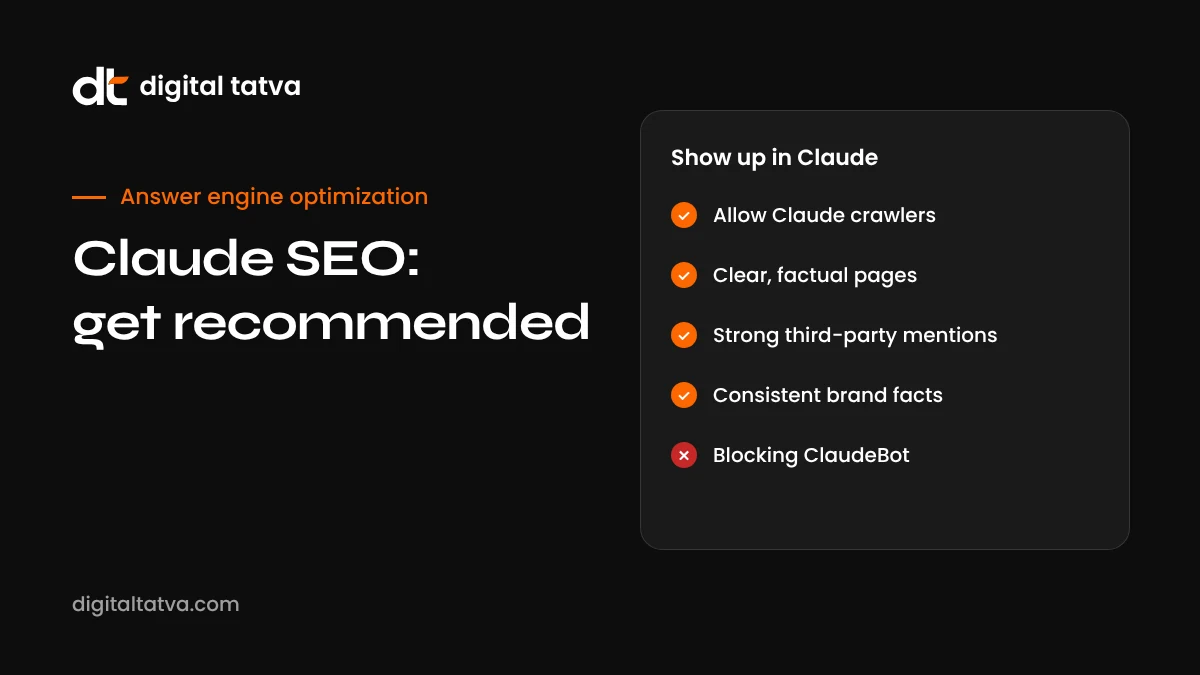
- Anthropic runs separate crawlers for training, search indexing and fetching pages a user asks about. Each can be controlled in robots.txt.
- Blocking all Anthropic bots also blocks your chances in Claude’s live web answers.
- Claude favours clear, well-structured, factual pages it can read quickly.
- Third-party mentions and consistent entity facts shape how Claude describes and recommends brands.
Why Claude matters for your brand
Claude, built by Anthropic, has grown into one of the most used AI assistants, especially among professionals, developers and businesses. People use it to research vendors, compare tools, draft proposals and make decisions. Claude is also available inside other products through the Claude API, Amazon Bedrock, Google Cloud and Microsoft’s platforms, so its answers can show up in more places than the Claude app itself.
That makes Claude a meaningful part of the AI visibility picture alongside ChatGPT, Gemini, Perplexity and Copilot. If a procurement manager asks Claude for “the best HR software for a 200-person company in India”, you want your brand to be part of the answer. Our guide to how to use Claude gives background on the product itself.
How Claude finds information
Claude can answer a question in two main ways.
| Source | How it works | Can you influence it quickly? |
|---|---|---|
| Training knowledge | What the model learned from data collected before its training cutoff | No; it reflects your long-term presence on the web |
| Web search | Claude searches the web, reads pages and cites sources in its answer | Yes; changes to your site and mentions can show up within weeks |
| User-provided links | A user pastes a URL and asks Claude to read it | Yes; your page must be fetchable and clear |
When web search is on and the question needs current information, Claude searches, reads several pages, and writes an answer with citations. Reports have indicated that Claude’s web search draws on Brave Search’s index, among other sources, which is one reason we recommend checking your visibility there too. Our post on the Brave Search index and AI explains why that matters.
Anthropic’s crawlers and what to allow
Anthropic documents several user agents. The names may change over time, so check Anthropic’s current documentation, but the roles are typically:
| Crawler | Purpose | Recommendation for most businesses |
|---|---|---|
| ClaudeBot | Collects public web content that may be used for model training | Your choice; blocking it affects training only |
| Claude-SearchBot | Indexes content to improve search results in Claude | Allow, if you want to appear in Claude’s search answers |
| Claude-User | Fetches a page when a Claude user asks about it | Allow, so users can read and cite your pages |
A common mistake is a robots.txt rule that blocks everything from Anthropic because someone wanted to opt out of training. That can also remove you from live answers. You can opt out of training while staying visible in search by allowing the search and user crawlers and disallowing only the training crawler.
Also check your firewall, CDN and security plugins. Some block unfamiliar bots by default, regardless of robots.txt. Our guides to AI crawlers, robots.txt for AI crawlers and opting out of AI training walk through the settings.
What Claude looks for in a source
Anthropic does not publish a ranking formula. From repeated prompt testing and how Claude cites pages, these qualities help:
- Clarity. Pages that state facts plainly and answer questions directly are easier to use.
- Structure. Descriptive headings, lists, tables and short paragraphs make it easier to find the right passage.
- Accessibility. Content that loads quickly and appears in the HTML without needing JavaScript.
- Specificity. Concrete numbers, dates, names and conditions rather than vague claims.
- Credibility. Named authors, transparent company details and citations of sources.
- Agreement. Facts that match what other reputable sources say.
These line up closely with the general AI search ranking factors that apply across assistants.
Step-by-step: Claude SEO for your business
Step 1: Test how Claude sees you now
Open Claude with web search on and ask questions your buyers would ask. Include category questions (“best X for Y”), comparison questions (“X vs Y”), and brand questions (“what is [your brand]”). Repeat each a few times in fresh chats and record who is mentioned and which sources are cited. Our guide to checking if AI recommends your brand has a template you can reuse.
Step 2: Fix crawler access
Update robots.txt to allow Claude’s search and user-fetch crawlers. Check firewall logs to confirm they are not being blocked.
Step 3: Make key pages easy to read
Your homepage, service or product pages, pricing page, about page and top guides should load quickly, render their main text without JavaScript, and answer questions directly. See JavaScript rendering for AI crawlers.
Step 4: Write answer-first content
Start pages and sections with the direct answer. Add comparison tables and FAQs. See answer-first content and content chunking for AI.
Step 5: Clarify your entity
Keep your company name, description, location, founding date, products and leadership consistent everywhere. Add Organization schema with sameAs links to your official profiles. See entity SEO for AEO.
Step 6: Earn third-party mentions
Claude, like other assistants, leans on independent sources when it recommends brands. Reviews, industry lists, comparison articles, media coverage and community discussions all help. See brand mentions for AEO and review sites for AEO.
Step 7: Publish genuinely useful expertise
Claude is popular with professionals who ask detailed questions. Deep, expert content with original data and real experience is especially valuable. See original research for AEO.
Step 8: Measure monthly
Re-run your prompt set each month and track mentions, citations and how you are described. Compare with ChatGPT, Gemini and Perplexity to see where you are strongest. See AI share of voice.
Claude vs other AI assistants: what is different?
| Assistant | Main web source | Key crawler | Our guide |
|---|---|---|---|
| Claude | Web search when enabled, with live fetches | Claude-SearchBot and Claude-User | This guide |
| ChatGPT | OpenAI search and partners | OAI-SearchBot | ChatGPT SEO |
| Gemini | Google Search | Googlebot | Gemini SEO |
| Perplexity | Own index and live search | PerplexityBot | Perplexity SEO |
| Copilot | Bing index | Bingbot | Copilot SEO |
The core work is the same across all of them. The differences are mainly which crawlers to allow and which indexes to watch.
Common Claude SEO mistakes
- Blocking all Anthropic bots to opt out of training, and accidentally blocking search too.
- Relying on JavaScript to show content, so fetchers see an empty page.
- Vague marketing copy that never states what you do, who for, where and at what price.
- Inconsistent facts across your site and profiles, leading to wrong or cautious descriptions.
- Ignoring third-party sources, so Claude has little independent evidence to recommend you.
- Testing once and concluding. Answers vary; test repeatedly and track over time.
What if Claude says something wrong about you?
If Claude’s answers include outdated or incorrect information, trace where it might come from. With web search on, check the cited pages. Fix your own pages first, then contact third-party sites with incorrect details. If the error appears without web search, it likely comes from training data and will only change as newer models are trained on corrected information. In the meantime, make sure the correct facts are clear and widely available. Our guide to fixing wrong AI answers about your brand has a step-by-step process.
A quick Claude SEO checklist
- Run 20 to 50 buyer prompts in Claude with web search on and record results.
- Allow Claude-SearchBot and Claude-User in robots.txt; decide separately on ClaudeBot.
- Confirm your firewall and CDN are not blocking Anthropic’s bots.
- Make sure key pages render without JavaScript and load quickly.
- Add answer-first summaries, tables and FAQs to important pages.
- Align brand facts across your site and profiles; add Organization schema.
- Build a plan for reviews and third-party mentions.
- Re-test monthly and compare with other assistants.
Who uses Claude, and what they ask
Understanding Claude’s audience helps you decide how much to prioritise it. Claude has a strong following among people who use AI for serious work: developers, analysts, writers, consultants, researchers and business teams. Many companies roll it out to staff through team and enterprise plans, and it is built into many other tools through the API.
That shapes the kinds of questions Claude gets:
- “Compare the top three payroll platforms for an Indian company with 150 employees.”
- “Which CRM integrates best with HubSpot and WhatsApp for a B2B team?”
- “Summarise the pros and cons of these two analytics vendors.”
- “What are the best agencies for answer engine optimization in India?”
- “Draft a shortlist of cybersecurity consultants for a fintech startup.”
These are high-value, often B2B questions. If your business sells to professionals, Claude visibility deserves serious attention. See AEO for B2B for related tactics.
How Claude handles links users paste
A lot of Claude usage involves users sharing links: “Read this page and tell me if this vendor is a good fit”, or “Compare these two pricing pages”. When that happens, Claude fetches the page and works from its content. This is a direct, high-intent moment, and many sites fail it without knowing.
Common reasons Claude cannot read a page well:
| Problem | What Claude sees | Fix |
|---|---|---|
| Bot protection blocks the fetcher | An error or a challenge page | Allow Claude-User in your firewall and CDN |
| Content loads only with JavaScript | An empty or partial page | Server-render key content |
| Pricing hidden behind a form or pop-up | No prices to compare | Show price ranges in plain text |
| Key details in images or PDFs only | Little usable text | Put important facts in HTML text |
| Cookie walls covering content | Consent text instead of content | Make sure content is in the HTML behind the banner |
Test this yourself: paste your main product, pricing and about pages into Claude and ask it to summarise what you offer and what it costs. If the answer is wrong or vague, a buyer doing the same thing gets the same poor impression.
Claude in other products
Claude models power features inside many other tools through Anthropic’s API and cloud platforms. Some of these features search the web, browse pages or read documents. That means the same accessibility and clarity work helps in places you may never see directly: research assistants, browser extensions, customer support tools and internal company assistants.
You cannot track all of these individually, but the principle is simple. If your pages are open to legitimate AI fetchers, fast, clear and factually consistent, they work well in any tool that reads them.
Claude and long-form research
Claude is often used for long, careful research: reading many sources and producing a structured comparison or report. In those tasks, depth and consistency matter a great deal. Pages that explain pricing models, limitations, ideal customers and alternatives in a clear way are more useful than pages full of slogans.
Practical content ideas that suit Claude-style research:
- Detailed comparison pages that treat competitors fairly. See comparison pages for AEO.
- Transparent pricing pages, including what is not included.
- Clear “who this is for and who it is not for” sections.
- Case studies with measured results and methods.
- Security, compliance and data handling pages for B2B buyers.
- Public documentation that explains how the product actually works.
How Claude visibility relates to ChatGPT and Gemini
In our prompt tracking, brands that do well in one assistant usually do reasonably well in others, but the details differ. A brand might be recommended consistently in Google AI Overviews and ChatGPT yet rarely appear in Claude, often because its pages are blocked from Anthropic’s crawlers or because Claude’s search draws on a slightly different set of sources.
That is why we recommend testing every major assistant rather than assuming one represents them all. A simple comparison table each month shows where you are strong and where you are missing:
| Prompt | ChatGPT | Gemini | Claude | Perplexity | Copilot |
|---|---|---|---|---|---|
| Best [category] for [use case] | Mentioned | Mentioned | Not mentioned | Cited | Mentioned |
| [Brand] vs [competitor] | Accurate | Accurate | Outdated pricing | Accurate | Not mentioned |
| Is [brand] reputable? | Positive | Positive | Cautious | Positive | Positive |
Gaps like the Claude column above usually point to a fixable access or source problem. See AI share of voice for how to turn this into a regular report.
Claude SEO for agencies and consultants
Professional services firms are often recommended, or overlooked, in Claude answers to questions like “best marketing agency for SaaS in Bengaluru”. A few specific tips:
- Publish detailed service pages with clear scope, process, timelines and price ranges.
- Show named team members with credentials and link them to LinkedIn.
- Publish case studies with permission and real numbers.
- Get listed in credible agency directories and review platforms for your niche.
- Write genuinely expert content in your specialism, not generic marketing articles.
Our guides to AEO for professional services and white label AEO for agencies go further.
How Digital Tatva can help
We test how Claude and the other major AI assistants describe your brand, fix crawler and rendering issues, restructure your key pages for AI retrieval, align your entity facts and build a plan for third-party authority. We then track your visibility across assistants every month. We cannot guarantee that Claude or any AI will recommend you, but we can remove the barriers and build the evidence that makes recommendation more likely.
Want to know what Claude says about your brand? Request an AEO audit covering Claude, ChatGPT, Gemini, Perplexity and Copilot, or run our free AI visibility checker to check crawler access.
A sample robots.txt for Claude visibility
Here is an example of rules a business might use to stay visible in Claude’s search answers while opting out of training. Always confirm the current user agent names in Anthropic’s documentation before using them, and test changes carefully.
| Rule | Effect |
|---|---|
| User-agent: Claude-SearchBot Allow: / |
Lets Claude index your pages for search answers |
| User-agent: Claude-User Allow: / |
Lets Claude read pages that users ask about |
| User-agent: ClaudeBot Disallow: / |
Opts out of crawling for training (optional) |
Keep private areas such as account pages, carts and admin paths disallowed for all bots, as you would normally. Our robots.txt guide for AI crawlers includes complete examples for every major AI company.
Measuring Claude referrals
Visits from Claude can appear in analytics as referrals from claude.ai. Set up an AI traffic channel in GA4 that includes Claude alongside ChatGPT, Perplexity, Gemini and Copilot, so you can see how many visitors arrive from each assistant and whether they convert. Some visits will not carry a referrer, for example when users copy a link, so treat the numbers as a minimum. Our guide to tracking AI traffic in GA4 has step-by-step setup instructions.
Claude visibility for ecommerce
Claude is used less for casual shopping than some other assistants, but it is often used for considered purchases and research: comparing laptops, cameras, software, appliances or B2B supplies. Product pages that explain specifications, use cases, trade-offs and compatibility in clear text perform well in that kind of research. Make sure prices and stock information are accurate, and avoid putting key details only in images. See AEO for ecommerce.
Claude SEO in five minutes a week
If you are short on time, a small weekly routine keeps you on track:
- Monday: ask Claude two of your most important buyer questions with web search on, and note who is mentioned.
- Tuesday: check whether any page Claude cited for your category is one you could appear on, such as a list, review site or directory.
- Wednesday: improve one section of a key page with a clearer, answer-first opening.
- Thursday: ask one happy customer for a detailed review.
- Friday: check your analytics for visits from claude.ai and other AI assistants.
Small, consistent improvements add up. Over a quarter, they often make a visible difference in how assistants describe and recommend you.
Why Claude may describe you differently from ChatGPT
Different assistants are trained on different data, use different search sources and apply different rules about what to include. It is normal for Claude, ChatGPT and Gemini to describe the same company in slightly different ways. Large differences, such as wrong services or outdated leadership in one assistant, usually point to an old or inconsistent source that one system relies on more. Find that source, fix it if you can, and make the correct information more prominent elsewhere. Over time, answers tend to converge on the facts that are clearest and most widely confirmed.
Frequently asked questions
What is Claude SEO?
It is the practice of optimising your website and brand presence so Anthropic’s Claude can find, understand and recommend you, especially when it searches the web to answer questions.
Does Claude search the web?
Yes, Claude can search the web when that feature is available and turned on. It reads pages and cites sources in its answers.
Which Anthropic crawlers should I allow?
To appear in Claude’s search answers, allow the search crawler (Claude-SearchBot) and the user-fetch crawler (Claude-User). You can decide separately whether to allow ClaudeBot, which relates to training.
Will blocking ClaudeBot remove me from Claude?
Blocking only ClaudeBot affects training data. Blocking all Anthropic crawlers can also stop Claude from reading your pages in live answers.
How is Claude SEO different from ChatGPT SEO?
The principles are the same. The main differences are the crawlers involved and the search sources each assistant uses.
How long does it take to appear in Claude’s answers?
For web search answers, improvements can show up within weeks once pages are accessible and indexed. Changes to training-based knowledge only appear as new models are released.
Can I pay to be recommended by Claude?
No. There is no paid placement in Claude’s answers. Visibility comes from being accessible, clear and well supported by independent sources.
Can Digital Tatva help with Claude visibility?
Yes. Claude is included in our AI visibility audits and ongoing AEO work alongside the other major assistants.
Product details, prices and features are checked at the time of writing and can change. Sources are linked in the text so you can check them yourself.
How does your brand appear in AI answers?
We test the questions your buyers ask across the major AI assistants and search engines, then show you what to fix first.
Get an AI Visibility Audit