AEO Agency Red Flags: 15 Warning Signs to Check Before You Sign
Fifteen warning signs to check before hiring an AEO agency, plus the green flags that show a team you can trust.
On this page
- Key takeaways
- Why AEO has more red flags than most services
- The 15 AEO agency red flags
- Red flags at a glance
- Green flags: what a trustworthy AEO agency looks like
- How to check an agency in one week
- What to do if you already hired the wrong agency
- Why honest AEO agencies avoid guarantees, explained
- Red flags in the sales process itself
- A simple scoring sheet for any AEO proposal
- Red flags in your own expectations
- How Digital Tatva can help
- Frequently asked questions
Last updated: 13 November 2026
Quick answer: The biggest AEO agency red flags are guaranteed placement in ChatGPT or Google AI Overviews, no prompt baseline before work starts, “secret” or proprietary methods they will not explain, reports built on cherry-picked screenshots, fake reviews or forum spam, mass AI content with no editing, and contracts that lock you in without clear deliverables. A trustworthy AEO agency explains what it will do, what it will measure and what it cannot control.
Key takeaways
- AEO is new, so the market includes many rebranded SEO offers and some outright overselling.
- Any guarantee of AI placement is the clearest warning sign. AI platforms control their own answers.
- A real AEO engagement starts with a baseline: a documented prompt set and measured visibility across AI platforms.
- Manipulative tactics such as fake reviews, sockpuppet accounts and hidden text can harm your brand and break platform rules.
- Use the 15 red flags and the green flag list below to check any proposal, including ours.
Why AEO has more red flags than most services
Every new marketing discipline goes through a gold rush. Social media had it. Early SEO had it. Answer engine optimization is going through it now. Demand rose quickly as buyers started using ChatGPT, Perplexity, Gemini and Google AI Overviews for research, and many providers relabelled existing services to meet that demand.
That is not always dishonest. Plenty of good SEO teams have learned AEO properly. But it does mean the label alone tells you little. Some offers are thin, some overpromise, and a few use tactics that could damage your brand. The red flags below help you tell the difference.
If you want the positive version first, read what an AEO agency does and how to choose an AEO agency.
The 15 AEO agency red flags
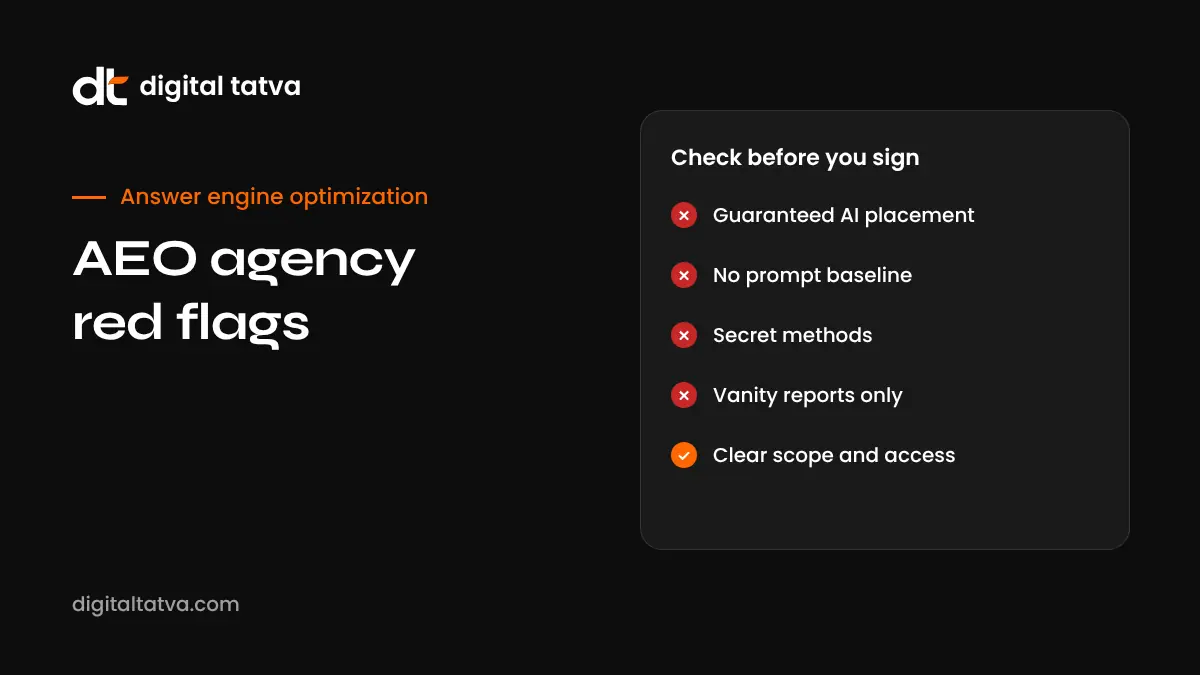
1. They guarantee placement in ChatGPT, Perplexity or AI Overviews
This is the most important red flag. No agency controls what OpenAI, Google, Perplexity, Anthropic or Microsoft show in their answers. Models change, retrieval systems change and answers vary from user to user. An agency can improve the signals that make you more likely to be named. It cannot guarantee the outcome.
Watch for softer versions too: “we will get you into ChatGPT in 30 days”, “guaranteed AI Overview inclusion” or “first position in AI answers”. These are not things anyone can promise honestly.
2. There is no baseline before work starts
If an agency starts editing pages before measuring where you stand, there is no way to prove later that anything changed. A real engagement begins with a documented prompt set run across the relevant AI platforms, with mention, recommendation and citation data recorded for you and your competitors. See our AI visibility audit checklist.
3. They will not show you the prompt set
The prompts tracked are the foundation of the whole engagement. If the agency treats them as confidential, you cannot judge whether they reflect how your buyers actually search. You should own the prompt set and be able to add or remove prompts. See AEO prompt research.
4. They rely on “secret” or proprietary methods
Most good AEO work is not secret. It is prompt research, technical fixes, schema, entity alignment, answer-first content and earning third-party mentions. Agencies can have their own frameworks and tools, which is fine. But if they cannot explain in plain language what they will do to your site and your brand presence, be cautious. Unexplained methods sometimes hide tactics you would not approve.
5. Reports are cherry-picked screenshots
AI answers vary between runs. A single screenshot of ChatGPT naming you proves very little, and a report made of only favourable screenshots proves even less. Good reporting re-runs the full prompt set, repeats prompts, shows trends over time and includes the prompts where you are still missing. See our AEO reporting template.
6. They only talk about schema
Schema markup helps AI and search engines understand your pages, and every AEO programme should include it. But an “AEO package” that is only FAQ schema and a plugin install is a small fraction of the work. If entity work, content and off-site authority are absent, ask why. See schema markup for AEO for where it fits.
7. They suggest fake reviews or review gating
Reviews matter for AEO because AI tools often cite review platforms. That creates a temptation to manufacture them. Fake reviews break platform policies and consumer protection rules in many countries, and review gating (only asking happy customers to post publicly) is against several platforms’ rules. If an agency proposes either, walk away. See review sites for AEO for legitimate approaches.
8. They plan to spam Reddit, Quora or forums
Reddit and Quora appear often in AI citations, so some agencies run networks of accounts that post promotional answers. This tends to be detected, removed and remembered by moderators and users, and it puts your brand reputation at risk. Legitimate community work is disclosed, helpful and done by real people. See Quora for AEO.
9. They use hidden text or prompt injection
Some tactics try to manipulate AI crawlers with hidden instructions, invisible text or content that says one thing to bots and another to humans. These are manipulative, may violate search engine spam policies, and can backfire badly if discovered. Any proposal that mentions “instructions for AI” hidden in your pages is a red flag.
10. They mass-produce AI content with no editing
Publishing hundreds of unedited AI-written pages is cheap and fast. It also tends to produce generic, repetitive content with factual errors, which helps neither your search rankings nor your chances of being cited. Ask who writes, who edits, who checks facts and whether your experts are involved. See E-E-A-T for AI search.
11. They ignore SEO completely
Many AI features retrieve content through search indexes. An agency that dismisses SEO as dead may optimise your pages for AI while your indexation, rankings and traffic weaken. That eventually hurts AEO too. See AEO agency vs SEO agency and is SEO dead.
12. They track only one AI platform
ChatGPT is the best known, but your buyers may use Google AI Overviews, AI Mode, Perplexity, Gemini, Copilot or Claude. Tracking only one platform gives a partial and possibly misleading picture. The platform mix should match your audience.
13. The contract is long, rigid and vague
Long contracts are not automatically bad, since AEO takes months. But a twelve month lock-in with no clear deliverables, no exit clause and no reporting standard puts all the risk on you. Look for defined deliverables per month, a clear notice period and ownership of all work and data. See how long AEO takes for realistic timelines.
14. They will not tell you who does the work
Some agencies sell with senior strategists and deliver with junior staff or undisclosed subcontractors. That is not always a problem, but you deserve to know. Ask who will run your account, who writes your content and who does technical changes. If they resell another provider’s work, that should be disclosed. See white label AEO for how it should work transparently.
15. They cannot say what they will not do
Ask directly: “What will you not do, and what can you not promise?” A good agency answers quickly and clearly. One that struggles with the question has probably not thought about its own limits, or does not want to share them.
Red flags at a glance
| Red flag | Why it matters | What to ask instead |
|---|---|---|
| Guaranteed AI placement | No one controls AI answers | What signals will you improve and how will you measure them? |
| No baseline | Progress cannot be proven | Can I see the baseline before you change anything? |
| Hidden prompt set | You cannot judge relevance | Will I own and approve the prompts? |
| Secret methods | May hide risky tactics | Explain each tactic in plain language |
| Screenshot reports | Ignores answer variability | Show repeated runs and trends |
| Schema only | Covers a small part of AEO | What about entity, content and off-site work? |
| Fake reviews or gating | Policy and legal risk | How do you ask real customers for reviews? |
| Forum spam | Reputation risk | Who posts, and is it disclosed? |
| Hidden text for AI | Manipulative and risky | Is everything on my pages visible to humans? |
| Unedited AI content | Errors and low quality | Who edits and fact checks? |
| Ignores SEO | Weakens AI retrieval | How do you protect organic search? |
| One platform only | Partial picture | Which platforms match my buyers? |
| Rigid, vague contract | All risk on you | What are the monthly deliverables and exit terms? |
| Unknown team | Quality gap | Who exactly works on my account? |
| No stated limits | Overselling likely | What can you not promise? |
Green flags: what a trustworthy AEO agency looks like
Red flags are only half the picture. These are the signs that an agency knows what it is doing and will treat you fairly:
- It starts with measurement. Baseline first, changes second.
- It shares the prompt set and invites you to refine it.
- It explains answer variability and reports trends from repeated runs.
- It covers the full scope: technical, entity, content, off-site and tracking. Compare against our AEO services checklist.
- It treats SEO as the foundation rather than the enemy.
- It states clear limits, including that AI placement cannot be guaranteed.
- It has a written process you can read before signing.
- It names the team working on your account.
- It defines monthly deliverables and gives you ownership of all work and data.
- It uses examples honestly, labelling illustrations as illustrations and not inflating results.
How to check an agency in one week
- Day 1: Read their own content. Does their blog explain AEO accurately and honestly, or is it vague and hype-driven?
- Day 2: Check their own AI visibility. Ask ChatGPT, Perplexity and Gemini about AEO agencies in their market. Do they appear? It is not proof, but it is a useful signal.
- Day 3: Ask for a sample audit or report. Look for repeated prompt runs, competitor data and cited sources.
- Day 4: Ask the hard questions. Use the “what to ask instead” column above.
- Day 5: Review the contract. Check deliverables, ownership, notice period and reporting.
- Day 6: Speak to a reference if they offer one, and ask what went wrong as well as what went right.
- Day 7: Compare proposals side by side using a consistent checklist.
Our AEO consultant vs agency guide can also help if you are unsure whether an agency is the right model at all.
What to do if you already hired the wrong agency
It happens. If you recognise several red flags in your current provider, you do not need to panic, but you should act.
- Ask for the baseline and prompt set. If none exists, request one now.
- Audit what was published. Look for thin AI content, hidden text, odd schema or duplicate pages.
- Check your review profiles and community mentions for anything that looks fake or undisclosed.
- Review the contract for exit terms and data ownership.
- Get an independent audit to see what needs fixing.
Common clean-up items are covered in AEO mistakes.
Why honest AEO agencies avoid guarantees, explained
It is worth understanding why guarantees are impossible, because some buyers assume a confident agency is a better one.
AI answers are produced by models owned by other companies. Those models are updated regularly, sometimes with large changes in how they choose sources. Many answers also depend on live web retrieval, which varies by query wording, location, user history and time. Two people asking the same question can get different brands. Even the same person can get different answers minutes apart.
So what can be promised? The work itself, the measurement method and the reporting standard. An agency can commit to a documented prompt set, a monthly re-run with repeated prompts, a list of implemented fixes and honest reporting of what moved. Those commitments are real and checkable. Our guide to how AI search engines work explains the mechanics.
Red flags in the sales process itself
Some warning signs appear before you ever see a proposal. Pay attention to how the agency sells, because it often predicts how it will deliver.
- Pressure to sign quickly. “This price is only valid until Friday” is a sales tactic, not a reason. Good agencies give you time to compare.
- No questions about your business. If the agency pitches a fixed package without asking about your buyers, competitors and goals, the work will likely be generic.
- Fear-led pitches. “AI will wipe out your traffic unless you act now” may contain some truth, but it is designed to stop you thinking carefully.
- Screenshots as proof. A slide full of ChatGPT screenshots naming past clients says little without context, repeated runs and permission from those clients.
- Unverifiable results. Big percentage claims with no explanation of the baseline, timeframe or method should be treated with caution.
- Dismissing your questions. If they become vague or defensive when you ask how something works, take note.
A simple scoring sheet for any AEO proposal
To make comparison easier, score each proposal from 0 to 2 on these ten questions. Zero means no or unclear, one means partly, two means clearly yes.
| Question | Score 0 to 2 |
|---|---|
| Does it start with a documented baseline across relevant AI platforms? | |
| Will you own and approve the prompt set? | |
| Does it cover technical, entity, content, off-site and tracking work? | |
| Are monthly deliverables clearly defined? | |
| Does reporting use repeated prompt runs and trends? | |
| Are all tactics explained in plain language? | |
| Does it state clearly what cannot be guaranteed? | |
| Does it protect and include SEO? | |
| Is the team named and is any subcontracting disclosed? | |
| Are contract terms, ownership and exit clear? |
A proposal scoring 16 or more out of 20 is usually worth serious consideration. Below 10, keep looking or ask the agency to address the gaps. This is a rough guide, not a formula, but it helps keep emotion and sales pressure out of the decision. Pair it with our AEO services checklist for a full scope comparison.
Red flags in your own expectations
It is fair to add that some problems come from the buyer side. These expectations tend to lead to disappointment with any agency:
- Expecting dramatic changes in AI mentions within the first month.
- Judging success on a single prompt or a single screenshot.
- Expecting AEO to fix a product, pricing or service problem.
- Being unable to give access, approvals or expert time.
- Dropping SEO entirely in the hope that AEO replaces it.
Setting realistic expectations up front helps you choose a good agency and get value from it. Our guides to how long AEO takes and the first 90 days with an AEO agency show what is realistic.
How Digital Tatva can help
We wrote this list partly as a standard for ourselves. Digital Tatva starts every engagement with a baseline, shares the prompt set with you, reports trends from repeated runs, explains every tactic in plain language and states clearly that AI placement cannot be guaranteed. Our full process is published in how Digital Tatva works. See our services and answer engine optimization service for scope.
Want a second opinion on a proposal or your current agency? Request an AEO audit and we will give you an independent view of your AI visibility and what is worth fixing. Or start with the free AI visibility checker.
Frequently asked questions
What is the biggest red flag when hiring an AEO agency?
A guarantee that your brand will appear in ChatGPT, Google AI Overviews or another AI tool. No agency controls those answers, so any guarantee means the agency is either overselling or misunderstands the work.
Can an AEO agency guarantee results?
It can guarantee the work it will do, how it will measure progress and how it will report. It cannot guarantee that AI platforms will name you, because the platforms control their own models and answers.
Is it a red flag if an AEO agency uses AI to write content?
Not by itself. Many teams use AI tools to assist. The red flag is publishing large volumes of unedited AI content without expert input, fact checking or human editing.
Should an AEO agency share its prompt set with me?
Yes. The prompts define what is being measured and optimised. You should be able to see, approve and change them, and you should keep them if the engagement ends.
Are fake reviews ever acceptable for AEO?
No. Fake reviews violate platform rules and, in many countries, consumer protection law. Legitimate review strategies focus on asking real customers at the right moment and responding well to feedback.
How can I tell if an agency is just rebranded SEO?
Ask for a sample prompt set, an AI visibility report with repeated runs and competitor share of voice, and their plan for entity consistency and cited source outreach. If none of these exist, it is likely SEO with an AEO label.
What contract length is reasonable for AEO?
Many engagements run three to six months at minimum because AEO results take time. A reasonable contract defines monthly deliverables, reporting and an exit or notice period. Long lock-ins without those details are a concern.
Is a cheap AEO package always a red flag?
No. A focused one-time audit can be affordable and very useful. The concern is a cheap package that claims to cover everything, because the work involved in full AEO takes real time.
What should I do if my AEO agency used spammy tactics?
Document what was done, remove or correct anything fake or hidden, review your contract and get an independent audit. Then rebuild with legitimate methods focused on genuine mentions and helpful content.
Does a good AEO agency need to be visible in AI answers itself?
It is a useful signal but not proof. Smaller or newer agencies may not be widely named yet. Judge them more on their method, transparency and reporting than on their own mentions alone.
Product details, prices and features are checked at the time of writing and can change. Sources are linked in the text so you can check them yourself.
How does your brand appear in AI answers?
We test the questions your buyers ask across the major AI assistants and search engines, then show you what to fix first.
Get an AI Visibility Audit