Quora for AEO: Write Answers AI Picks Up
Quora answers still show up in Google results and AI answers, especially for advice and comparison questions. Here is how Quora fits into answer engine optimization, how to write answers that get picked up, and how to avoid the spammy tactics that backfire.
On this page
- Key takeaways
- Why Quora still matters in the age of AI
- How Quora content reaches AI answers
- What makes a Quora answer worth citing
- Step 1: Set up a credible Quora profile
- Step 2: Find the right questions
- Step 3: Write answers that lead with the answer
- Step 4: Link responsibly
- Step 5: Build consistency over time
- Quora Spaces: should you start one?
- Quora vs Reddit vs other communities for AEO
- What not to do on Quora
- Using AI tools to help with Quora, without losing quality
- How to measure Quora’s impact
- Quora for different types of businesses
- A 30-day Quora plan for AEO
- Answer templates for common question types
- Keeping old answers accurate
- How Digital Tatva can help
- Frequently asked questions
Last updated: 13 November 2026
Quick answer: Quora can help answer engine optimization because its question pages often rank in Google and appear among the sources AI assistants read, especially for advice, opinion and comparison questions. Quora is also a large, public collection of human answers, which makes it useful material for AI systems. To use it well, answer real questions in your area of expertise, lead with a clear, direct answer, add specific experience and examples, show your credentials in your profile, and link to your own content only when it genuinely helps. Self-promotional, copy-pasted or link-heavy answers get downvoted, collapsed or removed, and they do not build the trust AI systems look for.
Key takeaways
- Quora pages rank for many long, conversational questions, which are exactly the kind of questions people ask AI.
- AI assistants and search engines can draw on public Quora answers, especially for experience-based questions.
- The best answers lead with a direct response, then add real experience and specific detail.
- Your Quora profile is part of your expertise signal: name, role and credentials matter.
- Quora works best as a long-term reputation channel, not a link-building shortcut.
- Quora is one piece of a wider plan that includes your own site, reviews and independent mentions.
Why Quora still matters in the age of AI
A few years ago, many marketers wrote Quora off as a channel past its peak. Then two things happened. First, Google began showing more forum and discussion content in results, including Quora, to give searchers first-hand perspectives. Second, AI assistants started reading the web to answer questions, and discussion sites became part of the source mix, particularly for questions where personal experience matters.
The kind of question that triggers a Quora result is revealing. People rarely ask Quora for a definition. They ask “Is it worth doing an MBA after five years of work experience in India?”, “Which is better for a beginner, Zoho Books or Tally?”, or “How did you get your first ten clients as a freelancer?” Those are long, nuanced, experience-driven questions, which is exactly the type of question people now also put to ChatGPT, Gemini and Perplexity.
So Quora is not a replacement for your own website, but it is a place where your expertise can be visible in a format that both search engines and AI systems use. Our guide to the kinds of pages AI assistants cite shows where discussion sites fit in.
How Quora content reaches AI answers
There are three main paths by which a Quora answer can influence an AI response:
| Path | How it works | What it means for you |
|---|---|---|
| Search retrieval | AI search tools run web searches; Quora question pages often appear in results for conversational queries | A strong, upvoted answer on a well-ranking question page can be read and cited |
| Google features | Google surfaces discussion and forum content in results and in perspectives-style features | Quora pages can appear in classic results alongside AI Overviews |
| Model training | Public web text, potentially including discussion sites, can be part of the data models learn from | Consistent expertise over time shapes general associations, though you cannot control this directly |
Exact sourcing policies differ by AI company and change over time, and Quora also runs its own AI products. Treat Quora as one useful public channel, not a guaranteed route into any particular AI answer. For the broader picture, see how AI search engines work.
What makes a Quora answer worth citing
Look at the top answers on any popular Quora question and you will see a pattern. They are not the longest or the most promotional. They are the most useful. In AEO terms, they are well-chunked, specific and credible.
| Quality | Weak answer | Strong answer |
|---|---|---|
| Opening | “Great question! There are many factors to consider…” | “For a 20-person agency, Zoho Projects is usually the better fit than Asana because…” |
| Experience | Generic advice anyone could write | “I have run payroll for 120 employees on both tools; here is what broke.” |
| Specificity | “It depends on your needs.” | “If you file GST monthly and have under 500 invoices, choose X; above that, Y.” |
| Structure | One long block of text | Short paragraphs, a list or a simple comparison |
| Links | Several links to the author’s site in the first lines | At most one relevant link where it genuinely adds detail |
| Credibility | Anonymous profile, no credentials | Named author with a relevant credential shown |
These are the same qualities that make content quotable anywhere. Our guides to answer-first content and content chunking for AI explain why.
Step 1: Set up a credible Quora profile
Your profile is part of every answer you write. Readers check it, and it gives context to anyone, or any system, judging whether your answer is credible.
- Use your real name and a clear photo. Anonymous profiles carry little weight.
- Write a specific profile headline. “Founder, Digital Tatva | Answer engine optimization consultant” says far more than “Entrepreneur”.
- Add credentials for topics. Quora lets you add topic-specific credentials, such as employment, education and location. Use them, and keep them accurate.
- Write a short bio. Who you are, what you do and how long you have done it, in plain language.
- Link to your website and LinkedIn. This connects your Quora identity to your other profiles, which helps establish who you are. See LinkedIn for AEO.
Consistency matters. Use the same name, role and company description as on your website author page and LinkedIn. That consistency helps machines connect your expertise across platforms. See author pages for AEO.
Step 2: Find the right questions
Not every question is worth answering. Prioritise questions that are relevant to your expertise, likely to be asked by your customers, and visible in search.
Ways to find good questions
- Search Quora for your core topics and sort through questions with many followers or views.
- Search Google for your target questions and note which Quora pages appear on the first page.
- Ask AI assistants your buyer questions and check whether Quora pages appear among cited sources.
- Use your sales and support conversations. If customers ask it, someone on Quora probably has too.
- Follow relevant topics and Spaces so new questions appear in your feed.
A simple prioritisation table
| Question type | Priority | Why |
|---|---|---|
| Ranks on Google page one and matches a buyer question | High | Visible to searchers and AI retrieval |
| Many followers but few strong answers | High | Room to become the top answer |
| Niche question in your exact specialism | Medium to high | Builds expertise association |
| Popular question with dozens of excellent answers | Low | Hard to stand out |
| Off-topic or controversial questions | Avoid | Little benefit, possible reputational risk |
This is closely related to prompt research for AI. See our guide to AEO prompt research.
Step 3: Write answers that lead with the answer
The structure that works best on Quora is the same one that works for AI retrieval.
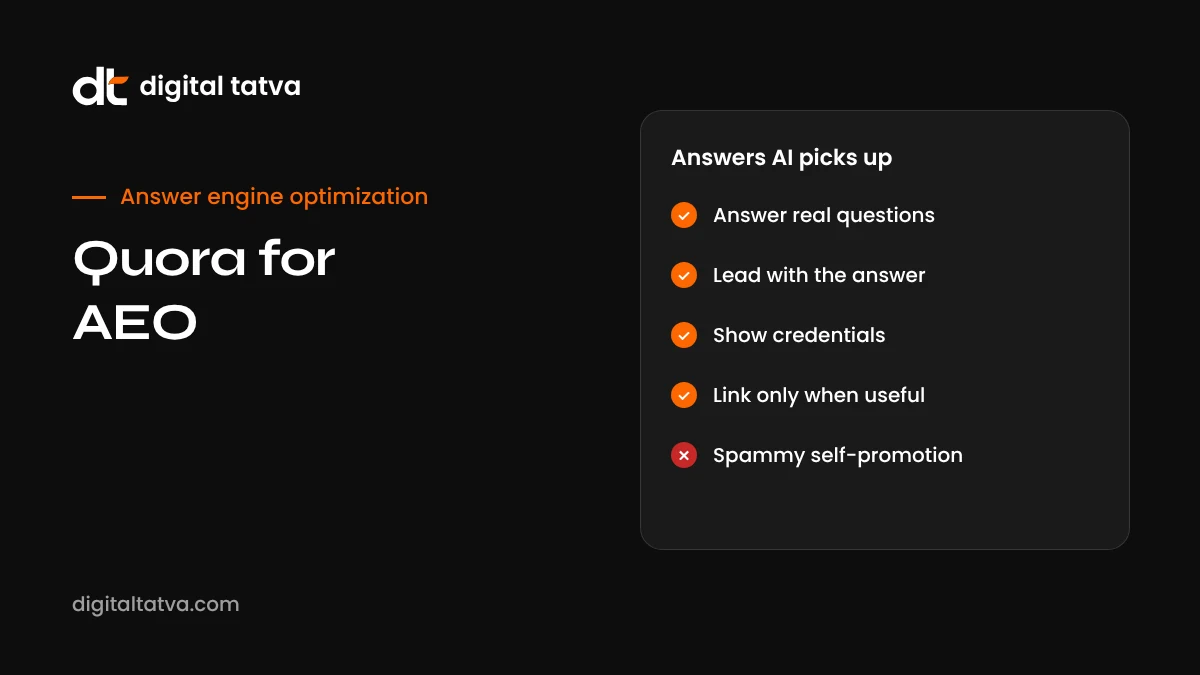
- Answer in the first one or two sentences. State your recommendation or conclusion clearly.
- Explain why. Give the reasoning behind your answer in a few short paragraphs.
- Add your experience. A specific example, number or story that only you could tell.
- Cover the “it depends”. When would the answer be different? Who is this not right for?
- Close with a practical next step. What should the reader do now?
Example
Question: “How can a small business check whether ChatGPT recommends it?”
Strong opening: “The simplest way is to ask ChatGPT the exact questions your customers would ask, in fresh chats with memory turned off, and record whether your business is named. Do it for 20 to 30 real questions and repeat each one three times, because answers vary between sessions.”
That opening is quotable on its own. The rest of the answer can then explain how to choose the questions, what to record and what to do if you are missing. If you have a detailed guide on the topic, one link to it at the relevant point is fine. Ours is how to check if ChatGPT recommends your brand.
Step 4: Link responsibly
Links are where many businesses go wrong on Quora. Quora’s community and moderation are designed to discourage spam, and answers that look like adverts are often collapsed, downvoted or removed. A sensible approach:
- Make the answer complete without the link. The link should add depth, not hold back the answer.
- Use at most one or two links, placed where they genuinely help.
- Disclose your connection when linking to your own business: “I run an agency that does this, so I am biased, but…”
- Never post the same answer, or the same link, across many questions.
- Follow Quora’s current policies on self-promotion and links, which can change.
Links from Quora are generally nofollow, so their direct SEO value is limited. Their real value is referral traffic from interested readers and the credibility of being seen as a helpful expert.
Step 5: Build consistency over time
A single excellent answer can perform well for years. But expertise is recognised through patterns: many good answers on the same topics, from the same person, over time. A realistic routine for a busy professional:
- Two or three thoughtful answers per week on your core topics.
- Update your best answers when facts change, especially prices or product details.
- Respond to comments politely and add clarifications.
- Share useful answers in relevant Quora Spaces where allowed.
Quora Spaces: should you start one?
Quora Spaces are community pages built around a topic, where members share posts and answers. Running a Space can build an audience and reinforce your association with a topic, but it takes ongoing effort. It makes sense if:
- You have a clear, focused topic with an active audience on Quora.
- You or your team can post useful content regularly.
- You are willing to moderate and engage with contributors.
For most businesses, contributing strong answers to existing questions delivers more value with less effort. Consider a Space once you have an established presence.
Quora vs Reddit vs other communities for AEO
Quora is one of several community platforms that matter for AI visibility. Each has a different culture.
| Platform | Strengths | Watch out for | Best for |
|---|---|---|---|
| Quora | Long, expert answers; named profiles with credentials; question pages rank well | Self-promotion is heavily discouraged | Advice, comparisons, career and business questions |
| Very active communities; candid discussions; frequently surfaced in search and AI answers | Strict community rules; marketing is often unwelcome | Honest product and service opinions | |
| Industry forums | Highly relevant, expert audiences | Smaller reach | Niche B2B and technical topics |
| Stack Exchange sites | High-quality technical answers | Strict focus on objective answers | Developer and technical questions |
| Professional identity and B2B reach | Feed content is short-lived | B2B expertise and leadership visibility |
Our guide to Reddit for AEO covers Reddit in detail. Most brands benefit from being genuinely helpful on one or two communities rather than thinly present on all of them.
What not to do on Quora
- Do not ask fake questions just to answer them with your product. It is easy to spot and damages trust.
- Do not use multiple accounts to upvote your own answers. This breaks platform rules.
- Do not paste AI-generated answers without your own experience and checking. Generic AI text adds nothing and may be removed.
- Do not copy your blog posts as answers. Write for the specific question.
- Do not attack competitors. Fair comparisons are fine; criticism without evidence is not.
- Do not hide your affiliation when recommending your own business.
These tactics might bring a short-term spike, but they undermine the very trust that makes Quora valuable for AEO. They also conflict with the principles of E-E-A-T for AI search.
Using AI tools to help with Quora, without losing quality
AI writing tools can speed up research and drafting, but Quora rewards personal experience, which AI cannot supply. A good workflow:
- Note your own view and two or three specific experiences before opening any AI tool.
- Ask an AI to suggest a clear structure or to list points you might have missed.
- Write the answer yourself, starting with your direct recommendation.
- Use AI to tighten wording or check clarity, then remove anything generic.
- Verify every fact, number and price before posting.
See our guide to AI writing tools for AEO for more on responsible use.
How to measure Quora’s impact
Quora’s direct impact on AI answers is hard to isolate, but you can track useful signals:
| Signal | Where to look |
|---|---|
| Views and upvotes on your answers | Quora stats |
| Referral traffic from Quora | GA4 referral reports |
| Quora pages cited in AI answers for your topics | Monthly prompt tracking |
| Your answers ranking in Google for target questions | Search for your target questions |
| Brand mentions in AI answers about your topic | AI share of voice tracking |
For tracking methods, see tracking brand mentions in ChatGPT and AI share of voice.
Quora for different types of businesses
B2B services and consultancies
Quora works well for consultants, agencies and B2B service firms because many questions are about choosing providers, solving business problems and comparing approaches. Founders and senior experts answering in their own names can build visible authority over time. See AEO for professional services.
SaaS and software
Comparison and “which tool should I use” questions are common. Team members can answer honestly, including when a competitor is the better fit for a specific situation. That honesty builds trust and often leads to recommendations when your product is the right fit. See AEO for SaaS.
Education and careers
Questions about courses, exams, colleges and careers are among the most active on Quora in India. Educators and institutions can contribute genuinely helpful guidance, as long as answers are not disguised advertisements. See AEO for education.
Local and consumer businesses
Quora is usually less important for local businesses than Google Business Profile and reviews. It can still help for broader questions in your field, such as “how often should I service my car?” for a garage owner.
A 30-day Quora plan for AEO
- Days 1 to 3: Set up or improve your profile with your real name, specific headline, credentials and links to your website and LinkedIn.
- Days 4 to 7: Build a list of 30 questions in your area, prioritising those that rank in Google or appear in AI answers.
- Days 8 to 28: Write two or three high-quality answers per week, each leading with a direct answer and adding real experience.
- Day 29: Review views, upvotes and referral traffic. Note which answer styles perform best.
- Day 30: Check whether any of your answers appear in Google or AI answers for your target questions, and plan the next month.
Answer templates for common question types
Different kinds of Quora questions call for slightly different structures. These templates keep your answers clear and useful.
“Which is better, X or Y?”
- One-sentence verdict for the most common situation.
- A short comparison of the two on the three factors that matter most.
- When the other option is the better choice.
- Your own experience with one or both.
“How do I do X?”
- A one-sentence summary of the approach.
- Numbered steps, each one or two sentences.
- Common mistakes to avoid.
- What results to expect and how long they take.
“Is X worth it?”
- A clear yes, no or “yes, if” answer.
- Who it is worth it for and who it is not.
- Costs, benefits and a realistic example.
- An alternative for people it does not suit.
“What is the best X for Y?”
- Your top recommendation and why, in one or two sentences.
- Two or three alternatives with the situations where each fits.
- What to check before choosing.
- Disclosure if you are connected to any option.
These structures map closely to the way AI assistants format their own answers, which is part of why clear, well-structured answers are easy for them to use.
Keeping old answers accurate
Quora answers can keep receiving views for years. That is a strength, but also a risk: an answer that recommends a product at a price that has since doubled, or a process that has since changed, can mislead readers and AI systems alike. Set a reminder to review your top ten answers every few months. Update prices, versions and recommendations, and add a short note such as “Updated November 2026” so readers know the answer is current.
How Digital Tatva can help
We help businesses decide where community platforms like Quora fit into their AI visibility plan, identify the questions that matter for their buyers, and guide founders and experts on writing helpful, credible answers without crossing into spam. We combine that with work on your own site, entity and reviews, and we track how AI assistants describe you over time. We never post fake questions, fake accounts or undisclosed promotion, and we do not promise placement in AI answers, because nobody can.
Want to know which communities AI cites for your category? Request an AEO audit and we will map the sources behind AI answers in your space, or run our free AI visibility checker.
Frequently asked questions
Does Quora help with SEO?
Quora links are generally nofollow, so they pass little direct ranking value. Quora helps mainly through visibility, referral traffic and building recognised expertise, which supports both search and AI visibility.
Do AI assistants use Quora answers?
Quora pages can appear in web search results that AI assistants read, especially for advice and opinion questions. Exact sourcing varies by AI product and changes over time.
How long should a Quora answer be?
Long enough to answer the question fully and add real experience. Many strong answers are 200 to 600 words, with a direct answer in the first sentences.
Can I promote my business on Quora?
You can mention your business when it is genuinely relevant and you disclose your connection. Answers that read like advertisements are often collapsed or removed.
Should I use AI to write Quora answers?
AI can help structure and polish, but the value of a Quora answer comes from your own experience and expertise. Always add personal insight and check every fact.
Is Quora better than Reddit for AEO?
They serve different purposes. Quora suits expert, named answers to advice questions; Reddit suits candid community discussion. Many brands benefit from one or both, depending on where their audience is.
How often should I answer on Quora?
Two or three thoughtful answers a week is a sustainable pace for most professionals. Quality and consistency matter more than volume.
Can Digital Tatva manage Quora for us?
We can identify priority questions and guide your experts on writing strong answers. Answers should come from real people at your company, in their own names.
Product details, prices and features are checked at the time of writing and can change. Sources are linked in the text so you can check them yourself.
How does your brand appear in AI answers?
We test the questions your buyers ask across the major AI assistants and search engines, then show you what to fix first.
Get an AI Visibility Audit