E-E-A-T for AI Search: How to Prove Expertise to Machines
E-E-A-T stands for experience, expertise, authoritativeness and trust. Here is how those signals carry into AI search, and the practical steps that help ChatGPT, Gemini and Google AI Overviews see your brand as a credible source.
On this page
- Key takeaways
- What E-E-A-T means
- Why E-E-A-T matters even more in AI search
- How machines actually see E-E-A-T
- How to show experience
- How to show expertise
- How to build authoritativeness
- How to build trust
- E-E-A-T for “your money or your life” topics
- Common E-E-A-T mistakes
- Using AI to write content without losing E-E-A-T
- An E-E-A-T audit you can run this week
- How E-E-A-T connects to AI recommendations
- E-E-A-T checklist by page type
- E-E-A-T for small businesses with little press coverage
- How AI assistants express trust in their answers
- Reviews and case studies as E-E-A-T evidence
- How to measure E-E-A-T improvements
- How Digital Tatva can help
- E-E-A-T and Google’s latest guidance
- A simple E-E-A-T improvement plan for the next quarter
- Frequently asked questions
Last updated: 13 November 2026
Quick answer: E-E-A-T stands for experience, expertise, authoritativeness and trustworthiness. It comes from Google’s search quality rater guidelines and describes what makes content credible. In AI search, the same ideas decide which sources ChatGPT, Gemini, Perplexity and Google AI Overviews feel safe repeating. To show E-E-A-T to machines, put real names and credentials on your content, show first-hand experience with specific details, back claims with evidence, earn mentions from respected independent sources, and make your business details transparent and consistent. Trust is the centre of it all: an AI system will not recommend what it cannot verify.
Key takeaways
- E-E-A-T is not a single score or a direct ranking factor. It is a set of qualities that many signals point to.
- AI search inherits these ideas because it relies heavily on search systems that already reward credible content.
- Experience is the hardest signal to fake and one of the most valuable: original photos, real numbers and lessons learned.
- Machines read E-E-A-T through names, credentials, schema, citations, reviews and consistent facts.
- Trust is the most important element. Without it, the other three count for little.
What E-E-A-T means
Google’s search quality rater guidelines are a long document used to train the people who evaluate search results. Those raters do not directly change rankings, but their feedback helps Google judge whether its systems are surfacing good content. In 2022, Google added an extra “E” for experience to the older E-A-T concept.
| Element | The question it asks | Example signal |
|---|---|---|
| Experience | Has the creator actually done or used this? | Original photos, test results, personal lessons |
| Expertise | Does the creator have the knowledge or skill? | Qualifications, years in the field, depth of detail |
| Authoritativeness | Is the creator or site a recognised go-to source? | Mentions and links from respected sites |
| Trustworthiness | Is the content accurate, honest and safe? | Clear sourcing, transparent business details, secure site |
Google describes trust as the most important member of the family. Experience, expertise and authority all support trust, but a page that is untrustworthy fails regardless of the others.
Why E-E-A-T matters even more in AI search
In classic search, a less credible page might still appear in position eight. A searcher could scroll past it. In AI search, the system often picks just a handful of sources and speaks on their behalf. If it repeats something wrong, the AI product looks bad. So AI systems have strong reasons to lean on sources that look credible.
There are three ways E-E-A-T carries into AI answers:
- Through search rankings. Google AI Overviews and AI Mode use Google’s ranking systems. Copilot uses Bing. Pages that those systems trust are more likely to be retrieved and cited. Our guide to AI search ranking factors explains this link.
- Through source agreement. AI systems prefer claims confirmed by several independent, credible sources. Authority is partly about being one of those sources.
- Through the model’s own training. Large language models learn from a huge body of text. Brands and experts who are widely and positively discussed are better represented in what the model knows.
How machines actually see E-E-A-T
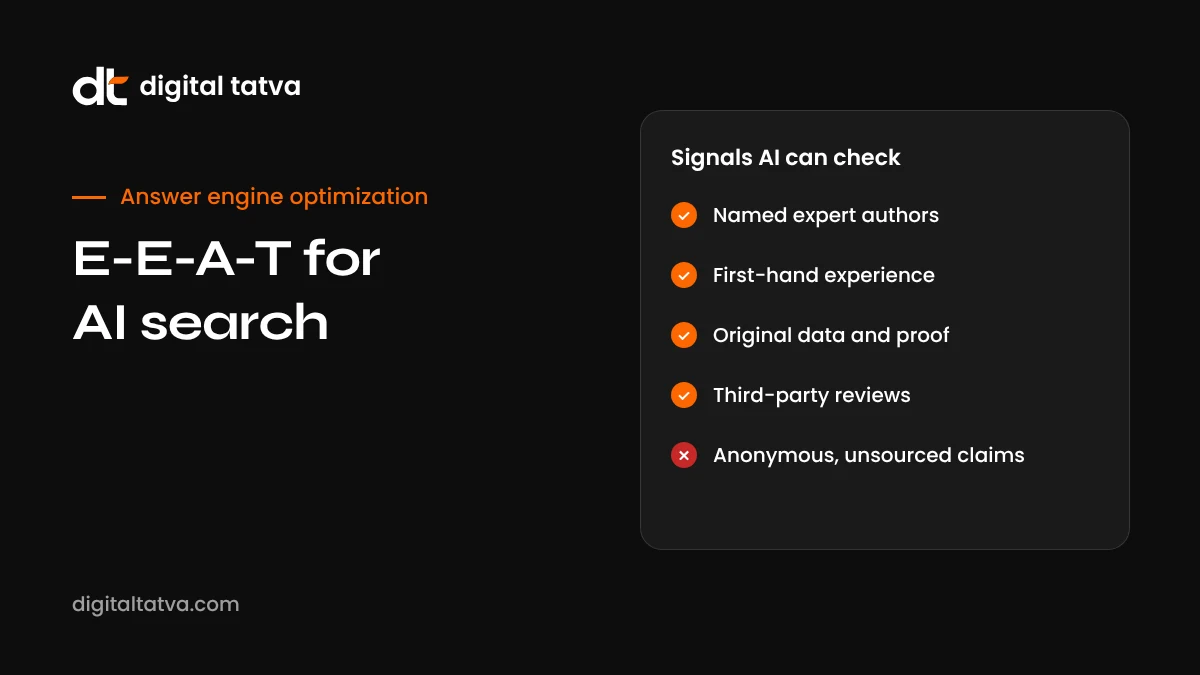
An AI system cannot meet your founder or visit your office. It infers credibility from signals it can read. This table translates each element into things a machine can check.
| Element | Machine-readable signals |
|---|---|
| Experience | Original images, specific numbers, step-by-step detail, first-person accounts, dated case notes |
| Expertise | Named authors, author pages, credentials, Person schema, consistent author profiles across sites |
| Authoritativeness | Mentions in industry publications, links from respected sites, citations of your research, speaking and awards |
| Trustworthiness | Accurate facts, sources cited, clear contact and company details, Organization schema, reviews, HTTPS, honest disclaimers |
How to show experience
Experience is the newest element and, in the age of AI-generated content, possibly the most valuable. Anyone can ask an AI to write a generic guide. Only you can describe what happened when you actually did the work.
- Use original images. Screenshots from your own tools, photos from your projects and charts from your data show first-hand involvement.
- Share specific numbers. “We tested 14 prompts across five AI engines for six weeks” is more credible than “we did extensive testing”.
- Describe what went wrong. Honest notes about mistakes and surprises are a strong experience signal and are rarely found in generic content.
- Show the process. Step-by-step accounts with real details make clear that someone actually did this.
- Date your observations. AI tools change fast. “Tested in October 2026” helps readers and machines judge relevance.
Here is a small example from our own work. When we track prompts for clients, the same question asked in two fresh ChatGPT sessions on the same day can mention different brands. Writing that down, with the dates and the prompts, is experience. Writing “AI answers can vary” without any detail is not.
How to show expertise
- Put a real name on every important page. Anonymous “admin” posts give machines nothing to connect.
- Create proper author pages. Include a photo, role, qualifications, years of experience, areas of focus and links to profiles such as LinkedIn. Our guide to author pages for AEO has a template.
- Add Person schema. Mark up authors with name, job title, affiliation and sameAs links so their identity is clear.
- Match the writer to the topic. Medical content reviewed by a doctor, legal content reviewed by a lawyer, financial content reviewed by a qualified professional.
- Go deeper than the obvious. Expertise shows in nuance: edge cases, trade-offs and “it depends” explained properly.
How to build authoritativeness
Authority comes mostly from what others say about you. That makes it slower to build, but also harder for competitors to copy.
- Earn mentions in respected publications. Expert quotes, guest articles, interviews and podcast appearances all count.
- Publish original research. Data that others cite creates authority quickly. See original research for AEO.
- Be present where your industry looks. Industry directories, association listings and respected review platforms.
- Build topical depth. A site that covers its topic thoroughly becomes a natural go-to source. Read topical authority in AI search.
- Use professional platforms. Thoughtful content on LinkedIn from your team builds visible expertise. See LinkedIn for AEO.
More on this in brand mentions for AEO.
How to build trust
Trust is where many otherwise strong websites fall short. These are the basics:
- Make your business real and reachable. Full company name, address, phone, email and registration details where relevant.
- Write a genuine about page. Who runs the business, how long you have been operating, how you work.
- Cite sources for claims. Link to the original data behind statistics, especially in health, finance and legal topics.
- Keep facts accurate and up to date. Outdated prices and features erode trust quickly.
- Show real reviews. On your site and on independent platforms. Never fake them.
- Be honest about limits. Clear disclaimers, no exaggerated promises. For example, we tell every client that no one can guarantee placement in an AI answer.
- Keep your entity consistent. The same facts everywhere. See entity SEO for AEO.
E-E-A-T for “your money or your life” topics
Google holds content about health, money, legal matters and safety, often called YMYL topics, to a higher standard because mistakes can cause real harm. AI systems are especially cautious here too. If you work in these areas:
- Have qualified professionals write or review every page and say so clearly.
- Cite authoritative sources such as government bodies, regulators and peer-reviewed research.
- Update content when rules or guidance change, and show the date.
- Avoid absolute claims and make clear when readers should seek professional advice.
Our industry guides for healthcare, fintech and law firms go into sector-specific detail.
Common E-E-A-T mistakes
| Mistake | Why it hurts | Better approach |
|---|---|---|
| Mass-produced AI content with no review | No experience, frequent errors | Use AI as a helper, add real insight, have an expert review |
| Fake author personas | Undermines trust if discovered; Google warns against deceptive authorship | Use real people with real profiles |
| Stock photos everywhere | Signals no first-hand involvement | Use original images and screenshots |
| Unsourced statistics | Machines cannot verify them | Link to the original source |
| Hidden company details | Looks like there is something to hide | Publish clear contact and company information |
| Overpromising | Erodes trust with people and systems | Be specific and honest about what you can deliver |
Using AI to write content without losing E-E-A-T
Using AI tools to help write is fine. Google has said it focuses on the quality of content, not how it was produced, and it expects AI-assisted content to be checked and reviewed by people. The problem is not AI assistance; it is content with no human experience or expertise behind it.
A sensible workflow:
- Start with your own notes, data, examples and opinions.
- Use AI to help outline, draft or tighten the writing.
- Add your specific experience, screenshots and results.
- Have a subject-matter expert fact-check every claim.
- Publish under a real author name with a clear review date.
Our guide to AI writing tools for AEO covers tools and guardrails.
An E-E-A-T audit you can run this week
- List your 20 most important pages.
- For each, check: is there a named author with an author page?
- Does the page show first-hand experience, such as original images, data or examples?
- Are claims backed by sources or your own data?
- Is the content current, with a visible updated date?
- Does your about page explain who you are, clearly and specifically?
- Are your contact and company details complete and consistent across the web?
- Search your brand name and see what independent sources say about you.
- Ask ChatGPT and Gemini “what is [your brand] and is it reputable?” and note the answer.
- Rank the gaps by impact and fix the top five first.
How E-E-A-T connects to AI recommendations
When an AI assistant recommends a provider, it is effectively vouching for them. Systems built by large companies have every reason to vouch carefully. Brands that are clearly real, clearly expert, clearly recognised by others and clearly honest are the ones machines feel safe recommending.
That is good news for businesses that genuinely know their field. E-E-A-T rewards the real thing. The work is mostly about making your existing expertise visible and verifiable.
E-E-A-T checklist by page type
Different pages need different trust signals. Use this table as a quick reference when you review your site.
| Page type | Most important signals |
|---|---|
| Homepage | Clear statement of what you do, who you serve, where you are; trust badges backed by real evidence; links to about and contact |
| About page | Founding story with dates, leadership with photos and credentials, mission, location, registration details |
| Service or product pages | Specific details, pricing or price ranges, process, case examples, reviews, named experts |
| Blog posts and guides | Named author, author bio, original insight, sources, last updated date, expert review where relevant |
| Case studies | Real client (with permission), measured results, timeline, method, quotes |
| Contact page | Address, phone, email, hours, map, response expectations |
| Comparison pages | Clear methodology, fair treatment of competitors, disclosure of your own interest |
E-E-A-T for small businesses with little press coverage
Many small businesses worry that they cannot compete on authority because they have never been featured in national media. That is less of a problem than it seems. E-E-A-T is about credibility for a specific topic and audience, not fame.
Practical ways to build it on a small budget:
- Lean on real experience. A local electrician who documents real jobs with photos and explanations shows more experience than a national directory.
- Collect detailed reviews. Ask customers to mention the specific service and outcome. Detailed reviews are stronger signals than star ratings alone.
- Join industry and local associations. Membership listings are independent confirmations of who you are.
- Contribute to local and trade publications. A short expert article in a trade magazine or a local business site is a credible mention.
- Answer questions publicly. Helpful answers in forums and Q&A communities build a visible track record. See Quora for AEO and Reddit for AEO.
- Show credentials. Licences, certifications and qualifications displayed clearly, with numbers where appropriate.
How AI assistants express trust in their answers
If you read many AI answers closely, you will notice how assistants signal confidence. They often say things like “widely recommended”, “frequently mentioned in reviews”, “known for” or “according to [publication]”. They hedge with phrases like “some users report” or “it may be worth checking” when evidence is thin or mixed.
Those phrases are a useful diagnostic. If an AI describes your business with hedging language, it probably found limited or conflicting evidence. If it describes competitors as “widely recommended”, they likely have stronger independent signals. Track the language used about you over time as well as whether you are mentioned. Improving E-E-A-T should move that language from cautious to confident.
Reviews and case studies as E-E-A-T evidence
Reviews and case studies sit at the intersection of experience, authority and trust. They show that real customers used your product or service and what happened. For AI systems, they offer specific, checkable details.
| Evidence type | What makes it strong | What weakens it |
|---|---|---|
| Customer reviews | Recent, detailed, on independent platforms, with responses from you | Old, vague, only on your own site, or suspiciously uniform |
| Case studies | Named client with permission, numbers, timeline, method | Anonymous, no numbers, no method |
| Testimonials | Full name, role, company, specific outcome | First name only, generic praise |
| Awards | Independent, credible awarding body, clear criteria | Pay-to-win awards with no criteria |
Never invent reviews, testimonials or case study results. Beyond the ethical and legal problems, fabricated evidence is increasingly easy for platforms and readers to detect, and it destroys the trust you are trying to build.
How to measure E-E-A-T improvements
E-E-A-T has no direct metric, but you can watch for its effects:
- AI descriptions: ask assistants what they know about your brand and founders each quarter. Note accuracy and confidence.
- AI recommendations: track how often you are recommended for your core topics. See AI share of voice.
- Search performance: watch rankings and impressions for expertise-driven queries, especially after core updates.
- Branded search: growing searches for your brand name suggest growing recognition.
- Mentions and links: count new independent mentions in relevant publications.
Our guide to AEO KPIs shows how to report these together.
How Digital Tatva can help
We review how your expertise, experience and trust signals appear to AI systems, then fix the gaps: author pages and schema, about and company information, evidence on key pages, consistent entity facts and a plan for earning independent mentions. Every step is measured against how AI assistants describe you. We do not promise placement in AI answers, because nobody can, but we can make your credibility far easier for machines to see.
Want to know how credible AI thinks you are? Request an AEO audit for a review of your E-E-A-T signals across AI search, or try our free AI visibility checker.
E-E-A-T and Google’s latest guidance
Google has continued to refine its guidance on helpful content. In 2026 it added clearer expectations about the main content of a page, warned against deceptive authorship information such as invented author personas, and stated that AI-generated content should be fact-checked and reviewed by people. These updates reinforce the same message: credible, people-first content from real, accountable sources is what search systems are designed to reward.
For AI search specifically, this matters because Google’s AI features draw on the same systems. A site that loses trust in Google’s core ranking systems is also less likely to be used in AI Overviews and AI Mode. Our guide to the November 2026 core update covers how to review your site after major updates.
A simple E-E-A-T improvement plan for the next quarter
- Month 1: Create or improve author pages for everyone who writes for you. Add Person schema and link to LinkedIn.
- Month 1: Rewrite your about page with specific facts: founding date, team, location, credentials and how you work.
- Month 2: Update your ten most important pages with first-hand examples, original images and sources for claims.
- Month 2: Start a review request routine on Google and the main review site in your industry.
- Month 3: Publish one piece of original data or a detailed case study, and pitch it to two or three industry publications.
- Month 3: Ask AI assistants what they know about your brand and compare with your starting point.
Each step is small. Together, they make your credibility much easier for both people and machines to see.
Frequently asked questions
What does E-E-A-T stand for?
Experience, expertise, authoritativeness and trustworthiness. It is a framework from Google’s search quality rater guidelines describing what makes content credible.
Is E-E-A-T a ranking factor?
Not directly as a single score. It describes qualities that many ranking signals try to capture, such as links, mentions, author information and content accuracy.
Does E-E-A-T matter for ChatGPT and other AI assistants?
Yes, indirectly. AI assistants prefer credible, well-supported sources, and many rely on search systems that already reward E-E-A-T signals.
Which part of E-E-A-T is most important?
Google describes trust as the most important. Experience, expertise and authority all support it.
Can AI-generated content have good E-E-A-T?
It can, if it is guided by real experts, includes genuine experience and data, and is reviewed and fact-checked by people before publishing.
How do I show experience in my content?
Use original images, specific numbers, step-by-step detail, dated observations and honest notes about what worked and what did not.
Do author pages really help?
Yes. They make it clear who wrote the content and why they are qualified, which helps both readers and machines judge credibility.
Can Digital Tatva improve our E-E-A-T for AI search?
Yes. Our AEO audit includes an E-E-A-T review and a prioritised plan to strengthen experience, expertise, authority and trust signals.
Does E-E-A-T apply to small businesses?
Yes. Real owner bios, genuine reviews, clear contact details and practical expertise shown in content all build trust, whatever your size.
How long does it take to build E-E-A-T signals?
Some improvements, like author pages and contact details, take days. Reputation signals such as reviews, mentions and citations build over months.
Product details, prices and features are checked at the time of writing and can change. Sources are linked in the text so you can check them yourself.
How does your brand appear in AI answers?
We test the questions your buyers ask across the major AI assistants and search engines, then show you what to fix first.
Get an AI Visibility Audit