AEO for Fintech: How Financial Brands Get Named Accurately in AI Answers
How payment apps, lenders, neobanks, trading platforms, insurtechs and B2B finance software can get named and described accurately in ChatGPT, Gemini, Perplexity and Google AI answers, with a compliance-friendly AEO plan.
On this page
- Key takeaways
- Why AI answers matter so much in fintech
- Why finance is different for AI search
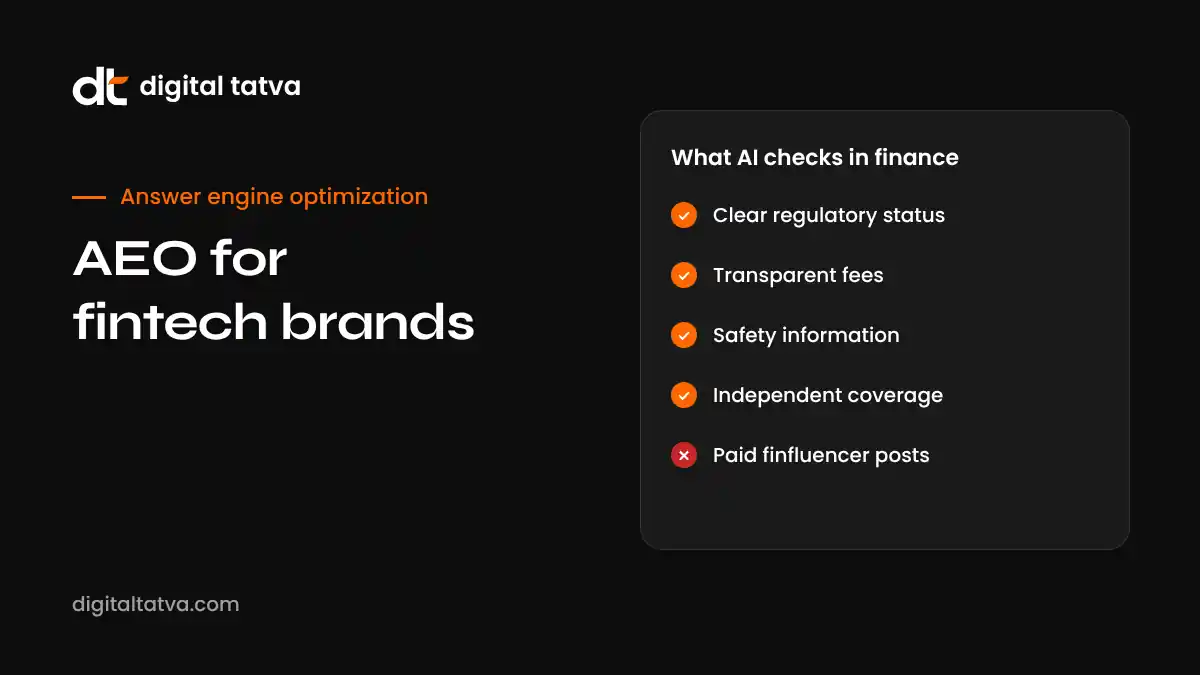
- What AI tools look for in fintech answers
- A fintech AEO plan
- Fintech AEO by segment
- A first-quarter fintech AEO roadmap
- Measuring trust, not only visibility
- Working with your compliance team
- Fintech AEO across markets
- Mistakes fintech brands make in AI search
- Example scenarios
- Why fintech brands work with Digital Tatva
- Frequently asked questions
- Sources
Last updated: 5 November 2026
Quick answer: AEO for fintech is the work of getting payment apps, lenders, neobanks, wealth and trading platforms, insurtechs and B2B finance software named and described accurately when people ask ChatGPT, Gemini, Perplexity, Copilot or Google’s AI features about financial products. Because finance is a high-trust, regulated category, fintech AEO puts accuracy, regulatory facts and trusted third-party sources ahead of volume. Done well, it helps AI tools state your licences, fees, eligibility and safety features correctly, and include you in “best app for…” and comparison answers. All content should go through your compliance review, and no provider can guarantee placement.
Key takeaways
- People now ask AI tools money questions directly: which app, which card, which loan, is it safe, what are the fees.
- AI answers about finance lean heavily on sources that look trustworthy: regulators, established publications, comparison sites, app stores and reviews.
- Wrong AI answers are a bigger risk in fintech than in most categories, because they can mislead customers about fees, eligibility or regulation.
- Fintech AEO priorities: accurate public facts, clear fee and eligibility pages, regulatory status stated plainly, expert authorship and presence on cited comparison sources.
- Digital Tatva runs fintech AEO through our answer engine optimization and entity SEO services, built to fit your compliance process.
Why AI answers matter so much in fintech
Financial decisions involve research. Before downloading a payments app, applying for a loan, opening a trading account or choosing billing software, people compare options and look for reassurance. More of that research now happens in AI tools. OpenAI said in November 2026 that ChatGPT has about 1.2 billion weekly users, and Google shows AI Overviews on many searches, including financial ones. Typical prompts look like this:
- “Best UPI app for small business payments”
- “Which personal loan app is safe and RBI registered?”
- “Zero balance savings account with the best interest rate”
- “Compare low-brokerage trading apps for beginners”
- “Best invoicing and GST software for freelancers”
- “Is [app name] legit?”
- “What are the charges on [card name]?”
The answer to each is usually a short list with reasons. If you are missing from it, or described with outdated fees or the wrong regulatory status, you lose the customer before they reach your site.
Why finance is different for AI search
Higher trust bar
Google has long treated money topics as “Your Money or Your Life” (YMYL) content in its Search Quality Rater Guidelines, meaning information that can significantly affect a person’s financial stability gets extra scrutiny for accuracy and trustworthiness. Google’s AI features draw on the same systems. In practice, AI answers about finance favour sources with clear expertise and reputation: regulators, established financial media, well-known comparison sites and brands with strong independent coverage.
Regulation shapes what you can say
Fintech marketing in India and elsewhere sits under regulators. A few examples relevant to Indian fintech:
- The Reserve Bank of India consolidated its digital lending rules in the Reserve Bank of India (Digital Lending) Directions, 2025, issued in May 2025, which cover areas such as disclosures, lending service providers and the apps lenders work with.
- SEBI decided in June 2024 that SEBI-regulated entities and their agents should not associate with unregistered persons who give investment advice or make performance claims, a move widely reported as a crackdown on unregistered “finfluencers”.
- Insurance, payments, mutual funds and other areas each have their own rules on advertising and disclosures.
We are not lawyers, and this is not legal advice. The point for AEO is practical: every page, FAQ and pitch must pass your compliance team, and promotional shortcuts common in other categories, such as influencer posts or bold performance claims, can create regulatory risk in finance. AEO for fintech has to be built around that review process from the start, not added afterwards.
Errors cost more
If an AI tool states the wrong interest rate, says a product has no fees when it does, or implies you are licensed for something you are not, it can mislead customers and create complaints. Monitoring and correcting what AI says about you is part of risk management, not only marketing. See our guide to AI reputation management.
What AI tools look for in fintech answers
From the fintech prompts we test, the brands and pages that appear in answers tend to share these traits:
| Signal | What it looks like |
|---|---|
| Clear regulatory status | Licences, registrations and regulated partners stated plainly on the site, matching regulator records |
| Transparent fees and terms | A public page listing charges, interest ranges, eligibility and limits, with the date last updated |
| Safety information | How customer money and data are protected, grievance redressal details, fraud guidance |
| Independent coverage | Mentions in established financial media and comparison sites |
| App store and review presence | Ratings and recent reviews on app stores and review platforms |
| Expert authorship | Guides written or reviewed by named people with relevant credentials |
| Consistent entity facts | The same legal name, brand name, address and leadership everywhere |
| Specific use cases | Clear statements of who the product is for, such as freelancers, MSMEs or first-time investors |
A fintech AEO plan
1. Build a fintech prompt set
We start with the questions your customers actually ask, collected from support tickets, sales calls, app store reviews and search data, then group them by stage:
- Category: “best app for…”, “how to…”, “which is better…”
- Trust: “is [brand] safe”, “is [brand] RBI approved”, “[brand] complaints”
- Cost: “[brand] charges”, “[product] interest rate”, “hidden fees”
- Comparison: “[brand] vs [competitor]”
- Eligibility: “who can get…”, “minimum salary for…”, “documents needed for…”
We test across ChatGPT, Google AI Overviews and AI Mode, Gemini, Perplexity and Copilot, more than once, in the location and language your customers use. See AEO prompt research.
2. Audit accuracy first
In fintech, accuracy comes before visibility. We log every factual statement AI tools make about you: fees, rates, limits, eligibility, licences, partners, leadership and features. Anything wrong is ranked by risk. A wrong fee or regulatory claim goes to the top.
3. Publish a facts layer
Many fintech sites spread key facts across app screens, PDFs and help-centre articles that AI crawlers struggle to read. We help you publish crawlable, compliance-approved pages that state:
- What the company is, its legal entity name and its regulatory status or regulated partners.
- Fees, charges and interest ranges, with effective dates.
- Eligibility and documents needed.
- How customer funds and data are protected.
- Grievance redressal and contact details.
Structured data such as Organization, FinancialProduct where appropriate and FAQ helps machines read these facts. See schema markup for AEO.
4. Fix technical access
Fintech sites often have strict security: bot protection, geo-blocking and heavy JavaScript. These can block AI search crawlers by accident. We check that the crawlers you want, such as OAI-SearchBot, PerplexityBot, Googlebot and Bingbot, can read public pages, while your security rules stay intact for app and account areas. See robots.txt for AI crawlers and JavaScript rendering and AI crawlers, or run our free AI visibility checker.
5. Write expert, answer-first guides
Educational content earns citations when it is accurate, specific and clearly authored. We brief guides that answer real customer questions, such as how a product works, what it costs, who it suits and what to watch out for, written or reviewed by a named expert from your team and approved by compliance. Author pages with real credentials matter in finance. See author pages for AEO and answer-first content.
6. Build honest comparison pages
“[Brand] vs [competitor]” is one of the most common fintech prompts. A fair comparison page with a clear table of fees, features and eligibility gives AI tools an accurate source, instead of leaving the comparison to a third party with outdated data. See comparison pages for AEO.
7. Earn presence on trusted sources
We map which domains AI tools cite for your prompts, typically financial media, comparison and aggregator sites, app stores, review platforms and community forums, then work on accurate inclusion: updated listings, corrected comparison data, expert commentary for journalists and genuine customer reviews. We do not use paid finfluencer posts, fake reviews or undisclosed placements. See how to get cited by AI.
8. Measure monthly
The same prompts are retested each month. You see mention share by engine, accuracy, competitors named, sources cited and AI referral traffic in GA4. See our reporting template.
Fintech AEO by segment
| Segment | Typical prompts | AEO priorities |
|---|---|---|
| Payments and UPI apps | Best app for merchants, transaction limits, charges | Clear limits and fees, merchant use cases, app store presence |
| Digital lending | Safe loan apps, eligibility, interest, RBI registration | Regulated partner disclosure, fee and rate transparency, grievance details |
| Neobanks and accounts | Zero balance accounts, interest rates, partner bank | Partner bank facts, deposit protection explanation, rate pages |
| Wealth and trading | Low brokerage apps, beginners, safety | Registration facts, charges, educational guides with expert review |
| Insurtech | Best term plan, claim process, premiums | Claim process clarity, insurer partners, plan comparisons |
| B2B finance software | Best invoicing, GST, expense or payroll software | Feature and pricing pages, integrations, review platforms. See AEO for SaaS |
| Cross-border and remittance | Cheapest way to send money, fees, speed | Fee and FX transparency, corridor pages, licence facts per market |
A first-quarter fintech AEO roadmap
This is the shape of a typical first 90 days. Timing depends on how quickly compliance reviews and development changes can happen.
| Period | Focus | Outputs |
|---|---|---|
| Weeks 1 to 2 | Prompt research and approved facts list | Agreed prompt set, single source of truth for fees, limits, licences and partners |
| Weeks 3 to 4 | Baseline audit | Mention share by engine, accuracy log ranked by risk, cited sources map |
| Month 2 | Technical access and facts layer | AI crawler access confirmed for public pages, fees, eligibility, safety and company facts pages live with structured data |
| Month 2 to 3 | Corrections and comparisons | Correction requests to third-party sources, first comparison pages, updated app store and directory listings |
| Month 3 | Expert content and first retest | Expert-reviewed guides for top questions, first monthly comparison against baseline |
Measuring trust, not only visibility
In most categories, AEO success means being named more often. In fintech, how you are named matters as much. We add trust measures to every fintech report:
- Fact accuracy: the share of answers where fees, rates, limits and regulatory facts are stated correctly.
- Safety framing: whether “is it safe” answers mention your regulatory status, partners and protections accurately.
- Complaint framing: whether past issues are presented fairly and in context.
- Source quality: the share of cited sources that are your own current pages, regulators or established publications.
- Comparison fairness: whether you and competitors are described with equally current information.
These measures help marketing, compliance and leadership see the same picture, and they flag risks early. Our AEO KPIs guide explains the core metrics behind them.
Working with your compliance team
Fintech AEO succeeds when compliance is involved from the start, not at the end. The way we work:
- Agree rules up front. What can be claimed, which disclosures are required, which words are off limits.
- Brief before writing. Content briefs list the facts and sources each page will use, so compliance can flag issues early.
- Single source of truth. A maintained list of approved facts, such as fees, rates, limits and licences, used for every page and every correction request.
- Review every page. Nothing is published or pitched without approval.
- Date everything. Fee and rate pages show when they were last updated, so AI tools and customers see current information.
- Keep records. A log of what was published, corrected and pitched, useful for audits.
Fintech AEO across markets
Many fintech companies operate in more than one country, or serve customers abroad, such as remittance, cross-border payments and global SaaS billing. AI answers differ by market, so AEO has to as well.
- Test per market. Run prompts with the location and language of each market. An answer in India may cite different sources from one in the UAE, UK or US.
- Separate regulatory facts. State licences and regulated partners for each market on its own page, so AI tools do not mix them.
- Local fees and currencies. Show fees and limits in local currency, with local examples.
- Local sources. Comparison sites, publications and review platforms differ by country. Map the cited sources in each market separately.
- Consistent global entity. Keep one clear parent brand identity, with subsidiaries and local entities linked in structured data.
- hreflang and site structure. Make sure search engines and AI crawlers can tell which page serves which market.
If you sell abroad from India, or into India from abroad, our guide to AEO services in India covers the Indian side of the picture.
Mistakes fintech brands make in AI search
- Hiding fees in PDFs or app screens. AI tools cannot cite what they cannot read, so they quote third parties instead.
- Blocking all bots. Security rules that stop AI search crawlers from reading public pages.
- Inconsistent names. Brand name, legal name and app name used differently across sites, confusing entity recognition.
- Relying on influencers. Paid posts can carry regulatory risk in finance and rarely become trusted AI sources.
- Bold claims without evidence. “Best returns” or “lowest rates” claims that AI tools will not repeat without independent support, and that compliance may not allow.
- Ignoring app store reviews. AI tools often draw on them for “is it safe” and “what do users say” answers.
- Not monitoring. Rates and fees change; AI answers lag unless the sources are updated.
More general pitfalls in AEO mistakes to avoid.
Example scenarios
These are illustrations, not client results.
A digital lending app
AI answers to “is [app] safe” said the company’s regulatory status was unclear, because the site named its partner lenders only in a footer PDF. The fix: a clear, compliance-approved page explaining the regulated lending partners, fees, grievance process and data practices, plus consistent facts on app stores and directories. Answers became more accurate after recrawl.
A B2B invoicing platform
In “best GST invoicing software” prompts, AI tools named three competitors drawn from comparison articles. The platform had no public pricing and appeared on none of the cited lists. The fix: a pricing explanation page, an honest comparison page and updated listings on the review platforms AI cited.
A trading platform
AI tools quoted brokerage charges from before a pricing change. The fix: an updated, dated charges page with structured data, correction requests to two comparison sites and expert-reviewed beginner guides. Retrieval-based answers updated as those pages were recrawled.
Why fintech brands work with Digital Tatva
- Accuracy first. Our audits log every fact AI tools state about you, ranked by risk.
- Compliance-friendly process. Briefs, approved fact lists and review at every step.
- Specialist method. Our five elements framework covers technical access, content, trust, measurement and entity facts in one plan.
- Honest rules. No guaranteed AI placement, no fake reviews, no paid finfluencer posts, no invented results.
- Founder-led. Every engagement is led by Ketan Parmar, who has 15 years of experience in digital marketing.
- India and international. Based in Ahmedabad, working with fintech teams in India and abroad.
See what AI says about your fintech brand. Our AI visibility audit tests real customer questions across ChatGPT, Gemini, Perplexity, Copilot and Google AI, logs every fact stated about you and ranks what to fix first. Or talk to us about fintech AEO.
Frequently asked questions
What is AEO for fintech?
It is answer engine optimization for financial technology companies: making sure AI tools such as ChatGPT, Gemini, Perplexity, Copilot and Google’s AI features can find, understand and accurately describe your products, fees, eligibility and regulatory status.
Why does ChatGPT give wrong information about my fintech app?
Usually because key facts are hidden in PDFs or app screens, are outdated on third-party sites, or are inconsistent across sources. Publishing clear, crawlable, dated facts and correcting third-party sources usually fixes it.
Is AEO allowed for regulated financial companies?
AEO is about publishing accurate information and earning genuine coverage, which fits within regulated marketing. All content should go through your compliance review, and tactics such as paid influencer advice may carry regulatory risk.
How do I get my fintech app into “best app” answers?
Be clear about who the product is for, publish transparent fees and features, appear on the comparison and review sources AI tools cite, and maintain strong app store reviews. No provider can guarantee inclusion.
Do AI tools check RBI or SEBI registration?
AI tools may cite regulator websites or news coverage when asked about safety. Stating your regulatory status or regulated partners clearly, matching regulator records, makes accurate answers more likely.
How long does fintech AEO take?
Accuracy fixes can show within weeks of recrawl. Inclusion in competitive “best app” answers usually takes several months, because it depends on content and third-party coverage.
How do you measure fintech AEO results?
With monthly prompt tests covering mention share, accuracy and sources cited, plus AI referral traffic and conversions in GA4.
Does Digital Tatva work with fintech companies?
Yes. We run fintech AEO through our answer engine optimization and entity SEO services, with a process built around compliance review.
Sources
- Search Quality Rater Guidelines, Google
- AI features and your website, Google Search Central
- RBI Digital Lending Directions, 2025, SCC Online
- SEBI bars registered entities from dealing with unregistered finfluencers, Business Today
- OpenAI: ChatGPT search is about 20% of Google, Big Technology
Product details, prices and features are checked at the time of writing and can change. Sources are linked in the text so you can check them yourself.
How does your brand appear in AI answers?
We test the questions your buyers ask across the major AI assistants and search engines, then show you what to fix first.
Get an AI Visibility Audit