AI Reputation Management: How to Fix What ChatGPT and AI Say About Your Brand
AI answers are now a first impression for buyers, candidates and investors. Here is how AI reputation management finds wrong, outdated or unfair statements in ChatGPT, Gemini, Perplexity and Google AI answers, and fixes them at the source.
On this page
- Key takeaways
- Why AI answers have become your reputation
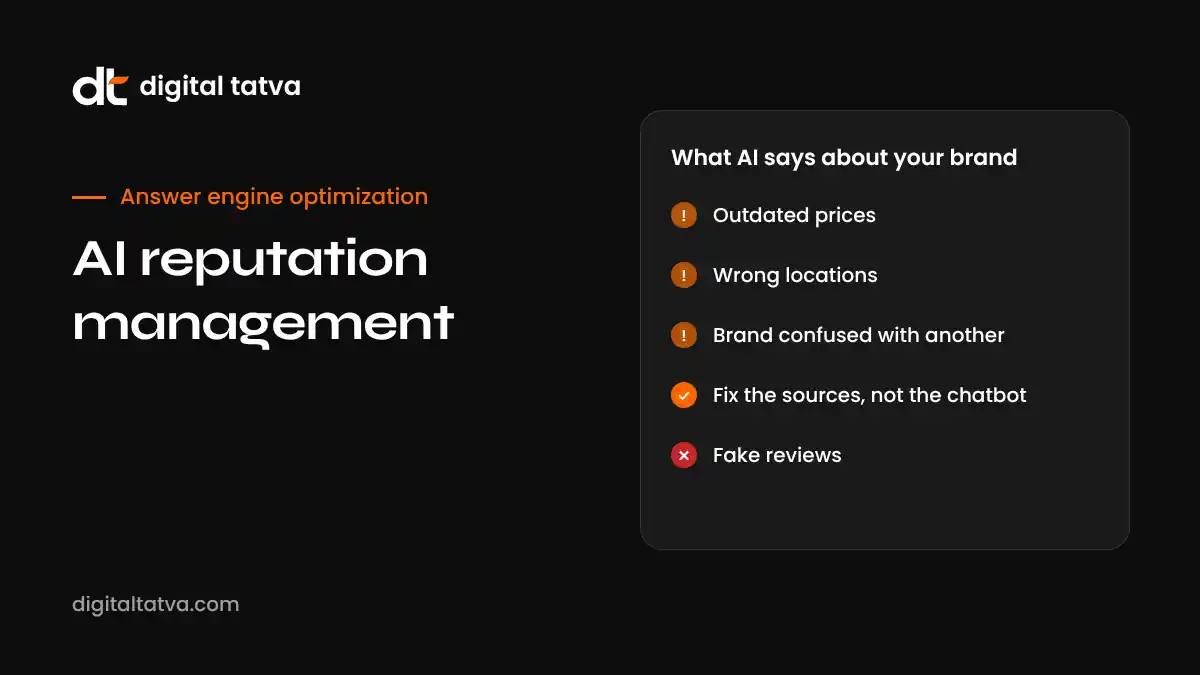
- What goes wrong in AI answers about brands
- How AI tools decide what to say about you
- What AI reputation management services include
- AI reputation management vs traditional online reputation management
- What AI reputation management cannot do
- Who needs AI reputation management
- How to check your AI reputation today
- Example scenarios
- AI reputation for founders and leaders
- When AI answers turn into an incident
- How Digital Tatva runs AI reputation management
- Measuring AI reputation over time
- Frequently asked questions
- Sources
Last updated: 5 November 2026
Quick answer: AI reputation management is the work of monitoring and improving how ChatGPT, Gemini, Perplexity, Microsoft Copilot and Google’s AI Overviews describe your brand. It finds wrong facts, outdated information, unfair comparisons and missing context in AI answers, traces each one to the sources the AI relied on, and fixes those sources honestly: your own pages, your profiles, directories, reviews and third-party coverage. It cannot delete legitimate criticism or force an AI tool to say something, and any provider who claims it can is overpromising.
Key takeaways
- AI answers are now a first impression. Buyers, candidates, investors and journalists ask AI tools about companies before they visit a website.
- Most AI reputation problems are fact problems: old prices, discontinued products, wrong locations, a competitor’s feature credited to you, or a single old complaint treated as the whole story.
- You fix AI answers by fixing the sources AI reads, not by talking to the AI.
- Good AI reputation management is continuous: a fixed set of brand prompts, tested every month across engines.
- Digital Tatva runs AI reputation work through our entity SEO and answer engine optimization services, starting with an AI visibility audit.
Why AI answers have become your reputation
For years, online reputation meant page one of Google for your brand name: your website, your reviews, a few news articles and perhaps a complaint thread. You could see it, measure it and work on it.
Now many people skip that page. They ask an assistant directly: “Is this company legitimate?”, “What do customers say about this brand?”, “Is this software better than its main competitor?”, “What is it like to work there?” The assistant reads a handful of sources and writes one paragraph. That paragraph is your reputation for that person, and you did not write it.
OpenAI said in November 2026 that ChatGPT has about 1.2 billion weekly users. Google shows AI Overviews across a large share of searches and offers AI Mode for longer questions. Perplexity, Copilot and Gemini add more. When so many first impressions are written by a model, what it says about you matters as much as your homepage.
What goes wrong in AI answers about brands
In the brand audits we run, the problems fall into a small number of patterns. Knowing which one you have tells you how to fix it.
| Problem | Example | Usual cause |
|---|---|---|
| Outdated facts | Old pricing, a former CEO, an office you closed | Old pages, stale directory listings, old news coverage |
| Wrong facts | A feature you do not offer, wrong founding year, wrong city | Conflicting information across sources, confusion with a similar brand |
| Entity confusion | Your brand merged with another company of the same or similar name | Weak entity signals, no structured data, missing knowledge base entries |
| Missing context | One old complaint presented as typical | Few recent reviews, little positive third-party coverage |
| Unfair comparisons | Competitor described with current features, you with old ones | Comparison articles that have not been updated, no comparison page of your own |
| Invisibility | “I could not find much information about this company” | Thin website, AI crawlers blocked, few mentions anywhere |
| Hallucination | Invented awards, invented controversies | Gaps the model fills by guessing, often from weak or conflicting data |
Hallucinations get the headlines, but in practice outdated and conflicting facts are far more common, and far easier to fix.
How AI tools decide what to say about you
You cannot edit an AI model, but you can understand where its answers come from. There are two main routes.
Training data
Models learn from large amounts of text gathered before a cutoff date. If most of what was written about you years ago was about an old product line, the model’s background knowledge may lean that way. You cannot change past training, but newer models are trained on newer data, so what you publish and earn now shapes future versions.
Live retrieval
For many questions, especially about specific companies, tools such as ChatGPT search, Perplexity, Copilot and Google’s AI features search the web in real time and cite what they find. This is where most reputation work pays off quickly. If the pages they retrieve are accurate, current and consistent, the answer usually follows. Google’s documentation on AI features and your website confirms that its AI features draw on the same index and quality systems as Search.
The practical rule: to change the answer, change the sources. Telling a chatbot it is wrong during a conversation may change that conversation, but it does not fix what other people see.
What AI reputation management services include
1. Brand prompt monitoring
We build a fixed set of prompts about your brand, the kind of questions real people ask:
- “What is [brand] and what does it do?”
- “Is [brand] reliable / legitimate / good value?”
- “What are the pros and cons of [brand]?”
- “[Brand] vs [competitor]: which is better for [use case]?”
- “What do customers complain about with [brand]?”
- “How much does [brand] cost?”
- “Who founded [brand]?” and “Where is [brand] based?”
- “Is [brand] a good place to work?” for employer reputation
We run these across ChatGPT, Google AI Overviews and AI Mode, Gemini, Perplexity and Copilot, more than once, because answers vary between sessions. We record the exact wording, the tone, the facts stated and the sources cited. That becomes your baseline.
2. Error and risk log
Every wrong or harmful statement goes into a log with its severity, the engines where it appears and the sources behind it. A wrong price on a pricing question is urgent. A slightly outdated founding story is minor. You see the list ranked, so effort goes where it matters.
3. Source tracing
For each error, we trace where it came from. Engines that cite sources make this easier. For engines that do not, we look for the phrasing elsewhere on the web: old press releases, directory profiles, scraped copies of your old pages, review sites, forum threads and comparison articles. Most errors have a clear origin.
4. Fixing your own sources first
Your website is the source you control fully, and often the cause. Old blog posts with outdated prices, orphaned product pages and inconsistent “about” text all feed AI answers. We:
- Update or retire outdated pages, with redirects where needed.
- Create a clear, factual about page and, where useful, a company facts page that states verified details in one place.
- Publish accurate pricing explanations, even if exact prices depend on scope.
- Add Organization, Product and FAQ structured data that matches the visible content. See schema markup for AEO.
- Check that AI crawlers can actually read the corrected pages. See robots.txt for AI crawlers.
5. Fixing third-party sources
Next come the profiles and pages others host: Google Business Profile, LinkedIn, Crunchbase, industry directories, marketplaces, review platforms and knowledge bases such as Wikidata. We claim, correct and complete profiles, request corrections from publishers where an article is factually wrong, and make sure the same facts appear everywhere. See Google knowledge panel for business and Wikidata for AEO.
6. Adding balance, honestly
If AI answers lean on one old complaint, the fix is not to bury it with fake praise. It is to make sure the fuller picture exists: recent genuine reviews from real customers on the platforms AI cites, a clear public response to the issue if it was resolved, case studies with permission and coverage that reflects your current business. See review sites for AEO.
7. Monthly reporting
We rerun the same prompts every month and report what changed: errors fixed, errors still present, new issues, tone and sources. You get a short summary, the evidence and the next actions.
AI reputation management vs traditional online reputation management
| Aspect | Traditional ORM | AI reputation management |
|---|---|---|
| What you watch | Google page one for your brand name, review scores | What AI tools write when asked about you |
| Format | A list of links | One written paragraph, often with a few citations |
| Main lever | Ranking positive pages above negative ones | Making the facts accurate and consistent across sources |
| Speed of change | Depends on rankings | Retrieval-based answers can change after a recrawl; training-based ones change with new model versions |
| Measurement | Rank tracking | Prompt testing across engines, repeated over time |
| Risk area | Negative articles and reviews | Plus hallucinations, entity confusion and outdated facts |
The two overlap. Strong pages and reviews help both. But an agency that only tracks Google rankings will miss what AI says, and that gap is growing.
What AI reputation management cannot do
Honesty about limits is part of the service. Here is what no legitimate provider can do:
- Delete legitimate criticism. If customers had a real problem, the goal is to address it and make sure the current picture is fair, not to hide it.
- Guarantee wording. AI tools paraphrase and combine sources. You can make the facts right; you cannot script the sentence.
- Change past training instantly. Retrieval answers can change quickly. Background knowledge in a model changes when new versions are trained.
- Use fake reviews or sock-puppet posts. These break platform rules, can breach consumer protection law in many countries and, once found, become the reputation problem.
We publish our rules on our About page: no guaranteed placements, no invented results, no fake reviews and no undisclosed paid placements.
Who needs AI reputation management
- Brands that changed. A rebrand, new pricing, a pivot, a merger or a new leadership team. AI answers often lag behind.
- Brands with a similar name to another company. Entity confusion is common and fixable.
- Brands in high-trust categories. Healthcare, finance, education, legal and real estate, where a wrong statement can cost a sale or create compliance risk. See AEO for healthcare and AEO for fintech.
- Brands that had a past issue. A resolved outage, a recall or an old dispute that still dominates answers.
- Founders and executives. People ask AI tools about leaders before meetings, deals and interviews.
- Employers. Candidates ask AI what a company is like to work for.
How to check your AI reputation today
You can do a first check yourself in under an hour.
- Write ten brand questions. Use the list above, with your brand name and main competitor.
- Ask four engines. ChatGPT, Gemini, Perplexity and Google (look at AI Overviews or AI Mode). Use a logged-out or fresh session where you can.
- Ask twice. Run each question again later. Note what stays the same and what changes.
- Record facts and sources. Write down every factual claim and every cited URL.
- Mark errors. Highlight anything wrong, outdated or unfair.
- Check crawler access. Run our free AI visibility checker to make sure AI tools can read your corrected pages.
Our step-by-step guide to fixing wrong AI answers about your brand covers what to do with each type of error, and checking if ChatGPT recommends your brand covers the buying-question side.
Example scenarios
These are illustrations of common situations, not client results.
A software company after a price change
A SaaS company moved from a single plan to three tiers. AI answers still quoted the old single price, taken from an old blog post and two comparison articles. The fix: update the blog post, publish a clear pricing explanation page with structured data, and ask the two publishers to update their articles with the new tiers. Retrieval-based answers corrected after the pages were recrawled.
A manufacturer confused with a namesake
An industrial supplier shared a name with a consumer brand in another country. AI tools mixed the two, describing the supplier with the other company’s products. The fix: a precise Organization schema with location, industry and sameAs links, a Wikidata item, consistent directory profiles and an about page that states clearly what the company is and is not. Over the following months, answers separated the two more reliably.
A clinic with one old complaint
A clinic had a widely shared complaint from several years earlier, and AI answers led with it. The clinic had resolved the issue but had few recent reviews. The fix: a factual public response, a steady programme asking real patients for reviews on the platforms AI cited, and updated service pages. The complaint was not removed, but answers began to present it as one past issue rather than the main story.
AI reputation for founders and leaders
People ask AI tools about individuals too: “Who is the CEO of [company]?”, “What is [founder] known for?”, “Has [executive] been involved in any controversy?” Investors check founders before meetings, journalists check spokespeople before interviews and senior candidates check leaders before accepting offers.
The same rules apply as for brands, with extra care for privacy. Useful steps include:
- A clear leadership page on your website with accurate roles, background and photos.
- Person structured data linked to your Organization data, so machines connect the leader with the company correctly.
- Consistent profiles on LinkedIn and relevant professional directories, with matching titles and dates.
- Author pages for leaders who write or speak, listing their articles, talks and expertise. See author pages for AEO.
- Genuine coverage: interviews, conference talks and contributed articles that reflect current work.
If an AI tool confuses a leader with someone of the same name, the fix is usually clearer, connected entity data across these sources, not a request to the AI company.
When AI answers turn into an incident
Sometimes a wrong AI answer is not a slow problem but an urgent one: a tool says your product was recalled when it was not, quotes a price far below your real one or links you to a scam. Here is the checklist we use in those cases.
- Capture evidence. Screenshot the answer with the date, engine, prompt and any cited sources. Run it again to see whether it repeats.
- Find the source. Check the cited pages first. If none are cited, search for the exact claim to find where it may come from.
- Correct your own pages. If anything on your site is unclear or outdated, fix it at once and request recrawling in Search Console and Bing Webmaster Tools.
- Contact third parties. Ask publishers, directories or platforms hosting the wrong information to correct it, with evidence.
- Use the platform’s feedback tools. Most AI products have a way to report an inaccurate answer. It does not guarantee a change, but it is worth doing for serious errors.
- Publish a clear statement if needed. For issues customers are already asking about, a short factual page answering the question directly gives AI tools a better source.
- Tell your teams. Support and sales should know what the AI says and what the correct facts are.
- Monitor daily until it settles, then return to the monthly rhythm.
How Digital Tatva runs AI reputation management
- Brand prompt baseline across the major AI engines, with an error and risk log.
- Source tracing for every error, ranked by severity.
- Own-site fixes: outdated pages, about and facts pages, pricing clarity and structured data.
- Entity work: consistent profiles, directories, knowledge bases and sameAs links.
- Third-party corrections and balance: publisher corrections, genuine review programmes and current coverage.
- Monthly monitoring of the same prompts, with a plain-language report.
The work connects to our five elements framework, especially the trust and entity layers. Most clients start with an audit, which on its own gives you a full error log and fix list your team can act on.
Find out what AI says about you. Our AI visibility audit shows how ChatGPT, Gemini, Perplexity, Copilot and Google AI describe your brand, what is wrong and what to fix first. Or talk to us about an urgent issue.
Measuring AI reputation over time
Reputation is easy to feel and hard to measure. We use a few simple numbers so you can see progress:
- Accuracy rate: the share of brand prompts where every stated fact is correct.
- Error count: open errors by severity, month by month.
- Tone: whether answers are positive, neutral, mixed or negative, judged against a fixed rubric.
- Source mix: how many cited sources are yours, current and accurate.
- Comparison fairness: whether you and competitors are described with equally current information.
- Branded search and AI referrals: from Search Console and GA4, as signs that people who hear about you go on to look for you.
Our guide to AEO KPIs covers these in more detail.
Frequently asked questions
What is AI reputation management?
It is the monitoring and improvement of how AI tools such as ChatGPT, Gemini, Perplexity, Copilot and Google’s AI Overviews describe your brand, by fixing the sources those tools rely on.
Can you remove negative information from ChatGPT?
Not directly. You can correct factual errors at their source, add accurate current information and earn genuine positive coverage, which changes what AI tools find. Legitimate criticism cannot and should not be removed.
How long does it take to fix a wrong AI answer?
For tools that search the web live, corrections can show up after the corrected pages are recrawled, often within weeks. Background knowledge from training changes only when new model versions are released.
Why does ChatGPT say something wrong about my company?
Usually because outdated or conflicting information exists online, your brand is confused with another, or there is too little information and the model fills the gap.
Is AI reputation management the same as online reputation management?
They overlap, but AI reputation management focuses on written AI answers rather than search result rankings, and adds problems such as hallucinations and entity confusion.
Do fake reviews help AI reputation?
No. They break platform rules, can be illegal in many markets and, once discovered, become a reputation problem of their own. Genuine reviews from real customers are the only sustainable route.
How often should we check what AI says about us?
Monthly is a good rhythm for most brands, and immediately after any major change such as a rebrand, price change or public issue.
Does Digital Tatva offer AI reputation management?
Yes, through our entity SEO and answer engine optimization services. Most clients start with an AI visibility audit.
Sources
- OpenAI: ChatGPT search is about 20% of Google, Big Technology
- AI features and your website, Google Search Central
- Organization structured data, Google Search Central
- Overview of OpenAI crawlers, OpenAI
Product details, prices and features are checked at the time of writing and can change. Sources are linked in the text so you can check them yourself.
How does your brand appear in AI answers?
We test the questions your buyers ask across the major AI assistants and search engines, then show you what to fix first.
Get an AI Visibility Audit