Is AEO Worth It? How to Judge the ROI for Your Business
Is answer engine optimization worth the investment? Here is where the return comes from, when AEO is worth it and when it can wait, how to estimate the value for your business and how to measure whether it is working.
On this page
- Key takeaways
- Why the question matters now
- Where the return on AEO comes from
- When AEO is worth it, and when it is not yet
- How to estimate the value of AEO for your business
- What AEO costs compared with the alternatives
- How long before AEO pays back
- What makes AEO fail to pay back
- How to measure whether AEO is working
- Three scenarios
- Building the business case for leadership
- Doing AEO yourself vs hiring help
- Questions to ask before you invest
- How Digital Tatva helps you decide
- Frequently asked questions
- Sources
Last updated: 5 November 2026
Quick answer: AEO (answer engine optimization) is worth it when your buyers research before they contact you and increasingly do that research by asking ChatGPT, Gemini, Perplexity, Copilot or Google’s AI features. It is less urgent if your sales come from a few named accounts or from urgent local searches. The honest way to decide is to measure first: test 20 to 50 real buyer questions across AI engines, check whether AI tools can read your site, and look at AI referral traffic in GA4. If competitors are named and you are not, the gap has a cost, and AEO is how you close it.
Key takeaways
- AEO is not a bet on a trend. It protects and extends the visibility you already pay for through SEO and content.
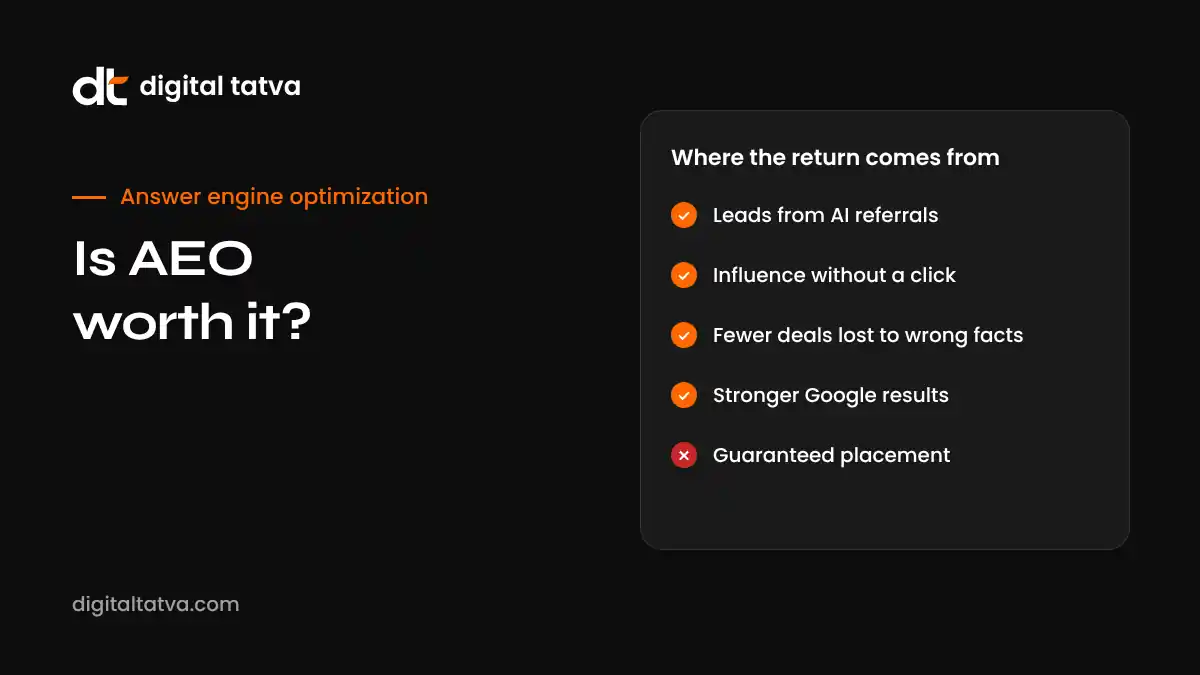
- The return comes from four places: new leads from AI referrals, influence on decisions without a click, accurate brand facts, and stronger Google results because the foundations overlap.
- Some of the value is hard to measure in clicks. Measure mentions, accuracy and branded demand as well as traffic.
- Start small: a baseline audit tells you whether the opportunity is real for your category before you commit a monthly budget.
- Digital Tatva starts every engagement with an AI visibility audit so the decision is based on your data, not ours.
Why the question matters now
Every new marketing channel arrives with hype. Some, like social media in the early years, became essential. Others faded. It is fair for a business owner or marketing head to ask whether AEO is real before spending on it.
Three facts make the case that AI answers are now a real channel:
- Scale. OpenAI said in November 2026 that ChatGPT has about 1.2 billion weekly users and that its search-like queries equal about 20% of Google’s search volume. Those are OpenAI’s own figures, without a published method, and we discuss their limits in ChatGPT search vs Google. Even discounted, the audience is large.
- Google’s own shift. Google now shows AI Overviews on many searches and offers AI Mode. Buyers who never open ChatGPT still read AI-written answers on Google.
- Quality of visitors. Ahrefs published data from its own website showing that AI search visitors made up 0.5% of its traffic but drove 12.1% of signups. That is one company’s experience, not a universal rule, but it fits a pattern many businesses see: people who click from an AI answer arrive better informed.
So the question is not whether AI answers matter in general. It is whether they matter enough in your category to justify the work now.
Where the return on AEO comes from
1. Leads from AI referrals
When an AI tool cites your page and a buyer clicks, that visit shows up in analytics as a referral from chatgpt.com, perplexity.ai, copilot.microsoft.com, gemini.google.com and similar sources. These visits are often small in number but high in intent. You can track them and their conversions in GA4. Our guide to tracking AI traffic in GA4 shows how.
2. Influence without a click
Many AI answers satisfy the question on the spot. If the answer names you as a good option, the buyer may search your brand later, call you or remember you at shortlist stage, without ever clicking the AI citation. This value is real but indirect. It shows up as higher branded search in Search Console, more direct traffic and more “I heard about you from ChatGPT” in sales calls.
3. Fewer lost deals from wrong facts
If an AI tool quotes an old price, lists a feature you dropped or confuses you with another company, buyers may rule you out before you ever hear from them. Fixing those errors protects pipeline you would otherwise lose silently. See fixing wrong AI answers about your brand and our guide to AI reputation management.
4. Better Google results
Most AEO work also improves classic SEO: faster, crawlable pages, clearer answers, structured data, consistent brand facts and mentions on trusted sites. Google’s guidance on AI features and your website says the same foundations apply. That overlap means AEO spending is rarely wasted even if AI referrals stay small.
When AEO is worth it, and when it is not yet
| AEO is likely worth it if… | AEO can probably wait if… |
|---|---|
| Buyers research before contacting you, comparing options and prices | Almost all revenue comes from a few named accounts who never search |
| Your category involves considered purchases: software, services, education, health, finance, travel, B2B | Demand is urgent and local, such as emergency repairs, and buyers go straight to maps |
| Competitors are named when you test buying questions in AI tools, and you are not | You are already named accurately for most buying questions |
| AI tools describe you wrongly or not at all | Your brand facts are correct across engines |
| You already see some AI referral traffic in GA4 | You see none after setting up tracking properly, and buyers do not mention AI |
| You invest in SEO and content and want that spend to count in AI answers too | You have no website foundations yet; fix the basics first |
Even in the right-hand column, a quick check that AI tools can read your site and describe you correctly is worth an hour. Our free AI visibility checker covers the technical side.
How to estimate the value of AEO for your business
You do not need a perfect model. A simple estimate is enough to decide whether to start.
- List your buying questions. Write the 20 to 50 questions buyers ask before choosing a provider like you. Include category, comparison, cost and “best for” questions. See AEO prompt research.
- Test them. Ask ChatGPT, Gemini, Perplexity and Google (AI Overviews or AI Mode). Run each question twice. Note whether you are named, who is named instead and which sources are cited. Our guide to checking if ChatGPT recommends your brand explains how.
- Calculate your share. The percentage of questions where you are named is your starting mention share. Compare it with your top competitors. See AI share of voice.
- Check current AI traffic. In GA4, look at referral sessions and conversions from AI sources over the last three to six months.
- Ask sales. How many recent leads mentioned AI tools? Add a “How did you hear about us?” option for AI assistants if you do not have one.
- Estimate the gap. If competitors are named in, say, half the questions and you in a tenth, ask what one extra deal per month from AI research would be worth. Compare that with the cost of the work.
This will not give you a precise ROI figure, and anyone who offers one before seeing your data is guessing. It will tell you whether the opportunity is large, small or already captured.
What AEO costs compared with the alternatives
AEO pricing varies with scope: the number of prompts tracked, markets and languages, and how much technical and content work is needed. Most providers offer a fixed-fee audit followed by a monthly programme. Our guide to AEO pricing explains the cost drivers in detail.
It helps to compare AEO with where the same budget might otherwise go:
| Option | What you get | How it compares with AEO |
|---|---|---|
| More paid search | Immediate clicks while you pay | Stops when spend stops; does not influence AI answers |
| ChatGPT ads | Placement for users on plans that show ads | Reaches only part of the audience; paid users see no ads. See ChatGPT Ads in India |
| More SEO content | Rankings and organic traffic over time | Overlaps with AEO; AEO makes the same content work in AI answers too |
| Traditional PR | Coverage and awareness | Overlaps with AEO citation work; AEO targets the specific sources AI cites |
| Doing nothing | No cost now | Competitors who invest get named more often; errors about you persist |
For most businesses AEO is not a replacement for these channels. It is a way to make SEO, content and PR spending count in the place buyers increasingly read.
How long before AEO pays back
Timelines depend on your starting point and category. In our experience:
- First month: baseline, technical fixes and entity corrections. If AI crawlers were blocked or facts were wrong, these fixes can matter quickly once engines recrawl.
- Months two to three: content improvements get picked up. Accuracy of AI descriptions often improves first.
- Months three to six and beyond: mention share rises as content and third-party coverage build. In competitive categories this takes longer.
Read how long AEO takes for the factors involved. The key point for an ROI decision is that early months are about foundations. Judge the programme at three and six months against your own baseline, not against a promise.
What makes AEO fail to pay back
When AEO disappoints, it is usually for one of these reasons, all avoidable:
- No baseline. Without a measured starting point, nobody can show what changed.
- Wrong prompts. Tracking vanity questions instead of real buying questions.
- Skipping foundations. Writing content while AI crawlers are blocked or key pages do not render. See the technical AEO checklist.
- Tricks instead of substance. Hidden text, keyword stuffing or fake reviews. These break platform rules and do not build lasting visibility.
- Measuring only clicks. Missing the influence AI answers have without a click.
- Treating llms.txt as a strategy. It is an optional extra at most. See llms.txt for AEO.
- Buying guarantees. No provider controls AI answers. A guarantee is a sign the provider does not understand the channel or is not being honest about it.
More in AEO mistakes to avoid.
How to measure whether AEO is working
Set these up before you start, so you can compare honestly.
| Metric | Where it comes from | What it tells you |
|---|---|---|
| Mention share | Monthly prompt tests | How often you are named for buying questions, by engine |
| Citation share | Monthly prompt tests | How often your pages are linked as sources |
| Accuracy | Monthly prompt tests | Whether facts about you are correct |
| AI referral sessions and conversions | GA4 | Direct visits and leads from AI tools |
| AI feature data | Search Console, where available | How you appear in Google’s AI features. See the AI performance report |
| Branded search | Search Console | Whether more people look for you by name |
| Self-reported source | Forms and sales calls | Leads who say AI tools pointed them to you |
Our guides to AEO KPIs and the AEO reporting template show how to put these together.
Three scenarios
These are illustrations, not client results.
A B2B software company: clearly worth it
Buyers ask AI tools for shortlists before booking demos. In testing, competitors are named in most comparison prompts and the company in very few. Its pricing is hidden behind a form and its comparison pages are thin. AEO work here is high value: clear pricing explanations, honest comparison pages, review platform presence and monthly tracking. See AEO for SaaS.
A regional manufacturer: worth a focused start
Distributors and procurement teams research suppliers online, and AI tools give vague or wrong answers about the company’s capabilities. A modest programme focused on entity facts, product specification pages and industry directories fixes the most damaging errors without a large budget. See AEO for manufacturers.
An emergency repair service: mostly not yet
Customers search maps and call immediately. AI tools rarely feature in the journey. The business keeps its Google Business Profile, reviews and service pages strong, which also helps Google’s AI features, and checks AI answers quarterly. A full AEO programme can wait. See AEO for local business.
Building the business case for leadership
If you need approval for an AEO budget, a one-page case works better than a long deck. Use this structure:
- The shift. One paragraph on how buyers in your category now research, with your own evidence: AI referral sessions in GA4, sales calls that mention AI tools, or results from your own prompt tests.
- The gap. Your mention share against two or three competitors for your top buying questions, and any wrong facts AI tools state about you.
- The risk of waiting. Competitors that build citations and content now are harder to displace later, and wrong facts keep costing deals until they are fixed.
- The plan. A fixed-fee audit first, then a monthly programme only if the audit confirms the opportunity.
- The measures. Mention share, accuracy, AI referral conversions and branded search, reviewed at three and six months.
- The cost. The audit fee and an indicative monthly range, compared with what one additional customer per month is worth.
Framed this way, the decision is small and reversible: pay for a measured baseline, then decide with evidence.
Doing AEO yourself vs hiring help
A lot of early AEO work is free and can be done by a capable marketer. Our AEO quick wins and free AEO tools guides cover it. Doing it yourself makes most sense when:
- You have a small number of buying questions and one main market.
- Someone on your team can spend a few hours a week on testing and content.
- Your site has no serious technical blockers.
Outside help usually pays off when:
- You need reliable measurement across many prompts, engines or markets.
- Technical issues such as bot rules, rendering or structured data need specialist attention.
- You need to earn mentions on third-party sources AI tools cite.
- You want a clear priority order instead of a long list of possible tasks.
Many clients do both: our audit sets the plan, their team handles content, and we handle measurement, technical work and citations. If you are comparing providers, read how to choose an AEO agency and LLM SEO services.
Questions to ask before you invest
- Do our buyers research before they contact us?
- When we test our top buying questions, are we named? Who is?
- Can AI crawlers read our key pages today?
- Do AI tools describe us accurately?
- Are we already getting AI referral traffic or leads?
- What is one extra deal per month worth to us?
- Can we commit to measuring for at least six months before judging?
If most answers point toward opportunity, AEO is worth starting. If not, do the basic checks, set up tracking and revisit in a quarter.
How Digital Tatva helps you decide
We would rather tell you AEO is not a priority yet than sell you a programme you do not need. That is why every engagement starts with measurement.
- Audit first. Our AI visibility audit tests your real buying questions across engines, checks technical access and entity facts, and gives you a ranked fix list. It is useful on its own even if you do the work in-house.
- Clear recommendation. We tell you plainly whether a monthly programme makes sense, and what we would expect it to change.
- Measured progress. If you continue, the same prompts are retested every month alongside GA4 and Search Console data.
- Honest rules. No guaranteed AI placement, no fake reviews and no invented results.
- Founder-led. Every engagement is led by Ketan Parmar, who has 15 years of experience in digital marketing.
Our services are listed on the services page, and our method is set out in Digital Tatva’s AEO process.
Decide with data. Request an AI visibility audit and see how ChatGPT, Gemini, Perplexity, Copilot and Google AI answer your buyers’ questions today. Or ask us whether AEO makes sense for your business.
Frequently asked questions
Is AEO worth it for small businesses?
Often, yes, in a focused form. Small businesses in research-heavy categories benefit from fixing crawler access, brand facts and key pages. Urgent local services may need little beyond a strong Google Business Profile and accurate listings.
What is the ROI of AEO?
It varies by category and starting point. Returns come from AI referral leads, influence without a click, fewer deals lost to wrong facts and stronger Google results. Measure your baseline first to estimate it for your business.
Is AEO just a new name for SEO?
No, but it builds on SEO. AEO adds prompt research, AI-specific technical checks, answer-first content, citation work on the sources AI uses and new measurement.
How long does AEO take to pay back?
Foundations take the first one to two months. Content and accuracy improvements often show by month three. Mention share in competitive categories usually takes three to six months or more.
Can AEO guarantee my business appears in ChatGPT?
No. AI tools choose their own sources and answers vary. AEO improves the inputs those tools use and measures the outputs over time.
Should I spend on AEO or ChatGPT ads?
They do different jobs. Ads reach users on plans that show them, while organic visibility reaches every user. Most businesses benefit from getting organic foundations right first.
How do I know if AEO is working?
Track mention share, citation share and accuracy from monthly prompt tests, plus AI referral sessions and conversions in GA4 and branded search in Search Console.
What is the cheapest way to start AEO?
Run free checks yourself, then commission a fixed-fee audit. It gives you a baseline and a fix list without committing to a monthly programme.
Sources
- OpenAI: ChatGPT search is about 20% of Google, Big Technology
- Does AI search traffic convert better than traditional search?, Ahrefs
- AI features and your website, Google Search Central
Product details, prices and features are checked at the time of writing and can change. Sources are linked in the text so you can check them yourself.
How does your brand appear in AI answers?
We test the questions your buyers ask across the major AI assistants and search engines, then show you what to fix first.
Get an AI Visibility Audit