AEO for Law Firms: Get Recommended When Clients Ask AI
More people now ask ChatGPT, Gemini and Google AI for legal help and lawyer recommendations. Here is how law firms can use answer engine optimization ethically to appear in AI answers, from practice area pages and lawyer profiles to reviews and local signals.
On this page
- Key takeaways
- How people use AI to find legal help
- Why AI is cautious with legal content
- A note on professional rules
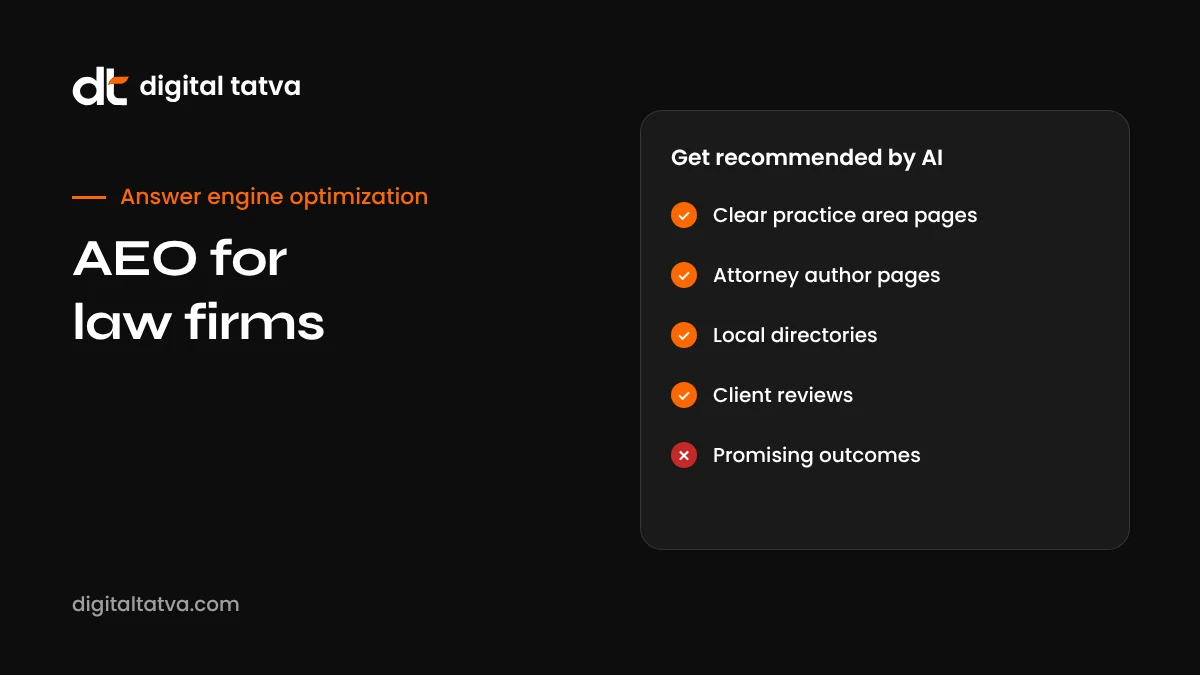
- Step 1: Build clear practice area pages
- Step 2: Create detailed lawyer profiles
- Step 3: Publish genuinely helpful legal content
- Step 4: Strengthen local and directory signals
- Step 5: Handle reviews carefully
- Step 6: Technical basics for law firm websites
- What AI recommendations of law firms look like
- Content ideas by practice area
- Common AEO mistakes law firms make
- Using AI tools inside the firm, responsibly
- Measuring AEO results for a law firm
- A 60-day plan for law firms
- Writing a practice area page: a worked example
- Answering the questions clients ask before calling
- Recognition and independent signals
- Handling incorrect AI answers about your firm
- AEO for solo practitioners and small firms
- How Digital Tatva can help
- Frequently asked questions
Last updated: 13 November 2026
Quick answer: AEO for law firms is the practice of making your firm easy for AI assistants like ChatGPT, Gemini, Perplexity and Google AI Overviews to find, understand and recommend when people ask legal questions or look for a lawyer. The essentials are: clear, accurate practice area pages that answer common client questions, detailed lawyer profiles with credentials, consistent firm details across directories and your Google Business Profile, genuine client reviews where your professional rules allow them, and helpful legal content written or reviewed by qualified lawyers. All of it must comply with the advertising and solicitation rules that apply to lawyers in your jurisdiction, such as the Bar Council of India rules in India.
Key takeaways
- People increasingly ask AI to explain legal problems and suggest lawyers before contacting anyone.
- AI treats legal topics carefully and prefers clearly expert, well-sourced content.
- Practice area pages and lawyer profiles are the foundation of law firm AEO.
- Directories, reviews and local signals strongly influence AI recommendations of firms.
- Professional conduct rules on advertising apply to everything you publish. When in doubt, check with your bar council or regulator.
- No one can guarantee a law firm will be recommended by AI. Be wary of anyone who claims otherwise.
How people use AI to find legal help
Legal problems are stressful, confusing and often urgent. That makes them exactly the kind of questions people now take to AI assistants first. Typical examples include:
- “My landlord is not returning my security deposit in Bengaluru. What can I do?”
- “How long does a mutual consent divorce take in India?”
- “Do I need a lawyer to register a trademark?”
- “Best property lawyer in Ahmedabad for a title search.”
- “What is the process for a cheque bounce case?”
- “How much does a startup lawyer charge for a shareholder agreement?”
Some of these are informational: the person wants to understand their situation. Others are commercial: they want to find a lawyer. AI assistants handle both. For informational questions, they explain the law and often suggest consulting a lawyer. For commercial questions, they may name firms or directories. Both are opportunities for a firm that has prepared well. Our guide to AI for lawyers covers how lawyers themselves are using AI tools.
Why AI is cautious with legal content
Legal information falls into what Google calls “your money or your life” topics, where inaccurate content can cause real harm. AI developers also design their assistants to be careful here. In practice that means:
- AI prefers authoritative, clearly expert sources such as government sites, bar councils, courts, established legal publishers and reputable firms.
- It often adds disclaimers and recommends consulting a qualified lawyer.
- It may avoid recommending specific firms unless there is strong independent evidence.
- It is more likely to cite pages that are accurate, current and clearly attributed to qualified authors.
This is good news for genuinely expert firms willing to publish clear, careful content. It rewards exactly what good lawyers already do well. See E-E-A-T for AI search for the underlying principles.
A note on professional rules
Before anything else: lawyers in many jurisdictions face strict rules on advertising and soliciting work. In India, the Bar Council of India’s rules restrict advocates from advertising or soliciting work, with limited permitted information on websites. Other countries have their own rules, which are often more permissive but still regulate claims, testimonials and comparisons.
This guide describes general AEO practices. It is not legal or regulatory advice. Every firm should check what its professional body permits, and keep content factual, accurate and free of promises about outcomes. Where rules limit what you can publish, focus on the permitted information and on genuinely educational content, and avoid anything that could be seen as solicitation.
Step 1: Build clear practice area pages
Practice area pages tell AI what your firm does. Many firm websites have a single “Services” page listing a dozen areas in one paragraph. That gives AI very little to work with. Instead, give each significant practice area its own page.
| Section | What to include |
|---|---|
| Summary | Two or three sentences stating the practice area, the kinds of matters handled, and the courts or forums where the firm practises |
| Who it is for | Individuals, startups, families, corporates or specific industries |
| Common matters | A list of typical matters, in plain language |
| Process overview | General steps in a typical matter and approximate timelines, with appropriate caveats |
| Lawyers | Who handles this area, linked to their profiles |
| FAQs | Short, accurate answers to common questions |
| Disclaimer | Clear statement that the page is general information, not legal advice |
Write in plain language. Clients search for “landlord not returning deposit”, not “recovery of security deposit under tenancy law”. Use both where helpful. Our guide to answer-first content explains the structure.
Step 2: Create detailed lawyer profiles
Clients hire lawyers, not just firms. AI systems also connect expertise to named people. Each lawyer profile should include:
- Full name, designation and a professional photo.
- Enrolment details and bar registration as appropriate for your jurisdiction.
- Education and years of practice.
- Practice areas and the courts or forums where they appear.
- Publications, talks and professional memberships.
- Languages spoken.
- Links to LinkedIn and other professional profiles.
Add Person schema to each profile, connected to the firm’s Organization or LegalService schema. See author pages for AEO and LinkedIn for AEO.
Step 3: Publish genuinely helpful legal content
Educational content is where law firms can build the most authority in AI search. AI assistants answering “how does a mutual consent divorce work?” need accurate, current, clearly written explanations. If your firm’s guide is the clearest and most reliable, it has a good chance of being used.
What works well:
- Process guides: step-by-step explanations of common legal processes with realistic timelines.
- Document checklists: what documents someone needs for a specific matter.
- Rights explainers: plain-language guides to common rights, such as tenant rights or consumer rights.
- Law change updates: clear summaries of new laws, amendments and important judgments.
- Cost guides: general information about how fees work, where your rules allow.
Every piece should be written or reviewed by a qualified lawyer, show the author and review date, cite statutes, rules or judgments where relevant, and carry a clear disclaimer. Update content when laws change, and remove or clearly mark outdated guidance.
Step 4: Strengthen local and directory signals
For “best lawyer near me” style questions, AI assistants lean on local and directory data. Make sure your firm is accurately represented:
| Source | What to check |
|---|---|
| Google Business Profile | Correct category, address, hours, phone, website, practice areas in the description, photos |
| Legal directories | Accurate listings on reputable legal directories relevant to your market |
| Bar association listings | Correct member details |
| Firm page and lawyer profiles complete and consistent | |
| Bing Places and Apple Maps | Same details as Google |
Consistency is critical. Different addresses or names across directories can lead to wrong or missing recommendations. See AEO for local businesses and entity SEO for AEO.
Step 5: Handle reviews carefully
Reviews are a strong signal for AI recommendations, but lawyer reviews are sensitive. Depending on your jurisdiction, there may be rules about soliciting testimonials, and confidentiality obligations limit what you can say in response. General principles:
- Check your professional rules on reviews and testimonials before asking for them.
- Never reveal client information when responding to reviews, positive or negative.
- Respond professionally and briefly, inviting further discussion offline where appropriate.
- Never post fake reviews or offer incentives where rules prohibit them.
If reviews are restricted for you, focus more on directory listings, professional recognition and educational content.
Step 6: Technical basics for law firm websites
- Allow AI search crawlers in robots.txt and your firewall. See our AI crawlers list.
- Make sure pages load fast and show their text without JavaScript.
- Use LegalService or Attorney-related schema where appropriate, plus Organization, Person and FAQPage schema.
- Use HTTPS, clear privacy policies and secure contact forms.
- Avoid hiding practice area content behind tabs or pop-ups.
See our technical AEO checklist.
What AI recommendations of law firms look like
When we test prompts like “best family lawyer in Pune”, AI answers usually do one of three things:
- Explain how to choose a lawyer and suggest directories or bar associations, without naming firms.
- Name a few firms or lawyers that appear consistently across directories, reviews and articles.
- Combine both, giving general advice and a short list.
Firms named in the answer typically have strong, consistent listings, detailed practice area content, recognisable lawyers and some independent coverage. That is the profile to build towards. Our guide to checking whether ChatGPT recommends your brand explains how to test your own visibility.
Content ideas by practice area
| Practice area | High-value content ideas |
|---|---|
| Family law | Divorce process and timelines, child custody basics, maintenance explained, documents checklist |
| Property law | Title search checklist, RERA complaints, property registration process, tenant rights |
| Corporate law | Company incorporation steps, shareholder agreement essentials, ESOP basics, compliance calendars |
| Intellectual property | Trademark registration process, copyright basics, IP for startups |
| Criminal law | Bail process explained, rights on arrest, cheque bounce cases |
| Employment law | Wrongful termination, notice periods, workplace harassment processes |
| Consumer law | How to file a consumer complaint, e-commerce disputes, timelines |
Build each into a cluster: a main practice area page plus supporting guides. See topical authority in AI search.
Common AEO mistakes law firms make
- One generic services page covering every practice area in a paragraph.
- Anonymous content with no named lawyer author or review date.
- Outdated legal information after laws or rules change.
- Promises about outcomes that may break professional rules and erode trust.
- Inconsistent firm details across directories and Google.
- Copying content from other firms or legal portals.
- Using AI to write legal content without lawyer review.
Using AI tools inside the firm, responsibly
Many firms now use AI to help draft research memos, summarise documents or prepare first drafts of articles. That can save time, but legal content published under your name must be accurate. Always have a qualified lawyer review and take responsibility for anything published, verify citations, and protect client confidentiality by not putting client information into tools that are not approved for it. See AI data privacy for business and our AI usage policy template.
Measuring AEO results for a law firm
- Prompt tracking: test 20 to 40 questions monthly, covering informational and “find a lawyer” queries in your cities and practice areas.
- AI referrals: track visits from AI assistants in GA4.
- Enquiries: ask new clients how they found you, and include “AI assistant” as an option.
- Search Console: watch impressions and clicks for practice area and guide pages.
- Directory and profile accuracy: audit quarterly.
See AEO KPIs and tracking AI traffic in GA4.
A 60-day plan for law firms
- Weeks 1 to 2: Baseline prompt tests; audit Google Business Profile, directories and website for consistency; check AI crawler access.
- Weeks 3 to 4: Rewrite or create pages for your three most important practice areas.
- Weeks 5 to 6: Build complete lawyer profiles with schema and LinkedIn links.
- Weeks 7 to 8: Publish two lawyer-reviewed guides answering common client questions; add FAQs to practice area pages.
- Day 60: Re-run prompts and compare with the baseline.
Writing a practice area page: a worked example
Here is how a property law practice area page might open, written for both clients and AI retrieval while staying factual.
Property law services in Ahmedabad. Our property law team advises individuals, families and developers on buying, selling, leasing and inheriting property in Gujarat. We handle title searches, sale deeds, registration, RERA complaints, tenancy disputes and property partition matters before civil courts and RERA authorities. A typical title search for a residential flat takes five to ten working days, depending on how quickly records can be obtained.
That opening tells a reader, and an AI system, exactly what the team does, where, for whom, and roughly how long a common task takes. It avoids superlatives and outcome promises. The rest of the page can then cover each matter type, process steps, documents needed and FAQs.
Answering the questions clients ask before calling
Clients usually have the same handful of questions before they contact a firm. Answering them clearly, within your professional rules, both helps clients and gives AI assistants accurate information to share.
| Client question | How to address it |
|---|---|
| Do I need a lawyer for this? | Explain when professional help is usually advisable and when simpler routes exist |
| How long will it take? | Give typical ranges with clear caveats about variation |
| What documents do I need? | Provide a checklist for common matters |
| How are fees structured? | Explain general fee approaches where your rules permit |
| What happens at the first consultation? | Describe the format, duration and what to bring |
| Can you handle matters outside this city? | State the courts, forums and regions you cover |
Recognition and independent signals
Beyond your own site, AI systems look for independent signs that a firm is credible. For law firms, useful signals include:
- Legal rankings and directories that assess firms using published methods.
- Articles and commentary by your lawyers in legal publications, newspapers and business media.
- Speaking engagements at bar association events, universities and industry conferences.
- Reported judgments where your lawyers appeared, mentioned factually where permitted.
- Professional memberships and committee roles.
Each of these creates an independent record connecting your lawyers to their areas of expertise. Over time, that record is what makes an AI assistant comfortable naming your firm. See brand mentions for AEO and AEO for professional services.
Handling incorrect AI answers about your firm
Sometimes AI assistants give wrong information about a firm: an old address, a lawyer who has left, or a practice area you no longer offer. Because legal clients rely on accuracy, fix these quickly:
- Identify the wrong fact and, if the answer cites sources, which source it came from.
- Correct your own website first, including lawyer profiles and the contact page.
- Update Google Business Profile, directories, bar listings and LinkedIn.
- Ask third-party sites to correct outdated details.
- Re-test after a few weeks; search-based answers usually update first.
See fixing wrong AI answers about your brand.
AEO for solo practitioners and small firms
Solo lawyers and small firms often assume large firms will always win in AI answers. For broad, competitive questions that may be true. But many client questions are local and specific, such as a particular court, a particular type of dispute or a particular language. A solo practitioner with a clear website, a complete Google Business Profile, accurate directory listings and a handful of genuinely helpful guides in a focused area can appear in AI answers for those questions. Focus on one or two practice areas and one city, and do them thoroughly.
How Digital Tatva can help
We help law firms and legal professionals understand how AI assistants describe them and build visibility in a careful, compliant way. We audit practice area pages, lawyer profiles, directories and technical setup, and we help plan educational content that lawyers review and own. We do not make claims about outcomes, we respect professional rules, and we never promise AI placement. Firms remain responsible for ensuring their content complies with the rules that apply to them.
Want to know whether AI recommends your firm? Request an AEO audit for a review of your AI visibility and content, or check AI crawler access with our free AI visibility checker.
Frequently asked questions
Can law firms appear in ChatGPT answers?
Yes. ChatGPT and other AI assistants can mention law firms when they find consistent, credible information across the firm’s website, directories, reviews and independent sources.
Is AEO allowed for lawyers in India?
Lawyers in India must follow the Bar Council of India’s rules, which restrict advertising and solicitation. Publishing accurate permitted information and educational content is generally the safer approach. Check the current rules or seek guidance for your situation.
What content helps law firms in AI search?
Clear practice area pages, detailed lawyer profiles and lawyer-reviewed guides that explain legal processes, rights and documents in plain language.
Do online reviews matter for law firms in AI answers?
Reviews can influence AI recommendations, but lawyers must follow their professional rules on testimonials and confidentiality. Where reviews are restricted, directories and educational content matter more.
Should law firms use AI to write blog posts?
AI can help draft, but every published piece should be reviewed and approved by a qualified lawyer, with verified citations and a clear review date.
Which schema should a law firm use?
Organization or LegalService schema for the firm, Person schema for lawyers, and FAQPage or Article schema for content, all with accurate details.
How long does AEO take for a law firm?
Technical and content improvements can show up in search-based AI answers within weeks. Building recognised authority in competitive practice areas usually takes several months.
Can Digital Tatva help our law firm?
Yes. We provide AI visibility audits and AEO support for law firms, with care for professional rules and accuracy.
Can law firms advertise in AI search?
Some AI platforms are testing labelled ads, but organic visibility depends on content, reputation and entity signals. Any advertising must follow the professional conduct rules that apply to lawyers in your jurisdiction.
Which pages matter most for a law firm’s AI visibility?
Practice area pages, lawyer profiles with credentials, clear contact and location details, and plain-language FAQ pages that answer common client questions without giving case-specific advice.
Do online reviews matter for law firms in AI answers?
Yes. AI assistants often summarise reputation from reviews and directories. Encourage genuine reviews where professional rules permit, and respond professionally without disclosing confidential details.
Should law firms publish legal guides?
Yes, general educational guides help people and AI systems understand your expertise. Add clear disclaimers that the content is not legal advice, and keep guides updated when laws change.
Can AI assistants recommend specific lawyers?
They often mention firms when asked for recommendations, drawing on directories, reviews and websites. Clear, consistent information improves your chances of being described accurately.
Is AEO different for law firms in India?
The principles are similar, but Bar Council rules on advertising and solicitation apply, so focus on informational content and accurate listings.
Product details, prices and features are checked at the time of writing and can change. Sources are linked in the text so you can check them yourself.
How does your brand appear in AI answers?
We test the questions your buyers ask across the major AI assistants and search engines, then show you what to fix first.
Get an AI Visibility Audit