Your First 90 Days With an AEO Agency: What to Expect
A week by week view of the first 90 days with an AEO agency, what you should receive, what you need to provide and what results are realistic.
On this page
- Key takeaways
- Why the first 90 days matter so much
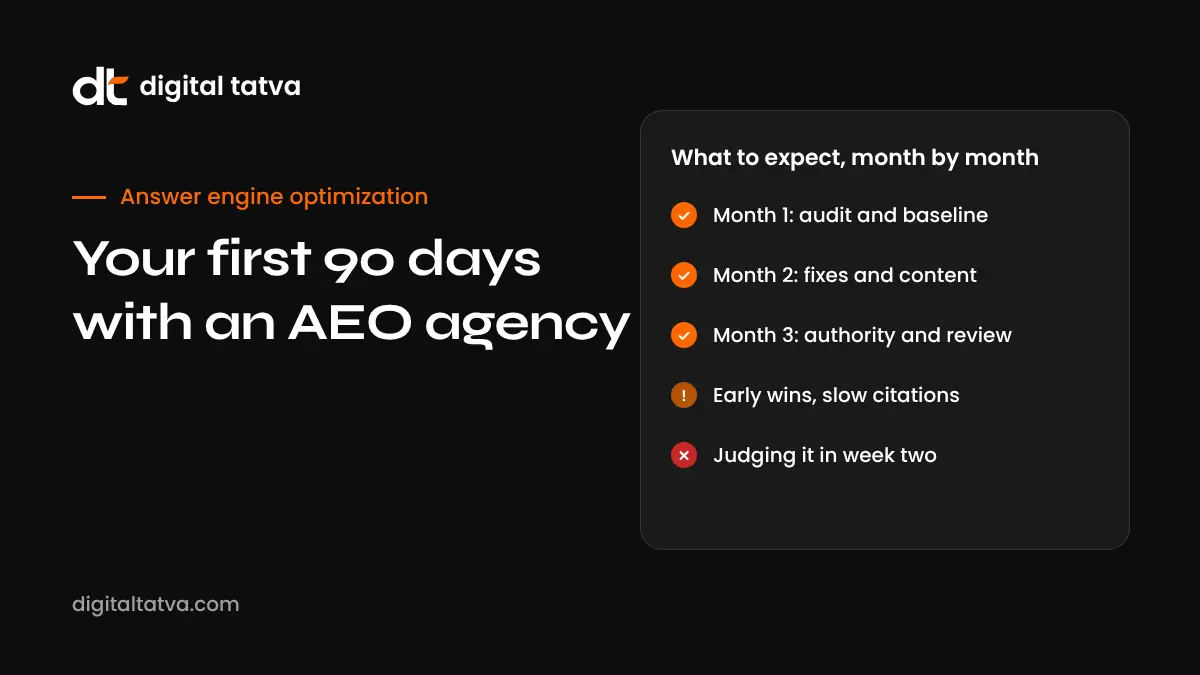
- The 90 day plan at a glance
- Month 1: onboarding, research and baseline
- Month 2: fixes and core content
- Month 3: authority and the first trend report
- What results are realistic by day 90?
- How to get the most out of the first 90 days
- Warning signs during the first 90 days
- What happens after day 90?
- A sample week by week checklist you can track
- How the plan changes by business type
- Questions to ask at your day 90 review
- How Digital Tatva runs the first 90 days
- Frequently asked questions
Last updated: 13 November 2026
Quick answer: In the first 90 days with an AEO agency, expect month one to cover onboarding, prompt research and an AI visibility baseline; month two to focus on technical fixes, schema, entity cleanup and rewriting your most important pages; and month three to start off-site authority work and deliver the first trend report. Early wins are usually technical and on-site. Changes in how often AI tools like ChatGPT, Perplexity and Google AI Overviews name you tend to show gradually after that, and cannot be guaranteed.
Key takeaways
- The first 90 days are mostly about building the base: measurement, fixes and core content.
- Your team’s input matters most in weeks one to three. Slow access and approvals are the most common cause of delays.
- Expect a written baseline report by the end of month one. Without it, nothing later can be measured.
- Search-connected AI features may respond within weeks of changes. Answers based mainly on model training data take longer.
- Judge the agency at day 90 on the quality and completion of the work and the honesty of reporting, not on dramatic jumps in AI mentions.
Why the first 90 days matter so much
The first three months of an AEO engagement set the direction for everything after. If the baseline is weak, you cannot prove progress. If the technical foundation is skipped, content work underperforms. If your team is slow to give access or approve changes, the whole timeline slips.
This guide explains what a well-run first 90 days looks like, week by week. It is based on how we run engagements at Digital Tatva, and it applies broadly to any good AEO agency. Treat it as an illustrative plan rather than a fixed promise, since every business, site and market differs.
If you have not chosen an agency yet, start with what an AEO agency does, how to choose an AEO agency and our AEO agency red flags.
The 90 day plan at a glance
| Phase | Main focus | Key deliverables | What you provide |
|---|---|---|---|
| Weeks 1 to 2 | Onboarding and discovery | Kickoff, access set up, goals agreed, competitor list | Access to site, analytics, search console, brand info |
| Weeks 3 to 4 | Research and baseline | Prompt set, AI visibility baseline, technical and entity audit | Feedback on prompts, sales and support questions |
| Weeks 5 to 6 | Technical and entity fixes | Crawler access fixes, schema, profile alignment, brand description | Approvals, developer time if needed |
| Weeks 7 to 8 | Priority content | Rewrites of key pages, FAQ sections, first new answer pages | Expert review, facts, pricing information |
| Weeks 9 to 10 | Off-site authority begins | Cited source targets, review profile work, outreach plan | Customer contacts for reviews, spokesperson time |
| Weeks 11 to 12 | First trend report and plan | Re-run of prompt set, trend report, next quarter roadmap | Review meeting, feedback |
Month 1: onboarding, research and baseline
Weeks 1 to 2: onboarding and discovery
The first two weeks are about understanding your business well enough to measure the right things. A good agency will run a kickoff session and ask questions like:
- Who are your best customers, and how do they usually find you?
- What questions do prospects ask on sales calls?
- Which competitors do you lose deals to?
- Which services or products matter most commercially?
- Which markets, cities and languages matter?
- Has anyone told you that an AI tool recommended you, or a competitor?
You should expect to give access to your website CMS, Google Search Console, Google Analytics or another analytics tool, Bing Webmaster Tools, your Google Business Profile if you are local, and any existing brand guidelines or company facts.
What you should get by the end of week two: an agreed list of goals, a competitor list, confirmed access, a communication plan, and a named point of contact on both sides.
Weeks 3 to 4: prompt research and the baseline
This is where the real AEO work starts. The agency builds a prompt set based on your discovery input, search data, community questions and competitor content. It groups prompts by funnel stage and commercial value. Our guide to AEO prompt research shows how this is done.
The agency then runs the prompt set across the AI platforms that matter for your audience, typically ChatGPT, Google AI Overviews and AI Mode, Perplexity and Gemini, with others added as relevant. Each prompt should be run more than once, because answers vary. It records:
- How often your brand is mentioned.
- How often you are recommended rather than just listed.
- Whether AI describes you accurately.
- Which competitors appear and how often.
- Which sources AI cites.
In parallel, it runs a technical review (crawler access, rendering, indexation, schema, site structure) and an entity review (how consistently your brand is described across your site and the web). See our AEO audit guide and AI visibility audit checklist.
What you should get by the end of month one: a written baseline report with the prompt set, current visibility, competitor share of voice, cited sources, technical findings, entity findings and a prioritised plan for months two and three. If this report does not exist, ask for it before the agency goes further.
Month 2: fixes and core content
Weeks 5 to 6: technical and entity fixes
With the baseline in hand, the agency fixes the things that stop AI tools from reading and trusting your site. Typical work includes:
- Unblocking AI search crawlers in robots.txt, firewall or CDN settings where they are blocked by mistake, and agreeing a policy for training crawlers with you.
- Making sure key content appears in server-rendered HTML.
- Fixing indexation problems on important pages.
- Adding or correcting Organization, Service, Product, LocalBusiness, FAQPage, Article and Person schema as appropriate. See schema markup for AEO.
- Writing one canonical brand description and aligning it across your site, Google Business Profile, LinkedIn, directories and social bios.
- Creating or improving a company facts page that AI tools can quote accurately.
These changes are often the fastest wins, because they remove blockers. They are also the most technical, so you may need your developer involved. Our technical AEO and entity SEO service pages describe this work.
Weeks 7 to 8: priority content rewrites
Next, the agency rewrites the pages that matter most commercially, usually your home page, main service or product pages, pricing page and about page. Each rewrite should:
- Open with a direct answer to the main question the page addresses.
- Use headings that mirror real buyer prompts.
- Break content into self-contained chunks. See content chunking for AI.
- State facts clearly: who the service is for, where you operate, how pricing works, typical timelines and limitations.
- Include a useful FAQ section.
The agency may also create the first new answer pages, such as a comparison page or a “best for” page targeting a high-value prompt where you are currently absent.
Your role here is important. Agencies can write well, but your experts know your business. Expect to review drafts for accuracy and add details only you know. The fastest engagements are the ones where the client turns around reviews within a few days.
What you should get by the end of month two: a log of all technical and entity fixes, rewritten priority pages live on the site, and a short progress note on any early changes.
Month 3: authority and the first trend report
Weeks 9 to 10: starting off-site authority
AI tools rely heavily on third-party sources. Using the cited source map from the baseline, the agency starts building your presence where it matters most. This usually includes:
- Claiming and completing review profiles on platforms relevant to your industry, and setting up a simple process for asking real customers for reviews. See review sites for AEO.
- Getting listed in the directories and roundups AI cites for your category.
- Planning digital PR, expert commentary or a data story. See press releases for AEO.
- Setting up a LinkedIn plan for founders or experts. See LinkedIn for AEO.
- Identifying genuine, disclosed community opportunities on Reddit and Quora.
Off-site work takes longer to show results than on-site changes because it depends on other people publishing. That is why it starts in month three and continues afterwards.
Weeks 11 to 12: re-run, report and plan
At the end of the quarter, the agency re-runs the full prompt set using the same method as the baseline and produces the first trend report. A good report includes:
- Mention, recommendation and citation rates compared with the baseline, per platform.
- Competitor share of voice changes.
- New sources citing you, and any you lost.
- Organic search changes, including AI Overview presence.
- A full log of work done in the quarter.
- What worked, what did not, and why.
- A roadmap for the next quarter.
See our AEO reporting template for a sample format, and AEO KPIs for the metrics.
What results are realistic by day 90?
We will not give you invented numbers. What we can describe honestly is the pattern most engagements follow.
| Area | Realistic by day 90 | Usually takes longer |
|---|---|---|
| Technical health | Blockers removed, schema valid, key pages indexed | Large site restructures |
| Entity consistency | Core profiles aligned, clear brand description live | Knowledge panel changes |
| Content | Priority pages rewritten, first new answer pages live | Full topic clusters |
| Search-connected AI tools | Possible early citations in Perplexity or AI Overviews for some prompts | Consistent presence across many prompts |
| Training-based AI answers | Usually little change yet | Depends on model updates |
| Off-site authority | Profiles improved, outreach started | Published mentions and PR coverage |
Some businesses see encouraging movement early, especially in less competitive niches or when they had obvious technical blockers. Others see little change in AI mentions until months four to six. Both are normal. Our guide on how long AEO takes explains why.
How to get the most out of the first 90 days
- Give access on day one. Delayed access is the most common reason engagements slip.
- Name one internal owner. One person who can answer questions and approve changes keeps things moving.
- Share sales and support insight. The questions your customers ask are the best source of prompts.
- Review content quickly. Aim to turn around drafts within a few working days.
- Involve your experts. Short interviews give content the depth AI tools and buyers value.
- Book developer time early if technical fixes need it.
- Ask real customers for reviews. This is one of the few things only you can do.
- Read the reports and ask questions. Engaged clients get better work.
Warning signs during the first 90 days
Even after signing, keep an eye out for these:
- No written baseline by the end of month one.
- Changes made to your site without a log or approval.
- Reports made of screenshots rather than repeated prompt runs.
- No progress on content because the agency is waiting on you, and nobody told you.
- Pressure to extend the contract before the first trend report.
- Claims of guaranteed AI placement appearing in conversations.
See AEO agency red flags for the full list.
What happens after day 90?
The second quarter usually shifts the balance from fixing to building. Technical work becomes maintenance. Content moves from rewrites to new topic clusters and comparison pages. Off-site authority grows as outreach turns into published mentions. Tracking continues monthly, and the prompt set gets expanded as you learn which areas matter most.
This is also when you can judge return more clearly. Our guide to whether AEO is worth it explains how to connect AI visibility to leads and revenue, and AEO strategy covers longer-term planning.
A sample week by week checklist you can track
If you like to keep your own record, use this checklist to follow progress. Tick each item when it is done and ask about anything that slips by more than a week or two.
| Week | Item | Owner |
|---|---|---|
| 1 | Kickoff meeting held and goals agreed | Both |
| 1 | Access given to CMS, analytics, search console, Bing and business profiles | You |
| 2 | Competitor list and priority services confirmed | Both |
| 2 | Sales and support questions shared | You |
| 3 | Draft prompt set shared for review | Agency |
| 3 | Prompt set approved | You |
| 4 | Baseline runs completed across platforms | Agency |
| 4 | Baseline report delivered and discussed | Agency |
| 5 | Crawler access and indexation fixes made | Agency, your developer if needed |
| 5 | Schema added or corrected and validated | Agency |
| 6 | Canonical brand description approved and rolled out | Both |
| 6 | Company facts page live | Agency |
| 7 | Priority page drafts delivered | Agency |
| 7 | Expert review of drafts completed | You |
| 8 | Rewritten pages published | Agency |
| 9 | Cited source target list shared | Agency |
| 9 | Review profiles claimed and completed | Agency |
| 10 | Review request process running with real customers | You |
| 10 | Outreach and PR plan agreed | Both |
| 11 | Full prompt set re-run | Agency |
| 12 | Trend report and next quarter roadmap delivered | Agency |
How the plan changes by business type
The structure above works for most businesses, but the emphasis shifts:
- Local businesses spend more of month two on Google Business Profile, local directories and review processes, and track prompts that include city and neighbourhood names. See AEO for local business.
- SaaS companies put more weight on comparison and alternatives pages and on review platforms in month two and three. See AEO for SaaS.
- Ecommerce brands focus heavily on product schema, merchant data and buying guides. See AEO for ecommerce.
- B2B service firms invest earlier in founder and expert visibility on LinkedIn and in case study pages. See AEO for B2B.
- Startups often compress the plan, prioritising a clear entity, a strong about page and a few comparison pages. See AEO for startups.
Questions to ask at your day 90 review
- Which prompts improved, and what work do we think caused it?
- Which prompts did not move, and what is the plan for them?
- Which competitors gained or lost share of voice?
- Which new sources started citing us?
- What did we plan to do that did not get done, and why?
- What should we stop doing?
- What will the next 90 days focus on, and how will we measure it?
Honest answers to these questions are a better sign of a good partnership than any single metric.
How Digital Tatva runs the first 90 days
Digital Tatva follows the plan above for every new AEO client, adjusted to your business. You get a written baseline by the end of month one, a log of every change we make, rewritten priority pages in month two, off-site work starting in month three, and an honest trend report at day 90. We tell you what moved, what did not and what we will change next. We never promise AI placement, because no agency can. Our full method is in how Digital Tatva works, and you can see our scope on the services page and answer engine optimization service page.
Ready to start your first 90 days? Request an AEO audit and we will begin with your baseline. Or check your current position first with the free AI visibility checker.
Frequently asked questions
What happens in the first month with an AEO agency?
Onboarding, discovery, prompt research and a baseline audit. The agency learns your business, builds the prompt set, measures how often AI tools mention and recommend you and your competitors, and reviews your technical and entity signals. You should receive a written baseline report by the end of the month.
How soon will AI tools start mentioning my brand?
It varies. Search-connected features such as Perplexity and Google AI Overviews can reflect changes within weeks for some prompts. Answers that rely more on training data usually take longer. Most businesses see readable trends over three to six months, and no timeline can be guaranteed.
What do I need to provide to an AEO agency?
Access to your website, analytics, search console and business profiles, plus brand facts, sales and support questions, competitor information, expert time for content review, and help asking real customers for reviews.
Why does an AEO agency start with a baseline?
Without a baseline, there is no way to show whether later work changed anything. The baseline records your current mentions, recommendations, citations and competitor share of voice across a fixed prompt set.
What are the quickest wins in AEO?
Fixing AI crawler access, correcting schema, aligning your brand description across profiles, and rewriting key pages so they answer questions directly. These remove blockers and are usually done in month two.
Is 90 days enough to judge an AEO agency?
It is enough to judge the quality of their work, process and reporting. It is often too early to judge the full impact on AI mentions, especially in competitive categories.
Will an AEO agency change my website without asking?
It should not. A good agency logs every change and agrees approvals with you in advance. Ask for a change log if you do not receive one.
When does off-site work start in an AEO engagement?
Usually in month three, once the baseline has shown which sources AI cites and your own site is in good shape. Off-site work then continues as an ongoing part of the programme.
What should the 90 day report include?
A re-run of the full prompt set compared with the baseline, mention and citation trends by platform, competitor share of voice, new cited sources, organic search changes, a complete work log, lessons learned and the next quarter’s plan.
What happens after the first 90 days?
The focus shifts from fixing to building: new topic clusters and comparison content, growing third-party mentions, expanding the prompt set and continued monthly tracking.
Can the first 90 days be done faster?
Sometimes. Smaller sites with quick approvals and clear priorities can compress the technical and content phases. The baseline and prompt research should not be rushed, because everything later depends on them.
Do I need a developer during the first 90 days?
Often for a few hours. Crawler access, rendering fixes and some schema changes may need someone with access to your server, CDN or theme. Booking that time early avoids delays in month two.
How much of my team’s time will the first 90 days take?
Expect the most time in weeks one to four for access, discovery and prompt review, then a few hours a week for content review and approvals. Having one internal owner keeps it manageable.
Product details, prices and features are checked at the time of writing and can change. Sources are linked in the text so you can check them yourself.
How does your brand appear in AI answers?
We test the questions your buyers ask across the major AI assistants and search engines, then show you what to fix first.
Get an AI Visibility Audit