Do Press Releases Help AI Visibility? A Practical Guide
Press releases can help AI visibility, but not in the way most people expect. Here is what actually helps your brand appear in ChatGPT, Gemini and Google AI answers, when wire distribution is worth it, and how to write releases that earn real coverage.
On this page
- Key takeaways
- How AI systems treat press releases
- When press releases help AI visibility
- When press releases do not help
- How to write a press release AI can use
- Where to publish your release
- Digital PR vs press releases
- Measuring the AEO impact of a press release
- Press release ideas that work for AEO
- Common press release mistakes
- A press release template built for AI
- How to pitch journalists so a release becomes coverage
- Building a newsroom page that AI can use
- Press releases in India: practical notes
- What results to expect
- How Digital Tatva can help
- Five press release scenarios, judged honestly
- Press releases, AI-generated summaries and accuracy
- How press releases fit with your wider AEO plan
- Writing quotes that journalists and AI actually use
- Measuring coverage quality, not just volume
- A simple press release checklist
- Frequently asked questions
Last updated: 13 November 2026
Quick answer: Press releases can help AI visibility, but mostly indirectly. A press release on a wire service or your own newsroom gives AI systems a clear, dated statement of facts, which can help them describe your company accurately. The bigger benefit comes when a release leads journalists and industry sites to write their own coverage, because AI assistants trust independent publications far more than self-published announcements. Releases with no real news, or that are only syndicated to low-quality sites, rarely help. For AEO, use press releases for genuine news, write them in a clear, factual, quotable style, host them on your site, and focus on earning coverage, not just distribution.
Key takeaways
- AI systems treat independent coverage as stronger evidence than your own announcements.
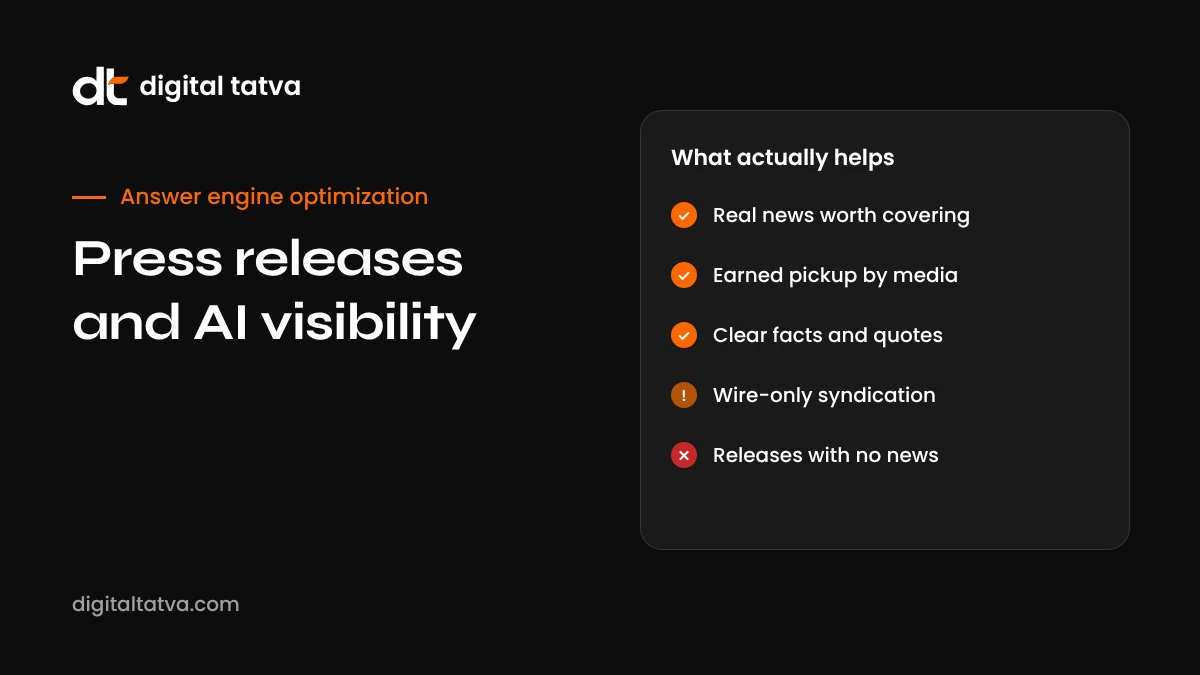
- Press releases are most valuable as a trigger for real media coverage.
- A clear, factual release on your own newsroom page can still help AI get your facts right.
- Mass syndication to low-quality sites adds little and can look spammy.
- Newsworthiness matters more than distribution budget.
How AI systems treat press releases
When an AI assistant answers a question about a company, it weighs sources by how much it can trust them. A press release is, by definition, written by the company about itself. That makes it a useful statement of the company’s claims, but not independent evidence.
In practice, AI answers draw on press releases in three ways:
| How it is used | Example | Value for AEO |
|---|---|---|
| As a factual source for company details | “The company launched in 2024 and is based in Pune” | Useful for accuracy |
| Via news articles that covered the release | A tech publication reports on your funding | High, because the coverage is independent |
| As evidence for a recommendation | “X is a leading provider because…” | Low on its own; AI prefers independent proof |
So the question is not “do press releases help?” but “what kind of release, distributed how, leading to what?” Our guide to AI search ranking factors explains why independent sources carry so much weight.
When press releases help AI visibility
1. When they announce real news
Funding rounds, major product launches, significant partnerships, new research findings, awards from respected bodies, expansions into new markets and leadership changes are the kinds of news journalists might cover. Real news is the foundation of everything else.
2. When they lead to independent coverage
The biggest AEO win from a press release is a journalist or industry site writing their own story. That story becomes an independent source that AI systems can cite. Coverage in respected publications in your sector is often worth far more than wide wire distribution.
3. When they clarify facts
A clear release, hosted on your own newsroom page, can help AI systems get basic facts right: names, dates, numbers, locations and product details. This is especially useful when existing information online is outdated or inconsistent.
4. When they contain original data
Releases built around original research tend to earn more coverage, and the data itself becomes something others cite. See original research for AEO.
When press releases do not help
- Non-news. “We updated our website” or “we are excited to share our values” rarely earns coverage or citations.
- Syndication-only distribution. Being republished on hundreds of low-quality sites does not create trust. Many of those pages are not indexed or valued.
- Keyword-stuffed releases. Written for old SEO rather than readers, they look spammy.
- Vague superlatives. “Leading”, “innovative” and “world-class” without evidence give AI nothing useful.
- Releases with no follow-up. Simply putting a release on a wire without pitching journalists often leads nowhere.
How to write a press release AI can use
Write as if the release will be quoted out of context, because it might be.
- Clear headline: state the news plainly. “Digital Tatva launches free AI visibility checker for Indian businesses” beats “Revolutionising digital visibility”.
- Answer-first opening: the first paragraph should answer who, what, when, where and why in two or three sentences.
- Specific facts: numbers, dates, locations, names and prices where relevant.
- Quotable quotes: one or two quotes from named people that add insight, not just enthusiasm.
- Context: why the news matters to customers or the industry.
- Boilerplate: a short, factual “about the company” paragraph with consistent facts: name, founding year, location and what you do.
- Contact details: a real person journalists can reach.
These are the same principles that make any content easy for AI to use. See answer-first content.
Where to publish your release
| Channel | Pros | Cons | AEO value |
|---|---|---|---|
| Your own newsroom page | Permanent, indexable, under your control | Limited reach on its own | Good for factual accuracy |
| Direct pitch to journalists | Can lead to independent coverage | Time-consuming, no guarantee | High if it lands |
| Major newswire services | Wide distribution, sometimes picked up by news sites | Cost; much syndication is low value | Moderate |
| Industry publications and associations | Targeted, credible audience | Smaller reach | High for niche authority |
| Free release sites | Free | Often low quality and ignored | Low |
A practical approach for most businesses: publish on your own newsroom page, pitch the story directly to a short list of relevant journalists and industry sites, and use a reputable wire service only for genuinely significant news.
Digital PR vs press releases
Digital PR is the broader practice of earning mentions and coverage through stories, data, expert commentary and relationships. Press releases are one tool within it. For AEO, digital PR is usually more effective because it focuses on getting independent publications to talk about you.
Examples of digital PR that help AI visibility:
- Publishing an annual survey or data report that journalists cite.
- Offering expert commentary on industry news.
- Contributing guest articles to respected publications.
- Appearing on podcasts and in industry events.
- Getting listed in credible “best of” roundups.
Our list of the best digital PR tools can help, and brand mentions for AEO explains why mentions matter even without links.
Measuring the AEO impact of a press release
- Before release: ask AI assistants a few questions about your company and the topic of your news. Save the answers.
- Track coverage: note every independent article that mentions the news.
- Two to four weeks after: ask the same questions again. Check whether the news appears and which sources are cited.
- Check search: look for growth in branded searches and referral traffic from coverage.
- Record it: build a simple log so you learn which kinds of news earn coverage and citations.
See tracking brand mentions in ChatGPT for a method.
Press release ideas that work for AEO
- Launch of a free tool or resource that solves a real problem.
- Results of original research or a customer survey.
- A milestone with clear numbers, such as customers served or locations opened.
- A partnership with a recognised brand or institution.
- An award from a respected, independent body.
- Expansion into a new city or country.
- A new certification or compliance milestone, especially in regulated industries.
Common press release mistakes
- Announcing too often, so nothing stands out.
- Burying the news under three paragraphs of background.
- Inconsistent company facts compared with your website and profiles.
- No newsroom page, so the release only exists on syndication sites.
- Overpromising, such as claiming to be “number one” without evidence.
- Paying for “guaranteed placement” on sites nobody reads.
A press release template built for AI
Here is a structure you can adapt. It keeps the facts clear, the news up front and the language quotable.
| Section | What to include | Example |
|---|---|---|
| Headline | Who did what, plainly stated | “Ahmedabad agency launches free tool to check if AI crawlers can read your website” |
| Subheadline | One supporting fact or benefit | “Tool checks access for ChatGPT, Gemini, Perplexity and Claude crawlers in under a minute” |
| Dateline and lead | City, date, and the full news in two sentences | “AHMEDABAD, 13 November 2026: Digital Tatva today launched…” |
| Why it matters | The problem it solves, with a specific fact | Data from your own tests, clearly described |
| Details | How it works, availability, price, eligibility | Bullet points or a short table |
| Quote | Named person adding insight | Founder explaining what they learned |
| Third-party quote (optional) | Customer or partner perspective, with permission | Early user describing a real result |
| Boilerplate | Consistent company facts | Name, founding year, location, what you do, website |
| Media contact | Name, email, phone | A real person who responds |
How to pitch journalists so a release becomes coverage
A release on its own rarely earns coverage. A thoughtful pitch to the right person often does. Some practical tips:
- Build a short, relevant list. Ten journalists who cover your topic are worth more than a thousand who do not.
- Read their recent work. Reference something they wrote and explain why your story fits.
- Lead with the story, not the company. What is new, surprising or useful for their readers?
- Offer something exclusive. Early access to data, an interview or a unique angle.
- Keep it short. A few lines in the email, with the full release linked or attached.
- Be available. Respond quickly to questions and requests for comment.
- Follow up once. Then move on gracefully.
Journalists value sources who are reliable and useful. Over time, those relationships lead to repeated coverage, which is exactly the kind of independent evidence AI systems rely on.
Building a newsroom page that AI can use
A dedicated newsroom or press page on your website gives AI systems and journalists a reliable home for your announcements and facts. Include:
- All press releases in date order, each on its own page with a clear title and date.
- A short company fact sheet: founding year, location, leadership, what you do, key numbers.
- Leadership bios with photos and links to LinkedIn.
- Brand assets: logos and approved images.
- Links to notable coverage, with the publication name and date.
- A media contact.
Mark up each release with Article or NewsArticle schema and keep company facts consistent with your Organization schema. See schema markup for AEO and entity SEO for AEO.
Press releases in India: practical notes
For Indian businesses, a few local considerations apply:
- Regional and language publications can be valuable, especially for local businesses and consumer brands.
- Startup and business news sites covering the Indian ecosystem often welcome funding, launch and data stories.
- Industry associations and chambers of commerce can amplify news to relevant audiences.
- Be careful with paid “featured on” placements. Disclose sponsored content honestly, and remember AI systems treat it as less independent.
If you want to strengthen your presence in AI answers in multiple languages, see multilingual AEO.
What results to expect
Set realistic expectations. A single press release, even a good one, rarely changes AI answers dramatically on its own. What changes AI answers is a steady accumulation of independent coverage, reviews and mentions over months. Think of each release as one step in building that record, and judge success by coverage earned and the change in how AI describes you over time, not by distribution numbers.
For a broader view of what moves AI visibility, see AI search ranking factors.
How Digital Tatva can help
We help businesses plan announcements and digital PR that strengthen AI visibility: finding genuinely newsworthy angles, writing clear, factual releases, setting up a proper newsroom page, and tracking how coverage changes what AI assistants say. We do not sell guaranteed media placement or AI placement, because no one honestly can, but we can help you earn the independent coverage AI trusts.
Planning an announcement? Request an AEO audit to see how AI currently describes you and where coverage would help most, or try our free AI visibility checker.
Five press release scenarios, judged honestly
To make this practical, here are five realistic scenarios and how much each is likely to help AI visibility.
Scenario 1: A SaaS company raises a seed round
Funding news is often covered by startup publications, especially with a clear story about the problem being solved. If coverage follows, AI systems gain independent confirmation of the company, its category and its backers. Likely AEO value: high, provided the release leads to real articles and the company’s facts are consistent everywhere.
Scenario 2: A restaurant announces a new menu
Local food writers and city guides might cover a genuinely interesting menu, but a wire release alone rarely helps. Better results usually come from inviting local food bloggers and updating the menu on the website and Google Business Profile. Likely AEO value: low from the release itself, moderate from the follow-up activity.
Scenario 3: An agency publishes an industry survey
Original data is one of the strongest press release angles. Journalists like numbers, and data gets cited repeatedly over time. If the survey is credible and well presented, it can create lasting references that AI systems use. Likely AEO value: high, especially if the full data lives on the agency’s website.
Scenario 4: A manufacturer announces ISO certification
Trade publications and buyers care about certifications. A clear release, plus updated certification details on the website and directories, helps AI systems describe the company accurately to procurement teams. Likely AEO value: moderate, mostly through accuracy and trade coverage.
Scenario 5: A company announces “a refreshed brand vision”
Without a concrete change for customers, this is unlikely to earn coverage or change AI answers. It may still be worth a short post on your own newsroom for completeness. Likely AEO value: very low.
Press releases, AI-generated summaries and accuracy
Increasingly, journalists, analysts and buyers use AI tools to summarise press releases and company news. That means your release may be read by a machine before a person sees it. Write with that in mind:
- Put the most important fact in the first sentence, because summaries often keep the opening.
- Avoid ambiguous phrasing that could be misread out of context.
- State numbers precisely, including units and dates.
- Name products, people and places consistently.
- Avoid hype that could be repeated as a claim you cannot support.
A release that summarises cleanly in one or two sentences is more likely to be represented accurately wherever it travels.
How press releases fit with your wider AEO plan
Press releases work best as part of a coordinated plan rather than as isolated announcements. A simple way to connect them:
| AEO workstream | How a release supports it |
|---|---|
| Entity clarity | Restates consistent company facts in the boilerplate |
| Content | Links to a detailed page on your site that AI can cite |
| Authority | Leads to independent coverage and mentions |
| Reviews | Launch news can prompt customers to share experiences |
| Measurement | Gives a clear date to compare AI answers before and after |
For the full picture, see our guides to AEO strategy and how to get cited by AI.
Writing quotes that journalists and AI actually use
Most press release quotes are forgettable: “We are thrilled to announce this exciting milestone.” Nobody quotes that, human or machine. A useful quote does at least one of these things:
- Explains why. “We built the checker because two out of three sites we audited were blocking at least one AI crawler without knowing it.”
- Adds a fact or number that is not elsewhere in the release.
- Offers an opinion grounded in experience, which gives a journalist something to react to.
- Looks ahead with a specific, realistic statement about what comes next.
Keep quotes short, attribute them to a named person with a clear title, and make sure any numbers in them are accurate and supported.
Measuring coverage quality, not just volume
When you report on a release, it is tempting to count pickups. For AEO, quality matters far more than count. A simple scoring approach:
| Coverage type | Score | Why |
|---|---|---|
| Original article by a journalist in a respected publication | High | Independent, trusted, likely to be cited by AI |
| Feature in a trade or industry publication | High for niche topics | Specialist authority |
| Inclusion in a roundup or “best of” list | Medium to high | Often cited directly in AI recommendations |
| Republished release on a news site | Low to medium | Some visibility, little independence |
| Syndication on low-quality release sites | Very low | Rarely indexed or trusted |
A release that earns two strong original articles is usually worth more for AI visibility than one picked up by two hundred syndication sites.
A simple press release checklist
- Is there genuine news that someone outside the company would care about?
- Does the headline state the news plainly?
- Does the first paragraph answer who, what, when, where and why?
- Are all numbers, dates and names accurate and consistent with your website?
- Is there at least one quote that adds insight rather than enthusiasm?
- Is the boilerplate factual and identical to your other company descriptions?
- Is the release published on your own newsroom page with Article schema?
- Have you prepared a short list of relevant journalists to pitch personally?
- Do you know what you will measure two to four weeks later?
If you can tick every item, your release has a real chance of earning coverage and helping AI describe you accurately.
Frequently asked questions
Do press releases help SEO?
Mostly indirectly. Links in syndicated releases are usually nofollow, but releases that lead to real coverage can bring links, brand searches and authority.
Do press releases help with ChatGPT visibility?
They can, mainly when they lead to independent coverage that ChatGPT cites, and by giving AI a clear source for factual company details.
Is newswire distribution worth the money?
For genuinely significant news, a reputable wire can widen reach. For minor updates, publishing on your own newsroom and pitching directly is often better value.
How often should I publish press releases?
Only when you have real news. For most businesses, that might be a few times a year.
What makes a press release newsworthy?
Something new, significant and relevant to an audience: a launch, data, a milestone, a partnership or an award from a credible body.
Should press releases be on my website?
Yes. A newsroom page keeps releases permanent, indexable and consistent with your other information.
Is digital PR better than press releases for AEO?
Digital PR is broader and usually more effective, because it focuses on earning independent coverage. Press releases are one tool within it.
Can Digital Tatva help with PR for AI visibility?
Yes. We help plan newsworthy announcements and digital PR as part of building authority for AEO.
Product details, prices and features are checked at the time of writing and can change. Sources are linked in the text so you can check them yourself.
How does your brand appear in AI answers?
We test the questions your buyers ask across the major AI assistants and search engines, then show you what to fix first.
Get an AI Visibility Audit