Multilingual AEO: Get Cited by AI in Hindi and Other Languages
People ask AI assistants questions in Hindi, Gujarati, Tamil and dozens of other languages. Here is how multilingual answer engine optimization works, how AI handles different languages, and how to build content that gets cited in every language your customers use.
On this page
- Key takeaways
- Why multilingual AEO matters now
- How AI assistants handle different languages
- Step 1: Choose your priority languages
- Step 2: Set up the technical structure
- Step 3: Create natural, high-quality content
- Step 4: Research questions in each language
- Step 5: Keep your entity consistent across languages
- Step 6: Earn local and language-specific mentions
- Step 7: Track each language separately
- Multilingual AEO for Indian businesses
- Translation workflow that keeps quality high
- Writing for how people actually ask in Indian languages
- Which pages to translate first
- Using AI tools to help, carefully
- Common multilingual AEO mistakes
- Schema and structured data for multiple languages
- Measuring multilingual AEO results
- An illustrative example: a Gujarat-based clinic
- How Digital Tatva can help
- Frequently asked questions
Last updated: 13 November 2026
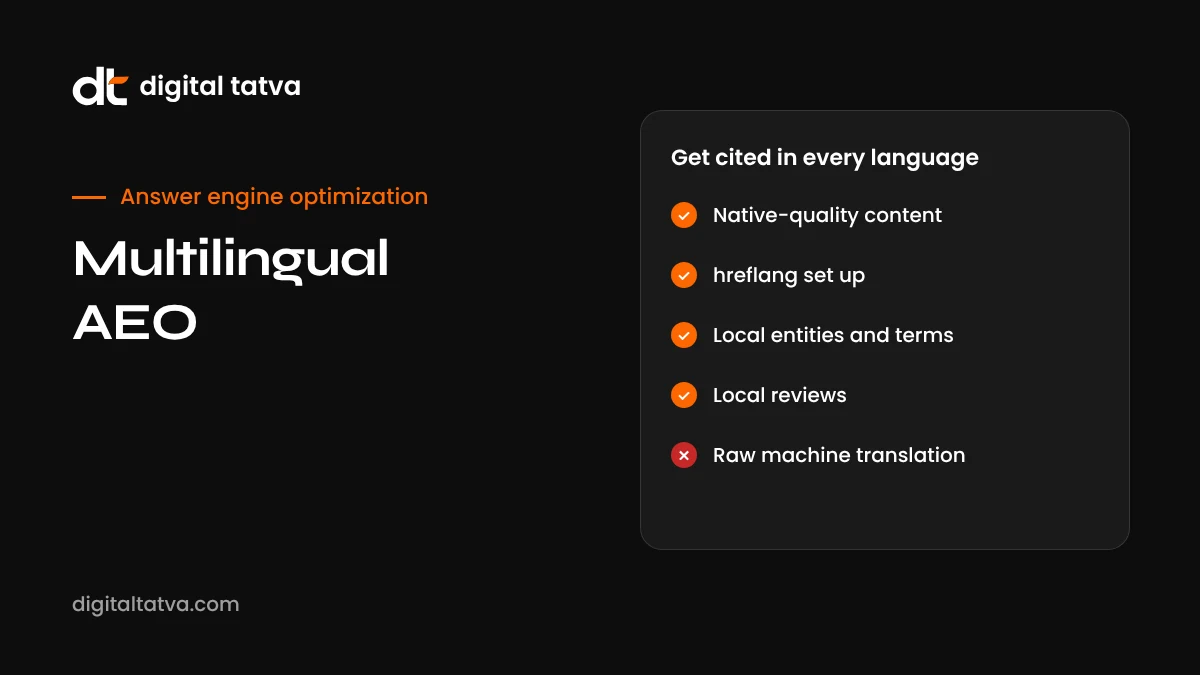
Quick answer: Multilingual AEO is the practice of making your brand visible in AI answers across the languages your customers use, such as Hindi, Gujarati, Tamil, Marathi, Bengali or Spanish. AI assistants can answer in many languages, but they often draw on sources written in the language of the question, especially for local and practical topics. To compete, publish natural, high-quality content in each priority language rather than raw machine translation, set up hreflang and separate URLs, use local terms and entities, keep business facts consistent across languages, earn local reviews and mentions, and track prompts in each language separately.
Key takeaways
- Many people, especially in India, ask AI assistants questions in their own language or in a mix like Hinglish.
- AI answers in a language often lean on content written in that language.
- Fewer high-quality sources exist in many Indian languages, which creates an opportunity.
- Natural, reviewed translations outperform raw machine translation.
- Technical setup, especially separate URLs and hreflang, helps search engines serve the right version.
- Track AI visibility separately for each language, because results differ.
Why multilingual AEO matters now
India alone has hundreds of millions of internet users, and a large share prefer content in Indian languages. Voice search and AI assistants have made it easier than ever to ask questions in Hindi, Tamil or Gujarati rather than typing in English. ChatGPT, Gemini, Meta AI and other assistants can understand and answer in many of these languages.
The same is true globally: Spanish, Arabic, Portuguese, Bahasa and many other language markets are adopting AI search quickly. Businesses that only publish in English are invisible to a large portion of potential customers when those customers ask questions in their own language.
There is also an opportunity. In many Indian languages, there is far less high-quality web content than in English. A business that publishes clear, accurate answers in Hindi or Marathi may face much less competition for citations than it would in English. See our list of AI tools for Indian languages for the wider landscape.
How AI assistants handle different languages
AI assistants deal with languages in a few different ways, and the details vary by product:
| Situation | What often happens | Implication for you |
|---|---|---|
| Question in Hindi about a general topic | The assistant may answer in Hindi using knowledge learned from many languages | Your brand must be well known across languages |
| Question in Hindi needing web search | The assistant may search in Hindi, English or both, and cite pages in either language | Hindi pages give you a better chance of being cited |
| Local question in a regional language | Local and regional sources are often preferred | Regional language content and local listings help |
| Hinglish or mixed-language questions | Assistants usually understand and answer in a mix | Natural content with common English terms helps |
Exact behaviour is not documented and changes as models improve. The safest strategy is to have strong content in the languages your customers actually use, rather than relying on the AI to translate your English content.
Step 1: Choose your priority languages
You do not need every language. Choose based on evidence:
- Customer data: what languages do your customers use in calls, chats and reviews?
- Search Console: look for queries in other languages or scripts.
- Market: which regions are you targeting?
- Competition: how much quality content already exists in each language for your topics?
- Capacity: can you produce and maintain quality content in that language?
Most businesses do better with one or two well-maintained additional languages than with five poorly maintained ones.
Step 2: Set up the technical structure
Search engines and AI crawlers need to find and understand each language version.
| Element | Best practice |
|---|---|
| URL structure | Separate URLs per language, such as /hi/ or hi.example.com; avoid switching language with cookies or scripts only |
| hreflang | Tell search engines which pages are language equivalents, including a self-reference and an x-default |
| Language declaration | Set the correct lang attribute in the HTML |
| Sitemaps | Include all language versions |
| Rendering | Make sure translated content is in the HTML, not injected by JavaScript translation widgets |
| Fonts | Use fonts that render Indian scripts correctly on all devices |
Client-side translation widgets that translate the page after loading are a common problem. Crawlers may never see the translated text. Use proper translated pages. See our technical AEO checklist and JavaScript rendering for AI crawlers.
Step 3: Create natural, high-quality content
Raw machine translation often produces awkward, unnatural text that people do not trust and that may not match how people actually ask questions. Better approaches:
- Translate and adapt. Use AI or professional translation as a first draft, then have a fluent speaker edit for natural language and local context.
- Write natively for key pages. For your most important pages, consider writing directly in the target language.
- Use the words people use. Many Hindi speakers use English terms for technology and business, such as “loan”, “EMI” or “software”. Do not force overly formal translations.
- Keep answer-first structure. Headings as questions, direct answers, tables and FAQs work in every language. See answer-first content.
- Localise examples. Prices in rupees, local places, local festivals and seasons.
Step 4: Research questions in each language
People ask different questions in different languages, and phrase them differently. Do not just translate your English keyword list.
- Search your topics in each language in Google and note autocomplete and People Also Ask questions.
- Ask AI assistants your core questions in each language and note what they cover.
- Talk to customer-facing staff who speak the language.
- Check regional forums, YouTube comments and social media in that language.
See AEO prompt research and People Also Ask optimization.
Step 5: Keep your entity consistent across languages
Your brand name, address, phone, founding year and key facts should be consistent in every language version. Decide how your brand name is written in each script, and use it consistently. Add Organization schema to each language version with the same core facts and sameAs links. Inconsistencies across languages can confuse AI systems as much as inconsistencies across directories. See entity SEO for AEO.
Step 6: Earn local and language-specific mentions
Authority signals in each language matter too:
- Regional newspapers and news sites in the target language.
- Local business directories and associations.
- Reviews written in the local language on Google and other platforms.
- Regional YouTube creators and podcasts.
- Local community groups and forums.
See brand mentions for AEO and review sites for AEO.
Step 7: Track each language separately
AI visibility in Hindi can be very different from visibility in English. Build a separate prompt set for each priority language, written naturally in that language, and test monthly across the assistants your customers use. Track AI referral traffic to each language section in GA4. See AI share of voice.
Multilingual AEO for Indian businesses
| Business type | Language priorities | Content ideas |
|---|---|---|
| Local services in Gujarat | Gujarati, Hindi, English | Service pages, prices, FAQs and local guides in Gujarati |
| Pan-India consumer brand | Hindi plus key regional languages, English | Product pages, how-to guides, comparison content |
| Fintech and insurance | Hindi and regional languages | Plain-language explainers on loans, insurance and savings |
| Education and coaching | Hindi and regional languages | Exam guides, course details, eligibility explainers |
| Healthcare | Regional languages by location | Doctor-reviewed treatment explainers, clinic information |
| B2B software | English first; Hindi for SMB segments | Simple guides and FAQs for small business owners |
Translation workflow that keeps quality high
Most teams fail at multilingual content not because they choose the wrong languages, but because they have no repeatable process. Translation becomes a one-off project, the pages go live, and then nobody updates them. Six months later the Hindi page lists an old price, a discontinued service and a phone number that no longer works. AI systems that read that page will repeat the wrong facts.
A simple, sustainable workflow looks like this:
- Lock the English source first. Translate only pages that are final and reviewed. Translating a draft doubles your editing work.
- Build a glossary. List your brand name, product names, service names and key industry terms, and decide how each should appear in every language. Note which terms should stay in English because that is how customers say them.
- Create the first draft with AI or a translator. Modern AI tools produce useful first drafts for Hindi and major Indian languages. Give the tool your glossary and ask it to keep the tone conversational.
- Have a fluent human edit. The editor should be a native or near-native speaker who knows your audience. Their job is to make the text sound natural, fix terminology and adapt examples.
- Check facts against the source. Prices, numbers, dates, addresses and legal terms must match exactly.
- Publish with correct technical tags. Add hreflang, lang attributes and the page to the sitemap.
- Set an update trigger. Whenever the English page changes, flag the translated versions for review. A shared spreadsheet with page, language, last updated date and owner is enough for most small teams.
This process is slower than pasting text into a translation tool, but it produces pages that customers trust and that AI systems can rely on.
Writing for how people actually ask in Indian languages
Questions in Indian languages often look different from their English equivalents. A few patterns are worth knowing:
- Code-mixing is normal. A person in Ahmedabad might ask “best CA near me jo GST filing kare” or “home loan ka EMI kaise calculate kare”. Content that uses natural mixed phrasing in headings and FAQs matches these questions better than formal Sanskritised Hindi.
- Script varies. Some people type Hindi in Devanagari, others type it in Roman script. Your main content should be in the native script, but FAQs can acknowledge common Roman-script phrasings where it reads naturally.
- Voice questions are longer. People speaking to an assistant tend to ask full questions, often with context, such as “mere bete ke liye Ahmedabad mein achha coaching centre kaunsa hai”. Content that answers full, specific questions does well here. See our guide to voice search AEO.
- Trust questions are common. Questions like “kya yeh company genuine hai” or “safe hai kya” are frequent. Clear information about your registration, address, reviews and policies helps answer these.
- Price questions are direct. People often ask “kitna kharcha hoga” or “fees kitni hai”. If you can share prices or ranges, do so plainly.
The best way to learn these patterns is to listen. Read your WhatsApp enquiries, ask your sales and support staff which questions come up most, and look at the comments on regional YouTube videos in your category. Then write answers to those exact questions.
Which pages to translate first
You do not have to translate the whole site on day one. Prioritise pages that answer high-intent questions and carry the most important facts about your business.
| Priority | Page type | Why it matters |
|---|---|---|
| 1 | About page and contact details | Establishes your entity and core facts in the new language |
| 2 | Main service or product category pages | Answers “who offers X” and “best X near me” questions |
| 3 | Pricing and FAQ pages | Directly answers cost and trust questions |
| 4 | Top three to five how-to or explainer articles | Builds topical authority in that language |
| 5 | Location pages | Supports local AI answers in regional languages |
| 6 | Comparison pages | Answers “X vs Y” questions buyers ask before deciding |
Once these are live and maintained, you can expand to blog content and supporting pages. For guidance on which page types AI assistants tend to cite, read pages AI assistants cite.
Using AI tools to help, carefully
AI assistants are genuinely useful for multilingual work, as long as a person stays in charge. Good uses include drafting first translations, suggesting how people might phrase a question in Hindi or Tamil, checking a translated page for awkward sentences, and generating FAQ ideas from customer enquiries. Risky uses include publishing AI output without review, translating legal or medical text without an expert, and letting AI invent local facts or prices. Treat AI as a fast junior assistant whose work always gets checked. Our guide to AI writing tools for AEO covers where these tools help and where they need supervision.
Common multilingual AEO mistakes
- Machine translation with no review, producing unnatural or wrong text.
- Translation widgets that crawlers cannot see.
- Missing or broken hreflang.
- Translating only the homepage and leaving everything else in English.
- Different facts in different language versions.
- Ignoring Hinglish and code-mixed phrasing people actually use.
- Not updating translations when the English version changes.
Schema and structured data for multiple languages
Structured data helps AI systems understand what each page is about, and it needs a little extra care on multilingual sites.
- Translate visible text inside schema. Names, descriptions and FAQ answers in your schema should match the language of the page they sit on.
- Keep identifiers the same. Your Organization schema should use the same URL, logo and sameAs profiles across every language version, so AI systems understand it is one entity.
- Use inLanguage where relevant. Article and WebPage schema can include an inLanguage property, such as “hi” for Hindi or “gu” for Gujarati.
- Match FAQ schema to visible FAQs. Only mark up questions and answers that readers can actually see on that page, in that language.
- Validate each version. Run each translated page through a schema testing tool, because a broken character or missing quote can invalidate the whole block.
Our guide to schema markup for AEO covers the main types in more detail.
Measuring multilingual AEO results
Measurement is where many multilingual efforts quietly fall apart. If you only track English prompts, you will never know whether your Hindi or Gujarati pages are making a difference. A practical measurement setup includes:
| What to measure | How | How often |
|---|---|---|
| AI mentions per language | A fixed set of 15 to 30 prompts per language, tested in ChatGPT, Gemini, Perplexity and Meta AI | Monthly |
| Citations of translated pages | Note which URLs are cited when your brand appears | Monthly |
| Organic search impressions per language | Search Console filtered by page path such as /hi/ | Monthly |
| AI referral visits per language | GA4 with an AI referrer segment and page path filter | Monthly |
| Enquiries by language | Ask on forms or note in your CRM which language the lead used | Ongoing |
Expect results in regional languages to move at a different pace from English. In some categories you may see faster gains because competition is thinner; in others it may take longer because AI assistants have less regional data to work with. Track trends over several months rather than reacting to a single test. See how to track AI traffic in GA4 and AEO KPIs.
An illustrative example: a Gujarat-based clinic
The following is an illustrative scenario, not a real client case. Imagine a dental clinic in Vadodara whose website is only in English. Many of its patients speak Gujarati at home and ask voice assistants questions like “Vadodara ma saro dentist kyo che” or “root canal ni fees ketli hoy”.
A sensible plan for this clinic would be to translate the About, treatments, fees and contact pages into Gujarati with a fluent editor, add Gujarati FAQs based on real front-desk questions, ask happy patients to leave Google reviews in whichever language they prefer, list the clinic consistently in Gujarati and English directories, and test a set of Gujarati prompts every month. The clinic would not be guaranteed a mention in any AI answer, but it would give assistants a clear, trustworthy Gujarati source to draw from, where before there was none.
How Digital Tatva can help
Based in Ahmedabad and working with clients across India and abroad, we understand how people search and ask questions in Indian languages. We help you choose priority languages, set up technical structure correctly, plan natural content for each language, and track AI visibility separately in each. We cannot guarantee AI placement in any language, but we can help you be a clear, credible source in the languages your customers use.
Want to reach customers who ask AI in their own language? Request an AEO audit covering your priority languages, or check crawler access with our free AI visibility checker.
Frequently asked questions
What is multilingual AEO?
It is answer engine optimization across multiple languages, making your brand visible in AI answers to questions asked in Hindi, regional Indian languages or other languages your customers use.
Does ChatGPT answer in Hindi?
Yes. ChatGPT and other major assistants can understand and answer in Hindi and many other languages, with quality varying by language and topic.
Do AI assistants cite Hindi websites?
They can, especially when answering questions asked in Hindi that need web search. Having quality Hindi content increases your chances.
Is machine translation good enough for multilingual AEO?
It can be a starting point, but reviewed, natural translations perform better and are more trustworthy for readers.
What is hreflang and do I need it?
hreflang tags tell search engines which pages are language or regional versions of each other. If you have multiple language versions, you should use it.
Should I use Hinglish on my website?
For audiences who naturally mix Hindi and English, using common English terms within Hindi content often reads more naturally. Match how your customers speak.
How many languages should I start with?
Start with one additional language that matters most to your customers, do it well, then expand.
Can Digital Tatva help with multilingual AEO?
Yes. We plan and support multilingual AEO for Indian and international businesses.
Does Google rank Hindi pages separately?
Google serves results based on the language and location of the search. Proper hreflang and language-specific URLs help it show your Hindi pages to Hindi searchers.
Should I create a separate website for each language?
Usually not. Subfolders such as /hi/ on one domain are easier to manage and keep authority consolidated.
How do I know which language to add first?
Check customer enquiries, Search Console queries and sales data to see which language your audience uses most.
Can AI translate my whole website?
It can draft translations quickly, but a fluent editor should review every page for accuracy, tone and local terms before publishing.
Product details, prices and features are checked at the time of writing and can change. Sources are linked in the text so you can check them yourself.
How does your brand appear in AI answers?
We test the questions your buyers ask across the major AI assistants and search engines, then show you what to fix first.
Get an AI Visibility Audit