People Also Ask Optimization: Win PAA Boxes and AI Answers
People Also Ask boxes reveal the follow-up questions searchers have, and the same questions drive AI answers. Learn how PAA works, how to find PAA questions, how to write answers that win them, and how PAA research feeds your AEO strategy.
On this page
- Key takeaways
- What is People Also Ask?
- Why PAA matters for AEO
- How Google chooses PAA answers
- How to find PAA questions for your topics
- Organising PAA questions
- How to write answers that win PAA
- Examples of PAA-friendly answers
- Where to place PAA answers on your site
- Does FAQ schema help with PAA?
- PAA, AI Overviews and AI Mode
- Tracking PAA and AI results
- Common PAA mistakes
- PAA for different industries
- Turning one PAA cluster into a content plan
- PAA research for AI prompt sets
- Keeping PAA answers fresh
- How Digital Tatva can help
- Why PAA questions change, and what that tells you
- PAA and voice assistants
- A PAA audit you can run in an hour
- PAA optimization for local businesses
- Writing PAA answers with AI tools
- Frequently asked questions
Last updated: 13 November 2026
Quick answer: People Also Ask (PAA) optimization is the practice of earning a place in Google’s “People also ask” boxes, the expandable list of related questions that appears in many search results. To win PAA, find the questions Google shows for your topics, add each one as a clear heading on a relevant page, answer it directly in the first 40 to 60 words, then expand with detail, lists or tables. PAA matters more in the AI era because the same follow-up questions shape how AI Overviews, AI Mode and assistants like ChatGPT break down and answer a topic. Pages that answer PAA questions well are often the same pages AI cites.
Key takeaways
- PAA boxes show real follow-up questions Google associates with a search.
- Each PAA answer usually comes from one web page and links to it.
- Short, direct answers under question-style headings win PAA most often.
- PAA questions are an excellent proxy for the sub-questions AI search engines explore.
- Use PAA research to plan headings, FAQs and topic clusters, not just to chase boxes.
What is People Also Ask?
People Also Ask is a Google search feature that shows a set of questions related to your search. Click a question and it expands to show a short answer taken from a web page, with a link to the source. Expanding one question often loads more related questions below it, creating an almost endless chain.
For example, a search for “electric scooter” might show PAA questions such as “Which electric scooter is best in India?”, “How long does an electric scooter battery last?” and “Is an electric scooter worth buying?”. Each answer is pulled from a page Google considers a good match.
PAA boxes appear on a very large share of searches, especially informational and comparison queries. They sit alongside AI Overviews, featured snippets, videos and other features on today’s results pages.
Why PAA matters for AEO
PAA is useful in its own right, because it gives your page extra visibility and a link on busy results pages. But in the AI era, its bigger value is as a window into how search engines understand a topic.
- PAA reveals sub-questions. The questions in PAA are the follow-ups real searchers have. AI search engines generate similar sub-questions when they use query fan-out.
- PAA answers are passages. Google selects a specific passage to answer each question, the same unit AI systems retrieve. See content chunking for AI.
- PAA winners often get cited in AI answers. Pages that give clear, direct answers to common questions are natural sources for AI Overviews and AI Mode.
- PAA shapes conversational AI. When someone asks a follow-up in ChatGPT or AI Mode, it is often one of the PAA-style questions.
In short, PAA research is one of the cheapest and best ways to understand the questions your content must answer for both classic search and AI search.
How Google chooses PAA answers
Google does not publish exact criteria, but the answers it selects tend to share these traits:
| Trait | What it looks like |
|---|---|
| Directness | The answer appears immediately after a heading that matches the question |
| Concision | Roughly 40 to 60 words for paragraph answers |
| Format match | Lists for steps and options, tables for comparisons, paragraphs for definitions |
| Relevance | The page is clearly about the topic, not a passing mention |
| Quality | The page and site are trusted for the topic |
Pages do not need to rank first for the main keyword to win a PAA box. Strong, clear answers on relevant pages from lower positions can be selected.
How to find PAA questions for your topics
1. Search manually
Search your main topics in Google, ideally in a private window and from your target country. Expand several PAA questions and note the new ones that appear. This takes a few minutes per topic and gives you the most accurate picture.
2. Use SEO tools
Many keyword research and content tools collect PAA questions at scale. They are useful for large topic sets. See our list of the best keyword research tools.
3. Check AI answers
Ask the same topic in Google AI Mode, ChatGPT and Perplexity. The sub-headings and follow-up suggestions in their answers often overlap with PAA. Combining both gives you a richer question list. See AEO prompt research.
4. Use your own data
Search Console shows the queries your pages already appear for, including many question-style queries. Sales and support teams know the questions customers ask before buying.
Organising PAA questions
Once you have a list, group the questions so they turn into a content plan rather than a pile of ideas.
| Group | Example PAA questions for “home solar panels India” | Where to answer |
|---|---|---|
| Cost | How much does a 5 kW solar system cost? Is there a subsidy? | Pricing section or dedicated cost guide |
| Suitability | Is solar worth it for a flat? How much roof space do I need? | Main guide sections |
| Process | How do I apply for net metering? How long does installation take? | Step-by-step guide |
| Maintenance | How often should panels be cleaned? How long do they last? | FAQ section |
| Comparison | On-grid vs off-grid, which is better? | Comparison table or page |
Big groups may deserve their own pages; small ones become sections or FAQs. This is how PAA research turns into topical authority.
How to write answers that win PAA
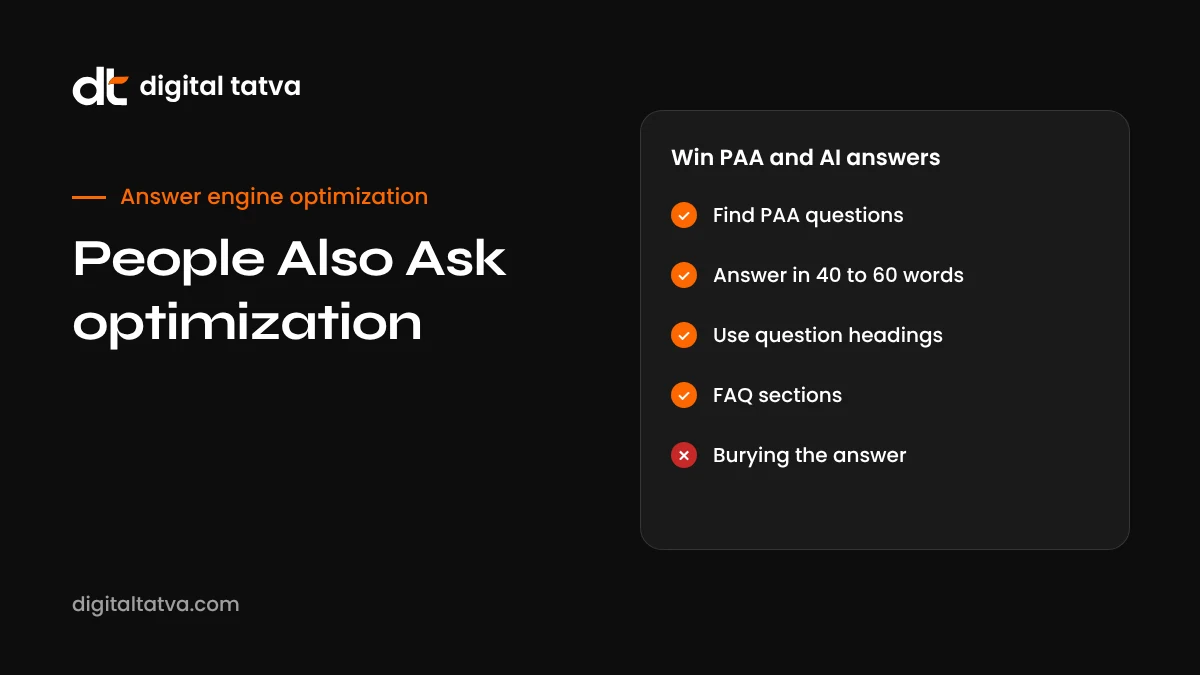
- Use the question as a heading. Match the wording closely, but naturally. “How long do solar panels last?” as an H2 or H3.
- Answer in the first sentence. “Most solar panels last 25 to 30 years, with output slowly declining by about half a percent per year.”
- Keep the first answer short. Aim for 40 to 60 words in the opening paragraph.
- Then expand. Add detail, examples, caveats and a table or list where helpful.
- Use the right format. Steps as numbered lists, options as bullets, comparisons as tables.
- Avoid fluff. No “great question” openings or long introductions.
- Be accurate and current. Update answers when facts change.
This is the same structure we use for answer-first content, which is no coincidence. The formats that win PAA are the formats AI finds easiest to quote.
Examples of PAA-friendly answers
Definition question
Q: What is answer engine optimization?
Answer engine optimization (AEO) is the practice of making your brand and content easy for AI assistants and answer features, such as ChatGPT, Google AI Overviews and Perplexity, to find, understand and cite. It builds on SEO but focuses on clear answers, structured content, entity clarity and third-party trust.
Process question
Q: How do I check if ChatGPT mentions my brand?
- List 20 to 30 questions your customers ask.
- Ask each in a fresh ChatGPT chat with memory off.
- Record whether your brand is named and how.
- Repeat three times and monthly to see trends.
Comparison question
Q: AEO vs SEO: what is the difference?
| SEO | AEO | |
|---|---|---|
| Goal | Rank pages in search results | Be cited and recommended in AI answers |
| Unit | Page | Passage and brand |
| Measured by | Rankings, clicks | Mentions, citations, AI referrals |
Where to place PAA answers on your site
- In the main body of relevant guides, as sections with question headings.
- In FAQ sections at the end of service, product and guide pages.
- On dedicated FAQ pages for broad topics, organised by theme. See FAQ page best practices.
- On product and category pages for buying questions.
Avoid creating thin standalone pages for every single question. Group related questions on strong pages instead.
Does FAQ schema help with PAA?
FAQ schema does not directly control PAA selection. Google limited FAQ rich results in search to a small set of authoritative sites, so most sites will not see FAQ rich results. However, FAQPage schema can still help machines understand that your content contains questions and answers, which can support AI systems reading your page. Use it accurately, only for genuine FAQ content. See schema markup for AEO.
PAA, AI Overviews and AI Mode
On many results pages, PAA boxes now appear below an AI Overview. Some people worry PAA no longer matters. In practice, the two are connected:
- AI Overviews often cover the same sub-questions that appear in PAA.
- Pages that answer PAA questions clearly are frequently among the sources linked in AI Overviews.
- AI Mode suggests follow-up questions that resemble PAA, and its answers draw on pages with clear question-and-answer content.
So optimising for PAA is effectively optimising for the questions AI systems care about. See AI Overviews optimization and featured snippets vs AI Overviews.
Tracking PAA and AI results
- Manual checks: search your target topics monthly and note which PAA answers come from your site.
- Rank tracking tools: many track SERP features, including PAA ownership.
- Search Console: look for growth in impressions for question-style queries.
- AI prompt tracking: test the same questions in AI assistants and note citations.
See the Search Console AI performance report and AI share of voice.
Common PAA mistakes
- Answering the question three paragraphs down instead of right after the heading.
- Vague headings that do not match how people phrase the question.
- Very long first answers that cannot fit a PAA box.
- Thin pages created for each question with little else of value.
- Outdated answers about prices, rules or products.
- Copying competitors’ answers instead of adding your own insight.
PAA for different industries
PAA questions look different from one industry to another. Knowing the typical patterns helps you plan faster.
| Industry | Typical PAA patterns | Content to create |
|---|---|---|
| Healthcare | Symptoms, treatment duration, costs, recovery, side effects | Doctor-reviewed treatment guides with clear disclaimers |
| Education | Eligibility, fees, exam patterns, career outcomes | Course pages with fees, eligibility tables and FAQs |
| Real estate | Prices per square foot, documents, loan eligibility, registration charges | Area guides, buying checklists, cost calculators |
| SaaS | Pricing, alternatives, integrations, free plans, setup time | Pricing pages, comparison pages, integration docs |
| Ecommerce | Sizing, durability, care, comparisons, warranties | Detailed product pages and buying guides |
| Finance | Interest rates, eligibility, tax implications, comparisons | Expert-reviewed explainers with current figures and sources |
| Local services | Costs, timing, how to choose, what to expect | Service pages with price ranges and process explanations |
For regulated or high-stakes topics like health and finance, accuracy and expert review are essential. See E-E-A-T for AI search and our guides for healthcare and education.
Turning one PAA cluster into a content plan
Here is how a single PAA cluster can become a small content plan, using an illustrative topic: “GST registration for freelancers”.
- Collect questions: Do freelancers need GST registration? What is the GST threshold for services? How long does registration take? Which documents are needed? Can I register voluntarily? What GST rate applies to export of services?
- Group them: eligibility (threshold, voluntary registration), process (documents, time), rates and exports.
- Decide pages: one main guide covering eligibility and process, with a separate page for GST on export of services because it needs a longer answer.
- Write sections: each question becomes a heading with a direct answer, then detail and a table where useful.
- Add an FAQ: short questions that did not fit as sections.
- Link: connect both pages to each other and to related content.
- Track: check PAA and AI answers monthly for these questions.
PAA research for AI prompt sets
When you build prompt sets for tracking AI visibility, PAA is a great source of realistic questions. A simple method:
- Take your five most important commercial topics.
- Collect 10 PAA questions for each.
- Keep the ones a buyer might ask before choosing a provider or product.
- Rewrite them as natural AI prompts, adding context like location or company size.
- Track them monthly across ChatGPT, Gemini, Perplexity and Google AI Mode.
This connects your classic SEO research to AI visibility measurement. See tracking brand mentions in ChatGPT.
Keeping PAA answers fresh
PAA answers can change often, especially for topics with prices, rules or new products. Set a routine to review your most important PAA-targeted sections every quarter. Update figures, add new questions that have appeared and remove outdated ones. Show a visible “last updated” date on the page. Fresh, accurate answers are more likely to keep their PAA spots and to be cited by AI. See content refresh for AEO.
How Digital Tatva can help
We research the PAA and AI follow-up questions in your category, map them to your existing pages, find the gaps and rewrite key sections in a format that wins both PAA boxes and AI citations. We track results across Google and AI assistants every month. We cannot guarantee any search feature or AI placement, but we can make sure your answers are the clearest available.
Want a map of the questions you should own? Request an AEO audit, or check AI crawler access with our free AI visibility checker.
Why PAA questions change, and what that tells you
PAA questions are not fixed. They shift with seasons, news, product launches and changes in how people search. Watching those shifts is a useful early signal.
- New questions appearing often signal emerging concerns, such as a new regulation, a price change or a new product category.
- Questions disappearing may mean an issue has been resolved or interest has moved elsewhere.
- Seasonal questions, such as gift ideas or tax deadlines, recur at predictable times and are worth preparing for in advance.
- Location differences: the same search in different countries or cities can show different PAA questions, reflecting local concerns.
Keep a simple log of PAA questions for your top topics, updated monthly. Over a year, it becomes a valuable record of what your audience cares about and when.
PAA and voice assistants
Voice assistants and smart speakers often answer spoken questions with a single short answer, frequently drawn from the same kind of concise, direct passages that win PAA and featured snippets. If your audience uses voice search, for example for local questions or quick facts, PAA-style answers help there too. Keep spoken-style questions in mind, such as “how long does it take to” or “what is the best way to”, and answer them in clear, natural sentences. See voice search and AEO.
A PAA audit you can run in an hour
- Pick your five most valuable pages.
- Search the main topic of each page in Google and record the first eight PAA questions.
- For each question, check whether the page answers it clearly under its own heading.
- Mark each as answered well, answered poorly or missing.
- For poorly answered questions, rewrite the opening sentence as a direct answer.
- For missing questions, add a section or FAQ entry.
- Re-check PAA and AI answers for these topics after four to six weeks.
This small exercise often reveals that important pages ignore the very questions people ask most. Fixing that helps in search, in AI answers and with visitors who arrive with those questions in mind.
PAA optimization for local businesses
Local searches also trigger PAA boxes, often alongside the map pack. Questions like “How much does a root canal cost in Ahmedabad?”, “Are clinics open on Sunday?” or “How do I choose a good interior designer?” give local businesses a chance to appear above or near competitors. To make the most of it:
- Add a city-specific FAQ to your main service pages with honest answers about costs, timing and process.
- Answer “how to choose” questions on your blog with genuinely useful criteria, not just reasons to choose you.
- Keep opening hours, holiday schedules and booking details current on your site and Google Business Profile.
- Use local terms naturally, such as neighbourhood names, local landmarks and regional language words customers use.
Local PAA answers often overlap with what AI assistants say when asked for local recommendations, because they draw on the same pages and profiles. See AEO for local businesses.
Writing PAA answers with AI tools
AI writing tools can help draft concise answers, but PAA answers are short enough that every word counts. Use AI to suggest a first draft, then:
- Check every fact, number and date against a reliable source.
- Replace generic phrasing with specific details from your experience.
- Make sure the first sentence answers the question completely.
- Keep the tone natural and human.
A short answer with one wrong fact is worse than no answer, because it can be repeated by search features and AI assistants. See AI writing tools for AEO.
Frequently asked questions
What is People Also Ask in Google?
It is a search feature showing related questions with short answers taken from web pages. Clicking a question expands the answer and often reveals more questions.
How do I get my content into People Also Ask?
Add the question as a heading on a relevant page, answer it directly in about 40 to 60 words, then expand. Keep the page accurate, clear and well structured.
Does FAQ schema help with People Also Ask?
Not directly. It can help machines understand question-and-answer content, but PAA selection depends on the page content and its relevance and quality.
Do I need to rank first to win a PAA box?
No. Pages ranking lower on the first page, or sometimes beyond, can be selected if they answer the question clearly.
Is PAA still useful with AI Overviews?
Yes. PAA questions reflect the sub-questions AI systems explore, and pages that answer them clearly are often cited in AI answers.
How long should a PAA answer be?
For paragraph answers, about 40 to 60 words works well. Lists and tables can be longer if the question calls for them.
How do I find PAA questions in bulk?
Use SEO tools that collect PAA data, combine them with manual searches and AI assistant follow-ups, and group the results by theme.
Can Digital Tatva help with PAA optimization?
Yes. PAA and AI question research is part of our content and AEO work.
How often do People Also Ask questions change?
They change regularly with search behaviour and seasons. Review your target questions every few months and update content accordingly.
Can I target People Also Ask with FAQ schema?
FAQ schema helps search engines understand questions and answers, but visible, well-written answers matter most.
Product details, prices and features are checked at the time of writing and can change. Sources are linked in the text so you can check them yourself.
How does your brand appear in AI answers?
We test the questions your buyers ask across the major AI assistants and search engines, then show you what to fix first.
Get an AI Visibility Audit