Featured Snippets vs AI Overviews: How to Win Both
Featured snippets and Google AI Overviews both answer questions at the top of search results, but they work differently. Here is how each one chooses content, how they affect clicks, and a practical playbook to win both.
On this page
- Key takeaways
- What is a featured snippet?
- What is an AI Overview?
- Featured snippets vs AI Overviews at a glance
- How each one chooses content
- Impact on clicks
- When do featured snippets still appear?
- A playbook to win both
- Examples: one question, two features
- Common mistakes
- Should you opt out of snippets or AI Overviews?
- Measuring results
- Snippet formats and how to win each one
- Why AI Overviews cite different pages than snippets
- Featured snippets, AI Overviews and AI assistants
- A step-by-step page rewrite for both features
- How to check which feature appears for your queries
- How Digital Tatva can help
- A short history: from snippets to AI answers
- Featured snippets and AI Overviews for ecommerce
- Featured snippets and AI Overviews for B2B
- Featured snippets and AI Overviews checklist
- What to do if you lost a featured snippet to an AI Overview
- Is it worth chasing snippets at all now?
- Frequently asked questions
Last updated: 13 November 2026
Quick answer: A featured snippet is a short excerpt copied from one web page and shown near the top of Google results, with a link to that page. An AI Overview is a summary written by Google’s AI that combines information from several pages and shows multiple source links. Featured snippets reward one clear, concise answer on a single page. AI Overviews reward pages that answer the main question and related sub-questions clearly, so they can be used as one of several sources. To win both, use question-style headings, answer directly in the first 40 to 60 words, add lists and tables, cover follow-up questions, and keep pages accurate, trusted and fresh.
Key takeaways
- Featured snippets quote one page; AI Overviews synthesise many.
- Both favour direct, well-structured answers under clear headings.
- AI Overviews often appear above featured snippets and other results, changing click patterns.
- Covering related sub-questions matters more for AI Overviews than for snippets.
- The same content work usually helps with both features and with AI assistants beyond Google.
What is a featured snippet?
A featured snippet is a box near the top of Google results that shows a short answer pulled directly from a web page. It includes the page title and a link. Featured snippets have existed for years and come in a few formats:
- Paragraph snippets for definitions and short explanations.
- List snippets for steps, rankings and options.
- Table snippets for comparisons, prices and specifications.
- Video snippets that jump to a relevant part of a video.
The key point: the text is copied from one page. Google chooses the page and the passage it thinks best answers the query.
What is an AI Overview?
An AI Overview is a summary generated by Google’s AI that appears at the top of many search results. It combines information from multiple sources into a written answer, often with headings or bullet points, and shows links to several pages it drew on. AI Overviews can cover more nuance than a snippet because they combine perspectives, and they may answer follow-up questions in the same box.
Google has expanded AI Overviews to a large share of searches. Google also offers AI Mode, a separate conversational search experience with deeper AI answers. See AI Mode vs AI Overviews for the difference.
Featured snippets vs AI Overviews at a glance
| Feature | Featured snippet | AI Overview |
|---|---|---|
| How the answer is created | Excerpt copied from one page | Written by AI from several sources |
| Number of sources | One | Several |
| Length | Short, often 40 to 60 words or a short list | Longer, can include several sections |
| Covers follow-ups | Rarely | Often |
| Position | Near the top of results | Usually at the very top when shown |
| Link prominence | One clear link to the source | Several source links, sometimes less prominent |
| Best content format | Direct answer under a matching heading | Direct answers plus coverage of related questions |
| Measurement | Rank trackers show snippet ownership | Search Console includes AI feature appearances in its reporting; third-party tools track citations |
How each one chooses content
Featured snippets
Google looks for a passage that directly answers the query in a format that fits the box. Common traits of winning passages:
- A heading that closely matches the question.
- An answer immediately after the heading.
- Concise wording, often 40 to 60 words for paragraphs.
- Clean list or table markup for list and table snippets.
- A page that already ranks on the first page for the query.
AI Overviews
Google’s AI runs searches related to the query, including sub-questions, and draws on pages from its index to compose an answer. Pages that help tend to:
- Answer the main question clearly and early.
- Cover related questions the AI is likely to explore. See query fan-out.
- Contain specific, verifiable facts.
- Come from sites Google trusts on the topic.
- Be well structured so passages can be extracted. See content chunking for AI.
Google has said its core ranking systems and quality signals apply to AI features, so traditional SEO strength still matters. See AI Overviews optimization.
Impact on clicks
Both features answer questions directly on the results page, which can reduce clicks for simple queries. AI Overviews tend to have a bigger effect because they are longer, sit at the top and can answer several related questions at once.
That does not mean they are bad for every site. Being cited in an AI Overview gives your brand visibility at the top of the page, and the people who click through are often more engaged. For complex, commercial or high-trust questions, people still click to learn more, compare or buy. See zero-click search and our guide to recovering from AI Overviews traffic drops.
When do featured snippets still appear?
Featured snippets have not disappeared. They still appear on many queries, sometimes alongside or below an AI Overview, and on queries where Google chooses not to show an AI Overview. Patterns change over time and vary by query type and country, so check your own target queries rather than relying on general statements.
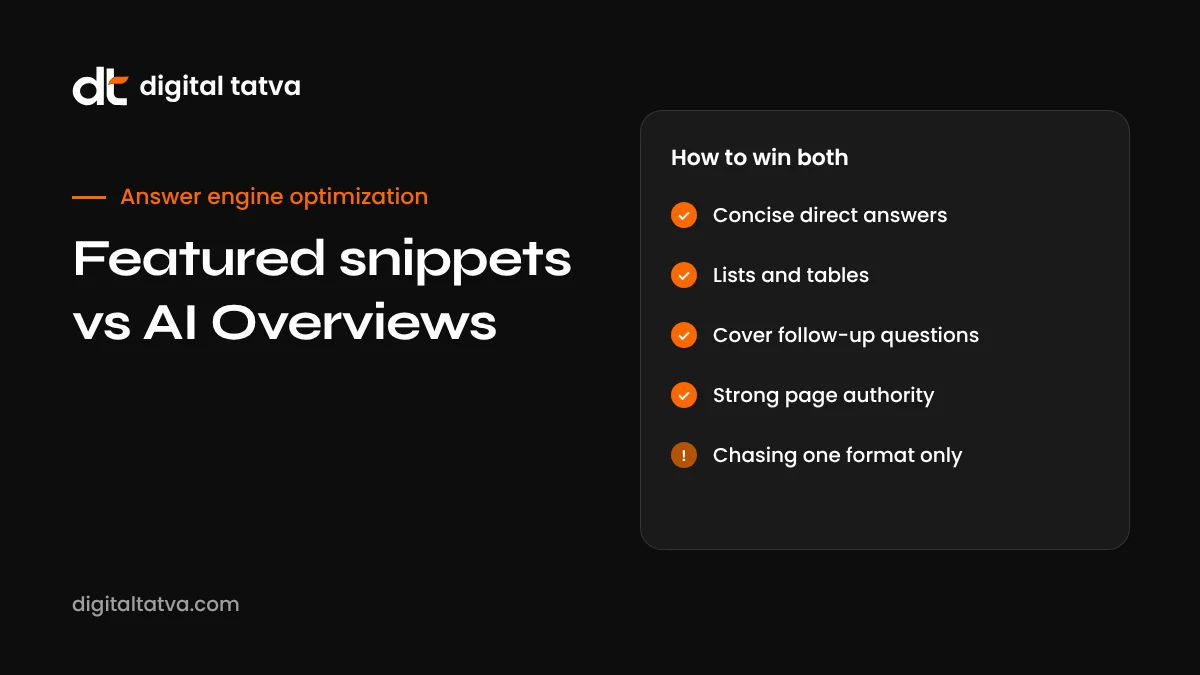
A playbook to win both
- Find the questions. Collect the main question and related questions from People Also Ask, AI Overviews and Search Console. See People Also Ask optimization.
- Use question headings. One H2 or H3 per important question.
- Answer first. 40 to 60 words directly after each heading.
- Match formats. Lists for steps, tables for comparisons, paragraphs for definitions.
- Cover follow-ups. Add sections for related questions so AI Overviews have more to draw on.
- Add evidence. Specific numbers, dates, examples and sources.
- Show expertise. Named authors and real experience. See E-E-A-T for AI search.
- Keep it fresh. Update facts and show the date.
- Strengthen rankings. Snippets and AI Overviews both lean on pages that already rank well.
- Measure. Track snippet ownership, AI Overview citations, impressions and clicks.
Examples: one question, two features
Query: “how to reduce electricity bill at home”
Snippet-friendly passage:
- Switch to LED bulbs and 5-star rated appliances.
- Set your AC to 24 to 26 degrees Celsius.
- Unplug devices on standby.
- Use natural light and ventilation during the day.
- Service your AC and fridge regularly.
What helps for the AI Overview: the same list, plus sections on how much each change saves, solar rooftop options, time-of-day tariffs where applicable and how to read your bill. The AI Overview might combine your list with another page’s solar section and a government page on tariffs.
Common mistakes
- Long introductions that push the answer down the page.
- Headings that do not match questions, such as “Overview” or “Details”.
- Tables built as images instead of HTML tables.
- Thin pages that answer one question and nothing else.
- Outdated facts that cause Google to prefer fresher sources.
- Chasing snippets with very short pages that lack depth for AI Overviews.
Should you opt out of snippets or AI Overviews?
Google offers controls such as the nosnippet meta tag and data-nosnippet attributes that limit how your content is shown in snippets and AI features. Using them can reduce your visibility, because Google may not show your content at all. For most businesses, opting out does more harm than good. If you have specific reasons, such as licensing or paywalled content, review the trade-offs carefully.
Measuring results
| What to track | Tool |
|---|---|
| Featured snippet ownership | Rank trackers with SERP feature tracking |
| AI Overview citations | AI visibility tools, manual checks |
| Impressions and clicks | Google Search Console |
| AI referral traffic | GA4 |
| Brand mentions in AI answers beyond Google | Prompt tracking in ChatGPT, Perplexity, Copilot |
See the Search Console AI performance report and tracking AI traffic in GA4.
Snippet formats and how to win each one
Paragraph snippets
Paragraph snippets answer “what is”, “why” and “how does” questions. To win them, place a concise definition or explanation directly after a heading that mirrors the question. Start with the subject: “Query fan-out is a technique where…” rather than “It is a technique where…”. Keep the first paragraph between 40 and 60 words, then expand below.
List snippets
List snippets answer “how to”, “steps”, “best” and “types of” questions. Use real HTML ordered lists for steps and unordered lists for options. Keep each item short, ideally under 15 words, and put any explanation in a following paragraph. If you have more than eight items, Google may show the first few with a “more items” link, which can encourage clicks.
Table snippets
Table snippets answer comparison, pricing and specification questions. Use proper HTML tables with header rows, not images or layouts built with divs. Keep tables focused, with clear column labels and consistent units.
Video snippets
For “how to” queries, Google may show a video snippet that jumps to a key moment. YouTube videos with clear chapters, accurate titles and spoken explanations that match the question have the best chance. See YouTube for AEO.
Why AI Overviews cite different pages than snippets
It is common to see a featured snippet from one page and an AI Overview citing entirely different pages for the same search. There are several reasons:
- Different questions. The AI Overview covers sub-questions the snippet does not, so it needs other sources.
- Different formats. A page with a perfect 50-word definition may win the snippet, while pages with richer detail on related points feed the AI Overview.
- Freshness. AI Overviews may prefer more recent sources for topics that change.
- Diversity. AI Overviews often draw on several types of sources, such as a government page, a guide and a forum discussion, to give a rounded answer.
The practical lesson is to aim for both: a crisp answer that can win the snippet, and depth on related questions that makes your page useful as an AI Overview source.
Featured snippets, AI Overviews and AI assistants
Winning in Google is only part of the picture. ChatGPT, Perplexity, Copilot and other assistants answer the same questions. The good news is that the same content principles apply across all of them: clear headings, direct answers, structured data, evidence and freshness. A page built to win snippets and AI Overviews is usually a strong candidate for citation in other assistants too, provided their crawlers can access it. See how to get cited by AI and our AI crawlers list.
A step-by-step page rewrite for both features
Here is how we would approach an existing article titled “Everything about home loans” to make it competitive for snippets and AI Overviews.
- Split by question. Replace vague sections like “Overview” and “Details” with question headings such as “What is the minimum salary for a home loan?” and “How is home loan EMI calculated?”.
- Add direct answers. Open each section with a 40 to 60 word answer.
- Add a table. Compare interest rate types, tenure options or eligibility criteria in a table.
- Add steps. Turn the application process into a numbered list.
- Add follow-ups. Include sections on prepayment, tax benefits and balance transfer, which AI Overviews often cover.
- Add evidence. Cite current rates or rules with dates and sources.
- Add expertise. Name the author and add a reviewer with relevant qualifications.
- Update the date and submit the page for re-indexing.
How to check which feature appears for your queries
Before investing effort, check what Google actually shows for your most important queries:
| What you see | What to prioritise |
|---|---|
| AI Overview only | Depth, sub-question coverage, trust signals |
| Featured snippet only | Crisp answer format under a matching heading |
| Both | Crisp answers plus depth on related questions |
| Neither, mostly links | Strong page quality and rankings; check again later as features change |
| Local pack or shopping results | Google Business Profile or Merchant Center data first |
Results can differ by location, device and time, so check from your target market and repeat periodically.
How Digital Tatva can help
We identify the queries where featured snippets and AI Overviews appear in your market, check which sources Google uses, and restructure your key pages to give clear answers and cover the follow-up questions AI explores. We track snippets, AI citations and traffic together. We cannot guarantee any search feature, but we can make your content the clearest candidate.
Want to know where you can win? Request an AEO audit, or check AI crawler access with our free AI visibility checker.
A short history: from snippets to AI answers
Understanding how we got here helps explain why the same content principles keep winning.
| Period | What changed in Google results | What content won |
|---|---|---|
| Mid 2010s | Featured snippets introduced and expanded | Concise answers under clear headings |
| Late 2010s | People Also Ask, knowledge panels and more SERP features | Well-structured pages covering related questions |
| Early 2020s | Passage ranking and improved language understanding | Strong individual passages within long pages |
| 2023 to 2024 | Generative AI answers tested, then launched as AI Overviews | Clear, trusted sources that cover the topic well |
| 2025 to 2026 | AI Mode and deeper AI search experiences | Depth across sub-questions, entity clarity and authority |
At every stage, the content that won was clear, direct, well structured and trustworthy. AI features have raised the stakes, but they have not changed the fundamentals.
Featured snippets and AI Overviews for ecommerce
Product and buying questions often trigger AI Overviews with product suggestions, alongside shopping results. Featured snippets appear more for informational product questions, such as “how to clean a cast iron pan” or “what size mattress for a 6 foot person”. Ecommerce sites can win both by:
- Publishing buying guides that answer common questions directly, with comparison tables.
- Adding care, sizing and compatibility FAQs to product and category pages.
- Keeping Merchant Center and Product schema accurate, which feeds shopping-related AI features.
- Earning reviews and inclusion in independent comparisons.
See AEO for ecommerce and AEO for Shopify.
Featured snippets and AI Overviews for B2B
B2B queries such as “what is SOC 2 compliance” or “how to calculate customer acquisition cost” frequently show both features. B2B companies can win by publishing clear definitions, step-by-step guides and calculators, written by recognised experts. Comparison and “how to choose” content often feeds AI Overviews for vendor research. See AEO for B2B and comparison pages for AEO.
Featured snippets and AI Overviews checklist
- Identify your top 20 informational and comparison queries.
- Check which features appear for each.
- Make sure each target page has a question heading for the main query.
- Write a 40 to 60 word direct answer after each heading.
- Use real HTML lists and tables where the question calls for them.
- Add sections for the top related questions from PAA and AI Overviews.
- Add author details, sources and a last updated date.
- Check AI crawler access and page speed.
- Re-check features and citations monthly.
What to do if you lost a featured snippet to an AI Overview
Many sites have seen a familiar pattern: a page that owned the featured snippet for years now sits below an AI Overview, and clicks have dropped. Some practical responses:
- Check whether you are cited in the AI Overview. If you are, your visibility has changed shape rather than disappeared. Track it.
- If you are not cited, compare with the cited pages. What do they cover that you do not? Usually it is related questions, fresher data or clearer structure.
- Add depth on sub-questions that the AI Overview covers.
- Give people reasons to click. Tools, calculators, templates, original data and detailed examples are things a summary cannot fully replace.
- Look at conversion, not just clicks. Fewer but better-qualified visitors can still be a good outcome.
Our guide to diagnosing and recovering from AI Overviews traffic drops goes into detail.
Is it worth chasing snippets at all now?
Yes, in most cases, because the work is the same work that makes content useful to AI systems and people. Clear headings, direct answers, structured lists and tables improve every version of search. What has changed is the measure of success. Instead of celebrating a snippet in isolation, look at whether your page is a trusted source across Google’s features and other AI assistants, and whether that visibility leads to enquiries and sales.
Frequently asked questions
What is the difference between a featured snippet and an AI Overview?
A featured snippet copies a short answer from one page. An AI Overview is an AI-written summary that combines several sources and shows multiple links.
Are featured snippets still shown?
Yes, on many queries, sometimes alongside AI Overviews. Patterns vary by query and change over time.
Can one page win both?
Yes. A page with clear, direct answers and good coverage of related questions can be used as a snippet and as a source in an AI Overview.
Do AI Overviews reduce clicks?
They can reduce clicks for simple questions. For complex, commercial or high-trust questions, people often still click, and being cited builds visibility.
How long should a snippet answer be?
For paragraph snippets, about 40 to 60 words is a good target. Lists and tables can be longer.
Does schema help with snippets and AI Overviews?
Schema helps machines understand content but does not guarantee either feature. Clear content and strong rankings matter most.
Should I block Google from using my content in AI Overviews?
For most businesses, no, because it reduces visibility. Review the trade-offs if you have specific licensing or content reasons.
Can Digital Tatva help us win AI Overviews?
Yes. We help restructure content and strengthen the signals that make pages good sources for AI Overviews and snippets.
Do featured snippets still exist in 2026?
Yes, although AI Overviews now appear on many queries that previously showed only a featured snippet. Both can appear depending on the search.
Can I be in a featured snippet and an AI Overview at the same time?
Yes. Clear, well-structured answers can earn both, which is why answer-first formatting remains valuable.
Should I still optimise for featured snippets?
Yes. The same practices help AI Overviews and other AI assistants, so the effort is not wasted.
What content format wins snippets and AI Overviews most often?
Direct answers of 40 to 60 words under a question heading, followed by supporting detail, lists or tables.
Do AI Overviews link to sources?
Yes. They show links to supporting pages, which is why being a clear, trusted source still matters.
Product details, prices and features are checked at the time of writing and can change. Sources are linked in the text so you can check them yourself.
How does your brand appear in AI answers?
We test the questions your buyers ask across the major AI assistants and search engines, then show you what to fix first.
Get an AI Visibility Audit