How to Become an AEO Specialist: Skills, Tools and Career Path
Answer engine optimization is one of the newest roles in digital marketing. Here is what an AEO specialist actually does, the skills and tools you need, how to build a portfolio, and how SEO professionals can make the move.
On this page
- Key takeaways
- What does an AEO specialist do?
- Why AEO is becoming a career path
- Core skills an AEO specialist needs
- Tools an AEO specialist uses
- How to become an AEO specialist: a step-by-step path
- A 90-day learning plan for SEO professionals
- Building a portfolio without paying clients
- Where AEO specialists work
- What interviews for AEO roles look like
- Mistakes new AEO specialists make
- How to stay current in a fast-moving field
- Career progression in AEO
- A reading path through the Digital Tatva blog
- How Digital Tatva can help
- Frequently asked questions
Last updated: 13 November 2026
Quick answer: An AEO specialist helps brands appear accurately in answers from AI assistants such as ChatGPT, Google AI Overviews, AI Mode, Gemini, Perplexity and Copilot. The role blends SEO, content strategy, technical skills, digital PR and analytics. To become one, learn how AI search engines retrieve and cite sources, master answer-first content and structured data, learn to track brand mentions across AI tools, practise on real sites (your own or volunteer projects), and document what you did and what you learned. SEO professionals are well placed to move into AEO because most of the foundations carry over.
Key takeaways
- AEO is a fast-growing specialism inside search and content marketing.
- The job mixes technical SEO, content, entity work, PR and measurement.
- You do not need a degree in AI; you need curiosity, clear writing and a testing mindset.
- A small, honest portfolio of real experiments beats a long list of certificates.
- SEO, content and PR professionals can transition in a few months with focused practice.
- Because AI answers change constantly, continuous learning is part of the job.
What does an AEO specialist do?
An AEO specialist, sometimes called an AI search specialist, GEO specialist or AI visibility manager, makes sure a brand is found, understood and recommended when people ask AI assistants questions. In practice the work looks like a mix of detective work, writing and project management.
A typical week might include:
- Running a set of prompts across ChatGPT, Gemini, Perplexity and Google AI Mode to see whether the brand is mentioned and what is said about it.
- Checking whether AI crawlers can access important pages, and fixing robots.txt or rendering issues.
- Rewriting key pages so they answer questions directly and clearly.
- Adding or fixing schema markup.
- Correcting outdated facts about the brand on third-party sites, directories and Wikidata.
- Working with PR to earn mentions in publications that AI tools tend to cite.
- Reporting share of voice, citations and AI referral traffic to stakeholders.
- Reading about the latest changes to AI search products and testing what they mean.
For a primer on the discipline itself, start with what is AEO and AEO vs SEO.
Why AEO is becoming a career path
Search behaviour has shifted. Google shows AI Overviews on many queries, AI Mode offers a conversational search experience, ChatGPT search and Perplexity are part of daily routines for many people, and Bing has folded Copilot into its results. When an AI assistant summarises the answer, fewer people click through, and the brands mentioned in the answer gain an advantage.
Companies have noticed. Marketing leaders now ask questions like “Why does ChatGPT recommend our competitor?” or “Why does Gemini say our product costs twice what it does?” Someone has to own those questions, and that is increasingly a dedicated AEO role or an SEO role with an explicit AI visibility responsibility. Agencies are building AEO services, in-house teams are adding AI visibility to job descriptions, and new tools for tracking AI mentions keep appearing.
The field is still young, which is both an opportunity and a caution. There is room for newcomers to build expertise quickly, but there is also a lot of hype and very little settled best practice. The best specialists are the ones who test carefully and say “we do not know yet” when that is the honest answer.
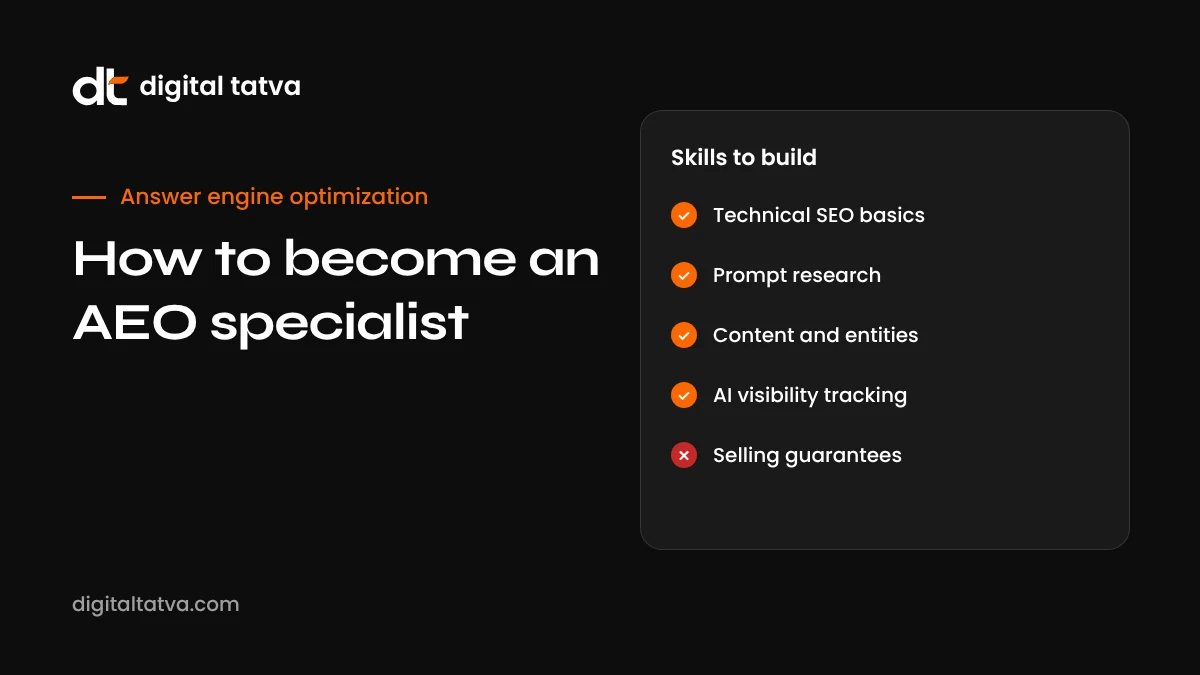
Core skills an AEO specialist needs
| Skill area | What it covers | How to build it |
|---|---|---|
| Search fundamentals | Crawling, indexing, ranking, intent, SERP features | Learn classic SEO thoroughly; it underpins AI search |
| How AI search works | Retrieval, grounding, query fan-out, citations, training vs live data | Read our guide to how AI search engines work and experiment daily |
| Content strategy | Answer-first writing, topical coverage, chunking, freshness | Rewrite pages and test how AI summarises them |
| Technical SEO | robots.txt, AI crawlers, rendering, site speed, schema | Audit real sites; learn to read server logs |
| Entity and knowledge graph work | Wikidata, Knowledge Panels, sameAs, consistent facts | Practise on your own brand or a willing local business |
| Digital PR and community | Earning mentions, reviews, Reddit and YouTube presence | Pitch stories, manage reviews, participate authentically |
| Analytics | GA4 AI referrals, share of voice, prompt tracking | Build a simple tracking sheet and dashboard |
| Communication | Explaining uncertain results to non-specialists | Write monthly reports even for practice projects |
Soft skills that matter more than you think
Technical knowledge gets you started, but the specialists who do well tend to share a few traits:
- Comfort with uncertainty. AI answers vary from one run to the next. You need to think in trends and probabilities, not single results.
- Clear, plain writing. Much of AEO is rewriting content so both people and machines can understand it.
- Honesty with clients and managers. Nobody can guarantee a place in an AI answer. Specialists who overpromise lose trust quickly.
- Cross-team influence. You will need help from developers, writers, PR and product teams, often without direct authority.
- Curiosity. The tools change monthly. People who enjoy testing new features keep ahead.
Tools an AEO specialist uses
You do not need expensive software to start. Many specialists begin with free tools and a spreadsheet.
| Purpose | Examples |
|---|---|
| AI assistants to test | ChatGPT, Gemini, Google AI Mode, Perplexity, Copilot, Claude, Meta AI |
| AI visibility tracking | Dedicated AI visibility platforms, or a manual prompt sheet; see best AI visibility tools |
| Classic SEO | Google Search Console, Bing Webmaster Tools, a crawler, a keyword tool |
| Schema | Schema validators and generators; see best schema markup tools |
| Analytics | GA4 with AI referral segments; see track AI traffic in GA4 |
| Entity work | Wikidata, Google Business Profile, major directories |
| Content | A good editor, readability checkers, AI writing assistants used carefully |
For a wider list, see best AEO tools and free AEO tools.
How to become an AEO specialist: a step-by-step path
- Learn SEO foundations. If you are new to search, spend time on crawling, indexing, on-page optimisation, links and intent. AEO builds on these.
- Understand how AI answers are built. Learn the difference between what a model knows from training and what it retrieves from the live web. Read about retrieval-augmented generation and query fan-out.
- Start testing prompts daily. Pick a category you know, write 20 realistic questions, and run them across several assistants every week. Note which sources are cited and how answers change.
- Practise on a real site. Your own blog, a friend’s business, or a non-profit. Make changes, record dates, and observe what happens.
- Learn the technical side. Audit robots.txt for AI crawlers, check JavaScript rendering, add schema. Use our technical AEO checklist.
- Get comfortable with measurement. Build a prompt tracker, set up GA4 segments and learn to report share of voice.
- Write publicly. Share what you test on LinkedIn or a blog. Honest notes from experiments are rare and valued.
- Build a portfolio. Document two or three projects with the problem, what you did, and what you observed, without exaggerating results.
- Apply or pitch. Look for SEO roles that mention AI search, AEO or GEO, or offer AEO audits to small businesses.
A 90-day learning plan for SEO professionals
If you already work in SEO, you can make the shift in about three months of focused effort alongside your job.
| Weeks | Focus | Output |
|---|---|---|
| 1 to 2 | How AI search engines retrieve and cite; differences between assistants | One-page summary in your own words |
| 3 to 4 | Prompt research and tracking | A 30-prompt tracker for one brand |
| 5 to 6 | Technical AEO: crawlers, rendering, schema | A technical audit of one site |
| 7 to 8 | Content: answer-first rewrites, chunking, FAQs | Three rewritten pages with before and after notes |
| 9 to 10 | Entity work and off-site signals | Entity consistency checklist and fixes |
| 11 to 12 | Measurement and reporting | A monthly AEO report template |
| 13 | Portfolio and positioning | Case write-up and updated LinkedIn profile |
Building a portfolio without paying clients
The most common question from people entering AEO is “how do I get experience if nobody will hire me without experience?” The good news is that AEO is unusually easy to practise in public, because the AI assistants are free to test and the results are visible to anyone.
Project ideas you can start this month
- Your own site. Start a small blog in a niche you know well. Publish ten answer-first articles, set up tracking, and record whether and when AI assistants begin citing them.
- A local business. Offer a free AI visibility check to a café, clinic or shop you know. Test what AI tools say about them, fix their Google Business Profile and directory listings, and write up what changed.
- A non-profit. Charities often have outdated facts across the web. Correcting those is genuinely helpful and makes a strong portfolio story.
- A category study. Pick a category such as “best project management tools for small teams”, run 50 prompts across five assistants, and publish an analysis of which sources and brands appear. This shows research skill without needing a client.
- A before and after rewrite. Take a confusing public page, rewrite it in answer-first format, and explain the reasoning. You do not need to publish it on their site to show your thinking.
How to write up a portfolio project honestly
Hiring managers in this field are wary of inflated claims, because they have seen many. A strong write-up is specific and modest:
- The starting point. What did AI assistants say about the brand or topic before you started? Include screenshots with dates.
- The diagnosis. What did you think was causing the problem, and why?
- The actions. List exactly what you changed, with dates.
- The observations. What changed in AI answers, traffic or citations afterwards? Be clear about what you can and cannot attribute to your work.
- The lessons. What would you do differently next time?
A write-up that says “mentions in our 30-prompt set rose from 3 to 7 over two months, though some of this may reflect model updates” is far more convincing than one that claims to have “dominated ChatGPT”.
Where AEO specialists work
| Setting | What the work looks like | Good fit if you |
|---|---|---|
| In-house at a brand | Deep work on one brand, close collaboration with product, PR and content teams | Like depth and seeing long-term results |
| SEO or digital agency | Several clients across industries, audits, strategy and reporting | Enjoy variety and learning quickly |
| Specialist AEO consultancy | Focused AI visibility projects, audits and training | Want to go deep on AI search specifically |
| SaaS and AI tool companies | Product marketing, documentation and developer content optimised for AI answers | Like technical products and documentation |
| Freelance | Audits, strategy and implementation for small businesses | Want flexibility and can sell your own services |
If you are considering consulting, our pieces on AEO consultant vs agency and AEO pricing explain how clients think about buying these services. You might also look at white-label AEO, where agencies deliver AEO under their own brand.
What interviews for AEO roles look like
Because the field is new, interviews often focus on how you think rather than on memorised facts. Expect questions like these, and prepare thoughtful answers:
- “How would you find out what ChatGPT and Gemini say about our brand today?”
- “Our competitor appears in AI Overviews for our main category and we do not. Where would you start?”
- “How do you measure AEO when AI answers change from one run to the next?”
- “What is the difference between how AI Overviews and ChatGPT search choose sources?”
- “An AI assistant states a wrong price for our product. What would you do?” (See how to fix wrong AI answers about your brand.)
- “Should we block AI crawlers?” (A good answer weighs training vs search crawlers; see robots.txt for AI crawlers.)
Some employers set a take-home task, such as a short AI visibility audit of their brand. Treat it like a real deliverable: clear findings, prioritised recommendations, and honest caveats.
Mistakes new AEO specialists make
- Treating one prompt result as truth. AI answers vary. Run each prompt several times and across assistants before drawing conclusions.
- Ignoring classic SEO. Many AI search features rely on search indexes. If a page does not rank or is not indexed, it is unlikely to be cited.
- Chasing tricks. Hidden prompts, keyword stuffing for LLMs and fake reviews may seem tempting, but they risk penalties and damage trust.
- Promising placement. Nobody controls what an AI assistant says. Promise process and effort, not outcomes.
- Working only on-site. AI assistants rely heavily on third-party sources such as reviews, forums, news and directories. See brand mentions for AEO.
- Skipping measurement. Without a baseline, you cannot show progress. Set one up on day one.
- Not keeping up. Features like AI Mode, ChatGPT shopping and agentic checkout change what good AEO looks like. Set aside time every week to read and test.
How to stay current in a fast-moving field
AI search changes faster than almost any other area of marketing. Model updates, new features and new assistants arrive every few weeks. A simple routine helps:
- Weekly prompt check. Re-run a small set of prompts you know well and note any changes in sources or format.
- Official announcements. Follow the blogs and changelogs of Google Search, OpenAI, Microsoft Bing, Perplexity and Anthropic.
- Practitioner communities. Join SEO and AI search communities where people share tests and observations.
- Your own notes. Keep a dated log of what you observe. Over time it becomes your most valuable reference.
- Teach others. Explaining a concept in a post or a talk is the fastest way to discover gaps in your own understanding.
Our AEO trends article and the AI search ranking factors guide are good starting points for understanding where the field is heading.
Career progression in AEO
Because the discipline is new, career ladders are still forming, but a common pattern is emerging:
| Level | Typical responsibilities |
|---|---|
| Junior or associate | Running prompt tracking, basic audits, implementing schema and content updates |
| Specialist | Owning AEO for a brand or several clients, building strategy, reporting to stakeholders |
| Senior or lead | Setting AEO direction across teams, managing specialists, working with leadership on brand visibility |
| Head of search or AI visibility | Owning both SEO and AEO, budget, tooling and long-term strategy |
| Consultant | Advising multiple organisations, training teams, running independent audits |
At every level, the specialists who stand out combine technical understanding with the ability to explain uncertain, changing results in plain language.
A reading path through the Digital Tatva blog
If you want a structured way to learn AEO using free guides, work through these articles in order:
- What is AEO and GEO vs AEO for the vocabulary.
- How AI search engines work for the mechanics.
- AEO strategy for planning.
- Answer-first content and content chunking for AI for writing.
- Entity SEO for AEO and Wikidata for AEO for entity work.
- AEO audit and AI visibility audit checklist for practical assessment.
- AEO reporting template for measurement.
How Digital Tatva can help
Digital Tatva is an AEO consultancy based in Ahmedabad. We publish practical guides like this one because the field benefits from open, honest knowledge sharing. If your company needs AEO done rather than learned, or wants an outside audit to train an in-house team against, we can help with audits, strategy and implementation support. We never guarantee AI placement; we focus on making your brand a clear, credible source.
Want to see AEO in practice on your own site? Request an AEO audit or try our free AI visibility checker.
Frequently asked questions
What is an AEO specialist?
An AEO specialist helps brands appear accurately and favourably in answers from AI assistants and AI search features, using a mix of SEO, content, technical, PR and analytics skills.
Is AEO a good career?
It is a growing specialism as more people use AI assistants to search. Like any new field it carries uncertainty, but the underlying skills in search, content and analytics stay valuable either way.
Do I need coding skills to work in AEO?
Basic HTML, an understanding of how websites render and comfort with structured data help a lot. Deep programming skills are useful but not required for most roles.
Can an SEO specialist become an AEO specialist?
Yes. SEO professionals have most of the foundations. The main additions are understanding how AI retrieves and cites sources, tracking AI mentions, and working more on entities and off-site signals.
What certifications exist for AEO?
The field is new and there is no widely recognised standard certification yet. A portfolio of documented experiments and real projects usually carries more weight.
What job titles should I search for?
Try AEO specialist, GEO specialist, AI search specialist, AI visibility manager, and SEO roles that mention AI Overviews, LLMs or AI search.
How much does an AEO specialist earn?
Pay varies widely by country, experience and company. Check current job listings and salary surveys in your market, and compare with senior SEO roles, which are the closest benchmark.
Can I learn AEO for free?
Yes. AI assistants, Search Console, GA4, Wikidata and many testing tools are free, and you can practise on your own site.
What does a typical AEO specialist job description include?
Common responsibilities include tracking brand visibility across AI assistants, improving content and technical setup, managing entity information, coordinating digital PR and reporting results to stakeholders.
Is AEO a good career in India?
Demand is growing as Indian brands, agencies and SaaS companies pay more attention to AI search. Strong SEO, content and analytics skills give you a solid foundation for these roles.
How long does it take to learn AEO?
An experienced SEO professional can learn the essentials in about three months of focused practice. Someone new to search should allow longer to build fundamentals first.
Which tools should I learn first?
Start with Google Search Console, GA4, a crawler, schema validators and the major AI assistants themselves. Add an AI visibility tracking tool once you understand manual testing.
Do I need a degree to become an AEO specialist?
No specific degree is required. Practical experience, a portfolio of documented projects and strong communication skills matter more.
Can freelancers offer AEO services?
Yes. Many start with audits for small businesses, then add ongoing optimisation and reporting as they build case studies.
Product details, prices and features are checked at the time of writing and can change. Sources are linked in the text so you can check them yourself.
How does your brand appear in AI answers?
We test the questions your buyers ask across the major AI assistants and search engines, then show you what to fix first.
Get an AI Visibility Audit