ChatGPT Shopping Optimization: How to Get Your Products Recommended
ChatGPT now helps millions of people research and compare products before they buy. Here is how ChatGPT shopping works after Instant Checkout was retired, which signals matter, and a practical plan to get your products recommended.
On this page
- Key takeaways
- How ChatGPT shopping works in 2026
- What happened to Instant Checkout
- Where ChatGPT gets product information
- Step 1: Get your product feed connected
- Step 2: Make product data complete and precise
- Step 3: Allow the right crawlers
- Step 4: Make product pages machine-readable
- Step 5: Build the reputation ChatGPT reads
- Step 6: Create content that answers buying questions
- Step 7: Track how ChatGPT presents your products
- How ChatGPT seems to choose between similar products
- Using your Google Merchant Center work twice
- What about ads in ChatGPT?
- ChatGPT shopping optimization for Indian ecommerce brands
- An illustrative example: a home appliance brand
- Common mistakes that keep products out of ChatGPT
- A 30-day ChatGPT shopping plan
- How Digital Tatva can help
- Frequently asked questions
Last updated: 13 November 2026
Quick answer: ChatGPT shopping optimization means making your products easy for ChatGPT to find, understand and recommend when people ask for product suggestions. In 2026 ChatGPT focuses on product discovery: it shows product results with images, prices and reviews, then sends shoppers to the retailer’s own site to buy. OpenAI retired its Instant Checkout feature in March 2026. To be recommended, keep a complete and accurate product feed connected (through Shopify’s AI channels or a direct feed), allow OAI-SearchBot to crawl your site, write clear product titles and attributes, publish policies and specs as plain text, earn genuine reviews and third-party mentions, and keep prices and stock on your site matching your feed. Nobody can guarantee a recommendation, but these steps give your products a fair chance.
Key takeaways
- ChatGPT shopping is now about discovery and comparison; checkout happens on your own site.
- Product feeds have become a major source for ChatGPT’s product results, according to industry monitoring.
- Shopify merchants can connect through Shopify’s AI channel; other merchants can share a product feed.
- Blocking OAI-SearchBot can keep you out of ChatGPT search answers; blocking GPTBot (training) is a separate choice.
- Clear titles, full attributes, accurate prices and plain-text policies matter more than clever copy.
- Reviews and mentions on trusted third-party sites still shape what ChatGPT says about your products.
How ChatGPT shopping works in 2026
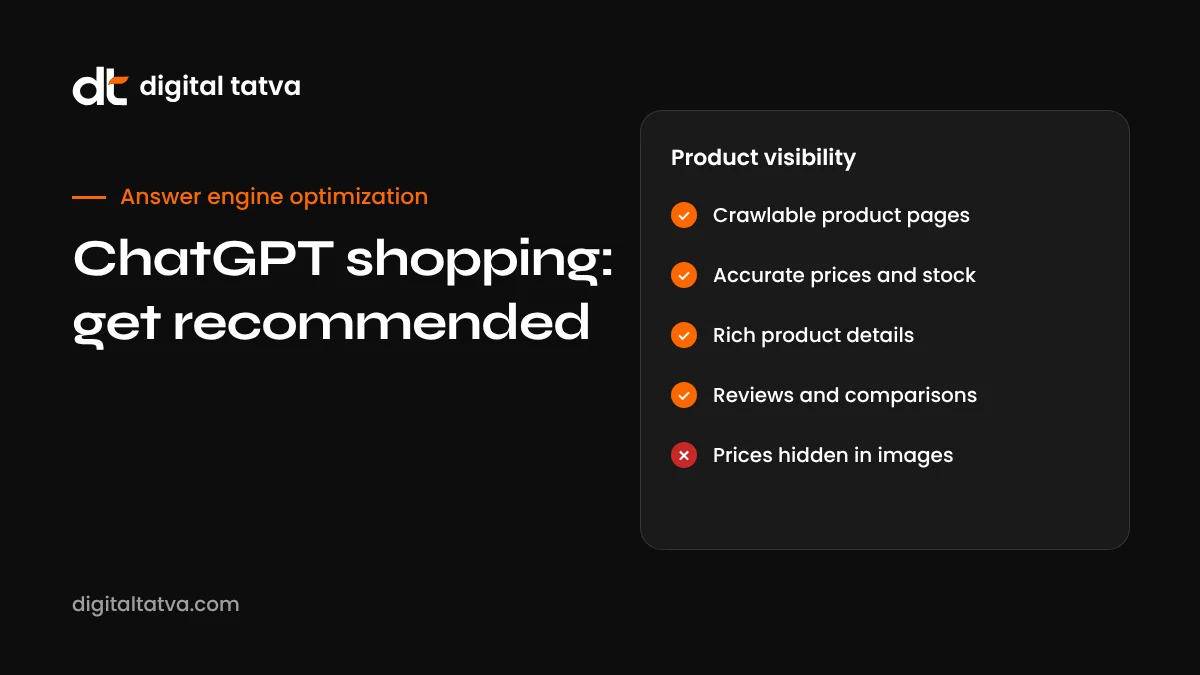
When someone asks ChatGPT a shopping question, such as “best running shoes for flat feet under ₹8,000” or “a quiet dishwasher for a small apartment”, ChatGPT can respond with a visual set of product results. These typically show product images, prices, ratings or review summaries, and the stores that sell each product. Shoppers can ask follow-up questions, compare products side by side, or upload a photo to find similar items. When they choose a product, ChatGPT links them to the retailer to complete the purchase.
ChatGPT also offers a deeper shopping research mode, where it asks clarifying questions about budget, needs and preferences, researches across sources, and produces a more detailed buyer’s guide. Both experiences rely on a mix of product data and web content.
OpenAI has said that these product results are selected independently and are not paid placements. Separately, OpenAI has been testing clearly labelled ads in ChatGPT in some markets, shown apart from the organic answer. For more on that, see our guide to ChatGPT ads.
What happened to Instant Checkout
In September 2025, OpenAI launched Instant Checkout, which allowed some shoppers in the US to buy products from participating merchants without leaving ChatGPT. It was built on the Agentic Commerce Protocol, developed with Stripe. In March 2026, OpenAI retired Instant Checkout, saying the first version did not offer the flexibility it wanted. Reports at the time noted that relatively few merchants had gone live and that many shoppers preferred to buy on familiar retailer sites where they already had accounts and saved payment details.
The practical result for merchants is simpler: ChatGPT is a discovery and research channel, and the sale happens on your own website or marketplace listing. That makes your product data, your product pages and your reputation the main levers. Some large retailers have also built deeper integrations or dedicated apps inside ChatGPT, but most businesses will compete through feeds and web content.
Google is moving in a related direction with agentic checkout in AI Mode; see our explainer on Google UCP and agentic checkout.
Where ChatGPT gets product information
| Source | What it provides | What you control |
|---|---|---|
| Merchant product feeds | Titles, descriptions, prices, availability, images, identifiers | Feed completeness and accuracy |
| Your website (via OAI-SearchBot) | Product pages, specs, policies, FAQs | Crawl access, page structure, clarity |
| Third-party reviews and editorial content | Opinions, comparisons, “best of” lists | Product quality, review requests, PR |
| Forums and communities | Real user experiences and complaints | Customer experience, authentic participation |
| Model training data | General brand awareness and reputation | Long-term brand building |
Industry monitoring by AI visibility platforms during 2026 suggested that, from around mid-year, merchant feeds became the dominant source of product results in ChatGPT. Treat specific percentages with caution, because they come from prompt monitoring rather than OpenAI, but the direction is clear: if you do not have a feed connected, you are at a disadvantage.
Step 1: Get your product feed connected
How you do this depends on your platform:
- Shopify: Shopify offers a channel that connects your catalog to ChatGPT and other AI assistants. Check your Shopify admin for its AI or agentic storefront options and confirm your products are included.
- Other platforms (WooCommerce, Magento, custom): OpenAI accepts product feeds from merchants. Check OpenAI’s merchant documentation for the current process and feed specification. Many feed management tools can generate a compatible feed from your existing Google Merchant Center data.
- Marketplaces: If you sell on large marketplaces, your listings there may appear in ChatGPT results through those retailers’ own integrations, so keep marketplace listings as accurate as your own site.
Once connected, check the feed regularly for errors, disapproved products and missing fields.
Step 2: Make product data complete and precise
ChatGPT matches products to detailed, conversational requests. A shopper asking for “a waterproof hiking jacket for women, lightweight, under 400 grams, with pit zips” needs your data to state those attributes explicitly. Vague data loses.
| Field | Weak example | Strong example |
|---|---|---|
| Title | Trail Pro Jacket | Trail Pro Women’s Waterproof Hiking Jacket, Lightweight 380 g, Pit Zips, Navy |
| Description | Our best jacket for every adventure! | Three-layer waterproof shell rated 20,000 mm, 380 g, packs into its own pocket, underarm vents, adjustable hood |
| Attributes | Colour only | Gender, size range, material, weight, waterproof rating, use case, care instructions |
| Identifiers | Missing | Brand, model number, GTIN or barcode where available |
| Images | One small image | Several high-quality images, including in use and detail shots |
For more on writing product content that AI understands, see AI product descriptions and AEO for ecommerce.
Step 3: Allow the right crawlers
OpenAI uses different crawlers for different purposes. OAI-SearchBot is used for ChatGPT search, and OpenAI has said that sites which block it may not appear in ChatGPT search answers. GPTBot collects data for model training; blocking it is a separate decision and does not by itself remove you from search results. ChatGPT-User fetches pages when a user asks ChatGPT to visit them.
Check your robots.txt, your CDN’s bot protection and any firewall rules. Some security settings block AI crawlers by default without the site owner realising. See our AI crawlers list and robots.txt for AI crawlers.
Step 4: Make product pages machine-readable
- Specs as text, not images. Size charts, specification tables and compatibility lists should be HTML text.
- Policies in plain text. Shipping times, return windows and warranty terms should be readable on the page, not hidden in pop-ups or PDFs.
- Product schema. Add Product, Offer and AggregateRating schema with accurate values. See schema markup for AEO.
- Server-rendered content. Make sure key product content appears in the HTML without needing JavaScript. See JavaScript rendering and AI crawlers.
- Consistent price and stock. Your page must match your feed. Mismatches frustrate shoppers who click through and can undermine trust.
Step 5: Build the reputation ChatGPT reads
Product data tells ChatGPT what you sell. Reputation tells it whether to recommend you. When ChatGPT explains why a product is a good choice, it often draws on review themes, expert opinions and community discussion. A product with thin or mixed reviews is harder to recommend confidently.
- Ask for reviews consistently. Send a polite review request after delivery, on your own site and on major platforms. Never buy or fake reviews.
- Respond to negative reviews. A thoughtful public reply shows care and can soften the impact of a complaint.
- Get into credible “best of” lists. Send products to independent reviewers and publications in your category. Editorial roundups are frequently used as sources for product comparisons. See best digital PR tools.
- Be present where people discuss products. Reddit threads, YouTube reviews and niche forums shape how AI tools describe products. Participate honestly; see Reddit for AEO and YouTube for AEO.
- Fix recurring complaints at the source. If many reviews mention sizing problems, update your size guide and product description. AI summaries often surface recurring themes.
Step 6: Create content that answers buying questions
Shoppers ask ChatGPT more than “show me products”. They ask “which is better for…”, “is X worth it”, “what size should I get” and “what is the difference between…”. Content on your site that answers these questions clearly helps ChatGPT explain your products accurately.
| Content type | Example question it answers |
|---|---|
| Buying guides | “How do I choose a mattress for back pain?” |
| Comparison pages | “Model A vs Model B, which is better for a small kitchen?” |
| Sizing and fit guides | “Do these shoes run small?” |
| Use-case pages | “Best backpack for a laptop and daily commute” |
| Care and maintenance guides | “How do I clean a cast iron pan?” |
| Detailed FAQs | “Does this blender crush ice?” |
Write these pages in an answer-first format, with honest recommendations even when the answer is “this product is not right for you”. Balanced content is more credible to people and is more likely to be quoted. Our guide to comparison pages for AEO covers the format in detail.
Step 7: Track how ChatGPT presents your products
You cannot improve what you do not measure. Build a simple tracking routine:
- Write 20 to 40 shopping prompts your customers might ask, mixing generic (“best air purifier for a bedroom”), specific (“air purifier with HEPA filter under ₹15,000”) and brand comparison prompts.
- Run them monthly in ChatGPT, ideally in a logged-out or fresh session, and note whether your products appear, at what position, and with which price and description.
- Record which stores and sources are shown for competitor products.
- Check accuracy. Are prices, features and availability correct? Note errors and trace them to your feed or pages.
- Measure traffic and sales from ChatGPT in GA4 using a referral segment. See track AI traffic in GA4.
Dedicated AI visibility tools can automate parts of this. See best AI visibility tools.
How ChatGPT seems to choose between similar products
OpenAI has not published a ranking formula for shopping results, and it would be misleading to claim otherwise. From testing many shopping prompts, though, a few patterns are consistent enough to plan around:
- Fit to the request matters most. Products whose data clearly matches the stated need, budget and constraints tend to appear. A product that might fit but does not say so in its data is often skipped.
- Clear evidence beats marketing claims. “Rated 4.5 from 2,300 reviews” or “tested by an independent lab” gives the model something concrete to repeat. “Best quality in India” does not.
- Consistency builds confidence. When the same product is described the same way on your site, your feed, marketplaces and reviews, it is easier to recommend.
- Availability matters. Out-of-stock products are less useful to recommend, so stale stock data can hurt.
- Answers vary. Running the same prompt twice can produce different products. Judge visibility across many prompts and several weeks, not one screenshot.
Using your Google Merchant Center work twice
If you already maintain a good Google Merchant Center feed for Shopping ads or free listings, you have done much of the work. The same product data discipline applies: accurate titles, GTINs, prices, availability, shipping and high-quality images. Many feed tools can export to multiple channels from one source of truth.
A good approach is to treat your product catalogue as a single master dataset, clean it once, and then distribute it to Google, ChatGPT, marketplaces and any other AI shopping channels you join. This prevents the common problem of each channel having slightly different, slightly wrong data. It also means improvements you make for Google AI Mode and AI Overviews carry over to ChatGPT, and vice versa. See AI Overviews optimization and Google AI Mode vs AI Overviews.
What about ads in ChatGPT?
OpenAI has been testing labelled ads in ChatGPT for some users. Ads are shown separately from the organic answer and, according to OpenAI, do not influence which products appear in the organic results. For most brands, organic optimization should come first, because it builds the foundation that any paid placement will also rely on: clear products, credible reviews and a good landing page. If ads become available in your market, test them as you would any new channel, with small budgets and clear tracking.
ChatGPT shopping optimization for Indian ecommerce brands
Indian D2C brands and online stores face a few specific considerations:
- Prices in rupees and GST clarity. Make sure your feed and pages show prices clearly in INR and state whether GST is included.
- Delivery coverage. State pin code coverage, delivery times and cash on delivery options in plain text. Shoppers frequently ask about delivery to specific cities.
- Marketplace consistency. Many Indian brands sell on their own site and on large marketplaces. Keep titles, specs and prices aligned so AI tools see one consistent product.
- Regional language questions. Shoppers increasingly ask in Hindi or Hinglish. See multilingual AEO.
- Trust signals. Clear return policies, a real address, customer support contacts and genuine reviews matter, because shoppers often ask whether a brand is genuine.
Shopify-based Indian brands should check which AI channel features are available for their store and region, as some integrations launch in the US first. WooCommerce stores can prepare a clean Google Merchant Center feed now, because it can usually be adapted for other AI channels. See AEO for Shopify and AEO for WordPress.
An illustrative example: a home appliance brand
This is an illustrative scenario, not a real client case. Imagine a mid-sized Indian brand selling air purifiers on its own WooCommerce site and on marketplaces. When the team asks ChatGPT “best air purifier for a 300 sq ft bedroom in Delhi”, their products never appear, while two competitors do.
An audit might find that the site’s firewall blocks unknown bots including OAI-SearchBot, product titles are model codes like “AP-300X”, room coverage is only shown inside an image, and reviews sit in a JavaScript widget. A sensible plan would be to allow OAI-SearchBot, rewrite titles to state product type and coverage, move specs into HTML tables, expose reviews in crawlable HTML with schema, submit a clean feed, and publish an honest buying guide on choosing a purifier by room size. None of this guarantees a recommendation, but it removes the barriers that made the products invisible.
Common mistakes that keep products out of ChatGPT
- No feed connected, relying only on website crawling.
- Bot protection blocking OAI-SearchBot without anyone noticing.
- Creative titles that do not say what the product is.
- Missing attributes such as size, material, compatibility or weight.
- Price and stock mismatches between feed and page.
- Policies hidden in images, accordions loaded by JavaScript or PDFs.
- Few or no reviews, or reviews only in a widget crawlers cannot read.
- Duplicate products with slightly different names across channels, which splits signals.
A 30-day ChatGPT shopping plan
| Week | Actions |
|---|---|
| 1 | Run baseline shopping prompts; check robots.txt and bot protection for OAI-SearchBot; review feed status |
| 2 | Fix titles and attributes for your top 20 to 50 products; add missing identifiers and images |
| 3 | Move specs and policies into plain text; add or fix Product schema; align page prices with feed |
| 4 | Launch a review request flow; publish one buying guide and one comparison page; re-run prompts and compare |
After the first month, keep a monthly rhythm: re-run prompts, fix data errors, add buying content and keep earning reviews and mentions.
How Digital Tatva can help
We help ecommerce brands in India and abroad get their product data, pages and reputation ready for AI shopping assistants, including ChatGPT, Google AI Mode and Perplexity. That includes feed and crawler audits, product page improvements, schema, buying content and AI visibility tracking. We cannot guarantee that ChatGPT will recommend your products, but we can remove the obstacles and build the signals that give them a fair chance.
Want to know how ChatGPT sees your products? Request an AEO audit or check crawler access with our free AI visibility checker.
Frequently asked questions
What is ChatGPT shopping optimization?
It is the practice of making your products easy for ChatGPT to find, understand and recommend, through product feeds, clear product data, crawlable pages and a strong reputation.
Can I still sell directly inside ChatGPT?
OpenAI retired Instant Checkout in March 2026. ChatGPT now sends most shoppers to the retailer’s own site to buy, though some large retailers have their own deeper integrations.
How do I get my products into ChatGPT?
Connect a product feed through Shopify’s AI channel or OpenAI’s merchant feed process, allow OAI-SearchBot to crawl your site, and keep product data complete and accurate.
Are ChatGPT product results paid?
OpenAI says organic product results are selected independently. Ads, where they appear, are labelled and shown separately.
Does blocking GPTBot remove me from ChatGPT shopping?
Not by itself. GPTBot is for training. OAI-SearchBot is the crawler used for ChatGPT search, and blocking that can keep you out of search answers.
Do reviews affect ChatGPT recommendations?
Reviews and third-party opinions are part of what ChatGPT uses to summarise and compare products, so genuine reviews help.
Is ChatGPT shopping available in India?
ChatGPT’s shopping features are available to users in many countries, though some features and integrations roll out to the US first. Check the current availability in your market.
Can you guarantee my products will be recommended?
No. No one can guarantee placement in ChatGPT answers. Good data, access and reputation improve your chances.
Do product reviews on my own site help with ChatGPT?
They can, especially when they are genuine, detailed and readable as HTML text. Third-party reviews on trusted platforms also matter.
How quickly do feed changes appear in ChatGPT?
Timing varies. Check feed status regularly and re-test your shopping prompts a few weeks after significant updates.
Can I see which retailers ChatGPT shows for my product?
Run your product queries and note the stores listed. If marketplace listings appear instead of your site, improve your own feed and product pages.
Product details, prices and features are checked at the time of writing and can change. Sources are linked in the text so you can check them yourself.
How does your brand appear in AI answers?
We test the questions your buyers ask across the major AI assistants and search engines, then show you what to fix first.
Get an AI Visibility Audit