How AI Search Engines Work: From Question to Cited Answer
A plain-English explanation of how AI search engines like ChatGPT search, Google AI Mode, Perplexity and Copilot turn a question into a cited answer, and what each step means for businesses that want to be mentioned.
On this page
- Key takeaways
- What is an AI search engine?
- Classic search vs AI search in one table
- Step 1: Understanding the question
- Step 2: Breaking the question into searches
- Step 3: Retrieving pages and passages
- Step 4: Weighing and choosing sources
- Step 5: Writing the answer and adding citations
- What happens without web search
- Why AI search engines get things wrong
- How each major AI search engine differs
- A worked example: one question from start to finish
- What this means for your AEO strategy
- Where AI search is heading
- How AI decides whether to search at all
- Personalisation, memory and location
- How citations are chosen and shown
- What AI search means for different teams
- Common myths about how AI search works
- How Digital Tatva can help
- Frequently asked questions
Last updated: 13 November 2026
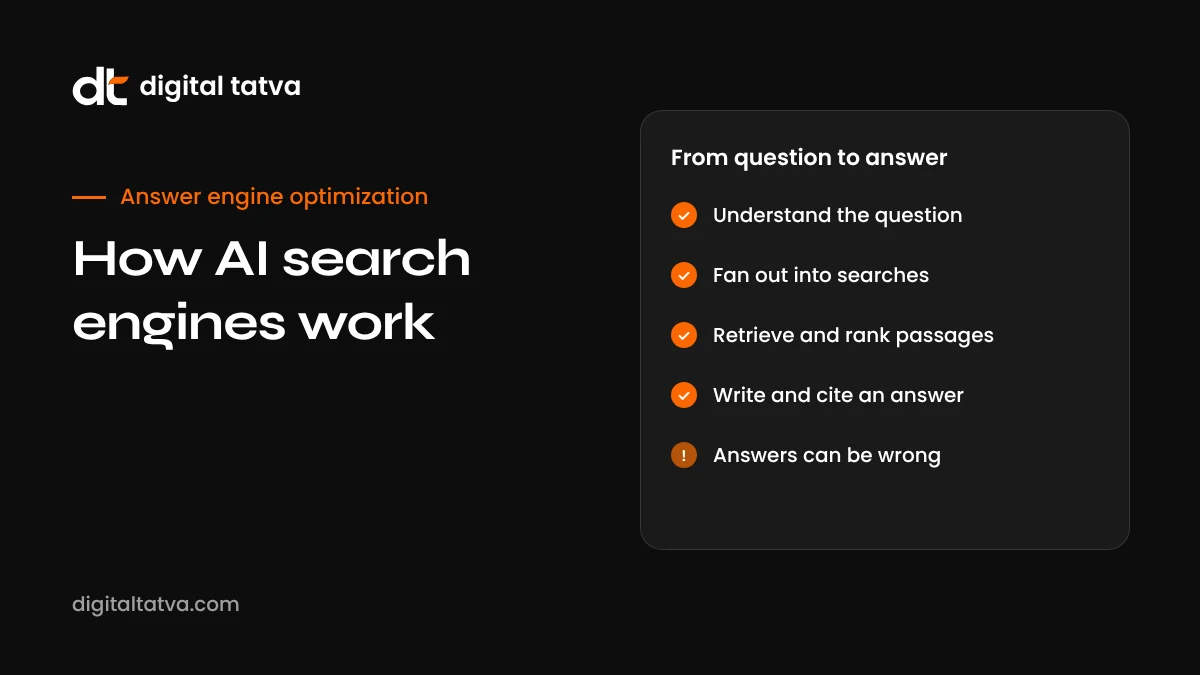
Quick answer: AI search engines work in five main steps. First, a language model works out what you are really asking. Second, it breaks that question into several smaller searches. Third, it retrieves pages from a search index and pulls out the most relevant passages. Fourth, it weighs those passages for relevance, reliability and agreement. Fifth, it writes a single answer in natural language and attaches citations to the sources it relied on. Tools like ChatGPT search, Google AI Mode, Perplexity and Microsoft Copilot all follow this pattern, often called retrieval-augmented generation, with their own indexes and rules.
Key takeaways
- AI search combines a search engine and a language model. The search part finds sources; the model reads them and writes the answer.
- One question usually becomes several searches behind the scenes, which is why broad topic coverage helps.
- AI reads passages, not whole pages, so clear, self-contained sections are more likely to be used.
- The final answer names only a few brands and sources, so the competition is for inclusion, not rank.
- AI answers can be wrong. They reflect the sources available and the model’s interpretation of them.
What is an AI search engine?
An AI search engine is a tool that answers your question with a written response instead of a list of links. You type or say something like “which laptop is best for video editing under 1.5 lakh”, and you get a few paragraphs explaining the options, often with sources you can click.
The main examples in 2026 are:
- Google AI Overviews and AI Mode, built into Google Search.
- ChatGPT search, inside ChatGPT on web, desktop and mobile.
- Perplexity, a dedicated AI answer engine.
- Microsoft Copilot and Bing AI Mode, built on Bing.
- Gemini, Google’s assistant app, which can search the web.
- Claude, which can search the web when the feature is turned on.
Under the hood, they work in broadly the same way. Understanding that process is the foundation of answer engine optimization, because each step is a place where your brand can be included or dropped.
Classic search vs AI search in one table
| Step | Classic search engine | AI search engine |
|---|---|---|
| Input | Short keywords | Full questions and conversations |
| Understanding | Matches keywords and intent | A language model interprets meaning and context |
| Searching | One query | Several sub-queries in parallel |
| Unit of retrieval | Whole pages | Passages within pages |
| Output | Ranked list of links | One written answer with a few citations |
| Follow-up | New search from scratch | Conversation keeps context |
| What you compete for | Position on the page | Being mentioned or cited at all |
Step 1: Understanding the question
Everything starts with a large language model reading your question. Unlike a keyword engine, it tries to understand intent, constraints and context. If you ask “what is a good CRM for us”, and earlier in the conversation you said you run a five-person real estate team in Pune, the model takes that into account.
At this stage the system also decides whether it needs to search at all. Simple factual or creative questions may be answered from the model’s training. Questions about recent events, prices, local businesses, products or anything that changes usually trigger a live search.
What it means for you: people ask AI longer, more specific questions than they type into Google. Your content should match the way real buyers describe their situation. Our AEO prompt research guide shows how to discover those questions.
Step 2: Breaking the question into searches
Once the system decides to search, it rarely runs just one query. It generates several related searches to cover different angles. Google calls this query fan-out. Other systems do the same thing under different names.
For example, “best CRM for a small real estate team in India” might become:
- best CRM for real estate agents
- CRM with WhatsApp integration India
- real estate CRM pricing in rupees
- CRM mobile app reviews for agents
- top real estate CRM alternatives
Each of those searches returns its own results. The system then pools them together.
What it means for you: a page that only targets the main phrase misses the sub-searches. Content that covers pricing, integrations, comparisons and use cases gives the system more reasons to pull you in. This is why topical authority matters so much in AI search.
Step 3: Retrieving pages and passages
Now the system fetches results from a search index. Each platform uses a different one:
| AI search engine | Main index | Crawler to allow |
|---|---|---|
| Google AI Overviews and AI Mode | Google Search index | Googlebot |
| Gemini app | Google Search | Googlebot |
| ChatGPT search | OpenAI’s own retrieval and partners | OAI-SearchBot |
| Microsoft Copilot and Bing AI Mode | Bing index | Bingbot |
| Perplexity | Perplexity’s own index and live fetches | PerplexityBot |
| Claude web search | Search provider plus live fetches | Claude bots |
The system does not read whole pages the way you would. It splits them into passages, often a few sentences to a few paragraphs long, and scores each one for relevance to the sub-question. The best passages from many pages move forward.
Some systems also fetch pages live at the moment of the question. If your page is slow, blocked or depends on JavaScript to show its text, that fetch may fail.
What it means for you: make sure the right crawlers can reach you, keep pages fast and server-rendered, and write in clear, self-contained passages. See our AI crawlers list and the guide to content chunking for AI search.
Step 4: Weighing and choosing sources
Retrieval gives the system far more material than it can use. It now has to choose. Exact methods are not public, but the system generally prefers passages that:
- Directly answer the sub-question.
- Come from sources that rank well and are considered reliable.
- Agree with other independent sources.
- Contain specific facts, numbers and dates rather than vague claims.
- Are recent when the topic changes over time.
Agreement between sources is especially important for recommendations. If five independent review sites and comparison articles mention the same three products, the model has strong grounds to recommend them. A brand mentioned only on its own website has weak grounds, however good the website is.
What it means for you: your own content is necessary but not sufficient. You also need presence on the sources AI trusts in your category. See the kinds of pages AI assistants cite and brand mentions for AEO.
Step 5: Writing the answer and adding citations
Finally, the language model writes the answer. It is given the selected passages as context and instructed to answer the question using them. This approach is called retrieval-augmented generation, or RAG. Our explainer on what RAG is covers the technical side.
The model summarises, compares and recommends, then attaches citations to some of the sources it used. Different products show citations differently: inline numbers, link cards, a sources panel or links beside each paragraph.
Two things are worth knowing here:
- Not every source used is cited. The model may draw on more pages than it links to.
- Brands can be mentioned without being linked. A recommendation in the text is valuable even if the citation goes to a review site rather than your website.
What it means for you: track both mentions and citations. Our guide to tracking brand mentions in ChatGPT and AI share of voice show how.
What happens without web search
Not every AI answer uses live search. When a model answers from its training alone, it relies on what it learned from data collected up to its training cutoff. That knowledge is broad but can be out of date, and it cannot be updated by changing your website today.
This has two practical consequences. First, brand building over years shapes how future models describe you, because they learn from what has been written about you. Second, for anything current, live search is where your efforts show up quickly. Most commercial questions, such as best tools, prices, local services and comparisons, tend to trigger search.
Why AI search engines get things wrong
AI answers can be inaccurate. Understanding why helps you protect your brand.
| Cause | Example | What you can do |
|---|---|---|
| Outdated sources | Old pricing from a 2024 review | Update your pages and ask publishers to refresh |
| Conflicting facts | Different founding years on different sites | Make your entity facts consistent everywhere |
| Missing information | AI cannot find your service area, so guesses | State key facts clearly on your site |
| Model interpretation | Two similar brands get confused | Strengthen unique identifiers and schema |
| Thin source pool | Only one forum thread mentions you | Earn more independent mentions |
If AI is saying something wrong about your business, read our guide to fixing wrong AI answers about your brand.
How each major AI search engine differs
Google AI Overviews and AI Mode
AI Overviews appear at the top of many Google results and summarise an answer with links. AI Mode is a separate, conversational search experience with deeper answers and follow-ups. Both are built on Google’s ranking systems, so traditional SEO strength carries over strongly. Read our guides on AI Mode vs AI Overviews and AI Overviews optimization.
ChatGPT search
ChatGPT decides when to search and shows sources alongside its answer. It tends to lean on established publishers, review platforms and comparison content. OpenAI’s OAI-SearchBot must be able to reach your site. See ChatGPT SEO and ChatGPT indexing.
Perplexity
Perplexity searches on almost every question and shows sources prominently. It favours fresh, specific pages and often cites forums and niche sites. See Perplexity SEO.
Microsoft Copilot and Bing AI Mode
These use Bing’s index through a process Microsoft calls grounding. Bing Webmaster Tools offers an AI Performance report that shows citations, which makes Bing one of the best places to learn how AI uses your content. See Bing AI Mode and Copilot SEO.
Gemini and Claude
Gemini draws on Google Search and Google services. Claude can search the web when enabled and cites the pages it reads. See Gemini SEO and Claude SEO.
A worked example: one question from start to finish
Let us follow a realistic question through the system. A marketing manager asks: “What is the best project management tool for a 20-person creative agency that uses Slack and Google Drive?”
- Understand. The model notes team size, industry, and two required integrations.
- Fan out. It searches for best project management tools for agencies, tools with Slack integration, tools with Google Drive integration, pricing for 20 users, and reviews from creative teams.
- Retrieve. It pulls passages from comparison articles, integration pages on vendor sites, review platforms and a few agency blogs.
- Weigh. Three tools appear repeatedly across independent sources with clear integration details and recent reviews. Two others appear only on their own sites.
- Write. The answer recommends the three well-supported tools, explains why each fits, notes pricing ranges and cites a comparison article, two vendor integration pages and a review site.
The two tools that were left out were not necessarily worse. They simply had less evidence available in the places the system looked. That is the core insight of AEO: visibility depends on the evidence trail, not just on the product. Our list of best AI project management tools is an example of the kind of comparison page that gets cited in answers like this.
What this means for your AEO strategy
Each step suggests a specific job for your business:
| Step | Your job | Guide |
|---|---|---|
| Understanding | Know the real questions buyers ask | Prompt research |
| Fan-out | Cover related sub-questions in depth | Topical authority |
| Retrieval | Be crawlable, fast and well structured | Technical AEO checklist |
| Weighing | Earn independent mentions and reviews | How to get cited by AI |
| Writing | Make your facts clear and consistent | Entity SEO |
For a full overview of the factors involved, read our guide to AI search ranking factors.
Where AI search is heading
AI search is moving quickly from answering questions to taking actions. Agents can now compare options, fill in forms and, in some cases, complete purchases. Google’s agentic checkout features and ChatGPT’s shopping experiences are early examples. This makes clear, structured, machine-readable information even more important, because an agent needs reliable data to act on.
If you want to prepare for that shift, our guides to agentic search and building an agent-ready website are good next reads.
How AI decides whether to search at all
One of the least understood parts of AI search is the decision to search in the first place. When you ask a question, the system has to choose between answering from what the model already knows and going out to the web. That choice shapes whether your website has any chance of appearing.
In general, AI systems are more likely to search when a question:
- Mentions something recent, such as “2026”, “latest”, “this week” or “current”.
- Asks for prices, availability, opening hours or other facts that change.
- Names a specific local area, business or product.
- Asks for recommendations, comparisons or “best” options.
- Involves a niche topic the model may not know well.
They are less likely to search for general explanations, creative tasks, coding help or stable facts such as definitions. Users can also turn search on or off in many products, and some products, such as Perplexity, search on almost every question by design.
This has a practical consequence for content planning. Commercial and local questions, which matter most to businesses, are exactly the ones most likely to trigger a search. That is why the work you do on your website, listings and reviews can show up in AI answers relatively quickly, while general awareness built over years shapes the model’s background knowledge.
Personalisation, memory and location
AI search is becoming more personal. Several factors can change the answer two people get to the same question:
| Factor | How it changes answers | What it means for you |
|---|---|---|
| Location | Local results and regional sources for nearby businesses | Keep local listings and location pages accurate |
| Conversation history | Earlier messages add context, such as budget or industry | Cover specific use cases, not just generic ones |
| Saved memory | Some assistants remember preferences across chats | Brands a user already likes may be favoured |
| Connected apps | Assistants may draw on email, calendar or documents | Direct relationships with customers matter more |
| Language | Answers in Hindi or other languages may use different sources | Consider content in the languages your buyers use |
Because of personalisation, a single test is never enough to judge your visibility. Test in fresh sessions, with memory off where possible, from the locations your customers are in, and repeat over time. Our guide to multilingual AEO covers the language side, and AI memory explained covers how assistants remember users.
How citations are chosen and shown
Citations are the visible part of AI search for businesses, so it helps to understand how they appear. Each product handles them differently:
- Google AI Overviews show link cards and inline links beside the answer, often from pages that rank well for the question or its sub-questions.
- Google AI Mode shows sources next to sections of the answer and lets users explore more links.
- ChatGPT search shows inline source chips and a sources panel listing the pages it used.
- Perplexity shows numbered citations prominently, often from many pages.
- Copilot and Bing AI Mode show citations beside sentences, linked to pages in the Bing index.
A citation is not the same as a recommendation. Your page might be cited for a definition while a competitor is recommended as the product to buy. When you track AI visibility, record both: whether your brand is named, and whether your pages are cited. The two often move separately, and the gap between them tells you what to work on next.
What AI search means for different teams
AI search is not only an SEO issue. It touches several parts of a business:
| Team | Why AI search matters to them | First action |
|---|---|---|
| Marketing and SEO | Visibility and traffic now depend on AI answers as well as rankings | Set up prompt tracking and AI referral reporting |
| PR and communications | Media coverage directly shapes what AI says about the brand | Focus on coverage in sources AI cites for your category |
| Product | AI describes features and limitations, sometimes inaccurately | Keep product pages and docs clear and current |
| Customer support | Customers may arrive with AI-generated expectations | Publish clear help content and FAQs |
| Sales | Buyers shortlist vendors using AI before talking to sales | Make sure comparison and pricing information is accurate |
| Leadership | Brand reputation in AI answers affects trust and hiring | Review what AI says about the company each quarter |
The businesses that adapt fastest treat AI visibility as a shared responsibility, with marketing coordinating and other teams feeding accurate information in.
Common myths about how AI search works
- “AI search does not use websites.” It does. Most current and commercial answers are built from web pages retrieved at the time of the question.
- “You can pay to be in the answer.” Organic AI answers are not sold. Some platforms now show clearly labelled ads around answers, which is a separate product.
- “AI only cites big brands.” Large brands have advantages, but specific, well-structured pages from smaller sites are cited often, especially for niche sub-questions.
- “Once AI says something, it is fixed.” Search-based answers change as sources change. Training-based knowledge changes with each new model.
- “Schema markup forces AI to use your data.” Schema helps clarity but does not guarantee anything.
How Digital Tatva can help
We help businesses show up at every step of this process. We check that AI crawlers can reach you, map the questions your buyers ask, restructure key pages into clear, quotable passages, align your brand facts and build the third-party evidence AI relies on. We measure progress with the same prompts every month. We cannot promise placement in any AI answer, because nobody controls these systems, but we can make your brand much easier to find, understand and trust.
Curious how AI search sees your business today? Request an AEO audit for a full baseline across the major AI engines, or try our free AI visibility checker to test crawler access now.
Frequently asked questions
How do AI search engines find information?
They run searches on a web index, such as Google’s, Bing’s or their own, retrieve relevant pages, and extract the passages that best answer the question. Some also fetch pages live when the question is asked.
What is retrieval-augmented generation?
Retrieval-augmented generation, or RAG, is the method most AI search engines use. The system retrieves relevant documents first, then gives them to a language model, which writes an answer based on them.
Do AI search engines use Google?
Google’s own AI features use Google’s index. Microsoft Copilot uses Bing. ChatGPT and Perplexity use their own retrieval systems and partners. So the answer depends on the product.
Why does AI search give different answers to the same question?
Language models generate text with some variation, searches can return different results at different times, and models are updated often. That is why visibility should be measured over repeated tests.
Are AI search answers accurate?
Often, but not always. They depend on the quality and recency of the sources found and on how the model interprets them. It is wise to check important facts in the cited sources.
How can my business appear in AI search answers?
Make sure AI crawlers can access your site, write clear answer-first content, keep your brand facts consistent, and earn mentions and reviews on sources AI trusts. Our guide to ranking in AI search covers the full process.
Is AI search replacing Google?
Not replacing, but changing it. Google itself now shows AI answers, and many people use ChatGPT and other assistants alongside search. Read is SEO dead for a balanced view.
Can Digital Tatva help my business with AI search?
Yes. We offer answer engine optimization services that start with an AI visibility audit and a baseline across ChatGPT, Gemini, Perplexity, Copilot and Google AI.
Product details, prices and features are checked at the time of writing and can change. Sources are linked in the text so you can check them yourself.
How does your brand appear in AI answers?
We test the questions your buyers ask across the major AI assistants and search engines, then show you what to fix first.
Get an AI Visibility Audit