AI Search Ranking Factors: What Gets Brands Cited in 2026
What actually decides which brands ChatGPT, Gemini, Perplexity and Google AI Overviews mention? A practical breakdown of the AI search ranking factors that matter, how they differ from classic SEO, and how to improve each one.
On this page
- Key takeaways
- Why “ranking factors” means something different in AI search
- What we know, and what nobody knows
- The 12 AI search ranking factors that matter most
- How the factors differ by AI platform
- Factors that matter less than people think
- A 30-day plan to improve your AI search ranking factors
- How to tell which factor is holding you back
- A real-world way to think about it
- How AI ranking factors connect to business results
- How Digital Tatva can help
- Frequently asked questions
Last updated: 13 November 2026
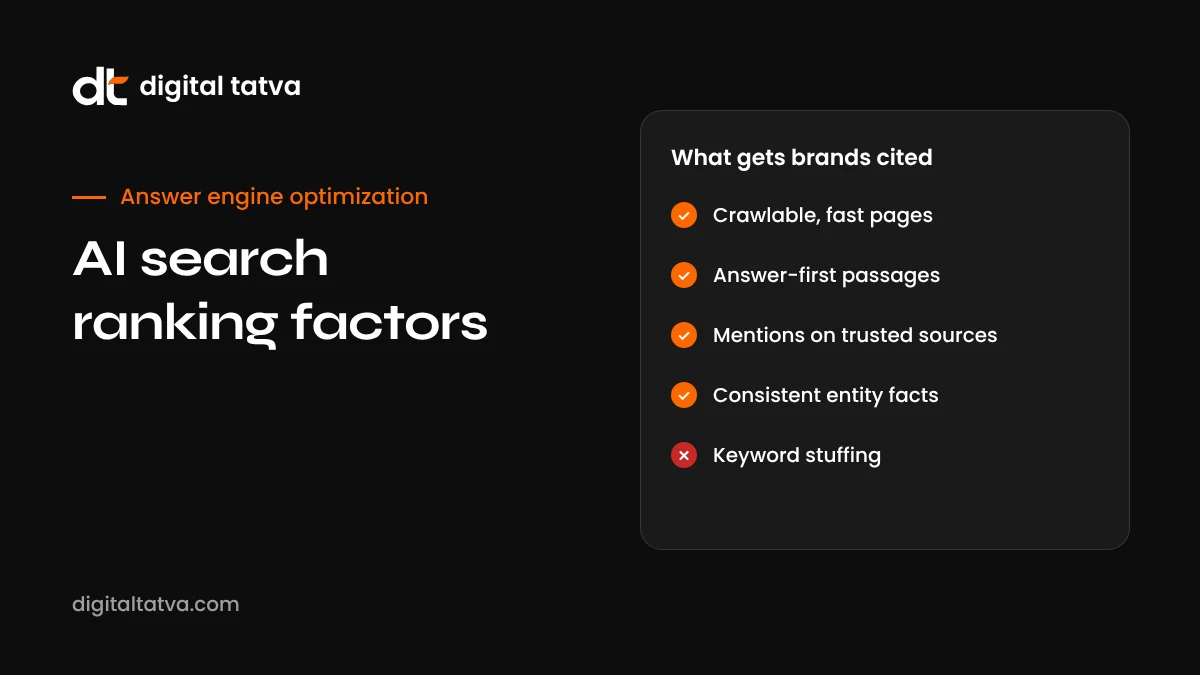
Quick answer: AI search ranking factors are the signals that decide whether ChatGPT, Gemini, Perplexity, Copilot and Google AI Overviews mention or cite your brand. No AI company publishes a full list, but the evidence points to the same core factors: your pages must be crawlable and fast, your content must answer specific questions in clear, quotable passages, your brand must be mentioned and recommended on sources the AI trusts, your facts must be consistent across the web, and your content must be fresh. Classic SEO signals still matter because most AI answers are built on search results, but the unit that wins is now the passage and the brand, not just the page.
Key takeaways
- AI assistants do not rank ten blue links. They choose a handful of sources and brands to mention, so the competition is for inclusion, not position.
- Most AI answers that use the web are built from search results, so strong traditional SEO is still the entry ticket.
- Passage quality matters more than page length. Short, self-contained answers under clear headings are easier to quote.
- Third-party mentions often decide who gets recommended. Reviews, comparisons and trusted publications carry a lot of weight.
- Consistent entity facts reduce the risk of AI describing you wrongly or leaving you out.
- Nobody can guarantee placement. You can only make your brand easier to find, understand and trust.
Why “ranking factors” means something different in AI search
For twenty years, SEO people talked about ranking factors as the signals Google used to order results on a page. You could rank third, eighth or forty-second. In AI search, that idea of a position mostly disappears. When someone asks ChatGPT “what is the best accounting software for a small agency”, the answer names three to six products and moves on. You are either in that answer or you are not.
That changes how you should think about the whole topic. In AI search, a ranking factor is anything that makes a system more likely to:
- Find your content when it searches the web or its index.
- Select your page or passage as a source worth reading.
- Trust what it reads enough to repeat it.
- Mention your brand by name in the final answer, ideally with a link.
Each of those four steps has its own signals. If you only work on one, you leave gaps. A brand with excellent content but no third-party mentions often gets cited as a source for facts while a competitor gets recommended as the product to buy. That is a painful but common result, and it is why it helps to understand the full chain. Our guide to how AI search engines work walks through that chain step by step.
What we know, and what nobody knows
A quick word on honesty before the list. OpenAI, Google, Anthropic, Microsoft and Perplexity do not publish ranking algorithms for their AI answers. Anyone claiming to know the exact weights is guessing. What we do have is:
- Public documentation from Google on AI Overviews and AI Mode, which says the same core systems and quality guidelines apply.
- Microsoft’s published notes on how Bing grounding selects content for Copilot and Bing AI answers, which highlight freshness, structured signals and how suitable a passage is for citation.
- Crawler documentation from each company, which tells you which bots need access.
- Large numbers of observed answers. Tracking the same prompts over months shows clear patterns in which kinds of sources and brands appear.
The factors below come from those sources and from repeated prompt testing. Treat them as strong working principles, not as a secret formula.
The 12 AI search ranking factors that matter most
| Factor | Stage it affects | Why it matters | Effort to improve |
|---|---|---|---|
| Crawler access | Find | If the AI bot cannot fetch the page, nothing else matters | Low |
| Traditional search visibility | Find | Many AI answers start with a web search | Medium to high |
| Page speed and clean HTML | Find and select | AI fetchers time out and skip heavy pages | Medium |
| Answer-first passages | Select | Short, direct answers are easy to lift | Low |
| Clear structure | Select | Headings, lists and tables map to questions | Low |
| Coverage of follow-up questions | Select | AI splits questions into sub-queries | Medium |
| Evidence and original data | Trust | Specific, checkable facts are safer to repeat | Medium |
| Expertise and authorship | Trust | Named experts signal reliability | Low to medium |
| Third-party mentions | Trust and mention | Independent sources confirm your claims | High |
| Reviews and sentiment | Mention | Recommendations lean on what customers say | Medium |
| Entity consistency | Trust and mention | Conflicting facts make AI hesitate or err | Low to medium |
| Freshness | Select and trust | Recent, dated content wins on changing topics | Low |
1. Crawler access
This is the most basic factor and the most often broken. Each AI company uses its own crawlers. OpenAI uses OAI-SearchBot for ChatGPT search, Anthropic uses its Claude bots, Perplexity has PerplexityBot, and Google and Bing rely on their main search crawlers. If your robots.txt or firewall blocks them, your pages cannot be read at the moment someone asks a question.
Many sites block AI crawlers by accident. A security plugin, a CDN bot setting or an old robots.txt rule written to stop training can also stop search. Check this first, because it is free to fix and nothing else works without it. Our AI crawlers list and robots.txt guide for AI crawlers explain which bots to allow and which you can safely block.
2. Traditional search visibility
It is tempting to think AI search replaced SEO. In practice, it sits on top of it. Google AI Overviews and AI Mode draw on Google’s index and ranking systems. Copilot and many other assistants use Bing results. ChatGPT search runs its own retrieval but still favours pages that are well established on the open web.
When we track prompts, the pages cited in AI answers very often also rank on the first page for related searches. That is not a coincidence. If you are invisible in search, you start every AI answer with a handicap. Keep your fundamentals strong: technical health, relevant content and good links. Our comparison of AEO vs SEO explains how the two work together.
3. Page speed and clean HTML
AI systems fetch pages on demand, often under tight time limits. A page that takes eight seconds to render, or that hides its text behind heavy JavaScript, may simply be skipped. Several AI crawlers do not run JavaScript at all, so content that only appears after scripts load can be invisible to them.
Server-rendered HTML, fast hosting and lean pages help. If your site relies on a JavaScript framework, test what a non-JavaScript fetch sees. Our guide to JavaScript rendering and AI crawlers shows how.
4. Answer-first passages
AI systems do not read your page the way a person does. They break it into passages and pick the ones that best answer the question. A passage that opens with a direct answer, in one to three sentences, is far easier to use than a paragraph that warms up for 200 words before getting to the point.
This is the single most practical change most businesses can make. For every important question, write a short, complete answer first, then expand. Our answer-first content guide and the deeper piece on content chunking for AI search cover how to do it.
5. Clear structure
Headings that read like questions, numbered steps, comparison tables and short lists all make content easier to parse. Structure tells the system where one idea ends and the next begins. It also helps AI match a sub-question to the exact section that answers it.
Schema markup adds a machine-readable layer on top. Organization, Product, Article, FAQPage and HowTo schema do not guarantee anything, but they reduce ambiguity. See our schema markup guide for AEO.
6. Coverage of follow-up questions
Modern AI search does not run one search. It breaks a question into several related searches, a process Google calls query fan-out. A question like “best CRM for a real estate team” might trigger searches about pricing, mobile apps, integrations and reviews. Pages that cover those angles have more chances to be pulled in.
This rewards depth within a topic. A strong page answers the main question and the five questions people ask next. Read our explainer on query fan-out to see how to plan for it.
7. Evidence and original data
AI systems are designed to avoid repeating claims they cannot support. Specific, checkable facts with dates and sources are safer to use than vague marketing language. “Used by 2,400 clinics in India as of October 2026” is more quotable than “trusted by thousands”.
Original research is especially powerful because it creates facts that only exist on your site. When other sites cite your data, the effect compounds. Our guide to original research for AEO explains how to create data worth citing on a small budget.
8. Expertise and authorship
Google’s quality guidelines have long emphasised experience, expertise, authoritativeness and trust. AI systems built on Google’s index inherit that. Named authors with real credentials, author pages that explain who they are, and first-hand experience in the content all help.
Anonymous content written to fill a keyword gap is the opposite of what AI systems want to cite. Read E-E-A-T for AI search and our guide to author pages for AEO for the practical steps.
9. Third-party mentions
This is where many businesses lose. When an AI assistant recommends products or providers, it leans heavily on what other sources say: review platforms, comparison articles, industry publications, forums and lists. Your own website can explain what you do, but independent sources confirm that you are worth recommending.
In prompt tracking, brands that appear on several trusted third-party lists for a category are recommended far more often than brands that only describe themselves well. Earning those mentions takes time, which is why it is also a durable advantage. See brand mentions for AEO and review sites for AEO.
10. Reviews and sentiment
Recommendations are judgments, and AI systems form them partly from what customers say. Review volume, recency and tone on platforms like Google Business Profile, G2, Trustpilot or industry-specific sites all feed into how a brand is described. A brand with recent, detailed, positive reviews is easier to recommend with confidence.
Negative patterns matter too. If many reviews mention slow support, AI answers may repeat that. That is not something to hide; it is something to fix and then show improvement on. Our guide to AI reputation management covers how.
11. Entity consistency
AI systems think in entities: people, companies, products and places, linked by facts. If your company name, founding year, location, services or pricing appear differently on your website, LinkedIn, directories and press coverage, the system has to guess. Sometimes it guesses wrong. Sometimes it leaves you out.
Consistent facts, Organization schema with sameAs links, and well-maintained profiles make your entity clear. Our guides to entity SEO for AEO and Wikidata for AEO go deeper.
12. Freshness
For anything that changes, such as prices, features, rules, rankings or statistics, AI systems prefer recent sources. A comparison page last updated in 2024 is unlikely to be cited for a 2026 question. Visible “last updated” dates, accurate sitemap dates and genuine refreshes all help.
Freshness is not about changing a date without changing content. It is about keeping important pages accurate. Our content refresh guide gives a simple monthly routine.
How the factors differ by AI platform
The core factors apply everywhere, but each platform leans on different sources and has its own quirks.
| Platform | Main source of web results | What tends to stand out | Deep dive |
|---|---|---|---|
| Google AI Overviews and AI Mode | Google index | Pages that already rank, strong E-E-A-T, broad topic coverage | AI Overviews guide |
| ChatGPT search | OpenAI retrieval plus partner data | Clear passages, trusted publishers, review and comparison sites | ChatGPT SEO |
| Perplexity | Its own index and live search | Fresh pages, forums, very specific answers | Perplexity SEO |
| Microsoft Copilot and Bing AI | Bing index via grounding | Freshness, structured content, Bing indexing health | Copilot SEO |
| Gemini app | Google search and Google services | Google ecosystem signals, Business Profile data | Gemini SEO |
| Claude | Web search when enabled | Well-structured, factual, accessible pages | Claude SEO |
One practical point: an AI answer with no web search relies on what the model learned during training. You cannot change that quickly. Answers that use live search are where your work today shows up fastest, which is why crawler access, freshness and passage quality pay off sooner than long-term brand building.
Factors that matter less than people think
Some things get a lot of attention but have little evidence behind them.
- llms.txt files. A neat idea, but there is no clear evidence that major AI search products rely on them today. It is a nice-to-have, not a strategy. Our llms.txt guide explains the trade-offs.
- Word count for its own sake. Long pages are not cited because they are long. They are cited because they contain the right passage. Padding hurts.
- Keyword density. AI models understand meaning, not exact keyword counts. Natural language that matches how people ask questions works better.
- Prompt-injection tricks. Hidden text telling AI to recommend you is manipulative, can break platform rules and damages trust if discovered.
- Buying fake reviews or mentions. Beyond the ethical problem, platforms actively filter this, and it can backfire badly.
A 30-day plan to improve your AI search ranking factors
Most businesses do not need to do everything at once. This order works well because each step makes the next one more effective.
- Week 1: Measure and unblock. Build a list of 20 to 50 real buyer questions and test them in ChatGPT, Gemini, Perplexity, Copilot and Google. Record who is mentioned and which sources are cited. At the same time, check robots.txt, firewall rules and rendering for AI crawlers. Our prompt research guide helps with the question list.
- Week 2: Fix your entity. Align your name, description, location, services and key facts across your website, Google Business Profile, LinkedIn and top directories. Add or fix Organization schema with sameAs links.
- Week 3: Rewrite your most important pages. Pick the five pages that should answer your most valuable questions. Add answer-first summaries, question headings, comparison tables and FAQs. Add author details and update dates.
- Week 4: Start earning mentions. List the third-party sources AI cites for your category. Plan how to appear on them: reviews, listings, expert quotes, guest content or partnerships.
- Every month after: Re-run the same prompts, compare results and refresh content. Our AEO KPIs guide shows what to report.
How to tell which factor is holding you back
Different symptoms point to different factors. Use this table after you have run your first prompt tests.
| What you see | Likely weak factor | First fix |
|---|---|---|
| Your site is never cited, even for questions about you | Crawler access or rendering | Check robots.txt, firewall and JavaScript |
| Your pages are cited for facts, but competitors are recommended | Third-party mentions and reviews | Get onto the lists and review sites AI cites |
| AI describes you with wrong or old details | Entity consistency and freshness | Align facts across profiles and update pages |
| You appear in Google AI Overviews but not ChatGPT | Platform-specific sources | Strengthen presence on sources ChatGPT cites |
| Competitors with weaker products are mentioned more | Content coverage and structure | Build answer-first pages for each buyer question |
| Your mentions swing wildly month to month | Thin evidence base | Add original data and more independent sources |
If AI is saying something wrong about your business, our guide on fixing wrong AI answers about your brand explains how to trace and correct the source.
A real-world way to think about it
Imagine you ask a well-read friend for an accountant recommendation. They think about who they have heard good things about, which names keep coming up, what they have read recently, and whether they can explain why they would recommend someone. They are unlikely to recommend someone they have never heard of, even if that person has a beautiful website.
AI assistants behave in a similar way, just at enormous scale. They prefer brands they can find easily, understand clearly and see confirmed by other people. Every factor in this guide maps to one of those three needs. That is a useful test whenever you are unsure what to prioritise: does this make us easier to find, easier to understand, or easier to trust?
How AI ranking factors connect to business results
It is easy to get lost in the mechanics. The reason to care is simple: when buyers ask AI for recommendations, being named shortens the sales cycle. Visitors who arrive from AI answers often already know what you do and why you were suggested. Track AI referral traffic and enquiries alongside mentions so you can see the commercial effect. Our guide to tracking AI traffic in GA4 shows the setup, and AI share of voice explains how to compare yourself with competitors.
How Digital Tatva can help
We help businesses work on every factor in this guide in the right order: technical access first, then entity clarity, then content and finally authority. Every engagement starts with a measured baseline across the AI engines your buyers use, so you can see what is holding you back and what changes over time. We will never promise a place in an AI answer, because no one controls these systems, but we can make sure your brand is as easy as possible to find, understand and recommend.
Want to know which factors are holding you back? Request an AEO audit for a measured baseline and a ranked fix list, or run our free AI visibility checker to test AI crawler access in a minute.
Frequently asked questions
What are AI search ranking factors?
They are the signals that make AI assistants like ChatGPT, Gemini, Perplexity and Google AI Overviews more likely to find, trust and mention your brand. The main ones are crawler access, search visibility, answer-first content, clear structure, evidence, expertise, third-party mentions, reviews, consistent entity facts and freshness.
Are AI search ranking factors the same as Google ranking factors?
They overlap a lot, because many AI answers are built on search results. The difference is that AI search rewards quotable passages and brand recommendations, not just page positions, and third-party mentions play a bigger role in who gets recommended.
Does SEO still matter for AI search?
Yes. Pages that rank well in Google and Bing are more likely to be used in AI answers. AEO builds on SEO rather than replacing it.
What is the fastest AI ranking factor to fix?
Crawler access is usually the fastest. If AI bots are blocked by robots.txt or a firewall, unblocking them takes minutes and removes the biggest barrier.
Do backlinks matter for AI search?
Indirectly, yes. Links still help pages rank in search, which feeds AI answers. But mentions on trusted sources matter even without a link, because AI reads and weighs what those sources say.
How long does it take to improve AI visibility?
Technical fixes and content updates can show up in search-based AI answers within weeks. Building third-party authority usually takes several months. Our guide on how long AEO takes gives realistic timelines.
Can anyone guarantee my brand will appear in ChatGPT?
No. No one controls what AI systems say. Be cautious of anyone promising guaranteed placement. What you can do is improve the factors that make inclusion more likely and measure progress over time.
Can Digital Tatva help improve our AI search visibility?
Yes. Our answer engine optimization service covers technical access, content, entity work and authority building, starting with an AI visibility audit and baseline.
Product details, prices and features are checked at the time of writing and can change. Sources are linked in the text so you can check them yourself.
How does your brand appear in AI answers?
We test the questions your buyers ask across the major AI assistants and search engines, then show you what to fix first.
Get an AI Visibility Audit