Wikipedia and AI Answers: What Businesses Can and Can’t Do
Wikipedia is one of the most trusted sources AI models learn from and cite. Here is how Wikipedia affects your brand in AI answers, what its rules allow businesses to do, and the honest, rule-respecting alternatives if you do not qualify for an article.
On this page
- Key takeaways
- Why Wikipedia matters so much to AI
- What Wikipedia’s rules say about businesses
- Should your business have a Wikipedia article?
- The wrong ways to get on Wikipedia
- The right ways to engage with Wikipedia
- Wikidata: a more accessible option
- Getting the benefits without a Wikipedia article
- What to do if Wikipedia says something wrong about you
- Wikipedia for people: founders and experts
- Which sources count toward notability?
- How Wikipedia shapes AI descriptions of your industry
- Wikimedia Commons and images
- A practical plan if you are not notable yet
- Warning signs when hiring help
- How Digital Tatva approaches Wikipedia
- Real-world scenarios
- Wikipedia, AI training and the long term
- Checklist: Wikipedia and your AI visibility
- Other trusted reference sources worth knowing
- How to monitor Wikipedia mentions
- Frequently asked questions
Last updated: 13 November 2026
Quick answer: Wikipedia matters for AI visibility because it is one of the most heavily used sources in AI training data and is frequently cited in AI answers about companies, people and topics. If your business has a well-sourced Wikipedia article, AI assistants are more likely to describe you accurately. But Wikipedia has strict rules: a subject must be notable, meaning it has significant coverage in reliable independent sources, and people with a conflict of interest should not write or edit articles about themselves. The honest path is to earn independent coverage first, disclose any conflict, suggest changes through talk pages, and use Wikidata and your own site to make your facts clear. Paying for or writing a promotional article usually backfires.
Key takeaways
- Wikipedia is a foundational source for many AI models and a common citation in AI answers.
- Most small and mid-sized businesses do not meet Wikipedia’s notability guidelines, and that is normal.
- Writing your own article or paying someone to write it secretly breaks Wikipedia’s rules and often leads to deletion.
- Earning independent press coverage is the real route to notability, and it also helps AI visibility directly.
- Wikidata, consistent profiles and strong third-party sources can achieve much of the same effect without an article.
Why Wikipedia matters so much to AI
Large language models learn from vast amounts of text. Wikipedia is one of the most valuable sources in that mix because it is large, multilingual, carefully structured, densely linked and maintained by volunteers who enforce sourcing standards. Many AI developers include it in their training data, and it is often given extra weight because of its quality.
Wikipedia also matters in live AI search. Wikipedia articles rank well for names of companies, people, places and concepts, so they are frequently retrieved and cited when AI assistants search the web. Google’s Knowledge Graph also draws on Wikipedia and Wikidata, which feeds knowledge panels and AI features.
In short, Wikipedia shapes how AI understands entities. Our guide to entity SEO for AEO explains why entities are central to AI visibility.
What Wikipedia’s rules say about businesses
Before thinking about an article, it is important to understand Wikipedia’s core principles. These are summarised here in plain terms; always check Wikipedia’s current guidelines for the exact wording.
| Principle | What it means for a business |
|---|---|
| Notability | A company needs significant coverage in reliable, independent, secondary sources, not just press releases or directory listings. |
| Neutral point of view | Articles must be balanced and factual, not promotional. |
| Verifiability | Every claim needs a reliable published source. |
| Conflict of interest | People connected to a subject are strongly discouraged from editing its article directly. |
| Paid editing disclosure | Anyone paid to edit must disclose it under Wikipedia’s terms of use. |
The notability bar is the main hurdle. A business with a few mentions in its local paper, its own website and some directory listings usually does not qualify. A business that has been profiled in depth by several major independent publications might.
Should your business have a Wikipedia article?
Ask yourself honestly:
- Have at least several reliable, independent publications written about your company in depth, not just quoted you or reprinted your press release?
- Would a neutral editor be able to write a balanced article using only those sources?
- Is there enough independent material to support an article that would not read like an advert?
If the answer is no, you are in the same position as the vast majority of businesses. That is fine. The rest of this guide covers what you can do instead.
The wrong ways to get on Wikipedia
Many agencies sell “Wikipedia article creation”. Be very cautious.
- Writing your own article without disclosure breaks Wikipedia’s conflict of interest guidance and can lead to deletion and a permanent note on your company.
- Paying an undisclosed editor breaks Wikipedia’s terms of use.
- Creating an article without real notability usually ends in deletion, sometimes with a discussion that remains publicly visible.
- Adding promotional language gets removed and can attract scrutiny to your company.
A deleted article, or one tagged as promotional, can be worse for your reputation than having no article at all. We do not offer Wikipedia article creation for this reason.
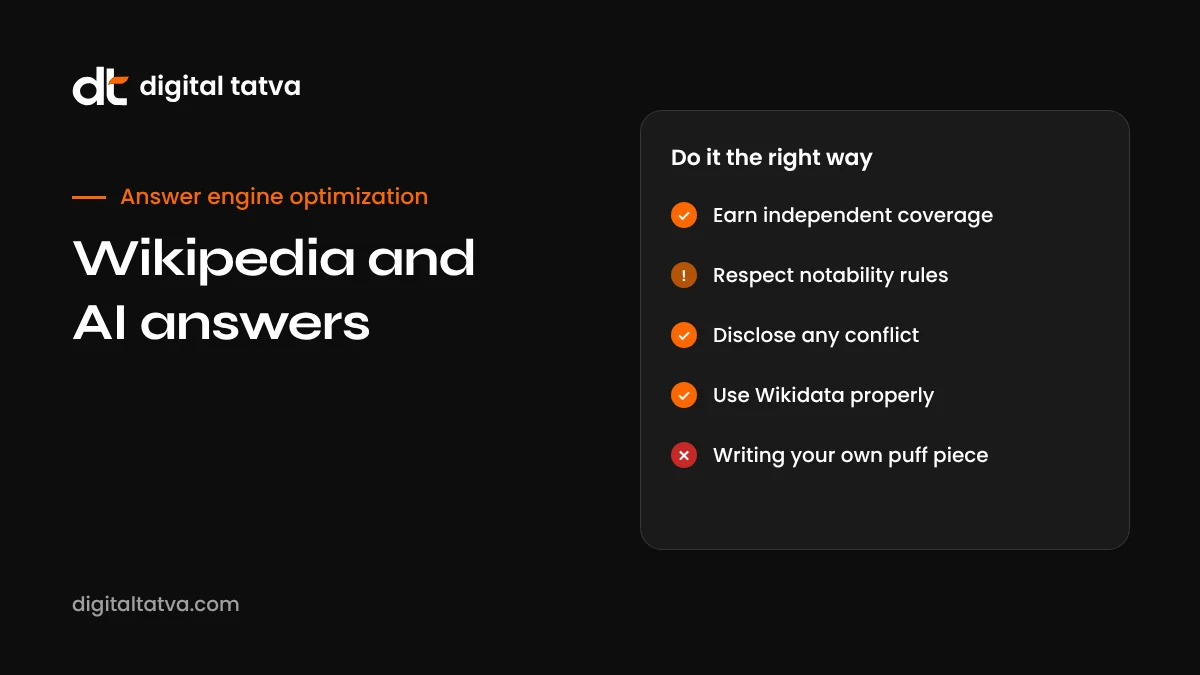
The right ways to engage with Wikipedia
1. Earn independent coverage first
The path to notability runs through real journalism and analysis about your company. Original research, newsworthy milestones, expert commentary and genuine industry contributions all help. That coverage also directly improves AI visibility, because AI systems use the same publications as sources. See press releases and AI visibility and original research for AEO.
2. If an article already exists, keep it accurate the right way
If there is an article about your company with outdated or incorrect information, do not edit it directly if you have a conflict of interest. Instead:
- Create a Wikipedia user account and disclose your connection on your user page.
- Post a clear, polite request on the article’s talk page explaining the issue and citing a reliable published source.
- Use Wikipedia’s edit request process so an independent editor can review it.
3. Contribute knowledge, not promotion
If you or your team have expertise, you can improve articles about general topics in your field with neutral, well-sourced information, as long as you avoid promoting your company and disclose any conflict where relevant.
4. If you are notable, consider a disclosed request
If your company genuinely meets notability guidelines, you can propose an article through Wikipedia’s Articles for Creation process with your conflict disclosed. An independent editor decides whether to accept it.
Wikidata: a more accessible option
Wikidata is Wikipedia’s sister project: a structured database of facts about entities. It is used by search engines, voice assistants and many other systems. Its inclusion criteria differ from Wikipedia’s; an item generally needs to be clearly identifiable and described using serious, publicly available references, or be needed for structural purposes.
A well-sourced Wikidata item can help machines connect your company to its official website, social profiles, founders, location and industry. Our guide to Wikidata for AEO explains how to approach it carefully and within the rules.
Getting the benefits without a Wikipedia article
Most of what Wikipedia does for AI visibility comes down to three things: clear entity facts, independent confirmation and authority. You can build all three without an article.
| Wikipedia benefit | Alternative way to achieve it | Guide |
|---|---|---|
| Clear entity facts | Organization schema, consistent profiles, about page, Google Business Profile | Entity SEO |
| Independent confirmation | Media coverage, industry directories, review platforms | Brand mentions |
| Authority on a topic | Original research, expert content, speaking, awards | Topical authority |
| Knowledge panel | Verified Google Business Profile, consistent entity data | Knowledge panel guide |
| Professional verification | Strong LinkedIn company page and leadership profiles | LinkedIn for AEO |
What to do if Wikipedia says something wrong about you
Errors on Wikipedia can spread to AI answers quickly. Handle them carefully:
- Identify the exact sentence that is wrong and why.
- Find a reliable, published, independent source that shows the correct information.
- Disclose your connection on a Wikipedia user account.
- Post an edit request on the article’s talk page with the correction and source.
- Be patient and polite; volunteer editors review requests in their own time.
- Meanwhile, make sure the correct information is clear on your own site and profiles.
Our broader guide to fixing wrong AI answers about your brand covers other sources too.
Wikipedia for people: founders and experts
The same principles apply to articles about people. Founders and experts should not write their own biographies. Notability for people also depends on significant independent coverage. Strong LinkedIn profiles, author pages, speaking pages and media coverage are better first steps. See author pages for AEO.
Which sources count toward notability?
Understanding the difference between sources that help and sources that do not saves a lot of wasted effort. This is a simplified summary of how Wikipedia editors generally view sources about companies.
| Source type | Usually counts? | Why |
|---|---|---|
| In-depth feature in a major newspaper or business publication | Yes | Independent, reliable, significant coverage |
| Detailed analysis in a respected trade journal | Often | Independent and specialised |
| Book or academic paper discussing the company | Often | Independent, in-depth |
| Press release or wire-distributed announcement | No | Not independent |
| Article that mostly repeats a press release | Usually no | Not independent analysis |
| Brief mention or a quote from your founder | No | Not significant coverage |
| Directory listings and company databases | No | Routine, not significant |
| Your own website, blog or social media | No | Not independent |
| Paid or sponsored content | No | Not independent |
The same distinction matters for AI visibility. AI systems also give more weight to independent, in-depth coverage than to self-published material, so the work that builds notability also builds AI trust.
How Wikipedia shapes AI descriptions of your industry
Even if your company never has its own article, Wikipedia still affects you through articles about your industry, product category and related topics. If the article on your product category lists notable providers, or describes the market in a way that leaves out an important segment, AI answers may follow that framing.
Within the rules, experts can help improve general topic articles with neutral, well-sourced information. This must not be promotional, and you should not add your own company to lists unless independent reliable sources support it and you disclose any conflict of interest. Many businesses find it more practical to focus on getting covered by the independent sources that such articles already cite.
Wikimedia Commons and images
Images used in Wikipedia articles come from Wikimedia Commons. If your company or founder has an article, an accurate, freely licensed image can help readers and machines recognise the subject. Images must be uploaded under a free licence that allows reuse, so only upload images you have the rights to license this way, and follow Commons’ guidelines. This is a minor point compared with notability, but it is often overlooked when an article exists.
A practical plan if you are not notable yet
For most businesses, the realistic plan is to build the kind of recognition that both Wikipedia editors and AI systems respect. A 12-month outline:
- Months 1 to 2: Fix your entity basics: consistent facts across your site, LinkedIn, Google Business Profile and directories; Organization schema with sameAs links. See entity SEO for AEO.
- Months 2 to 4: Publish one piece of original research or a genuinely useful free resource in your field.
- Months 3 to 6: Pitch that research and your expert commentary to respected industry and business publications.
- Months 4 to 9: Build a steady record of independent coverage, speaking and contributions.
- Months 6 to 12: Consider a well-referenced Wikidata item if your references support it. See Wikidata for AEO.
- After 12 months: If several independent, in-depth sources now exist, an article might be appropriate through Wikipedia’s disclosed processes. If not, keep building.
Throughout, track how AI assistants describe you. Many businesses find their AI visibility improves significantly long before any Wikipedia question arises.
Warning signs when hiring help
If you are approached by a service offering Wikipedia pages, be cautious when you see:
- Guarantees that an article will be published or will stay up.
- No mention of conflict of interest or paid editing disclosure.
- Offers to create articles for any business regardless of coverage.
- Promises of instant knowledge panels or AI placement.
- Requests to pay for “edits” on existing articles without disclosure.
These practices break Wikipedia’s rules and can damage your reputation. The same caution applies to anyone guaranteeing AI placement; see how to choose an AEO agency.
How Digital Tatva approaches Wikipedia
We do not write or pay for Wikipedia articles for clients, because doing so without disclosure breaks Wikipedia’s rules and often harms the brand. Instead, we help you build the independent coverage and clear entity facts that AI systems rely on, guide you on correcting existing errors through proper channels, and help structure Wikidata entries where they are appropriate and supported by references. We cannot promise a Wikipedia article or any AI placement, but we can help you earn the kind of recognition that both value.
Want to strengthen how AI understands your brand? Request an AEO audit for a review of your entity and authority signals, or try our free AI visibility checker.
Real-world scenarios
A funded startup with growing press coverage
A startup that has raised a significant round and been profiled by several major business publications may be approaching notability. The right move is not to write an article, but to make sure the independent coverage is accurate and accessible, keep company facts consistent, and, if appropriate, propose an article through Wikipedia’s Articles for Creation process with full disclosure. Meanwhile, the press coverage itself is already helping AI visibility.
A respected local business with no national coverage
A thirty-year-old family business with an excellent local reputation may still not meet Wikipedia’s notability guidelines. That is not a judgment on the business. Its AI visibility will depend far more on its Google Business Profile, reviews, local press, directories and website clarity. Those are where effort should go.
An established company with an outdated article
A company with an existing article that lists an old CEO and outdated product lines should disclose its connection, post a clear edit request on the talk page with reliable sources, and wait for an independent editor. It should also update its own site, LinkedIn and other profiles so AI systems see consistent current facts from several places.
A founder who wants a personal article
A founder with some media quotes but no in-depth independent profiles is unlikely to meet notability guidelines for a biography. Strong author pages, a detailed LinkedIn profile, speaking pages and expert content will do more for AI visibility in the meantime. See author pages for AEO.
Wikipedia, AI training and the long term
Because Wikipedia is so central to how AI models learn about the world, its influence is long term. Changes made today may affect how future models describe a topic for years. That is one more reason to engage carefully and honestly. A promotional edit that is later reverted, or an article that is deleted after discussion, leaves a trace that can outlast the attempt.
The businesses that benefit most from Wikipedia over time are those that become genuinely notable through their work, and whose independent coverage is accurate and well documented. The path is slower, but it builds the same credibility that AI systems are designed to reward.
Checklist: Wikipedia and your AI visibility
- Search Wikipedia for your company, founders and products. Note any existing articles or mentions.
- Check that any mentions are accurate and properly sourced.
- If errors exist, use disclosed talk page requests with reliable sources.
- Assess honestly whether independent, in-depth coverage exists.
- Strengthen your entity on your own site, LinkedIn, Google Business Profile and directories.
- Consider a Wikidata item only if references clearly support it.
- Invest in original research and expert commentary to earn coverage.
- Track how AI assistants describe you each quarter.
Other trusted reference sources worth knowing
Wikipedia is not the only reference source that shapes AI understanding. Depending on your industry, these may matter as much or more:
| Source type | Examples | Who it matters for |
|---|---|---|
| Official registries | Company registries, regulator listings, licensing databases | Regulated industries, finance, healthcare, legal |
| Industry directories | Trade association member lists, B2B directories | Manufacturers, B2B services |
| Review platforms | Google, G2, Capterra, Trustpilot, industry-specific sites | Software, local services, ecommerce |
| Business databases | Crunchbase and similar company profiles | Startups, funded companies |
| Academic and research sources | Papers, citations, institutional pages | Research-led businesses, healthcare |
Keeping your information accurate across these sources often does more for AI accuracy than a Wikipedia article would. See review sites for AEO and brand mentions for AEO.
How to monitor Wikipedia mentions
Even without an article, your company may be mentioned in other articles, for example in a list of companies in your industry or a city’s economy article. Monitor occasionally:
- Search Wikipedia for your company name, product names and founder names.
- Use the “What links here” tool on any article about you to see where it is referenced.
- Watch articles about you if you have an account, so you see changes.
- Check that mentions are accurate and properly sourced.
Frequently asked questions
Does Wikipedia affect ChatGPT answers?
Yes, often. Wikipedia is widely used in AI training data and frequently appears as a source in AI search answers about companies, people and topics.
Can I create a Wikipedia page for my business?
Only if your business meets Wikipedia’s notability guidelines, and you should not write it yourself without disclosing your conflict of interest. Most small businesses do not meet the bar.
Is it legal to pay someone to write a Wikipedia article?
It is not illegal, but Wikipedia’s terms of use require paid editors to disclose that they are paid. Undisclosed paid editing breaks the rules and can lead to deletion and bans.
What does notability mean on Wikipedia?
It means a subject has received significant coverage in reliable sources that are independent of the subject. Press releases, your own website and directory listings do not count.
How can I fix incorrect information on Wikipedia about my company?
Disclose your connection, then request the change on the article’s talk page with a reliable published source, so an independent editor can review it.
Is Wikidata easier than Wikipedia?
Wikidata has different inclusion criteria and can be more accessible, but entries still need to follow its rules and be supported by references.
Can I get AI visibility without Wikipedia?
Yes. Clear entity facts, consistent profiles, independent mentions, reviews and expert content can achieve much of the same effect.
Does Digital Tatva create Wikipedia pages?
No. We help you earn independent coverage and strengthen your entity signals through rule-respecting methods.
Can I pay someone to create a Wikipedia page for my company?
Paid editing must be disclosed under Wikipedia’s rules, and articles still need independent, notable coverage. Focus first on earning genuine press and third-party sources.
Does Wikipedia affect ChatGPT answers?
Wikipedia is widely used in AI training and retrieval, so accurate, well-sourced articles can influence how assistants describe notable organisations.
Product details, prices and features are checked at the time of writing and can change. Sources are linked in the text so you can check them yourself.
How does your brand appear in AI answers?
We test the questions your buyers ask across the major AI assistants and search engines, then show you what to fix first.
Get an AI Visibility Audit