LinkedIn for AEO: Why AI Cites LinkedIn and How to Use It
LinkedIn company pages, profiles and articles often show up as sources in AI answers about businesses and people. Here is why, and a practical plan to use LinkedIn to strengthen your brand's visibility in ChatGPT, Gemini and Google AI.
On this page
- Key takeaways
- Why AI assistants use LinkedIn
- How LinkedIn fits into your AI visibility
- Step 1: Optimise your LinkedIn company page
- Step 2: Strengthen leadership and expert profiles
- Step 3: Publish expert articles and newsletters
- Step 4: Post consistently on your core topics
- Step 5: Keep everything consistent
- LinkedIn for B2B AEO
- What LinkedIn will not do
- A 30-day LinkedIn AEO plan
- What to write about on LinkedIn for AEO
- Turning LinkedIn activity into website authority
- Employee advocacy and AI visibility
- LinkedIn and Google knowledge panels
- Measuring LinkedIn’s contribution to AEO
- An illustrative example of LinkedIn fixing an AI error
- How Digital Tatva can help
- LinkedIn for different business types
- Common LinkedIn mistakes that hurt AI visibility
- LinkedIn newsletters and AEO
- Using AI tools to help with LinkedIn, without losing your voice
- LinkedIn company page checklist
- How LinkedIn fits with your other profiles
- Is LinkedIn worth the time for AEO?
- Frequently asked questions
Last updated: 13 November 2026
Quick answer: LinkedIn matters for AEO because AI assistants often use it to understand who a company is, who leads it and what it is known for. Company pages, leadership profiles and public articles are trusted, well-structured sources of professional facts. To use LinkedIn for AEO, complete your company page with consistent facts, link it to your website and schema, make sure founders and key staff have detailed, accurate profiles, publish expert articles that answer real questions in your field, and keep everything consistent with your other profiles. LinkedIn will not make you appear in AI answers on its own, but it is one of the most reliable ways to strengthen your brand entity and expertise signals.
Key takeaways
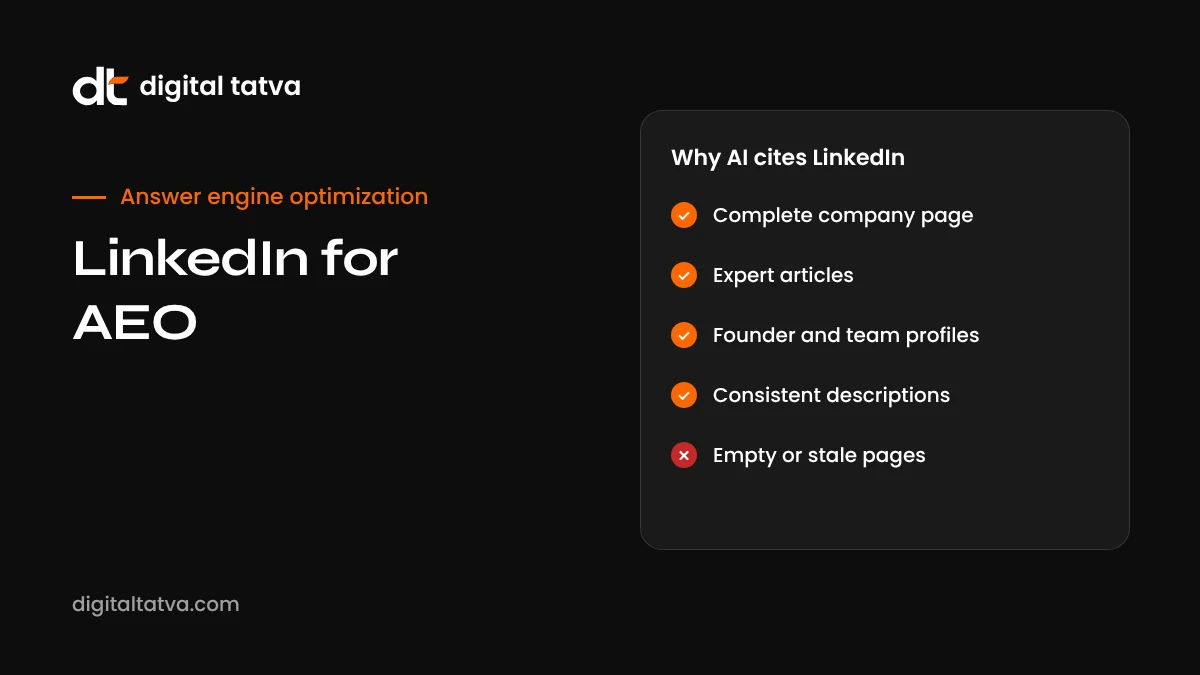
- AI assistants use LinkedIn to verify basic facts about companies and people.
- Your company page and leadership profiles act as entity anchors, especially for B2B brands.
- Public LinkedIn articles can be indexed and cited, so expert content there adds visibility.
- Consistency between LinkedIn, your website and other profiles reduces AI errors.
- LinkedIn supports AEO; it does not replace your website or third-party mentions.
Why AI assistants use LinkedIn
When someone asks an AI assistant “who founded [company]?”, “what does [company] do?” or “who are the best AEO consultants in Ahmedabad?”, the system needs reliable professional information. LinkedIn is one of the largest structured sources of that information on the web: company descriptions, industries, sizes, locations, leadership, job histories and expertise.
In prompt testing, LinkedIn pages appear regularly among sources for questions about people, B2B companies and professional services. It is not always the main source, but it often helps an AI system confirm who someone is and what a company does.
There are a few reasons LinkedIn is useful to machines:
- Structured data. Company and profile pages follow a consistent layout with clear fields.
- Verification signals. Connections, employees and activity make fake profiles easier to spot.
- Professional context. Roles, skills and history connect people to topics.
- Scale. Most professionals and companies have a presence, so it is a common reference point.
How LinkedIn fits into your AI visibility
| LinkedIn asset | AEO role | Example AI question it supports |
|---|---|---|
| Company page | Confirms company facts and category | “What does Digital Tatva do?” |
| Founder and leadership profiles | Connects people to the company and expertise | “Who founded Digital Tatva?” |
| Employee profiles | Shows size, skills and legitimacy | “Is this a real agency?” |
| Public articles and newsletters | Demonstrates expertise; can be cited | “How do I track ChatGPT brand mentions?” |
| Posts and engagement | Builds brand association with topics over time | “Who are experts in AEO in India?” |
All of this feeds the broader idea of a clear brand entity. See entity SEO for AEO for how the pieces fit together.
Step 1: Optimise your LinkedIn company page
- Name: use your exact official brand name, the same as on your website and Google Business Profile.
- Tagline: one clear sentence saying what you do and for whom. Avoid vague slogans.
- About section: start with a direct, factual description: what you do, who you serve, where you are based and what makes you different. Then add detail.
- Industry and specialities: choose the most accurate industry and list specific specialities using the terms customers use.
- Location, size and founding year: fill them in and keep them consistent with other profiles.
- Website link: point to your main site.
- Logo and banner: the same branding as your site.
Then link back the other way. Add your LinkedIn company page to your website footer and to your Organization schema’s sameAs property. That two-way link helps machines connect the profiles to the same entity. Our schema markup guide shows how.
Step 2: Strengthen leadership and expert profiles
For many businesses, especially consultancies, agencies and B2B firms, people are part of the brand. AI assistants often connect companies to their founders and experts.
- Headline that states role and expertise clearly, for example “Founder, Digital Tatva | Answer engine optimization consultant”.
- About section written in plain language with specific experience and focus areas.
- Current role linked to the company page, so the connection is explicit.
- Experience entries with dates and real descriptions.
- Featured section with key articles, case studies or talks.
- Consistent name and photo across LinkedIn, your website author page and other profiles.
Link author pages on your website to their LinkedIn profiles, and use Person schema with sameAs. See author pages for AEO.
Step 3: Publish expert articles and newsletters
Public LinkedIn articles can be indexed by search engines, which means they can be found and cited by AI search. They also build visible expertise.
What works well:
- Answer specific questions your buyers ask, with a direct answer at the top.
- Share original insight: data from your work, lessons learned, honest opinions.
- Use clear structure: headings, short paragraphs and lists.
- Link to deeper resources on your website where it helps the reader.
- Stay consistent with your positioning and terminology.
Avoid copying your blog posts word for word. A short, original take with a link to the full guide is usually better than duplicate content. Our LinkedIn prompts guide and the list of best AI LinkedIn tools can speed up drafting, but keep the insight your own.
Step 4: Post consistently on your core topics
Regular posts do not usually get cited directly, but they build association between your brand and your topics. Over time, that association appears in what people write about you elsewhere and in what models learn. Focus on a few themes you want to be known for and post useful, specific content about them.
Step 5: Keep everything consistent
Inconsistency is one of the most common causes of wrong AI answers. Check that these match across LinkedIn, your website, Google Business Profile, directories and press coverage:
| Fact | Check |
|---|---|
| Company name | Exact same spelling and format |
| Description | Same core positioning |
| Founding year | Identical everywhere |
| Location | Same city and address format |
| Founder and leadership names | Same names and titles |
| Services | Same main services listed |
| Website URL | Same domain, with HTTPS |
If you find AI repeating outdated details, see how to fix wrong AI answers about your brand.
LinkedIn for B2B AEO
LinkedIn is particularly important for B2B brands, because buyers often research vendors and their teams there. When an AI assistant is asked to compare B2B providers, it may draw on LinkedIn to check company size, specialism and leadership. A thin or abandoned company page can make a real business look less credible.
Combine LinkedIn with other B2B AEO tactics such as comparison pages, case studies and review platforms. See AEO for B2B and AEO for SaaS.
What LinkedIn will not do
It is worth being realistic:
- LinkedIn alone will not make AI recommend you over competitors with stronger reviews and mentions.
- Posts and engagement do not guarantee citations.
- Some AI crawlers have limited access to LinkedIn content behind login walls, so public, indexable content matters most.
- LinkedIn does not replace your website as the main source of detailed information about you.
Think of LinkedIn as one strong pillar in a wider strategy. Our guide to AI search ranking factors shows how it fits with the rest.
A 30-day LinkedIn AEO plan
- Days 1 to 3: Audit your company page and leadership profiles against your website and Google Business Profile. Fix every inconsistency.
- Days 4 to 7: Rewrite the company About section with a direct, factual opening. Update specialities with customer language.
- Days 8 to 10: Add LinkedIn to your website footer and Organization schema sameAs. Link author pages to personal profiles.
- Days 11 to 20: Publish two expert articles answering important buyer questions, each linking to a deeper page on your site.
- Days 21 to 30: Post twice a week on your core topics and encourage leaders to share their own insights.
- Day 30: Ask ChatGPT, Gemini and Perplexity what they know about your company and founders. Compare with your starting point.
What to write about on LinkedIn for AEO
Not every LinkedIn post helps AI visibility. The content that builds topical association and gets referenced tends to share a few traits: it is specific, it is based on real experience, and it answers a question people in your field actually have. Here are formats that work well.
| Format | Why it helps | Example |
|---|---|---|
| Data snapshot | Creates a fact others can cite | “We tracked 40 prompts for 3 months. Here is how often AI named local brands.” |
| How-to breakdown | Shows practical expertise | “How we fixed a client’s wrong pricing in ChatGPT answers in five steps” |
| Myth vs reality | Positions you as a clear thinker | “No, llms.txt will not get you into ChatGPT. Here is what does.” |
| Lessons learned | Strong experience signal | “Three mistakes we made in our first year of AEO audits” |
| Industry commentary | Associates you with current topics | “What Google’s latest core update means for Indian ecommerce” |
| Carousel guide | Easy to save and share | “A 10-step checklist for AI crawler access” |
Keep a consistent set of themes so your brand becomes associated with them. Three to five core topics is plenty for most businesses.
Turning LinkedIn activity into website authority
LinkedIn and your website should work together. A practical loop:
- Publish a detailed guide on your website, structured for AI with answer-first sections.
- Share a short, original insight from it on LinkedIn with a link to the full guide.
- Use the comments to learn which questions people still have.
- Add answers to those questions to the website guide’s FAQ.
- Repeat for your next topic.
This loop improves both channels. The website stays the detailed, citable source, and LinkedIn builds visibility and associations around it. See topical authority in AI search for how to plan the website side.
Employee advocacy and AI visibility
When several people from the same company post consistently about the same topics, the association between that company and those topics becomes stronger. That shows up in how people describe the company elsewhere and, over time, in what AI systems learn.
Encourage your team to:
- List the company correctly as their current employer, linked to the company page.
- Describe their role and specialities in plain, specific language.
- Share their own experiences and lessons, not just repost company updates.
- Engage thoughtfully in discussions in your industry.
Never ask employees to post anything misleading, and respect that personal profiles belong to them.
LinkedIn and Google knowledge panels
Google often shows LinkedIn as one of the social profiles in a company or person knowledge panel. Consistent LinkedIn information, linked from your website and schema, helps Google connect the profile to the right entity. Knowledge panels in turn feed Google’s understanding of your brand, which carries into AI Overviews and AI Mode. See our guide to Google knowledge panels for business.
Measuring LinkedIn’s contribution to AEO
You cannot isolate LinkedIn’s effect perfectly, but you can track meaningful signals:
| Signal | How to check |
|---|---|
| AI accuracy about your company and founders | Ask assistants who you are and who leads you each quarter |
| LinkedIn cited as a source | Note citations in AI answers about your brand |
| Article visibility | Search your article titles; check whether they are indexed |
| Referral traffic | LinkedIn referrals to your website in GA4 |
| Topic association | Ask AI “who are experts in [your topic] in [your region]?” |
Combine these with your wider AI reporting. Our AEO reporting template shows one way to do it.
An illustrative example of LinkedIn fixing an AI error
Here is a common pattern, described as an illustration rather than a specific client case. Imagine a business that finds AI assistants consistently giving the wrong founding year and describing it with an old service it has stopped offering. Often the cause is a mix of an outdated LinkedIn About section and an old directory listing. Updating LinkedIn, the directory and the website’s about page with the same facts, and adding the LinkedIn page to the site’s Organization schema, typically clears up such errors in search-based AI answers over the following weeks. Answers without web search take longer to change, which is normal.
The lesson: small inconsistencies on trusted profiles can echo through AI answers. Fixing them is quick and pays off.
How Digital Tatva can help
We audit how your brand appears to AI assistants, including how your LinkedIn presence connects to your website and other profiles. We align your entity facts, improve leadership and company profiles, and plan expert content that strengthens your authority. We track the effect on AI mentions over time. We cannot promise any AI will cite your LinkedIn or recommend you, but we can make your professional presence clear, consistent and credible.
Want to see how AI describes your company and founders? Request an AEO audit, or start with our free AI visibility checker.
LinkedIn for different business types
| Business type | LinkedIn priority | Focus areas |
|---|---|---|
| B2B SaaS | High | Company page, founder thought leadership, product updates, customer stories |
| Agencies and consultancies | High | Expert profiles, case studies, articles on methods and results |
| Manufacturers and exporters | Medium to high | Certifications, capabilities, leadership, trade show presence |
| Professional services such as law and accounting | High | Partner profiles, practice area expertise, regulatory commentary |
| Local consumer businesses | Low to medium | Accurate company page; Google and Meta profiles usually matter more |
| D2C ecommerce | Medium | Founder story, brand milestones, hiring, partnerships |
If LinkedIn is not a natural channel for your customers, you still need an accurate company page, because AI systems may use it to verify who you are. You just do not need to invest heavily in posting.
Common LinkedIn mistakes that hurt AI visibility
- Abandoned company pages with old logos, outdated descriptions or the wrong website.
- Several duplicate company pages created by different employees over the years.
- Vague taglines like “Innovating the future” that say nothing about what you do.
- Founders listing the company inconsistently, for example under an old name.
- Articles that are copies of blog posts, creating duplicate content without adding anything.
- No link between your website and LinkedIn, so machines cannot easily connect them.
Duplicate pages are especially worth fixing. LinkedIn has a process for reporting and merging duplicate company pages; consolidating them removes a common source of confusion.
LinkedIn newsletters and AEO
LinkedIn newsletters let you publish a series of articles that followers can subscribe to. For AEO, newsletters have two benefits. First, they encourage consistency: a regular publication on a defined topic builds a clear association between you and that topic. Second, newsletter editions are public articles that can be indexed, so each edition is another chance to be found and cited.
Tips for an AEO-friendly newsletter:
- Pick a specific theme, such as “AI visibility for Indian SaaS” rather than “marketing tips”.
- Give each edition a clear, descriptive title that matches a real question.
- Open each edition with a direct answer or key insight.
- Include something original in every edition: data, an example or a lesson.
- Link to the detailed guide on your website where relevant.
- Publish on a predictable schedule, even if it is only monthly.
Using AI tools to help with LinkedIn, without losing your voice
AI writing tools can help you draft LinkedIn posts and articles faster. Used carelessly, they produce generic content that looks like everyone else’s and adds nothing to your authority. A sensible approach:
- Start with your own raw material: a client lesson, a number from your work, an opinion.
- Ask the AI to help structure it or tighten the wording.
- Remove clichés and generic filler from the draft.
- Add specific details only you know.
- Read it aloud; if it does not sound like you, rewrite it.
See our list of the best AI LinkedIn tools and ChatGPT prompts for LinkedIn for practical help.
LinkedIn company page checklist
| Item | Status |
|---|---|
| Exact official company name | Matches website and Google Business Profile |
| Clear tagline stating what you do | No vague slogans |
| About section opens with a direct, factual description | Who, what, where, for whom |
| Industry, size, founding year and location | Filled in and consistent |
| Specialities using customer language | Five to ten specific terms |
| Website link | Main domain with HTTPS |
| Leadership linked as current employees | Founder and key staff connected |
| Recent activity | At least one post in the last month |
| Linked from website footer and schema sameAs | Two-way connection in place |
| No duplicate company pages | Old duplicates reported or merged |
How LinkedIn fits with your other profiles
LinkedIn is one of several profiles that together define your brand entity. Each has a different role:
- Your website: the detailed, authoritative source you control.
- Google Business Profile: location, hours, reviews and local trust.
- LinkedIn: professional identity, leadership and B2B credibility.
- Industry directories and review sites: independent confirmation and comparisons.
- Social profiles: activity, community and brand personality.
When all of them tell the same story, AI systems can describe you with confidence. See entity SEO for AEO and Wikidata for AEO for how to connect them.
Is LinkedIn worth the time for AEO?
For most B2B companies, consultancies and professional services firms, yes. The basics take a few hours: a complete company page, accurate leadership profiles and two-way links with your website. That small investment removes a common source of AI errors and strengthens your entity. Regular posting and articles take more time, so prioritise them if your buyers are active on LinkedIn and you have genuine expertise to share. If your customers are mainly consumers who never use LinkedIn, keep the company page accurate and put most of your effort into Google, Meta and review platforms instead.
Frequently asked questions
Does LinkedIn help with AI visibility?
Yes. AI assistants often use LinkedIn to confirm company and people facts, and public articles can be cited. A complete, consistent LinkedIn presence strengthens your brand entity.
Can ChatGPT read LinkedIn?
AI systems can access public LinkedIn content that is indexed by search engines. Content behind login walls is generally not accessible.
Should I publish articles on LinkedIn or my blog?
Both, with different roles. Keep detailed guides on your website, and use LinkedIn for original insights and summaries that link back to them.
Does LinkedIn help with Google rankings?
LinkedIn profiles and articles can rank for names and topics. LinkedIn links are generally nofollow, so their SEO value is mainly visibility and brand association rather than link equity.
What should my LinkedIn company description include?
A direct statement of what you do, who you serve, where you are based and what makes you different, using the same facts as your website and other profiles.
Do personal profiles matter for AEO?
Yes, especially for founders and experts. AI systems connect people to companies and topics, so strong leadership profiles support your brand’s credibility.
How often should I post on LinkedIn for AEO?
Consistency matters more than volume. One or two useful posts a week on your core topics is a good starting point.
Can Digital Tatva optimise our LinkedIn for AI search?
Yes. LinkedIn review and alignment is part of our entity and authority work within our AEO service.
Product details, prices and features are checked at the time of writing and can change. Sources are linked in the text so you can check them yourself.
How does your brand appear in AI answers?
We test the questions your buyers ask across the major AI assistants and search engines, then show you what to fix first.
Get an AI Visibility Audit