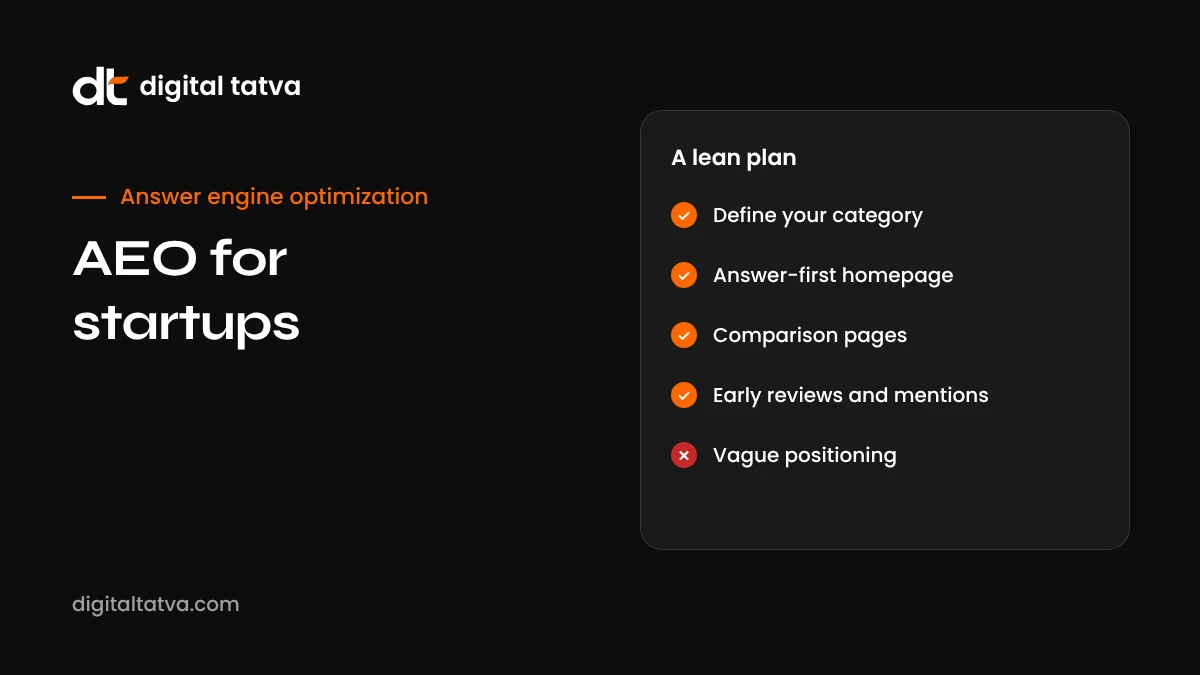
AEO for Startups: A Lean Plan to Get Named by AI
A lean, practical answer engine optimization plan for startups with small teams and tight budgets: define your category, fix the basics, build comparison and answer-first pages, earn early mentions and track AI visibility from day one.
On this page
- Key takeaways
- Why AEO matters for startups specifically
- Step 1: Define your category in one sentence
- Step 2: Get the technical basics right from day one
- Step 3: Build the five pages every startup needs for AEO
- Step 4: Write comparison and alternatives pages
- Step 5: Answer the questions buyers ask
- Step 6: Get listed where AI looks
- Step 7: Earn a few credible mentions
- Step 8: Track AI visibility from day one
- A 90-day AEO plan for startups
- How much should a startup spend on AEO?
- Mistakes startups make with AEO
- AEO for startups in India
- What AI says about startups with no presence
- Founder-led AEO
- Product launch checklist for AI visibility
- Using AI tools to move faster
- When competitors dominate AI answers
- How Digital Tatva can help
- AEO metrics for startup board updates
- An illustrative startup scenario
- Frequently asked questions
Last updated: 13 November 2026
Quick answer: AEO for startups is about getting your new company named by AI assistants like ChatGPT, Gemini, Perplexity and Claude when potential customers ask about your category. Because startups have little history online, the lean plan is: define your category and positioning in plain words, make your site crawlable and clear, publish answer-first pages for the questions buyers ask, create honest comparison pages against known alternatives, get listed on the review sites and directories AI cites, earn a few credible mentions, and track a fixed set of prompts monthly. You do not need a big budget, but you do need consistency from the start.
Key takeaways
- AI assistants rely on evidence, and new startups have little of it. Your job is to create clear evidence quickly.
- Positioning matters more than ever: if you cannot state your category in one sentence, AI cannot either.
- Comparison pages and “alternatives” pages are some of the highest-leverage content for startups.
- Early listings on review platforms and directories create independent proof.
- Start tracking AI visibility from day one so you can see progress as you grow.
- Avoid shortcuts like fake reviews or spammy mentions; they backfire and are hard to undo.
Why AEO matters for startups specifically
Buyers increasingly research software, services and products by asking AI. A founder at a 15-person company might ask Claude “what are the best tools for managing contractor payments in India?” A marketing lead might ask ChatGPT “alternatives to [big incumbent] for a small team”. If your startup is not named, you never enter the consideration set, and you may never know you lost the deal.
Startups face a specific challenge. AI assistants, like people, trust brands they have heard about from several sources. New companies have few reviews, little press, thin backlink profiles and almost no mentions in the content AI models learned from. That is not a reason to wait. It is a reason to be deliberate about building the evidence AI needs.
The good news is that AI search also gives startups a chance that classic SEO rarely did. Because AI answers pull passages from many sources and often search for specific sub-questions, a startup with the clearest answer to a niche question can be cited even when it has little domain authority. See query fan-out for why.
Step 1: Define your category in one sentence
AI systems organise the world into categories: “expense management software”, “AEO agency”, “D2C skincare brand”, “payroll platform for startups”. To be recommended, you need to be clearly placed in a category that people actually ask about.
Write one sentence that states:
- What you are, using a category name buyers recognise.
- Who you are for.
- What makes you different, in concrete terms.
Example: “Payline is payroll software for Indian startups with 10 to 200 employees that automates PF, ESI and TDS compliance and pays salaries through UPI.”
Use this sentence, or close variants, consistently on your homepage, LinkedIn, Crunchbase-style profiles, app store listings, directory listings and press materials. Many startups use clever taglines that say nothing about the category. That might be fine for a billboard, but it leaves AI guessing. See entity SEO for AEO.
Creating a new category?
Some startups want to define a new category. That is possible but harder, because nobody is asking AI about a category that does not exist yet. A practical approach is to describe yourself in an existing category people search for, then explain how you are different: “an expense management tool that works entirely in WhatsApp” rather than “the world’s first conversational spend platform”.
Step 2: Get the technical basics right from day one
Startups often launch on modern JavaScript frameworks, website builders or no-code tools. These can be great, but some create pages that AI crawlers struggle to read. Check:
- Rendering: does your main content appear in the page source without JavaScript? If you use a framework like Next.js, use server-side rendering or static generation for marketing pages. See JavaScript rendering for AI crawlers.
- Crawler access: are AI search bots allowed in robots.txt and not blocked by your CDN? See our AI crawlers list.
- Speed: are pages fast on mobile?
- Schema: Organization schema with your logo, founders and sameAs links; SoftwareApplication or Product schema where relevant.
- Indexing: submit sitemaps to Google Search Console and Bing Webmaster Tools.
Our technical AEO checklist covers everything. If you are still choosing a website platform, our list of the best AI website builders notes which ones produce crawler-friendly pages.
Step 3: Build the five pages every startup needs for AEO
You do not need hundreds of pages. You need a handful of excellent ones.
| Page | Purpose | AEO tips |
|---|---|---|
| Homepage | States category, audience and difference | Answer-first opening in plain text, not just a slogan |
| Product or service page | Explains what you do in detail | Features in text, use cases, integrations listed by name |
| Pricing page | Shows what it costs | Plain-text prices or ranges; what is included; FAQs |
| About page | Proves you are real and credible | Founders, founding date, location, backers, mission, contact |
| Comparison or alternatives page | Positions you against known options | Honest tables, clear “best for” guidance |
Hidden pricing is a common startup mistake. When buyers ask AI “how much does X cost?”, an assistant with no pricing information may say “pricing is not publicly available” and move on to a competitor that shows prices. If you cannot show exact prices, show starting prices or ranges.
Step 4: Write comparison and alternatives pages
For startups, comparison content is often the highest-leverage content you can create. Buyers ask AI “X vs Y”, “alternatives to X” and “best X for Y” constantly. The pages AI cites for those questions are frequently comparison pages.
How to do it well:
- Pick the incumbents buyers already know. “Alternatives to [big brand]” captures people looking to switch.
- Be honest. Say where the competitor is stronger. AI systems and buyers both distrust one-sided comparisons.
- Use tables. Features, pricing, ideal customer, integrations and support side by side.
- Give a clear verdict for each situation. “Choose X if you need Y; choose us if you need Z.”
- Keep it current. Update when competitors change pricing or features.
Step 5: Answer the questions buyers ask
Beyond your core pages, publish a small number of answer-first guides for the questions your buyers ask before they buy. Find those questions through:
- Sales calls and demo questions.
- Support tickets from early customers.
- Communities where your buyers hang out.
- AI assistants themselves: ask your category questions and note what they cover.
Write each guide with a direct answer up top, clear headings, tables and an FAQ. Link to your product where it is genuinely relevant. See AEO prompt research and answer-first content.
Step 6: Get listed where AI looks
AI assistants often cite review platforms, directories and “best of” lists when recommending products and services. For a startup, getting onto the right ones early creates independent evidence.
| Startup type | Where to be listed |
|---|---|
| B2B SaaS | Software review platforms, product launch sites, integration marketplaces, startup databases |
| Consumer apps | App stores with complete descriptions, app review sites, product launch sites |
| D2C brands | Marketplaces, Google Merchant Center, review platforms, gift guides |
| Agencies and services | Agency directories, Google Business Profile, industry association listings |
| All startups | LinkedIn company page, startup databases, local startup ecosystem listings |
Ask your first happy customers for honest reviews on the platforms that matter in your category. Ten detailed reviews on the right platform can outweigh a hundred generic mentions elsewhere. See review sites for AEO.
Step 7: Earn a few credible mentions
You do not need a big PR budget. A few well-chosen mentions go a long way.
- Launch coverage: pitch your launch or funding to startup and industry publications.
- Founder expertise: founders writing guest posts, appearing on podcasts or giving talks in their domain.
- Original data: a small survey or analysis of your market that journalists can cite. See original research for AEO.
- Community presence: genuinely helpful answers on Reddit, Quora and niche forums. See Reddit for AEO and Quora for AEO.
- Partnerships: integration partners and customers who mention you on their sites.
See also press releases and AI visibility.
Step 8: Track AI visibility from day one
Set up a simple tracking routine early, even if your results are near zero at first. It shows progress, highlights where competitors appear, and helps you prioritise.
- Write 20 to 30 prompts covering category, comparison and problem questions.
- Test them monthly in ChatGPT, Gemini, Perplexity, Claude and Google AI Mode.
- Record whether you are mentioned, how you are described and who else appears.
- Track AI referral traffic in GA4.
- Add “AI assistant” as an option in your “how did you hear about us” question.
See tracking brand mentions in ChatGPT and AI share of voice. Our list of free AEO tools helps if budget is tight.
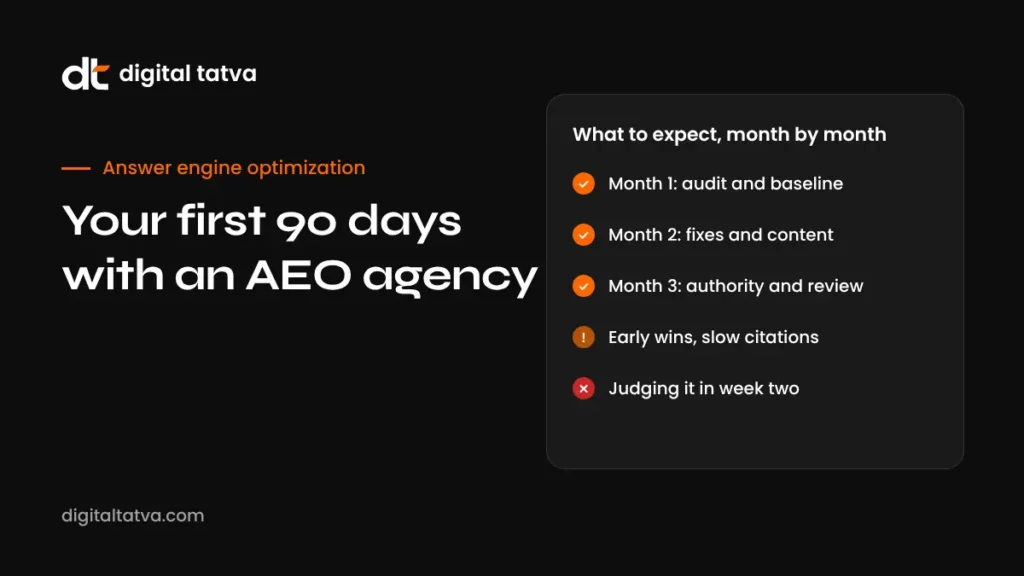
A 90-day AEO plan for startups
| Weeks | Focus | Deliverables |
|---|---|---|
| 1 to 2 | Foundations | One-sentence positioning, technical checks, Organization schema, baseline prompt tests |
| 3 to 4 | Core pages | Rewritten homepage, product, pricing and about pages |
| 5 to 6 | Comparisons | Two comparison or alternatives pages against known competitors |
| 7 to 8 | Listings | Profiles on the top review platforms and directories in your category; first reviews |
| 9 to 10 | Answers | Three answer-first guides for top buyer questions |
| 11 to 12 | Mentions and review | Two outreach pitches, community contributions, re-run prompts and compare |
How much should a startup spend on AEO?
Early-stage startups can do much of this themselves with time rather than money. The highest-impact tasks, positioning, core pages, comparisons and listings, need founder input anyway because they depend on deep product knowledge. Consider outside help when:
- You need a technical audit of a complex site or framework.
- You are entering a competitive category where incumbents dominate AI answers.
- You have product-market fit and want to scale visibility quickly.
Our guide to AEO pricing explains typical costs, and is AEO worth it helps you decide.
Mistakes startups make with AEO
- Vague positioning that never names the category.
- Hidden pricing, so AI cannot answer cost questions.
- Client-side rendered marketing pages that AI crawlers cannot read.
- No comparison content, leaving incumbents to define the conversation.
- Inconsistent facts across profiles, pitch decks and directories.
- Fake reviews or astroturfing, which can destroy trust permanently.
- Waiting until later, so the company has no visibility history when it matters.
AEO for startups in India
Indian startups often sell to both Indian and global buyers. A few practical points:
- Show pricing in rupees for Indian buyers and in dollars or other currencies where you sell abroad.
- Explain compliance fit for Indian regulations where relevant, such as GST, data protection or sector rules.
- Get listed in Indian startup ecosystem databases and local directories as well as global platforms.
- Consider Hindi or regional language content for consumer products. See multilingual AEO.
Our guide to AEO services in India covers the local market in more depth.
What AI says about startups with no presence
It is useful to know what happens when an AI assistant has little or no information about a company. In our testing, assistants usually do one of three things when asked about an unknown startup:
- Say they have limited information and suggest checking the company’s website.
- Confuse the startup with a similarly named company, sometimes in a different country or industry.
- Describe it vaguely or inaccurately, based on a single thin source.
The second case is a real risk for startups with common or generic names. Clear, consistent descriptions with your location, category and founders, plus Organization schema with sameAs links, help AI tell you apart. If your name is easily confused, mention distinguishing details in your descriptions, such as “Bengaluru-based payroll software” rather than just the brand name.
Founder-led AEO
For many startups, the founder is the most credible voice the company has. AI systems connect people to companies and topics, so founder visibility can accelerate company visibility.
| Founder activity | AEO benefit |
|---|---|
| Detailed LinkedIn profile linked to the company | Confirms the founder and company connection |
| Expert articles in their domain | Associates the founder and company with the topic |
| Podcast and conference appearances | Independent mentions, often transcribed online |
| Answers in communities | Visible expertise in places AI reads |
| Author page on the company site | Clear expertise signal with Person schema |
See LinkedIn for AEO and author pages for AEO.
Product launch checklist for AI visibility
A product launch is one of the best moments to create a burst of evidence. Before launch day, prepare:
- A launch page on your site with an answer-first summary, features, pricing and FAQs.
- Updated homepage, pricing and product pages reflecting the launch.
- Listings on product launch platforms and relevant directories.
- A short, factual press release on your newsroom page.
- Personal pitches to a handful of relevant journalists and newsletter writers.
- A plan to ask early users for honest reviews in the first weeks.
- Prompt tests before launch, to compare with results a month later.
Using AI tools to move faster
Startups can use AI tools to speed up AEO work: drafting comparison tables, summarising customer interviews into FAQ lists, generating first drafts of guides and checking pages for clarity. The rule is simple: use AI for speed, but make sure every published fact is accurate and every page includes knowledge only your team has. See AI writing tools for AEO and the best AI tools for startups.
When competitors dominate AI answers
If a well-funded incumbent appears in every AI answer for your category, do not try to beat them head-on immediately. Instead:
- Target narrower questions where you are genuinely the best fit, such as a specific industry, company size or region.
- Publish honest “alternatives to [incumbent]” pages for people looking to switch.
- Get reviews that mention the specific situations where you excel.
- Build expertise content in the niche your product serves best.
Winning narrow questions first builds the evidence that later helps with broader ones.
How Digital Tatva can help
We work with startups to build AI visibility efficiently. We help sharpen positioning so AI can categorise you, fix technical issues on modern frameworks, plan comparison and answer-first content, and identify the listings and mentions that matter in your category. We track your progress across AI assistants every month. We cannot promise AI will recommend a new startup, and nobody honestly can, but we can make sure every piece of evidence you create is clear and working for you.
Launching or scaling a startup? Request an AEO audit for a baseline and a lean action plan, or check AI crawler access with our free AI visibility checker.
AEO metrics for startup board updates
Investors and boards increasingly ask about AI search. A short, honest set of metrics works well in monthly or quarterly updates:
| Metric | What it shows |
|---|---|
| AI mention rate across tracked prompts | How often you are named in AI answers for your category |
| AI share of voice vs top three competitors | Your visibility relative to the market |
| AI referral sessions and sign-ups | Whether AI visibility brings real users |
| Reviews on key platforms | Growth of independent evidence |
| Branded search volume | Growing awareness |
Keep the numbers small and real. Early-stage results are often modest, and that is fine. The trend matters more than the absolute figure. See AEO KPIs.
An illustrative startup scenario
Here is a typical scenario to show how the pieces fit together. It is an illustration, not a specific client. Imagine a seed-stage HR software startup in Pune. At the start, AI assistants did not mention it for any category prompts, and one assistant confused it with a recruitment agency of a similar name. Over three months, the team rewrote the homepage to state its category clearly, published transparent pricing, wrote two honest comparison pages against well-known tools, listed the product on two major software review platforms and collected a dozen detailed reviews from early customers, and the founder wrote three expert articles on Indian payroll compliance. By the end of the quarter, the confusion had disappeared, and the startup began appearing in answers to narrow prompts such as “payroll software for Indian startups under 50 employees”. Broad category prompts still favoured incumbents, which is normal at that stage.
That pattern, clarity first, then narrow wins, then broader visibility, is what most startups should expect.
Frequently asked questions
Can a new startup appear in ChatGPT answers?
Yes, especially for specific or niche questions. Clear positioning, crawlable pages, comparison content, reviews and a few credible mentions all increase the chance.
What is the most important AEO task for a startup?
Clear, consistent positioning that names your category and audience, followed closely by crawlable core pages with visible pricing.
Should startups write comparison pages?
Yes. Honest comparison and alternatives pages are among the most frequently cited types of content for buyer questions.
How long does AEO take for a startup?
Technical fixes and new pages can show up in search-based AI answers within weeks. Building enough independent evidence to be recommended consistently usually takes several months.
Do startups need a big PR budget for AI visibility?
No. A few credible mentions, honest reviews, community contributions and founder expertise can be enough to start.
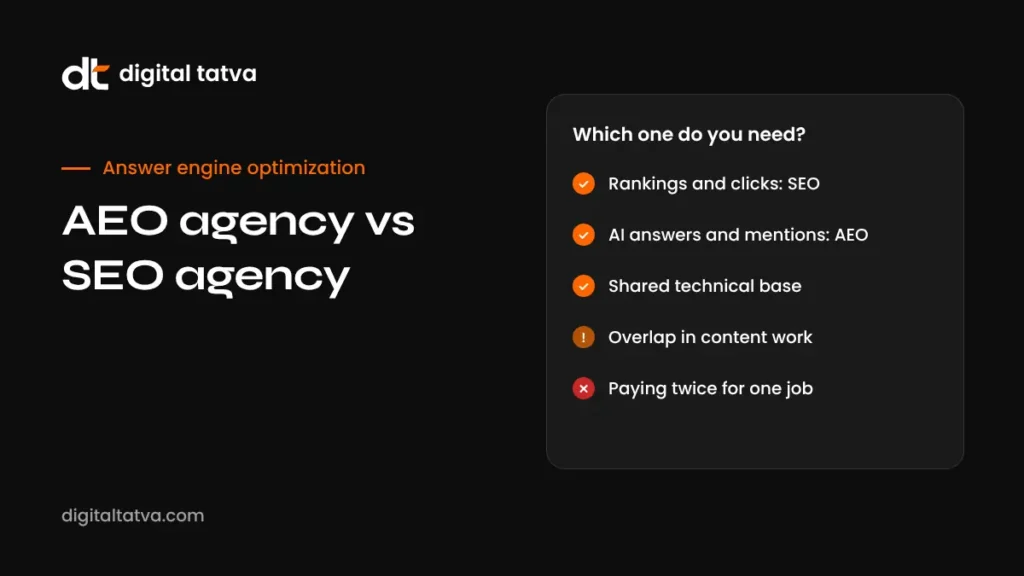
Should we use an agency or do AEO in-house?
Early on, founders can do much of it. Outside help is useful for technical audits, competitive categories or scaling. See AEO consultant vs agency.
Does hiding pricing hurt AI visibility?
Often, yes. AI assistants cannot answer cost questions about you and may recommend competitors that show prices.
Can Digital Tatva help our startup?
Yes. We offer AEO audits and lean plans tailored to startups, focused on the highest-impact tasks first.
Should startups do AEO before product-market fit?
Basic steps, such as a clear website, consistent company information and crawler access, are worth doing early. Larger AEO programmes make more sense once you know your positioning and audience.
Can AI visibility help startups raise funding?
Indirectly. Being described accurately by AI assistants supports credibility with customers, partners and investors who research you there.
Product details, prices and features are checked at the time of writing and can change. Sources are linked in the text so you can check them yourself.
How does your brand appear in AI answers?
We test the questions your buyers ask across the major AI assistants and search engines, then show you what to fix first.
Get an AI Visibility Audit