How Do AI Detectors Work? Accuracy, False Positives and What to Do If You’re Flagged
How AI detectors like Turnitin, GPTZero and ZeroGPT work, how accurate they really are, why human writing gets flagged, and what to do if your work is wrongly marked as AI.
On this page
- Key takeaways
- What is an AI detector?
- How AI detectors work
- How accurate are AI detectors?
- Why human writing gets flagged as AI
- What to do if your work is flagged as AI
- How to protect yourself before submitting
- Guidance for teachers and institutions
- AI detectors for marketers, publishers and website owners
- Popular AI detectors at a glance
- Detecting AI images, video and voice
- Common myths about AI detectors
- Illustrative example: a flagged college assignment
- AI detector checklist
- How Digital Tatva can help
- Frequently asked questions
Last updated: 20 November 2026
Quick answer: AI detectors such as Turnitin, GPTZero, ZeroGPT, Copyleaks and Originality.ai estimate how likely a piece of text was written by an AI model. Most work by measuring how predictable the writing is (perplexity), how much sentence length and structure vary (burstiness), and by running trained classifiers that compare text with known human and AI samples. They give a probability, not proof. Detectors can wrongly flag human writing, especially formal, simple or non-native English text, and they can miss AI text that has been edited or paraphrased. OpenAI withdrew its own AI text classifier in 2023 because of low accuracy. Use detector scores as one signal alongside drafts, version history and a conversation, never as the only evidence.
Key takeaways
- AI detectors predict likelihood; they cannot prove who wrote a text.
- False positives happen, and non-native English writers are at higher risk.
- Light editing, paraphrasing and newer models make detection harder.
- If you are wrongly flagged, your drafts, version history and knowledge of the topic are your best evidence.
- For websites, Google focuses on whether content is helpful, not whether AI was involved.
What is an AI detector?
An AI detector is a tool that analyses text and returns a score or label such as “likely AI-generated”, “mixed” or “likely human”. Schools use them to check assignments, publishers and agencies use them to review content, and some platforms use them to flag automated spam.
Popular tools include Turnitin (built into many university systems), GPTZero, ZeroGPT, Copyleaks, Originality.ai, Winston AI and the AI checkers inside QuillBot and Grammarly. For a full comparison, read 10 best AI detectors in 2026 and GPTZero vs ZeroGPT vs Turnitin.
How AI detectors work
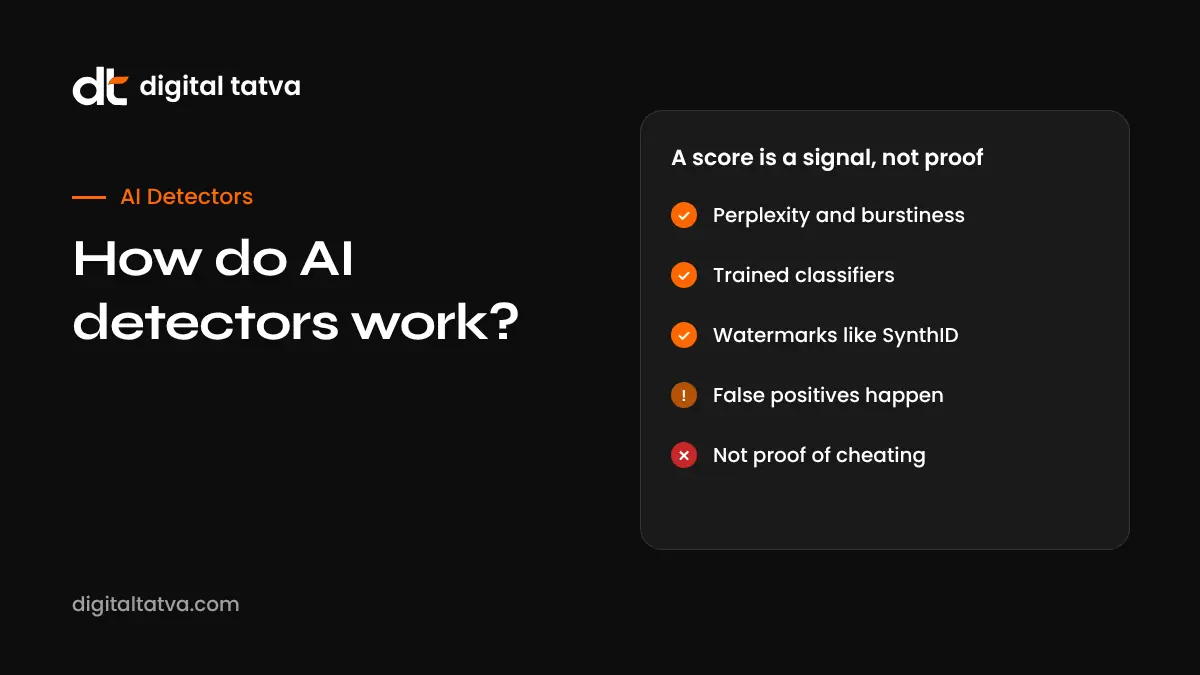
Large language models write by predicting the next word. That leaves statistical patterns that detectors try to spot. Most tools combine several of the methods below.
1. Perplexity: how predictable is the text?
Perplexity measures how surprised a language model is by each word. AI-generated text often uses the most likely word choices, so it tends to have low perplexity. Human writing usually includes more unexpected words, personal phrasing and small irregularities, which raise perplexity.
2. Burstiness: how much does the writing vary?
Burstiness looks at variation across sentences. People often mix long and short sentences, change rhythm and shift tone. AI text can be more uniform. Low variation is treated as a sign of AI writing.
3. Trained classifiers
Many detectors use machine learning models trained on large sets of human-written and AI-generated text. The classifier learns patterns such as word choice, structure and phrasing, then predicts which group a new text resembles. Quality depends heavily on the training data and on whether it includes the newest AI models.
4. Watermark detection
Some AI companies have built invisible statistical watermarks into generated content. Google’s SynthID can mark text, images, audio and video created by its models, and Google offers tools to check for it. Watermarks only work for content from models that add them, and heavy editing can weaken them. See SynthID detector and does ChatGPT watermark text.
5. Sentence-level highlighting
Tools like GPTZero and Turnitin highlight individual sentences or passages they consider likely AI-written, then combine these into an overall score. This helps reviewers see which parts triggered the result, but individual highlights can be unreliable on short passages.
| Method | What it checks | Main weakness |
|---|---|---|
| Perplexity | Word predictability | Simple, formal or formulaic human writing also scores low |
| Burstiness | Variation in sentence length and structure | Some people naturally write evenly; edited AI text varies more |
| Trained classifiers | Similarity to known AI and human samples | Struggle with new models, niche topics and mixed writing |
| Watermarks | Hidden signals added by specific AI models | Only covers participating models; editing weakens signals |
| Sentence highlights | Passage-level likelihood | Less reliable on short texts |
How accurate are AI detectors?
Accuracy depends on the tool, the AI model used, the length of the text, the topic and how much the text was edited. Vendors often publish high accuracy figures from their own tests, but independent studies and real-world experience show more mixed results.
- OpenAI withdrew its own detector. OpenAI launched an AI text classifier in early 2023 and shut it down in July 2023, citing its low rate of accuracy.
- Non-native English writers are at higher risk. A 2023 Stanford study found that several popular detectors flagged a large share of essays written by non-native English speakers (TOEFL essays) as AI-generated, while performing much better on essays by native speakers.
- Some universities disabled AI detection. Several universities, including Vanderbilt in 2023, turned off Turnitin’s AI detection feature over concerns about false positives and transparency.
- Turnitin itself urges caution. Turnitin says its AI score should not be used as the sole basis for action and handles low percentage scores differently because they are less reliable.
- Editing reduces detection. Paraphrasing, mixing human and AI writing, and newer AI models can all lower detection rates. See AI humanizer tools compared.
The practical conclusion: a detector score is a lead to investigate, not a verdict.
Why human writing gets flagged as AI
| Cause | Why it triggers detectors |
|---|---|
| Non-native English | Simpler vocabulary and common phrases reduce perplexity |
| Formal or academic style | Structured, predictable phrasing looks machine-like |
| Templates and formulas | Lab reports, legal text, product descriptions and cover letters follow fixed patterns |
| Grammar tools | Heavy use of grammar and rewriting tools can smooth text into AI-like patterns |
| Short texts | Less text means less evidence and more random results |
| Common knowledge topics | Explaining widely known facts produces predictable wording |
| Lists and bullet points | Fragmented text gives detectors little context |
What to do if your work is flagged as AI
If you wrote the work yourself and a detector says otherwise, stay calm and collect evidence.
- Ask for the details. Request the report, the score and which passages were highlighted.
- Show your version history. Google Docs and Microsoft Word keep edit history that shows your writing over time.
- Share drafts and notes. Outlines, research notes, earlier drafts and sources help show your process.
- Offer to explain your work. Discussing your argument, sources and choices is strong evidence of authorship.
- Point to known limitations. Mention that detector providers themselves say scores should not be the only evidence.
- Follow the formal process. Read your institution’s academic integrity policy and appeal procedure.
- Be honest about tool use. If you used grammar tools, translation or AI for brainstorming, say so and check whether it was allowed.
How to protect yourself before submitting
- Write in Google Docs or Word with version history turned on.
- Keep your research notes, outlines and drafts.
- Read your institution’s or client’s rules on AI use and follow them.
- Add personal examples, specific details and your own analysis.
- If AI use is allowed, disclose how you used it.
- Avoid running your work through humanizers to dodge detection; this can break rules and does not prove authorship.
Guidance for teachers and institutions
- Use detectors as a starting point, not proof. Combine results with your knowledge of the student’s work.
- Talk before you penalise. A short conversation about the work often reveals more than a score.
- Set clear AI policies for each assignment: allowed, allowed with disclosure, or not allowed.
- Design AI-resistant tasks: personal reflections, in-class writing, oral presentations and process-based grading.
- Be aware of bias against non-native English writers.
For classroom ideas, see AI for teachers. For students, see ChatGPT prompts for students for ways to use AI to learn rather than to replace your own writing.
AI detectors for marketers, publishers and website owners
Many agencies and clients run blog posts through AI detectors before publishing. That can be useful as a quality signal, but it is often misunderstood.
- Google does not penalise content just for being AI-assisted. Google’s guidance focuses on whether content is helpful, reliable and people-first, and warns against using automation mainly to manipulate rankings. Read does Google penalize AI content.
- A “100% human” score does not mean quality. Thin, generic content can pass a detector and still fail readers.
- AI answer engines cite useful content. ChatGPT, Gemini and Google AI Overviews tend to cite clear, specific and trustworthy pages, regardless of a detector score. See what is AI search visibility.
- Labelling rules may apply. Some regions require disclosure of certain AI-generated content; see EU AI Act Article 50 for marketers.
A better quality process for AI-assisted content:
- Start with a clear brief and real expertise.
- Use AI for research support, outlines or first drafts if helpful.
- Add first-hand experience, original examples, data and opinions.
- Fact-check every claim and number.
- Edit for your brand voice; see how to train AI to write in your brand voice.
- Have a subject expert review important pages.
Popular AI detectors at a glance
| Tool | Common users | Notes |
|---|---|---|
| Turnitin | Schools and universities | Built into many learning systems; access usually through institutions |
| GPTZero | Teachers, students, writers | Sentence highlighting and writing reports; free and paid plans |
| ZeroGPT | General users | Free and easy to use; results can vary |
| Copyleaks | Education and businesses | AI and plagiarism detection with multilingual support |
| Originality.ai | Publishers and SEO teams | Paid credits, AI and plagiarism checks for web content |
| QuillBot and Grammarly checkers | Students and writers | Convenient checks inside writing tools; see QuillBot review and Grammarly review |
Features and pricing change often; check each tool’s website for current details.
Detecting AI images, video and voice
Text is not the only concern. AI-generated images, videos and cloned voices are increasingly used in scams and misinformation. Detection here relies on watermarks such as SynthID, content credentials (C2PA metadata), visual and audio clues, and source verification. Learn more in how to spot AI deepfake and voice clone scams.
Common myths about AI detectors
- Myth: a high AI score proves cheating. It shows statistical similarity, not authorship.
- Myth: a 0% score proves human writing. Edited AI text can pass.
- Myth: all detectors agree. Different tools often give very different scores for the same text.
- Myth: Google uses AI detectors to rank pages. Google’s public guidance focuses on helpfulness and spam policies, not detector scores.
- Myth: humanizers make AI writing undetectable and safe. Results are inconsistent, and using them can break academic or client rules.
Illustrative example: a flagged college assignment
This is an illustrative scenario, not a client story.
A second-year engineering student in Pune submits a lab report that Turnitin flags with a high AI percentage. The student wrote it alone but used a grammar tool to polish the language. Instead of panicking, she shares her Google Docs version history showing three days of writing, her handwritten lab notes and an earlier draft. She explains her method and results in a short meeting with her professor, who is satisfied that the work is hers. She also learns that her course allows grammar tools but asks students to mention them, so she adds a note to future submissions.
AI detector checklist
- Treat detector scores as probabilities, not proof.
- Use more than one signal: drafts, history, conversation.
- Know your institution’s or client’s AI policy.
- Keep version history and notes for important work.
- Disclose permitted AI use honestly.
- For web content, focus on helpfulness, accuracy and expertise.
How Digital Tatva can help
Digital Tatva helps brands create content that both people and AI answer engines trust, using clear structure, real expertise and accurate facts rather than chasing detector scores. Explore our AEO services.
Want content that AI search engines cite? Request an AEO audit or try the free AI visibility checker.
Frequently asked questions
How do AI detectors work?
They analyse how predictable the text is (perplexity), how much it varies (burstiness) and compare it with known human and AI writing using trained classifiers. Some also check for watermarks.
Are AI detectors accurate?
They can be useful but are not fully reliable. They produce false positives and can miss edited AI text, so scores should not be used as the only evidence.
Can AI detectors be wrong about human writing?
Yes. Formal, simple, formulaic or non-native English writing is more likely to be wrongly flagged.
What should I do if Turnitin flags my work as AI?
Ask for the report, share your version history, drafts and notes, offer to explain your work and follow your institution’s appeal process.
Why did OpenAI stop its AI detector?
OpenAI shut down its AI text classifier in July 2023, citing its low rate of accuracy.
Can teachers prove a student used ChatGPT?
Detector scores alone are not proof. Teachers usually combine them with drafts, writing history, conversations and knowledge of the student’s work.
Does Google penalise AI-generated content?
Google says it rewards helpful, people-first content regardless of how it is produced, but it acts against content created mainly to manipulate rankings.
Do AI humanizers beat AI detectors?
Sometimes, but results are inconsistent, quality can suffer and using them may break academic or client rules.
Which AI detector is most accurate?
No detector is perfect. Results vary by text type and model. Compare tools in our guide to the best AI detectors and treat all scores with caution.
Can AI detectors detect images and videos?
Text detectors cannot. AI images, video and audio need tools that check watermarks such as SynthID or content credentials.
Product details, prices and features are checked at the time of writing and can change. Sources are linked in the text so you can check them yourself.
How does your brand appear in AI answers?
We test the questions your buyers ask across the major AI assistants and search engines, then show you what to fix first.
Get an AI Visibility Audit