Does Google Penalize AI Content? What Actually Gets Sites in Trouble
What Google really says about AI content, what triggers penalties and an editorial workflow for safe AI-assisted publishing.
On this page
- Key takeaways
- What Google actually says about AI content
- What gets AI-heavy sites into trouble
- Signs your AI content is underperforming
- How to use AI safely for content
- Should you disclose AI use?
- AI content and AI search
- A practical quality checklist
- Recovering from AI content problems
- Illustrative example: two ways to use AI for the same article
- An editorial workflow for AI-assisted content
- How Digital Tatva can help
- Frequently asked questions
Last updated: 17 November 2026
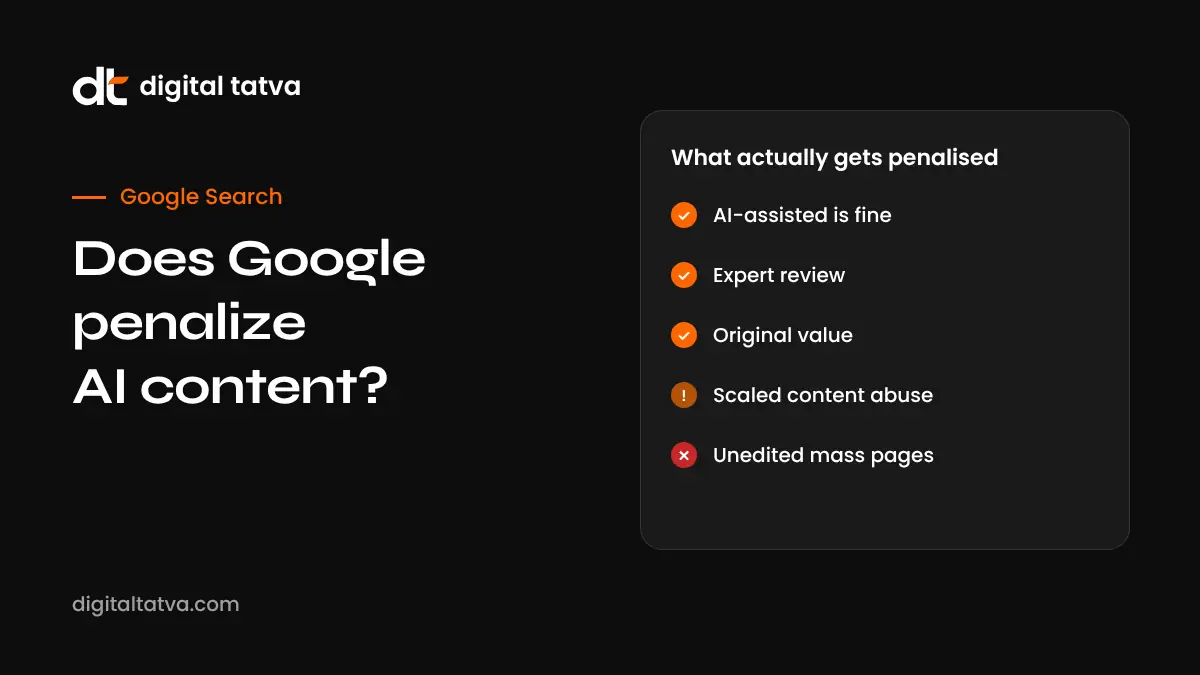
Quick answer: No, Google does not penalise content just because AI helped write it. Google’s guidance has been clear since 2023: it rewards helpful, reliable, people-first content however it is produced, and acts against content made primarily to manipulate rankings. What gets sites into trouble is scaled content abuse (publishing many low-value pages mainly to rank), thin or inaccurate content, and content with no real expertise or original value. AI content that a knowledgeable person reviews, improves and stands behind is fine. Mass-produced, unedited AI pages are risky, whether they are written by AI or by people.
Key takeaways
- Google judges content by quality and purpose, not by whether AI was used.
- “Scaled content abuse” is a spam policy that covers mass-produced low-value pages made by any method.
- Thin AI content often shows up as pages stuck in “Crawled, currently not indexed” or losing traffic after core updates.
- Expertise, accuracy, originality and editorial review are what make AI-assisted content safe and useful.
- The same principles apply to being cited by AI assistants.
What Google actually says about AI content
Google’s Search Central guidance states that appropriate use of AI or automation is not against its guidelines, and that it focuses on the quality of content rather than how it was produced. Its spam policies, however, prohibit using automation, including AI, to generate content primarily to manipulate search rankings. The key distinction is purpose and value.
Google’s helpful content principles ask whether content is created for people, demonstrates first-hand experience and expertise, provides original information or analysis, and leaves readers satisfied. Content that fails these tests underperforms regardless of who or what wrote it.
What gets AI-heavy sites into trouble
| Problem | Why it hurts |
|---|---|
| Scaled content abuse | Hundreds or thousands of pages made mainly to rank, with little value; a spam policy violation that can lead to manual actions |
| Thin, generic content | Repeats what already exists; often not indexed or ranked |
| Factual errors | Damages trust and quality signals; can mislead users |
| No expertise or experience | Fails helpful content expectations, especially for health, finance and legal topics |
| Templated pages | Location or keyword pages that only swap one word |
| Fake authors or reviews | Misleading and against policies |
In November 2026 SEO consultants reported more manual action messages than usual, and Meta’s Facebook Answers project, with over 6 million AI-generated pages indexed, sparked debate about scaled content. See Facebook Answers and Google spam policies explained.
Signs your AI content is underperforming
- Many pages in Search Console’s “Crawled, currently not indexed” report. See our fix guide.
- Traffic drops after core updates, such as the November 2026 core update.
- High impressions but very low clicks.
- Short time on page and quick returns to search.
- A manual action notice in Search Console for scaled content or spam.
How to use AI safely for content
- Start with a real purpose. Write for a specific reader question, not a keyword list.
- Use AI for research and drafting, not as the final author.
- Add first-hand experience. Examples, photos, data, case details and opinions only you can provide.
- Fact-check everything. Verify names, dates, prices, statistics and claims against reliable sources.
- Edit for clarity and voice. Remove filler and generic phrasing.
- Show who is responsible. Real author names and bios with relevant experience.
- Publish fewer, better pages. Quality beats volume.
- Update and prune. Refresh valuable pages; merge or remove weak ones.
Should you disclose AI use?
Google says disclosure can be helpful where readers would reasonably wonder how content was produced, such as AI-generated images or automated reports. Many publishers add a short note on their editorial process. What matters most is that a responsible person stands behind the content.
AI content and AI search
The same rules apply to being cited in AI Overviews, AI Mode, ChatGPT and Perplexity. AI assistants prefer clear, accurate, specific and original content. Generic AI-written pages rarely add anything an assistant cannot already generate itself, so they are less likely to be cited. Original data, expert insight and precise answers are what earn citations. See original research for AEO.
A practical quality checklist
| Question | Yes means |
|---|---|
| Would I publish this if search engines did not exist? | It serves readers |
| Does it include something new: data, experience, examples? | Original value |
| Has an expert checked the facts? | Accuracy |
| Is a real author accountable? | Trust |
| Does it fully answer the question? | Satisfying |
| Is it different from the top results? | Not redundant |
Recovering from AI content problems
- Identify weak pages using Search Console and analytics.
- Decide for each: improve, merge, noindex or remove.
- Rewrite valuable pages with expertise and original detail.
- Strengthen internal links to your best pages.
- If you received a manual action, fix the issues across the site and submit a reconsideration request.
- Wait for the next core update cycle; recovery often takes months.
Illustrative example: two ways to use AI for the same article
These are illustrative scenarios, not client stories.
Approach A: A site asks an AI tool to “write 1,500 words on best home loans in India” and publishes the result unchanged, along with 200 similar articles in a month. The articles repeat general advice, include outdated interest rates and have no author. Most are never indexed, and traffic falls after the next core update.
Approach B: A finance writer uses AI to outline the article and summarise lender terms she has collected. She checks every rate against lender websites on the day of publishing, adds a comparison table, explains how she would choose as a first-time buyer, adds her credentials, and schedules a monthly update. The site publishes four such articles a month. They are indexed quickly, attract links and are cited in AI answers about home loans.
Both used AI. Only one created something worth ranking.
An editorial workflow for AI-assisted content
- Brief: a human defines the reader, question and unique angle.
- Research: AI helps gather and summarise sources; a human verifies them.
- Draft: AI drafts sections from verified notes.
- Expert pass: a subject expert adds experience, examples and corrections.
- Edit: an editor removes filler and checks tone and clarity.
- Fact check: every number, name and claim is verified.
- Publish: with a real author and clear date.
- Maintain: scheduled reviews keep it accurate.
How Digital Tatva can help
Digital Tatva audits content quality, identifies thin or risky pages, and helps businesses build expert, AI-assisted content workflows that work for Google and AI assistants. See our content optimization service.
Worried about AI content on your site? Request an audit and we will show you what to keep, improve or remove.
Frequently asked questions
Does Google penalize AI-generated content?
Not for being AI-generated. Google acts against content made primarily to manipulate rankings or that is low quality, regardless of how it was produced.
What is scaled content abuse?
It is a Google spam policy covering the generation of many pages primarily to manipulate rankings without adding value, whether using AI, automation or people.
Can Google detect AI content?
Google focuses on quality signals rather than detection. Whether it detects AI is less important than whether the content is helpful.
Is it safe to use ChatGPT for blog posts?
Yes, if a knowledgeable person reviews, fact-checks and improves the content, and you publish for readers rather than volume.
Should I label AI-written content?
Disclosure can help where readers would expect it. Many sites explain their editorial process. Accountability matters more than labels.
Why did my AI content stop ranking?
Common causes are thin or generic content, factual errors, lack of expertise, too many similar pages and core update changes.
Can AI content get a manual action?
Yes, if it violates spam policies such as scaled content abuse. Manual actions appear in Search Console.
Does AI content get cited in AI Overviews?
It can, but generic content rarely adds unique value. Original, expert and specific content is more likely to be cited.
How much AI content is too much?
There is no fixed percentage. The question is whether every page is helpful, accurate and worth publishing.
How long does recovery take?
Often months. Improvements are usually reflected over time and around core updates.
Product details, prices and features are checked at the time of writing and can change. Sources are linked in the text so you can check them yourself.
How does your brand appear in AI answers?
We test the questions your buyers ask across the major AI assistants and search engines, then show you what to fix first.
Get an AI Visibility Audit