Facebook Answers: Meta’s 6 Million AI Pages in Google and What It Means
What Facebook Answers is, why it is controversial in SEO and how businesses can protect their visibility against scaled AI pages.
On this page
- Key takeaways
- What is Facebook Answers?
- Why SEOs call it scaled content abuse
- The double standard question
- What it means for your website
- How to protect your search visibility
- The lesson for your own AI content
- How Facebook Answers fits Meta’s AI strategy
- What to watch next
- How to check if Facebook Answers competes with you
- A short history of scaled content and big platforms
- What AI assistants may do with Facebook Answers
- A checklist for your content team
- How Digital Tatva can help
- Frequently asked questions
Last updated: 16 November 2026
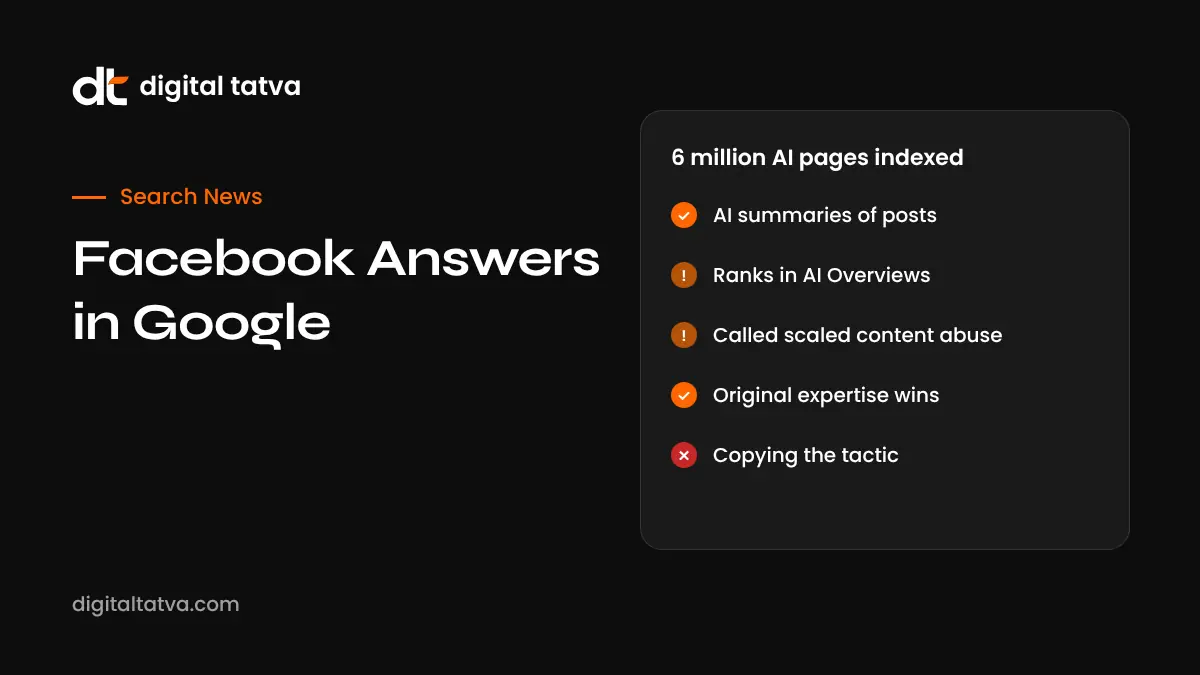
Quick answer: Facebook Answers is a set of AI-generated topic pages from Meta, published under facebook.com/fb-answers/, that summarise subjects using public Facebook posts and pages. By early November 2026 more than 6 million of these pages were indexed in Google, and SEO experts such as Glenn Gabe called it scaled content abuse. The pages reportedly rank across blue links, AI Overviews, AI Mode and Gemini citations. Google has not responded publicly. For businesses, it is a reminder that AI-generated pages from large platforms now compete for the same searches, and that real expertise and original information are your best defence.
Key takeaways
- Facebook Answers pages live in the /fb-answers/ directory and are written by AI from public Facebook content.
- About 6 million pages were reported indexed in Google by 5 November 2026.
- SEO consultant Glenn Gabe called the project “scaled content abuse”; Google has not commented.
- The pages reportedly appear in classic results, AI Overviews, AI Mode and Gemini citations.
- Rumours suggest Instagram may be doing something similar, but that is unconfirmed.
What is Facebook Answers?
Facebook Answers is Meta’s collection of AI-written topic pages. Each page takes a question or topic and generates a summary based on public Facebook posts and pages. The pages sit in a dedicated directory at facebook.com/fb-answers/ and are open to search engines, so Google and others can index them.
Saul Westbrook of Peripheral Creative wrote about noticing the pages in June 2026. Glenn Gabe said Facebook began populating the directory in July 2026. Either way, it grew fast: by early November, Gabe reported “6M+ urls” indexed in Google.
Why SEOs call it scaled content abuse
Google’s spam policies define scaled content abuse as generating many pages primarily to manipulate rankings rather than help users, whatever tool is used to produce them. The concern with Facebook Answers is that it appears to be exactly that: millions of automatically generated pages targeting search queries.
Gabe said the directory ranks for millions of queries across traditional blue links, AI Overviews and AI Mode, and that the pages appear in Gemini visibility with citations. Barry Schwartz of Search Engine Roundtable, who covered the story on 5 November, said he expected the pages to be deindexed soon now that they were public. As of mid-November, Google had not made a public statement.
The double standard question
Many site owners have received manual actions or seen traffic collapse for publishing far less AI-generated content. In November, Lily Ray said she had received more manual action messages from site owners in recent weeks than ever before. When a giant platform publishes millions of AI pages and they rank, small publishers understandably ask whether rules apply equally.
Google has not addressed that question directly. Historically, Google’s spam team has acted against large sites too, sometimes months after problems became public. It is worth watching how this case is handled.
What it means for your website
New competition for informational queries
If you publish general informational content, such as “best places to visit in Gujarat in winter” or “how to start a home bakery”, you may now compete with an AI-generated Facebook Answers page for the same query. These pages benefit from Facebook’s domain strength.
Generic content is the most exposed
AI pages that summarise public posts are good at broad, generic overviews. They are weaker at original expertise, firsthand experience, specific data and accountable advice. Content that offers those qualities is harder to replace.
Your social presence may feed these pages
Because Facebook Answers draws on public Facebook posts and pages, what your business publishes publicly on Facebook could appear in summaries. That cuts both ways: helpful, accurate posts may be reflected, while outdated or careless posts could be too.
How to protect your search visibility
| Action | Why it helps |
|---|---|
| Add original information | Data, examples, photos and firsthand experience that summaries cannot copy |
| Show real expertise | Named authors with genuine credentials and accountable advice |
| Go specific | Narrow, detailed answers beat broad overviews |
| Strengthen your entity | Clear, consistent brand facts help AI attribute expertise to you |
| Earn mentions | Independent references build trust that generic pages lack |
| Keep content fresh | Up-to-date facts beat summaries of old posts |
| Clean up your public Facebook page | Accurate public information is what may be summarised |
Our guides on E-E-A-T for AI search and topical authority go deeper.
The lesson for your own AI content
Facebook Answers is an extreme example of a trend many businesses are tempted by: publishing large volumes of AI-generated pages. Whether or not Meta faces consequences, smaller sites usually do. Google’s policies apply to the purpose and quality of content, not the tool used. Safe practice looks like this:
- Use AI to assist research and drafting, not to replace expertise.
- Have a knowledgeable person review, edit and add original insight to every page.
- Publish fewer, better pages rather than thousands of thin ones.
- Avoid templated pages that only change a keyword or location.
- Remove or improve weak pages that add nothing. See our guide to “Crawled, currently not indexed”, which is often a sign of quality issues.
See also common AEO mistakes.
How Facebook Answers fits Meta’s AI strategy
Meta has been expanding AI across its products, including Meta AI in WhatsApp, Instagram and Facebook, and new AI experiences such as Muse. Facebook Answers turns Meta’s huge store of public content into pages that can attract search traffic and appear in other companies’ AI answers. Read more in Meta AI SEO and Meta Muse.
What to watch next
- Whether Google deindexes or demotes the /fb-answers/ directory.
- Whether Google comments on scaled AI content from large platforms.
- Whether Instagram or other Meta properties launch similar pages, as rumoured.
- How often Facebook Answers pages appear as citations in AI Overviews, AI Mode and Gemini for your topics.
- How the November 2026 core update, which began on 10 November, affects these pages.
How to check if Facebook Answers competes with you
- Search Google for your main informational topics and note whether facebook.com/fb-answers/ pages appear.
- Use the site: operator, for example
site:facebook.com/fb-answers/ your topic, to see related pages. - Check AI Overviews and AI Mode answers for citations to Facebook Answers.
- Compare your page with theirs honestly. What do you offer that they cannot?
- Improve your page with original information and clear expertise.
A short history of scaled content and big platforms
Facebook Answers is not the first time a large platform has published huge numbers of thin or automated pages that rank in Google. Over the years, question and answer sites, user-generated forums, content farms and “parasite” sections on strong domains have all grown fast in search, then lost visibility when Google adjusted its systems or policies. Google introduced its scaled content abuse policy and site reputation abuse policy partly in response to these patterns.
The lesson from those cycles is consistent. Scaled pages can win traffic quickly, especially on strong domains. They are also exposed to sudden drops when Google acts. Businesses that copy the tactic on their own sites rarely have the domain strength to benefit in the first place, and they carry all the risk. In November 2026, Google also emailed sites with site reputation abuse manual actions to say those actions no longer affect results in the European Economic Area following a policy change, while nothing changed elsewhere. Policies continue to evolve, which is another reason not to build a strategy on edge cases.
What AI assistants may do with Facebook Answers
The more interesting question for 2027 is not only Google rankings but AI citations. Reports say Facebook Answers pages appear as citations in Gemini and inside AI Overviews and AI Mode. If AI assistants cite AI-written summaries of social posts, the chain of evidence behind an answer gets weaker: an AI summarising an AI summary of public posts. That may push AI companies to weigh original, accountable sources more heavily over time. In our view, businesses that publish clear, original and verifiable information are best placed whichever way that goes.
A checklist for your content team
- Every article has a named author with real experience in the topic.
- Each page contains at least one thing a summary could not produce: original photos, data, examples, quotes or a clear opinion based on experience.
- Facts are checked and dated, and outdated pages are updated or removed.
- AI tools are used for research and drafts, never published without human review.
- Pages are planned around real customer questions, not around keyword lists alone.
- Thin, overlapping pages are merged into stronger ones.
Following this checklist keeps your site on the right side of Google’s policies and gives AI assistants better reasons to cite you.
How Digital Tatva can help
Digital Tatva helps businesses build the kind of content and authority that AI-generated summaries cannot replace: specific, expert and well-sourced pages, consistent brand signals and genuine mentions. We track how AI assistants cite you and which sources compete with you. See our content optimization service and AEO services.
Losing visibility to AI-generated pages? Request an AEO audit and we will show you where you compete and how to stand out.
Related reading: does Google penalize AI content and Google spam policies explained.
Frequently asked questions
What is Facebook Answers?
Facebook Answers is a collection of AI-generated topic pages from Meta, published at facebook.com/fb-answers/, that summarise topics using public Facebook posts and pages.
How many Facebook Answers pages are in Google?
About 6 million pages were reported indexed in Google by early November 2026.
Is Facebook Answers spam?
Some SEO experts, including Glenn Gabe, have called it scaled content abuse. Google has not made a public statement about it.
When did Facebook Answers start?
Reports differ slightly. One SEO noticed the pages in June 2026, while Glenn Gabe said Facebook began populating the directory in July 2026.
Do Facebook Answers pages appear in AI Overviews?
Reports say they rank across blue links, AI Overviews and AI Mode, and appear as citations in Gemini.
Can my Facebook posts appear in Facebook Answers?
The pages summarise public Facebook posts and pages, so public content from your business page could be reflected in summaries.
Will Google remove Facebook Answers pages?
It is unknown. Some industry commentators expect deindexing, but Google had not acted publicly as of mid-November 2026.
Is Instagram doing the same thing?
There are rumours, reported by Search Engine Roundtable, but nothing has been confirmed.
Can I publish AI-generated content safely?
Yes, if it is genuinely helpful, reviewed and improved by knowledgeable people, and not mass-produced primarily to rank. Google’s policies focus on purpose and quality.
How do I compete with Facebook Answers pages?
Offer what summaries cannot: original data, firsthand experience, named expertise, specific detail and up-to-date facts.
Should I block AI summaries of my Facebook posts?
There is no specific control for Facebook Answers reported. Keep public posts accurate and helpful, and keep private information off public pages.
Does this affect AI visibility for my brand?
Possibly. If AI assistants cite Facebook Answers pages on your topics, those pages compete with your own content for citations.
Is it safe to use AI for my blog?
Yes, if a knowledgeable person reviews and improves each piece and you publish for readers rather than volume.
Product details, prices and features are checked at the time of writing and can change. Sources are linked in the text so you can check them yourself.
How does your brand appear in AI answers?
We test the questions your buyers ask across the major AI assistants and search engines, then show you what to fix first.
Get an AI Visibility Audit