Core Web Vitals 2026: LCP, INP and CLS Thresholds and How to Pass
The current Core Web Vitals thresholds, what they mean for SEO and AI search, and how to fix LCP, INP and CLS.
On this page
- Key takeaways
- Core Web Vitals thresholds
- Do Core Web Vitals affect rankings?
- How to measure Core Web Vitals
- How to improve LCP
- How to improve INP
- How to improve CLS
- Platform tips
- A practical priority order
- Illustrative example: fixing a slow WordPress homepage
- Third-party script audit
- How Digital Tatva can help
- Frequently asked questions
Last updated: 17 November 2026
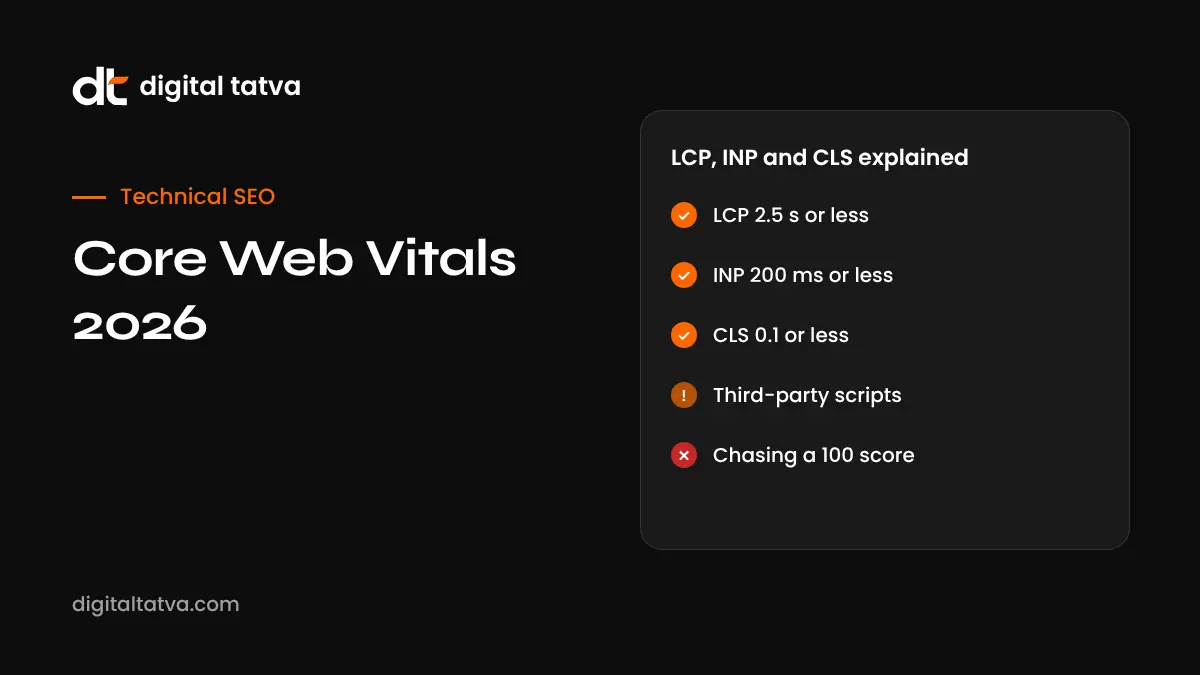
Quick answer: Core Web Vitals are Google’s three user experience metrics: Largest Contentful Paint (LCP) for loading, Interaction to Next Paint (INP) for responsiveness and Cumulative Layout Shift (CLS) for visual stability. In 2026 the “good” thresholds remain LCP of 2.5 seconds or less, INP of 200 milliseconds or less and CLS of 0.1 or less, measured at the 75th percentile of real user visits. They are part of Google’s page experience signals, so they matter, but they do not outweigh relevance and content quality. Fast, stable pages also help users who arrive from AI answers and help crawlers process your site.
Key takeaways
- The three Core Web Vitals are LCP, INP and CLS. INP replaced First Input Delay in March 2024.
- Google assesses real user data (field data) from the Chrome UX Report at the 75th percentile.
- Passing Core Web Vitals helps page experience but will not rescue weak content.
- INP is the metric most sites struggle with, usually because of heavy JavaScript and third-party scripts.
- Check Google’s official web.dev and Search Central pages for any methodology updates.
Core Web Vitals thresholds
| Metric | Measures | Good | Needs improvement | Poor |
|---|---|---|---|---|
| LCP | How fast the main content loads | 2.5 s or less | 2.5 to 4 s | Over 4 s |
| INP | How quickly the page responds to interactions | 200 ms or less | 200 to 500 ms | Over 500 ms |
| CLS | How much the layout shifts unexpectedly | 0.1 or less | 0.1 to 0.25 | Over 0.25 |
A page passes when at least 75% of real visits meet the “good” threshold for each metric. Time to First Byte (TTFB) and First Contentful Paint (FCP) are useful diagnostic metrics but are not Core Web Vitals.
Do Core Web Vitals affect rankings?
Google includes Core Web Vitals in its page experience signals. Google has also been clear that relevance and helpful content come first: a slower page with the best answer can outrank a faster page with a weaker one. Think of Core Web Vitals as a tie-breaker and a user experience essential rather than a shortcut to rankings.
Speed also matters beyond rankings. Slow pages lose visitors, convert worse and can be harder for crawlers to process at scale. Visitors arriving from AI answers expect quick, clear pages. See technical AEO checklist.
How to measure Core Web Vitals
| Tool | Data type | Best for |
|---|---|---|
| Search Console Core Web Vitals report | Field (real users) | Site-wide status by URL group |
| PageSpeed Insights | Field and lab | Single page diagnosis |
| Chrome DevTools Performance panel | Lab | Finding exact causes |
| Lighthouse | Lab | Quick audits and suggestions |
| Real user monitoring tools | Field | Ongoing tracking of real visitors |
Field data is what Google uses. Lab scores like a Lighthouse “92” are helpful for testing but are not the pass or fail measure.
How to improve LCP
- Identify the LCP element, often a hero image or headline.
- Serve images in modern formats such as WebP or AVIF, correctly sized.
- Preload the LCP image and avoid lazy-loading it.
- Reduce render-blocking CSS and JavaScript.
- Improve server response time with caching and a good host or CDN.
- Avoid large sliders and video backgrounds above the fold.
How to improve INP
- Find slow interactions in field data and DevTools.
- Reduce JavaScript, especially unused code and heavy frameworks.
- Defer or remove non-essential third-party scripts such as chat widgets, trackers and ad tags.
- Break up long tasks so the main thread can respond.
- Avoid heavy work in event handlers; show visual feedback quickly.
- Test on mid-range mobile phones, not only fast laptops.
How to improve CLS
- Set width and height on images and videos.
- Reserve space for ads, embeds and banners.
- Avoid inserting content above existing content after load.
- Use font-display settings and preload key fonts to reduce text shifts.
- Animate with transforms rather than layout properties.
Platform tips
| Platform | Common issues | Quick wins |
|---|---|---|
| WordPress | Heavy themes, too many plugins, duplicate scripts | Caching, image optimisation, remove unused plugins, avoid combining files that duplicate assets |
| Shopify | Apps injecting scripts | Audit apps, lazy-load below-the-fold media |
| Webflow and Wix | Interactions, large images | Compress images, limit animations. See AEO for Webflow and Wix |
| Custom JavaScript apps | Long tasks, client-side rendering | Server-side rendering, code splitting |
Third-party scripts are a frequent cause of poor INP. Analytics, chat, heatmap and AI widget scripts all add up. Review which ones you truly need.
A practical priority order
- Check Search Console for failing URL groups.
- Fix site-wide template issues first; they affect many pages at once.
- Tackle the metric with the most failing URLs.
- Re-test with PageSpeed Insights, then wait for field data to update over about 28 days.
Illustrative example: fixing a slow WordPress homepage
This is an illustrative scenario based on common patterns.
A consultancy’s WordPress homepage fails INP and LCP on mobile. Investigation shows the hero is a large PNG background image, a caching plugin is combining CSS and JavaScript in a way that loads some files twice, and five third-party scripts load in the head: a chat widget, two analytics tools, a heatmap tool and an ad pixel. A large block of custom CSS is also inlined on every page.
The team converts the hero to a compressed WebP image and preloads it, turns off file combining that caused duplication, moves custom CSS into a cached file, defers non-essential scripts and removes one unused analytics tool. The homepage HTML size roughly halves, and field data improves over the following weeks as Chrome UX Report data updates.
Third-party script audit
| Question | Action |
|---|---|
| Do we still use this tool? | Remove if not |
| Does it need to load on every page? | Limit to relevant pages |
| Does it need to load immediately? | Defer or delay until interaction |
| Is it duplicated by another tool? | Keep one |
| Does it add visible widgets? | Reserve space to avoid layout shift |
How Digital Tatva can help
Digital Tatva improves technical health for SEO and AI search, including Core Web Vitals, crawlability and rendering. We identify the scripts and templates slowing your site and fix them without breaking features. See our technical SEO and technical AEO services.
Failing Core Web Vitals? Request an audit and we will show you what to fix first.
Frequently asked questions
What are Core Web Vitals?
Three Google metrics for page experience: Largest Contentful Paint (loading), Interaction to Next Paint (responsiveness) and Cumulative Layout Shift (visual stability).
What are good Core Web Vitals scores in 2026?
LCP of 2.5 seconds or less, INP of 200 milliseconds or less and CLS of 0.1 or less, at the 75th percentile of real visits.
Do Core Web Vitals affect Google rankings?
They are part of page experience signals, but relevance and content quality matter more.
What replaced First Input Delay?
Interaction to Next Paint (INP) replaced First Input Delay as a Core Web Vital in March 2024.
Why is my PageSpeed score high but Core Web Vitals failing?
PageSpeed lab scores simulate a load, while Core Web Vitals use real user data, which reflects real devices and networks.
How long until Search Console shows improvements?
Field data is based on a rolling period of about 28 days, so improvements show gradually.
What usually causes poor INP?
Heavy JavaScript, long tasks and third-party scripts such as chat widgets, trackers and ads.
Do Core Web Vitals matter for AI search?
Indirectly. Fast, stable pages help crawlers and users arriving from AI answers, though content quality is what earns citations.
Is TTFB a Core Web Vital?
No. Time to First Byte is a diagnostic metric that affects LCP but is not one of the three Core Web Vitals.
Should I aim for a perfect 100 score?
No. Aim to pass the real-user thresholds. Chasing a perfect lab score often wastes effort.
Product details, prices and features are checked at the time of writing and can change. Sources are linked in the text so you can check them yourself.
How does your brand appear in AI answers?
We test the questions your buyers ask across the major AI assistants and search engines, then show you what to fix first.
Get an AI Visibility Audit