Programmatic SEO With AI: When It Works and When It Gets Penalised
How to use programmatic SEO and AI to scale useful pages without triggering Google's spam policies.
On this page
- Key takeaways
- What is programmatic SEO?
- When programmatic SEO works
- Programmatic SEO and Google’s policies
- How to build programmatic pages the right way
- Examples by business type
- Programmatic SEO and AI search
- Warning signs
- Illustrative example: integration pages for a SaaS tool
- Programmatic page quality checklist
- Tools commonly used
- How Digital Tatva can help
- Frequently asked questions
Last updated: 17 November 2026
Quick answer: Programmatic SEO means creating many pages from a template and a dataset, such as “[tool] integrations”, “[city] property prices” or “[currency] to [currency]”. It works when every page answers a real search with unique, useful data that people actually want. It fails, and can trigger Google’s scaled content abuse policy, when pages differ only by a swapped keyword or AI-written filler. With AI, it is easier than ever to build thousands of pages, which makes quality control more important, not less.
Key takeaways
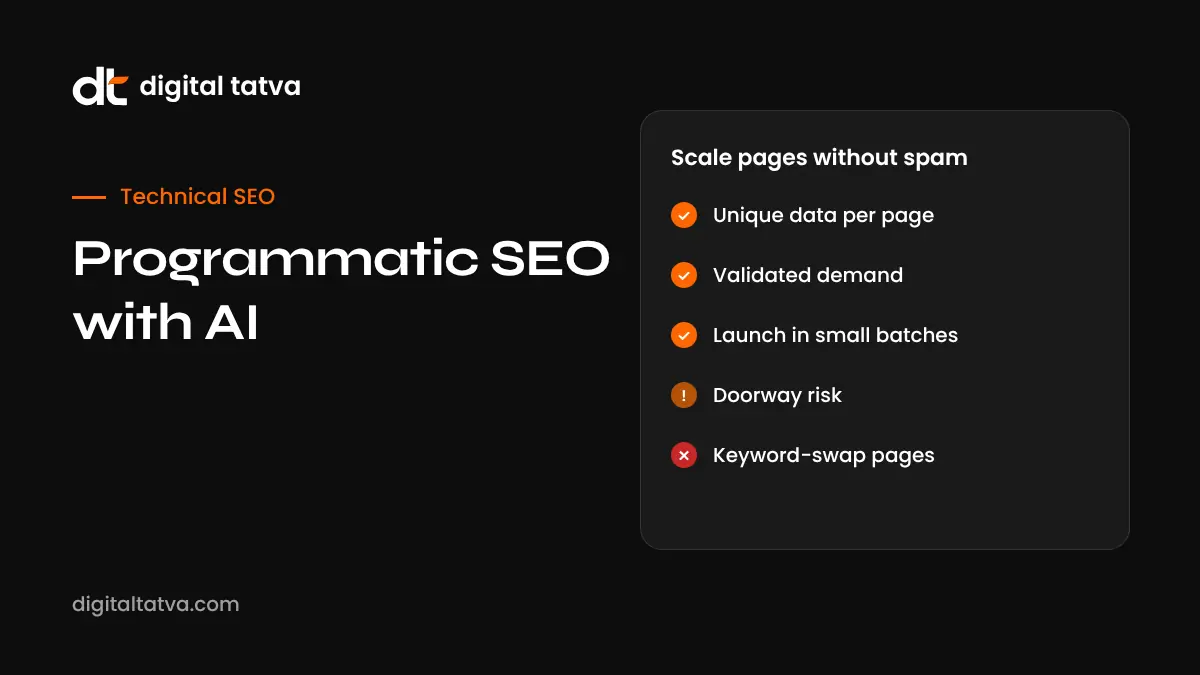
- Successful programmatic SEO is built on a unique, valuable dataset.
- Each page must satisfy a real search intent on its own.
- Thin templated pages often end up “Crawled, currently not indexed” or demoted.
- AI is useful for enriching pages, not for padding them.
- Launch in small batches, measure indexing and engagement, then scale.
What is programmatic SEO?
Programmatic SEO creates large numbers of pages from a structured dataset and a page template. Famous examples include travel sites with pages for every route, real estate sites with pages for every neighbourhood, SaaS sites with pages for every integration, and comparison sites with pages for every product pair. Each page targets a specific long-tail search.
When programmatic SEO works
| Works well | Fails |
|---|---|
| Proprietary or hard-to-get data on every page | Same text with one keyword swapped |
| Real search demand for each variation | Pages for combinations nobody searches |
| Useful features: tables, calculators, maps, filters | Only AI-written paragraphs |
| Accurate, updated information | Stale or invented data |
| Strong internal linking and hubs | Orphan pages reachable only by sitemap |
Programmatic SEO and Google’s policies
Google’s scaled content abuse policy targets pages generated at scale primarily to manipulate rankings, whatever method is used. Programmatic SEO is not banned, but it is the area most at risk. Doorway abuse also applies when many similar pages funnel users to the same destination. See Google spam policies explained and does Google penalize AI content.
A practical test: if you removed the keyword from a page, would it still be meaningfully different from its siblings? If not, it is probably too thin.
How to build programmatic pages the right way
- Start with data, not keywords. What unique information do you have or can you compile? Prices, availability, specs, reviews, local facts, integration details.
- Validate demand. Check that real people search for the page variations.
- Design the template for the user. Put the answer first, then supporting data, comparisons and related links.
- Use AI to enrich, not pad. AI can summarise data, generate structured descriptions from facts, or explain differences, but every claim should come from your data and be checked.
- Add unique elements per page. Charts, tables, local images, reviews, FAQs based on real questions.
- Build hubs and internal links. Category pages linking to children, related pages linking sideways.
- Launch a small batch. Publish 50 to 200 pages, then monitor indexing, impressions and engagement.
- Scale what works and prune or improve what does not.
- Keep data fresh with scheduled updates.
Examples by business type
| Business | Page type | Unique value per page |
|---|---|---|
| SaaS | “[Your tool] + [integration]” | Setup steps, use cases, supported features |
| Real estate | “[Area] property prices” | Price trends, listings, amenities |
| Travel | “[Origin] to [destination] by train” | Routes, durations, fares, tips |
| Ecommerce | “Best [product] for [use]” | Filtered products, specs, reviews |
| Local services | “[Service] in [area]” | Local team, coverage, local reviews; only where real |
| Finance | “[Currency] to [currency] rate” | Live data, history, calculators |
Programmatic SEO and AI search
AI assistants rarely cite generic templated pages. They do cite pages with specific, structured data that answers precise questions, such as pricing tables, specifications and comparisons. If your programmatic pages hold genuinely useful data presented clearly, they can be retrieved for AI answers to long-tail questions. See query fan-out, which explains how AI breaks questions into many specific searches.
Warning signs
- Most new pages stuck in “Crawled, currently not indexed”. See our fix guide.
- Impressions without clicks.
- Sitewide traffic drops after core updates.
- A manual action for scaled content abuse.
Illustrative example: integration pages for a SaaS tool
This is an illustrative scenario, not a client story.
A scheduling SaaS integrates with 80 apps. A thin approach would publish 80 pages saying “Connect [App] with our tool to save time”, with AI-written filler. A better approach starts from data the company already has: which features each integration supports, setup steps, sync direction, plan requirements, common use cases from customers, and help articles.
Each page opens with a direct answer (“Yes, our tool integrates with [App]: two-way calendar sync on all paid plans”), shows a feature table, lists setup steps with screenshots, gives three real use cases, and links to related integrations. The company publishes the 20 most-searched integrations first, checks indexing and sign-ups after six weeks, then rolls out the rest and removes integrations nobody uses.
Programmatic page quality checklist
- Each page answers a specific, validated search.
- At least several data points on the page are unique to that page.
- The answer appears in the first lines.
- There is a useful element: table, calculator, map, chart or steps.
- Data is accurate and has an update process.
- Pages link to a hub and related pages.
- Pages with no demand or no data are not published.
- Indexing and engagement are monitored after launch.
Tools commonly used
Teams typically combine a data source such as a spreadsheet, database or API; a CMS that supports templates and dynamic fields, such as WordPress custom post types or Webflow CMS; automation tools such as n8n or Zapier to sync data; and AI APIs to generate structured descriptions from verified data. See n8n vs Zapier.
How Digital Tatva can help
Digital Tatva helps businesses plan and audit programmatic SEO: validating data and demand, designing useful templates, setting quality controls and pruning pages that put your site at risk. See our technical SEO service.
Planning programmatic pages? Request an audit before you publish thousands of URLs.
Frequently asked questions
What is programmatic SEO?
It is creating many pages from a template and a dataset to target long-tail searches, such as location, integration or comparison pages.
Is programmatic SEO against Google’s guidelines?
No, but pages generated at scale mainly to manipulate rankings without adding value violate the scaled content abuse policy.
Can I use AI for programmatic SEO?
Yes, to enrich pages from real data, but not to pad pages with generic text. Check accuracy.
How many pages should I launch at once?
Start with a small batch, such as 50 to 200 pages, measure indexing and engagement, then scale.
What makes a programmatic page valuable?
Unique data, a clear answer to a real search, useful features like tables or calculators, and accurate, updated information.
Why are my programmatic pages not indexed?
Often because they are too similar, too thin or poorly linked. Improve uniqueness and internal links.
Are location pages programmatic SEO?
They can be. They are only valuable when each page has genuine local information and the business truly serves that area.
Can programmatic pages appear in AI answers?
Yes, if they contain specific, structured data that answers precise questions.
What is the difference between programmatic SEO and doorway pages?
Doorways are similar pages made mainly to rank and funnel users elsewhere. Good programmatic pages each provide unique value.
How often should data be updated?
As often as it changes. Stale prices, availability or facts reduce trust and usefulness.
Product details, prices and features are checked at the time of writing and can change. Sources are linked in the text so you can check them yourself.
How does your brand appear in AI answers?
We test the questions your buyers ask across the major AI assistants and search engines, then show you what to fix first.
Get an AI Visibility Audit