Knowledge Graph Optimization: Help Google and AI Understand Your Brand
How to make your brand a clear entity for Google's Knowledge Graph and AI assistants, step by step.
On this page
Last updated: 17 November 2026
Quick answer: Knowledge graph optimization means helping Google and AI systems recognise your brand, people and products as clear “entities” with consistent facts. You do it by publishing one authoritative description of your organisation, adding Organization and Person schema with sameAs links to official profiles, keeping facts identical across your website, Google Business Profile, LinkedIn, Wikidata and directories, earning coverage from reputable sources, and claiming your knowledge panel when it appears. A strong entity helps knowledge panels, AI Overviews on brand searches and how ChatGPT and Gemini describe you.
Key takeaways
- Google’s Knowledge Graph stores facts about entities: organisations, people, places and things.
- AI assistants also build an understanding of entities, so consistency across the web matters.
- Schema with sameAs links connects your website to your official profiles.
- Third-party sources confirm facts; your own website alone is rarely enough.
- Since late 2026, AI Overviews often appear where knowledge panels used to be on brand searches, making entity accuracy more visible.
What is the Knowledge Graph?
Google’s Knowledge Graph is a database of facts about entities and how they relate: a company, its founder, its headquarters, its products. It powers knowledge panels, some search features and the understanding behind Google’s AI answers. AI assistants such as ChatGPT and Gemini similarly learn which facts belong to which brand from many sources.
If your brand is a clear entity, AI is more likely to describe you accurately and confidently. If facts conflict across the web, AI may hedge, mix you up with another company or repeat outdated details. See fixing wrong AI answers about your brand.
Why it matters more now
Since late October 2026, Google has shown AI Overviews in the right-hand column for many US desktop brand searches, where knowledge panels used to appear. These summaries draw on many sources and have occasionally shown conflicting facts. See AI Overviews on brand searches. A clean, consistent entity is your best protection.
Knowledge graph optimization step by step
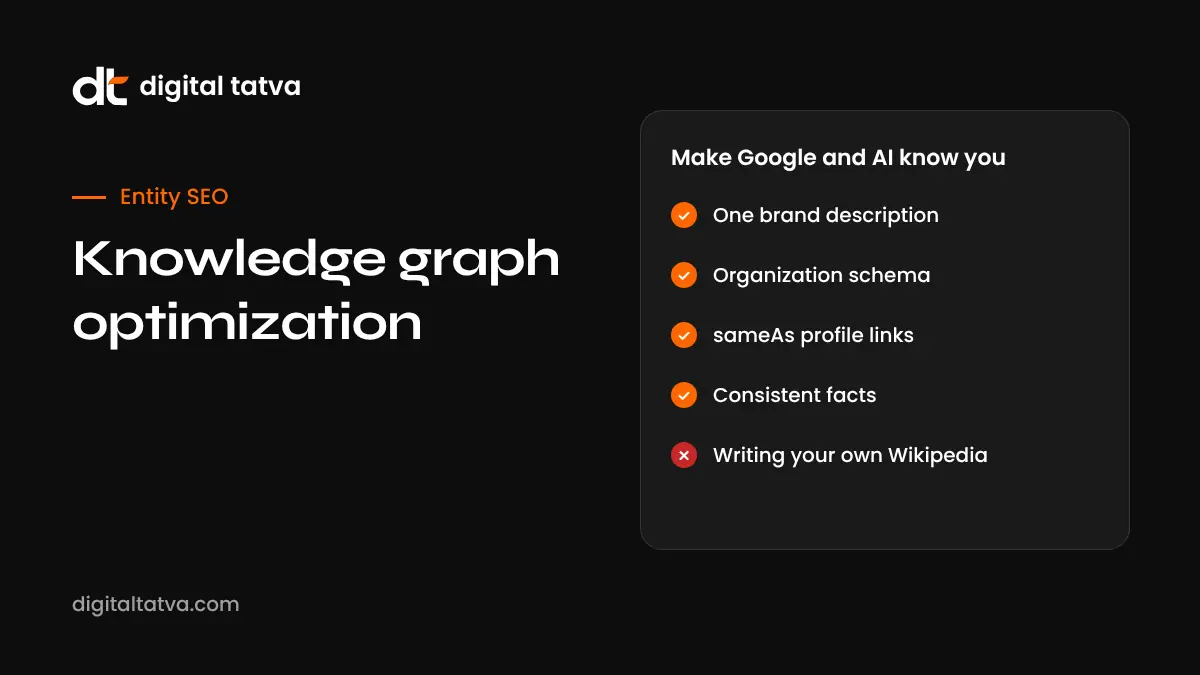
1. Write one canonical brand description
Two or three sentences covering who you are, what you do, who you serve and where. Use it consistently on your website, social bios, directories and press materials.
2. Create a company facts page
Publish a clear page with legal name, brand name, founding year, founders, leadership, headquarters, locations, services, key products and official profiles. Our company facts page is an example.
3. Add Organization schema with sameAs
On your homepage or about page, add Organization (or a more specific type like LocalBusiness) schema with name, logo, URL, founding date, founders, address, contact points and sameAs links to official profiles such as LinkedIn, Wikidata, Crunchbase, YouTube, X and Instagram. See schema markup for AEO.
4. Mark up people as entities
Add Person schema for founders and authors on their bio pages, with job title, affiliation and sameAs links to their LinkedIn and other profiles.
5. Align every major profile
| Profile | Why it matters |
|---|---|
| Google Business Profile | Core local entity data for Google |
| LinkedIn company page | Widely trusted business facts |
| Wikidata | Structured open data used by many systems, if you are notable enough |
| Crunchbase | Company facts for startups and tech |
| Industry directories | Category confirmation |
| Social profiles | Consistency signals |
| Apple Business Connect and Bing Places | Data for Apple Maps, Siri and Microsoft surfaces |
6. Earn reputable mentions
News coverage, industry publications, podcasts and conference listings confirm your facts from independent sources. See brand mentions for AEO.
7. Consider Wikipedia and Wikidata carefully
Wikipedia requires notability shown by independent reliable sources and strict conflict-of-interest rules. Do not write your own article. Wikidata has lower thresholds but still requires accurate, sourced data. See Wikipedia for AEO.
8. Claim your knowledge panel
If a knowledge panel appears for your brand or a person, use Google’s verification process to claim it, then suggest corrections. See Google knowledge panel for business.
9. Fix conflicting facts
Search your brand and founders, list every inconsistent fact you find, then correct what you control and request updates elsewhere.
10. Monitor regularly
Check brand searches and AI answers monthly. See monitoring brand sentiment in AI answers.
Example Organization schema fields
| Field | Example value |
|---|---|
| @type | Organization or ProfessionalService |
| name | Your brand name |
| legalName | Registered company name |
| url | Your homepage |
| logo | Logo image URL |
| foundingDate | Year founded |
| founder | Person entity |
| address | Headquarters address |
| sameAs | List of official profile URLs |
| description | Your canonical description |
Common mistakes
- Different brand descriptions on every platform.
- Old addresses or phone numbers left on directories.
- sameAs links pointing to unofficial or inactive profiles.
- Writing your own Wikipedia article.
- Ignoring founder and author entities.
Illustrative example: fixing a confused entity
This is an illustrative scenario, not a client story.
A digital agency named “Pixel Craft” shares a similar name with a design app and a photography studio in another country. When people ask ChatGPT about “Pixel Craft agency”, answers mix details from all three. Google shows no knowledge panel for the agency.
The agency publishes a company facts page stating its legal name, founding year, founders, Ahmedabad address and services; adds Organization schema with sameAs links to its LinkedIn, Clutch, Google Business Profile and YouTube channel; adds Person schema for its founders; makes its brand description identical across every profile; and earns a few industry interviews that mention the agency with its city and services. Over the following months, AI answers become more accurate and Google begins associating searches with the correct entity.
Entity audit worksheet
| Fact | Website | Google Business Profile | Directories | AI answers | |
|---|---|---|---|---|---|
| Brand name | |||||
| Description | |||||
| Founding year | |||||
| Founders and CEO | |||||
| Address | |||||
| Services or products |
Fill in what each source says, highlight mismatches, and fix them one by one.
How Digital Tatva can help
Entity work is one of the five layers of the Digital Tatva method. We write your canonical description, build schema, align profiles, correct conflicting facts and monitor how Google and AI assistants describe you. See our entity SEO service.
Does Google understand who you are? Request an AEO audit or try the free AI visibility checker.
Frequently asked questions
What is knowledge graph optimization?
It is the process of helping Google and AI systems understand your brand, people and products as clear entities with consistent, verified facts.
How do I get into Google’s Knowledge Graph?
Build consistent facts across your website, schema and profiles, and earn mentions from reputable sources. Google decides inclusion; there is no direct submission.
What is sameAs in schema?
sameAs lists URLs of official profiles that represent the same entity, helping search engines connect your website with your other profiles.
Do I need Wikipedia to get a knowledge panel?
No. Many businesses have knowledge panels without Wikipedia, especially local businesses with Google Business Profiles.
How do I claim my knowledge panel?
Search your brand on Google and, if a panel appears, use the option to claim it and verify through an official profile or account.
Does the Knowledge Graph affect AI answers?
Google’s AI features draw on its understanding of entities, and other AI assistants learn from similar sources, so consistent facts help.
What is Wikidata?
Wikidata is a free structured database of facts used by many systems. Entries need to meet notability and sourcing requirements.
Why does Google show wrong facts about my company?
Usually because outdated or conflicting information exists online. Fix your sources and suggest corrections through claimed panels.
Should founders have their own schema?
Yes. Person schema on founder and author pages helps connect people entities to your organisation.
How long does entity optimization take?
Fixing your own sources is quick, but changes in Google and AI answers can take weeks to months.
Product details, prices and features are checked at the time of writing and can change. Sources are linked in the text so you can check them yourself.
How does your brand appear in AI answers?
We test the questions your buyers ask across the major AI assistants and search engines, then show you what to fix first.
Get an AI Visibility Audit