Google Spam Policies Explained: Scaled Content, Site Reputation Abuse and More
A plain-English guide to every Google spam policy, manual actions and how to recover if your site is affected.
On this page
- Key takeaways
- Why spam policies matter more in 2026
- Google’s spam policies explained
- The two policies everyone is talking about
- Manual actions vs algorithmic actions
- How to check if your site is affected
- How to recover
- Spam policies and AI search
- Illustrative example: a site that slipped into spam
- Spam risk self-check
- How Digital Tatva can help
- Frequently asked questions
Last updated: 17 November 2026
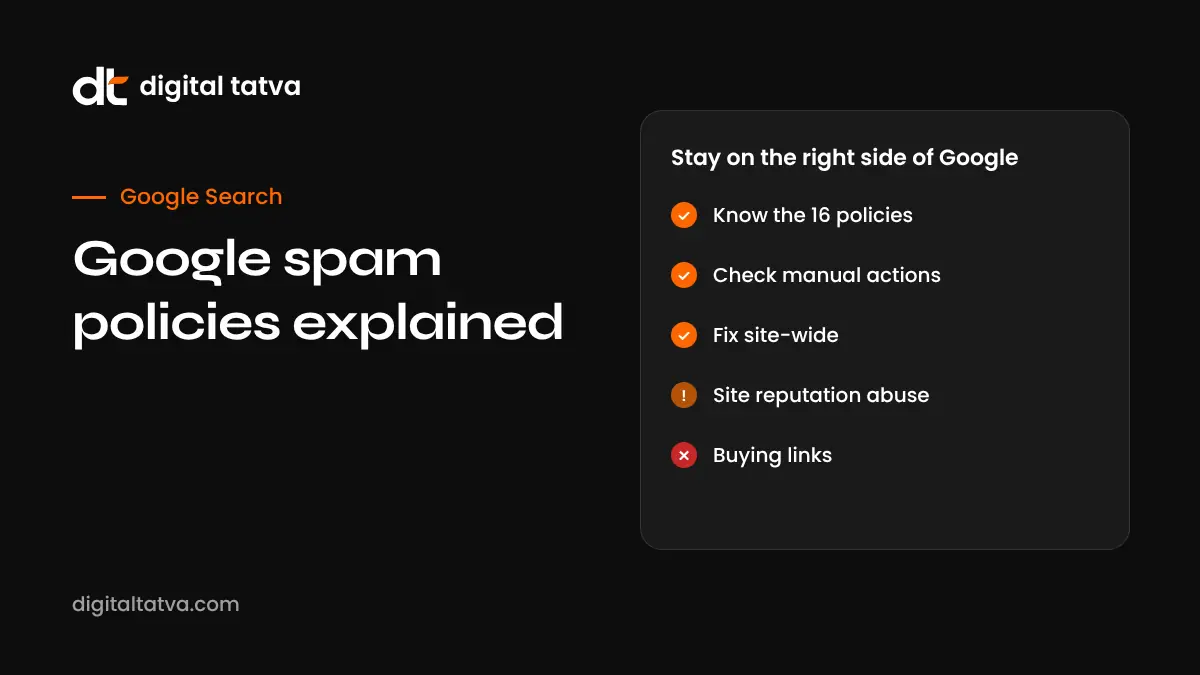
Quick answer: Google’s spam policies list the tactics that can cause pages or whole sites to rank lower or disappear from Google Search. The main ones are cloaking, doorway pages, expired domain abuse, hacked content, hidden text and links, keyword stuffing, link spam, machine-generated traffic, malware, misleading functionality, scaled content abuse, scraped content, sneaky redirects, site reputation abuse, thin affiliate pages and user-generated spam. Violations can be caught automatically by systems like SpamBrain or by human reviewers through manual actions shown in Search Console.
Key takeaways
- Spam policies apply regardless of how content is made, including AI.
- Scaled content abuse and site reputation abuse are the policies most discussed in 2025 and 2026.
- Manual actions appear in Search Console; algorithmic actions do not send a notice.
- Recovery means fixing the issue site-wide, then requesting reconsideration for manual actions.
- In November 2026, Google told some sites that site reputation abuse manual actions no longer affect results in the EEA following a policy change.
Why spam policies matter more in 2026
AI makes it cheap to produce huge amounts of content and links. Google has responded by strengthening enforcement against scaled, low-value content and tactics that exploit strong domains. In November 2026, SEO consultant Lily Ray reported receiving more manual action messages from site owners in recent weeks than ever before. At the same time, Google’s November 2026 core update began rolling out on 10 November. Knowing the rules helps you grow without risking your site.
Google’s spam policies explained
| Policy | What it means | Example |
|---|---|---|
| Cloaking | Showing search engines different content than users | Serving a text page to Googlebot and a casino page to visitors |
| Doorway abuse | Pages made to rank for similar queries that funnel users elsewhere | Hundreds of “plumber in [city]” pages with the same text |
| Expired domain abuse | Buying old domains to host low-value content on their reputation | A former charity domain hosting payday loan content |
| Hacked content | Content placed on a site without permission | Injected spam links from a compromised plugin |
| Hidden text and links | Text or links hidden from users to manipulate ranking | White text on a white background |
| Keyword stuffing | Overloading pages with keywords | Lists of city names repeated in a footer |
| Link spam | Manipulating links to influence ranking | Buying links, excessive link exchanges, private blog networks |
| Machine-generated traffic | Automated queries to Google | Bots scraping rankings at scale |
| Malware and malicious practices | Software or behaviour harmful to users | Downloads that install unwanted software |
| Misleading functionality | Pretending to offer a service that does not work | A fake “free credit score” tool that shows ads |
| Scaled content abuse | Many pages generated mainly to rank, with little value | Thousands of unedited AI articles |
| Scraping | Copying content without adding value | Republishing other sites’ articles |
| Sneaky redirects | Redirecting users somewhere different than search engines see | Mobile users redirected to spam |
| Site reputation abuse | Third-party pages published on a host site to exploit its ranking signals | Coupon or casino sections on a news site with no host involvement |
| Thin affiliation | Affiliate pages that add no original value | Copied product descriptions with affiliate links |
| User-generated spam | Spam added by users | Spam comments and forum profiles |
Google also handles legal removals, personal information removals and policy circumvention. Always read the latest version on Google Search Central, as policies are updated.
The two policies everyone is talking about
Scaled content abuse
This covers producing many pages primarily to manipulate rankings, whether by AI, automation, people or a mix. The test is purpose and value, not the tool. Large libraries of near-identical pages, auto-generated content and stitched-together summaries are common triggers. See does Google penalize AI content.
Site reputation abuse
This covers third-party content published on an established site to take advantage of its ranking signals, often called “parasite SEO”. In November 2026 Google emailed sites with site reputation abuse manual actions explaining that, following a policy change effective 30 August, those actions no longer affect results in the European Economic Area. Nothing changed outside the EEA.
Manual actions vs algorithmic actions
| Manual action | Algorithmic | |
|---|---|---|
| Who decides | A Google reviewer | Automated systems like SpamBrain |
| Notification | Shown in Search Console | No notice |
| Scope | Specific pages or whole site | Varies |
| Recovery | Fix and request reconsideration | Fix; improvements reflected over time |
How to check if your site is affected
- Open Search Console and check Security & Manual actions.
- Review traffic drops against known update dates.
- Look for hacked content or unknown pages using a site: search.
- Audit backlinks for paid or manipulative links.
- Review large sections of similar or thin pages.
- Check third-party content hosted on your domain.
How to recover
- Find the root cause. Manual actions name the policy; algorithmic drops need investigation.
- Fix the issue across the site, not just on a few pages.
- Remove or improve low-value content.
- Clean up links where possible; use disavow only for clear manipulative links you cannot remove.
- Secure the site if hacked.
- Submit a reconsideration request for manual actions, explaining what you fixed.
- Be patient. Recovery often takes weeks to months.
Spam policies and AI search
Google’s AI Overviews and AI Mode build on Google’s index, so content demoted or removed for spam is unlikely to be cited there. Other AI assistants also prefer trustworthy sources. Following spam policies is part of the foundation of AEO.
Illustrative example: a site that slipped into spam
This is an illustrative scenario, not a client story.
A home services company wanted to rank across 300 cities. An agency created 300 location pages with identical text except the city name, plus a blog that published 20 AI-written articles a day, and bought links from a network of blogs. Traffic rose for a few months, then dropped sharply, and a manual action for scaled content abuse appeared in Search Console.
Recovery involved removing or noindexing location pages for cities the business did not serve, rewriting pages for real service areas with local team details, reviews and photos, deleting or consolidating hundreds of thin blog posts, asking link sellers to remove paid links where possible and disavowing the rest, then submitting a reconsideration request explaining every change. Rankings recovered gradually over the following months, though not to the inflated peak.
Spam risk self-check
- Do any pages differ only by a keyword or city name?
- Have we published content in bulk without expert review?
- Have we paid for links or joined link schemes?
- Do we host third-party content we do not control or review?
- Are there pages users never see but Google does?
- Do redirects send mobile or certain users somewhere unexpected?
- Are plugins, themes and logins secure and up to date?
If you answered yes to any of these, review those areas before they become a problem.
How Digital Tatva can help
Digital Tatva audits sites for spam policy risks, from thin AI content and doorway pages to link problems, and helps businesses clean up and rebuild with sustainable SEO and AEO. See our technical SEO and SEO consulting services.
Hit by a traffic drop or manual action? Request an audit and we will help you find the cause.
Frequently asked questions
What are Google’s spam policies?
They are Google’s rules describing tactics that can cause pages or sites to rank lower or be removed, such as cloaking, link spam, scaled content abuse and site reputation abuse.
What is a manual action?
A penalty applied by a Google reviewer when a site violates spam policies. It appears in Search Console with details.
How do I know if I have a manual action?
Check Security & Manual actions in Google Search Console.
What is site reputation abuse?
Publishing third-party content on an established site mainly to exploit its ranking signals, sometimes called parasite SEO.
Did Google change site reputation abuse in the EU?
In November 2026 Google told affected sites that, after a policy change effective 30 August, site reputation abuse manual actions no longer affect results in the EEA. Nothing changed elsewhere.
Is buying backlinks against Google’s rules?
Yes. Buying or selling links to manipulate rankings is link spam.
Are doorway pages always spam?
Pages created mainly to rank for similar queries and funnel users elsewhere are doorways. Genuine, unique location pages with real value are fine.
How long does recovery from a manual action take?
After fixing issues and submitting reconsideration, reviews can take days to weeks, and rankings may take longer to recover.
Can a hacked site get a penalty?
Yes. Hacked content can lead to warnings or manual actions. Secure the site and clean the content quickly.
Does AI content violate spam policies?
Not by itself. It violates policies when used to mass-produce low-value pages mainly to manipulate rankings.
Product details, prices and features are checked at the time of writing and can change. Sources are linked in the text so you can check them yourself.
How does your brand appear in AI answers?
We test the questions your buyers ask across the major AI assistants and search engines, then show you what to fix first.
Get an AI Visibility Audit