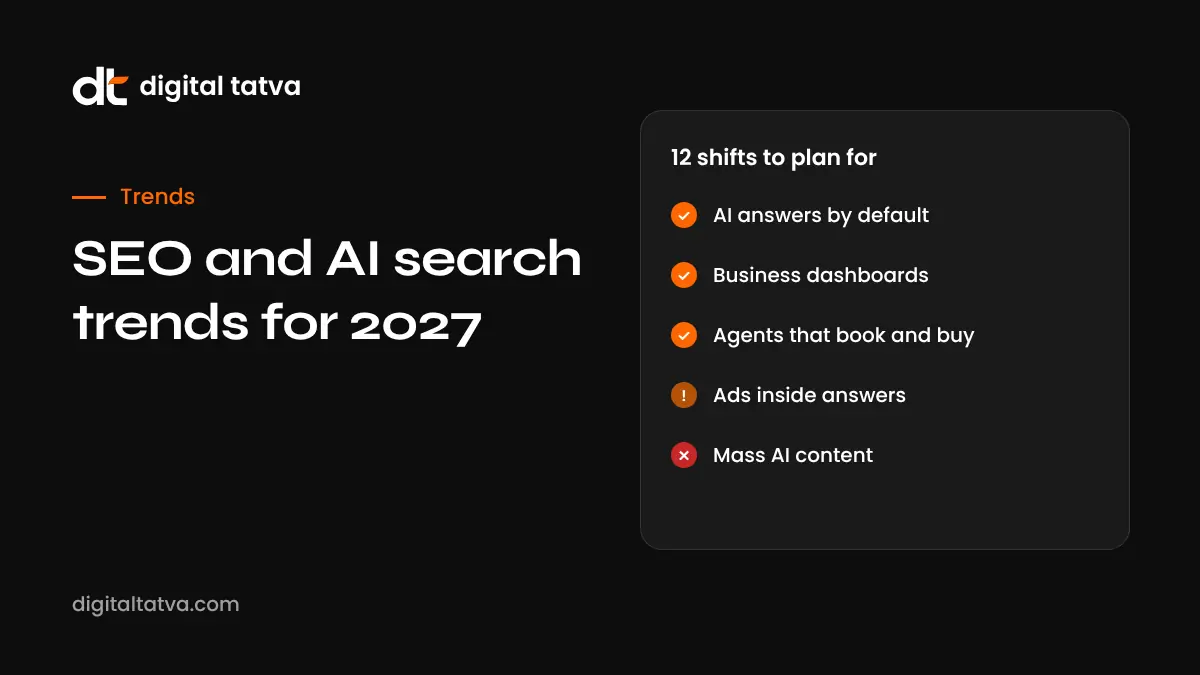
SEO and AI Search Trends for 2027: 12 Shifts to Plan For
Twelve SEO and AI search trends for 2027, each based on real changes from 2026, plus a practical action plan for the year ahead.
On this page
- Key takeaways
- How we chose these trends
- 1. AI answers become the default search experience
- 2. AI platforms give businesses dashboards
- 3. AI agents start completing purchases and bookings
- 4. Agent-friendly websites become a technical priority
- 5. Ads move inside AI answers
- 6. AI describes your brand directly on the search page
- 7. Local search becomes conversational
- 8. Quality enforcement tightens, with visible exceptions
- 9. Publishers get paid for AI use, slowly
- 10. Model competition keeps reshaping answers
- 11. Measurement catches up with AI traffic
- 12. Personalisation makes rankings less universal
- Your 2027 action plan
- What will not change in 2027
- How Digital Tatva can help
- Frequently asked questions
Last updated: 16 November 2026
Quick answer: The biggest SEO and AI search trends heading into 2027 are AI answers becoming the default search experience, AI assistants giving businesses dashboards and profiles, AI agents starting to book and buy for users, ads moving inside AI answers, AI describing brands directly on search pages, and growing pressure on low-quality AI content. The practical response is to measure AI visibility, make your brand facts consistent, write specific expert content, prepare your site for agents and connect AI traffic to revenue. Below are 12 trends, each grounded in what actually happened in late 2026.
Key takeaways
- Every trend below is based on launches and changes from 2026, not guesswork. Where we look ahead, we say so.
- Search is splitting into classic results, AI answers and AI agents, and businesses need a plan for all three.
- AI platforms are starting to give businesses data, through tools like ChatGPT Business Hub and the Search Console AI report.
- Quality enforcement is getting stricter, while large platforms test the limits with scaled AI pages.
- Measurement and brand consistency are the two investments that pay off whatever happens next.
How we chose these trends
Trend lists often recycle predictions with no evidence. This one is different. Each trend is anchored in a specific change from the second half of 2026, mostly from October and November. Our view of what it means for 2027 is clearly labelled as our view. No one can predict exactly how Google, OpenAI or Microsoft will change their products, so treat this as a planning guide, not a forecast.
1. AI answers become the default search experience
What happened: On 12 November 2026 Google made Gemini 4 Hydrogen the default model in AI Mode for all users globally and started using it for the hardest questions in AI Overviews. Google says it links to a broader range of sites. Yahoo rebuilt its search around Yahoo Scout with Pivot Search on 10 November. Bing has been replacing Copilot Search with Bing AI Mode.
What it means for 2027: In our view, more queries will be answered by AI before users see a list of links. Visibility will increasingly mean being cited or named inside answers. See Gemini 4 in Google Search and Yahoo Scout and Pivot Search.
2. AI platforms give businesses dashboards
What happened: OpenAI launched Businesses in ChatGPT in beta on 10 November 2026. Eligible businesses can claim a profile at the Business Hub and see mentions, website clicks and discovery topics. Google already has a generative AI performance report in Search Console. Microsoft Clarity added agent analytics.
What it means for 2027: AI visibility will become more measurable. Claiming profiles and reading these reports will be routine marketing tasks, much like Google Business Profile and Search Console are today. See ChatGPT Business Hub and the Search Console AI report.
3. AI agents start completing purchases and bookings
What happened: OpenAI launched ChatGPT Wallet on 13 November 2026, letting agents pay with network tokens after biometric approval. Google AI Mode added booking and quote links for US home services on 4 November. Microsoft extended Brand Agents to local service bookings.
What it means for 2027: Expect more agent-driven transactions, but adoption will be gradual. OpenAI’s earlier in-chat checkout was shut down in March 2026 after weak results, and surveys show many shoppers are cautious. Businesses should prepare without over-investing. See ChatGPT Wallet and AI Mode home services booking.
4. Agent-friendly websites become a technical priority
What happened: OpenAI asked merchants to recognise signed agent requests using Web Bot Auth. One audit found bot protection blocking an AI shopping agent at 14.5% of 200 retailers. Microsoft Clarity added simulations to test whether agents can complete tasks.
What it means for 2027: Technical SEO will expand to include agent access: verifying signed agents, simplifying forms and checkout, and measuring agent sessions. See Web Bot Auth and Clarity agent analytics.
5. Ads move inside AI answers
What happened: Google AI Mode can now show up to four ads in a single answer, and multi-turn follow-up ads are live. ChatGPT Ads added target cost-per-action and cost-per-click bidding in November 2026. Bing ads appear at the top of AI Mode results.
What it means for 2027: Paid and organic AI visibility will sit side by side, much as they do in classic search. Budgets will need to cover both. See ads in AI Mode and AI Overviews and ChatGPT ads.
6. AI describes your brand directly on the search page
What happened: From late October 2026, Google began showing AI Overviews in the right-hand column of many US desktop brand searches, where knowledge panels used to be. One reported example showed conflicting founding years.
What it means for 2027: Brand searches, once fully controlled by your own site and knowledge panel, will increasingly show AI-written summaries. Entity consistency becomes essential brand management. See AI Overviews on brand searches.
7. Local search becomes conversational
What happened: AI Mode added home service bookings. Google tested a mobile AI Overview local pack without call or directions buttons. Some Business Profiles showed automatic “Book online” buttons, some broken.
What it means for 2027: Local businesses will compete inside AI conversations, not just the map pack. Complete profiles, consistent listings, reviews and booking integrations will matter more. See our local AEO services.
8. Quality enforcement tightens, with visible exceptions
What happened: Google started the November 2026 core update on 10 November, its third core update of the year. Lily Ray reported more manual action messages than ever. Google rewrote its “Crawled, currently not indexed” help text, and John Mueller said the status can reflect quality. At the same time, Meta’s Facebook Answers passed 6 million indexed AI-generated pages.
What it means for 2027: Small and mid-sized sites should expect strict quality standards. Mass AI content is risky, whatever large platforms appear to get away with. See the November core update, crawled not indexed and Facebook Answers.
9. Publishers get paid for AI use, slowly
What happened: The Internet Licensing Collective launched on 12 November 2026 with more than 3,000 members and Yahoo Scout as its first commercial licensee. It uses the RSL standard and pays publishers based on how their content is used.
What it means for 2027: Collective licensing will give publishers a new revenue option and a new decision about how their content is used by AI. Adoption by the largest AI companies is the key unknown.
10. Model competition keeps reshaping answers
What happened: Gemini 4 Carbon became generally available on 10 November 2026 and topped MathArena, while GPT-6.1 Sol offered similar quality at much lower cost. New models from OpenAI, Google, Anthropic and others arrived almost monthly.
What it means for 2027: Every model change can shift how assistants describe and cite brands. Tracking a fixed prompt set over time is the only reliable way to see the effect. See Gemini 4 Carbon vs GPT-6.1 Sol.
11. Measurement catches up with AI traffic
What happened: Nearly all ChatGPT referral visits now carry a utm_source=chatgpt.com tag, according to one monitoring firm, while Gemini visits often lack tags. Google published a help page on identifying Google Search traffic in analytics and logs. Search Console’s AI report had a logging bug from 9 to 11 November.
What it means for 2027: AI traffic will be easier to measure but still imperfect. Combine analytics, Search Console, platform dashboards and prompt tracking, and annotate known data issues. See tracking AI traffic in GA4.
12. Personalisation makes rankings less universal
What happened: Google prompted AI Mode users to opt in to Personal Intelligence. Yahoo Scout launched Scout Memories. ChatGPT continues to expand memory features.
What it means for 2027: Two people asking the same question may get different answers. “Rank number one” becomes less meaningful; share of voice across many prompts and users becomes the better measure. See AI memory explained.
Your 2027 action plan
| Priority | Action | Trends it addresses |
|---|---|---|
| 1 | Set up AI visibility tracking with a fixed prompt set | 1, 10, 11, 12 |
| 2 | Claim ChatGPT Business Hub and keep Google Business Profile complete | 2, 7 |
| 3 | Align brand facts across your site, schema and profiles | 6, 1 |
| 4 | Audit and improve content quality; consolidate weak pages | 8 |
| 5 | Write specific, expert, answer-first content | 1, 8, 10 |
| 6 | Check bot protection and agent journeys | 3, 4 |
| 7 | Test AI ad formats where relevant | 5 |
| 8 | Connect AI traffic to leads and revenue | 11 |
What will not change in 2027
- Search engines and AI systems still need to crawl and understand your site.
- Helpful, accurate, specific content still wins over generic content.
- Trust is still built through reputation, reviews and independent mentions.
- No one can guarantee placement in AI answers.
For the bigger picture, see our AEO trends 2026 review and AEO strategy guide.
How Digital Tatva can help
Digital Tatva helps businesses plan for AI search: tracking how assistants describe you, fixing technical, entity and content gaps, preparing for agents and connecting AI visibility to real enquiries. We never promise placement in AI answers. See our AEO services.
Planning for 2027? Request an AEO audit to see where you stand today, or try the free AI visibility checker.
Related reading: does Google penalize AI content and Google spam policies explained.
Frequently asked questions
What are the biggest SEO trends for 2027?
AI answers becoming the default search experience, AI platform dashboards for businesses, AI agents booking and buying, ads inside AI answers, AI-written brand summaries, conversational local search and stricter quality enforcement.
Is SEO still relevant in 2027?
Yes. AI search features rely on crawling, indexing and quality signals, so SEO remains the foundation. It now extends into AI visibility and agent readiness.
What is the most important thing to do for AI search in 2027?
Start measuring how AI assistants describe and recommend your brand with a fixed set of prompts, then fix the gaps you find.
Will AI agents replace websites?
Unlikely in 2027. Agents still use websites to research and complete tasks. Sites that agents can navigate easily will have an advantage.
Should I worry about AI ads in ChatGPT and AI Mode?
Not worry, but plan. Ads inside AI answers are growing, so test them where your buyers are and keep investing in organic visibility.
How do I protect my brand in AI summaries?
Keep facts consistent across your site, schema and profiles, publish a company facts page, correct outdated third-party information and monitor AI summaries regularly.
Is AI-generated content risky in 2027?
Mass-produced, unedited AI content is risky. AI-assisted content that is reviewed, improved and backed by real expertise is fine.
How do I measure AI search traffic?
Combine GA4 referral data, Search Console’s AI report, platform dashboards such as ChatGPT Business Hub, Clarity agent analytics and regular prompt tracking.
Will rankings matter in 2027?
Rankings still matter for classic results, but personalised AI answers make share of voice across many prompts a more useful measure.
Where should a small business start?
Claim and complete your profiles, align your brand facts, improve your most important pages and run a simple AI visibility check every month.
Are these trends based on predictions?
Each trend is based on a real change from 2026, mostly October and November. Our view of what it means for 2027 is clearly labelled.
Which AI platforms should businesses track in 2027?
Usually Google AI Mode and AI Overviews, ChatGPT, Gemini, Perplexity and Copilot, plus others such as Yahoo Scout where your audience uses them.
Product details, prices and features are checked at the time of writing and can change. Sources are linked in the text so you can check them yourself.
How does your brand appear in AI answers?
We test the questions your buyers ask across the major AI assistants and search engines, then show you what to fix first.
Get an AI Visibility Audit