ChatGPT Wallet Explained: How AI Agents Pay and How Businesses Should Prepare
What ChatGPT Wallet is, how agent payments work, who can use it today and what merchants should do so legitimate AI agents are not blocked.
On this page
- Key takeaways
- What is ChatGPT Wallet?
- How ChatGPT Wallet works, step by step
- Who can use ChatGPT Wallet right now?
- Why this matters: from recommendations to purchases
- The merchant problem: bots blocking legitimate agents
- What OpenAI asks businesses to do
- A practical readiness checklist for online stores
- Is ChatGPT Wallet safe for users?
- What comes next
- What Indian businesses should do now
- How Digital Tatva can help
- Frequently asked questions
Last updated: 16 November 2026
Quick answer: ChatGPT Wallet is OpenAI’s new payment feature, announced on 13 November 2026, that lets ChatGPT’s dots agents buy things on websites for you without ever seeing your real card number. You approve each purchase with Face ID or a fingerprint, the card network issues a payment token, and the merchant is charged through that token. It was built with American Express, Mastercard and Visa and is currently limited to US ChatGPT Pro subscribers aged 18 and over. For businesses, the immediate task is to make sure your site, firewall and fraud tools do not block legitimate agent purchases.
Key takeaways
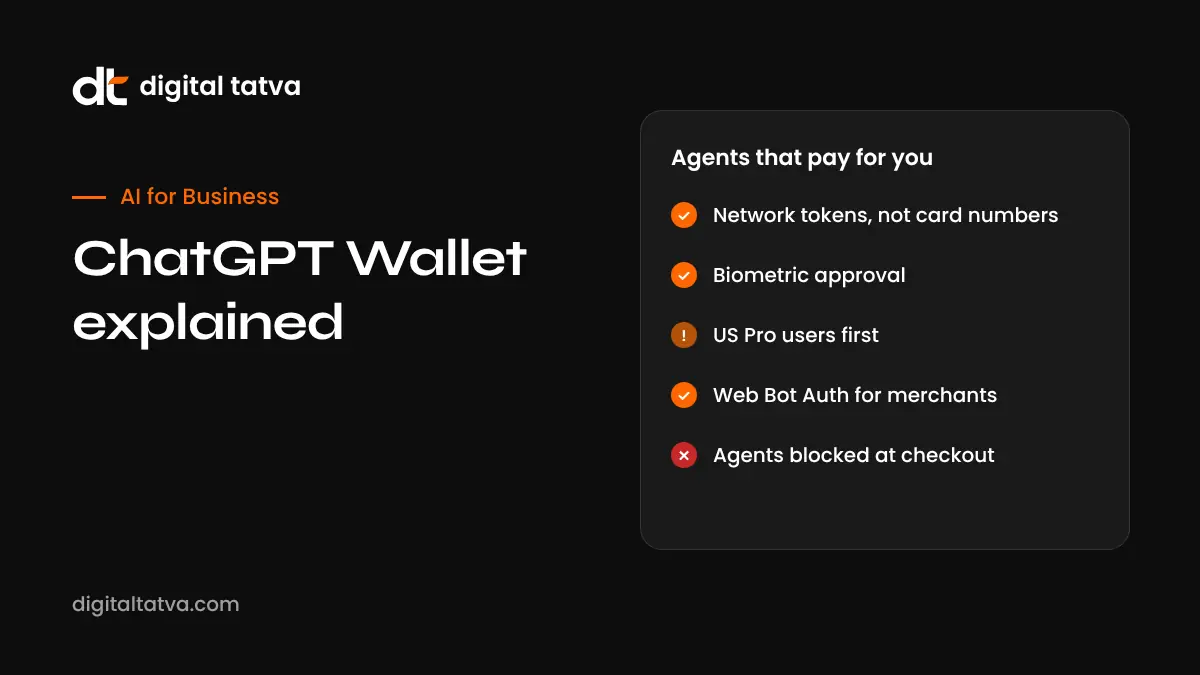
- ChatGPT Wallet lets AI agents pay on your behalf using network tokens instead of your real card details.
- Every purchase still needs your approval with a biometric check. Pre-approved spending limits are planned but not available yet.
- Availability is narrow for now: US ChatGPT Pro subscribers, eligible US-issued cards, purchases made through dots.
- OpenAI openly says some websites may unintentionally block agent purchases, and asks businesses to recognise signed agent requests using Web Bot Auth.
- For merchants, this is a readiness exercise today and a potential sales channel tomorrow. Nobody can promise it will drive meaningful revenue yet.
What is ChatGPT Wallet?
ChatGPT Wallet is a payment layer inside ChatGPT designed for agent purchases. Instead of you typing card details into a checkout page, a ChatGPT agent prepares the purchase, shows you the items, total and the card it plans to use, and asks you to approve it. Once you approve with a security check such as Face ID or a fingerprint, the card network issues a payment token. That token carries its own card number, security code and expiry date that stand in for your real card. The merchant receives the token, not your actual card number.
OpenAI announced the feature on 13 November 2026 and says it was built together with American Express, Mastercard and Visa. According to OpenAI’s description reported by several outlets, existing card rewards and dispute protections still apply for eligible disputes. You remain the customer of the business you buy from, so pricing, delivery, returns and customer service stay between you and that business.
If you are new to the idea of AI agents acting for you, start with our explainers on what AI agents are and agentic search.
How ChatGPT Wallet works, step by step
- Add a card once. You add an eligible US-issued card to ChatGPT Wallet.
- Ask a dot to shop. A dot, OpenAI’s always-on personal agent, searches, compares and prepares the purchase on a merchant’s website.
- Review. ChatGPT shows you the items, the total and the selected card.
- Approve with a biometric check. You confirm with Face ID, a fingerprint or a similar security check.
- Token issued. The card network creates a payment token for the transaction.
- Merchant charged. The merchant processes the token and your card is charged. The merchant never receives your real card number.
- After the sale. Delivery, returns and support are handled directly between you and the business.
Dots launched on 29 September 2026. We cover them in detail in ChatGPT dots explained.
Who can use ChatGPT Wallet right now?
| Requirement | Current status |
|---|---|
| Country | United States only |
| Plan | ChatGPT Pro subscribers |
| Age | 18 and older |
| Cards | Eligible US-issued cards |
| How purchases happen | Through dots |
| Approval | Biometric check on every purchase |
| Wider rollout | No date announced |
| Fees | None announced for users or merchants |
If you are in India or elsewhere, you cannot use it yet. That does not make it irrelevant. Many Indian and international businesses sell to US customers, and features like this tend to expand once the first version is stable.
Why this matters: from recommendations to purchases
For the past two years, the main question for businesses was whether ChatGPT and other AI assistants recommend them. ChatGPT Wallet adds a second question: can an AI agent actually complete a purchase on your site?
Those are different problems. Being recommended depends on content, reputation and entity clarity, which we cover in ChatGPT shopping optimization. Being purchasable by an agent depends on whether your site lets automated, but legitimate, visitors through, whether your checkout is simple enough for an agent to follow, and whether your fraud systems approve the payment.
It is also worth keeping perspective. OpenAI’s earlier Instant Checkout feature launched in September 2025 and was shut down in March 2026. Walmart reported that in-chat checkout converted about three times worse than sending shoppers to its own website. A Salesforce survey found that three in four holiday shoppers were not interested in having an AI agent buy for them. Agent purchasing is real and growing, but it is early, and it will not replace normal shopping any time soon.
The merchant problem: bots blocking legitimate agents
The most practical part of the announcement is OpenAI’s admission that “some sites may unintentionally block purchases through ChatGPT Wallet or other agentic payment products.” Here is why that happens.
- Bot protection. CDNs and firewalls are built to stop automated traffic. An agent browsing and checking out looks like a bot because it is one, even when a real customer approved the purchase.
- Fraud scoring. Payment risk systems may flag unusual behaviour, such as fast navigation or new device fingerprints, and decline or cancel the order.
- Complex checkouts. Pop-ups, forced account creation, CAPTCHAs and multi-step flows can stop an agent.
This is not hypothetical. In a separate audit reported alongside the launch, bot protection refused one AI shopping agent at 29 of 200 UK and US retailers, a rate of 14.5%. Some large companies are also choosing to restrict agents deliberately, as United Airlines recently did with unauthorised AI booking agents.
What OpenAI asks businesses to do
OpenAI’s merchant guidance focuses on a few clear steps:
- Do not block agents by accident. Check that general security settings are not stopping ChatGPT agents.
- Recognise signed requests. Configure your CDN or firewall to recognise requests signed with Web Bot Auth, a standard that lets agents prove who they are. Our guide to Web Bot Auth explains it.
- Tune fraud tools. Make sure payment and risk systems can recognise legitimate agent purchases. OpenAI says it is working with fraud vendors Forter, Riskified, Sardine and Signifyd, and with payment providers Adyen, Checkout.com and Stripe.
- Go deeper if you want. Browser-based agent access needs no plugin or product feed, but businesses can claim listings, upload product feeds and add plugins or WebMCP tools for deeper integration.
Claiming your listing ties in with the new ChatGPT Business Hub, where eligible businesses can see mentions and clicks from ChatGPT.
A practical readiness checklist for online stores
| Area | What to check | Who owns it |
|---|---|---|
| Bot protection | Signed agent traffic is verified, not blocked; review CDN and WAF rules | Developer or hosting provider |
| Checkout | Guest checkout available, no unnecessary pop-ups, clear form labels | Ecommerce manager |
| Fraud rules | Agent purchases not auto-declined; talk to your fraud vendor | Finance or payments lead |
| Product data | Clear names, prices, availability and structured data | Catalogue team |
| Policies | Returns, delivery and contact pages easy to find | Operations |
| Measurement | Agent visits and orders identifiable in analytics | Analytics owner |
For a wider view of agent readiness, see our guide to building an agent-ready website and Google’s equivalent approach in agentic checkout. Microsoft Clarity now offers agent analytics and task simulations, which we cover in Clarity agent analytics.
Is ChatGPT Wallet safe for users?
The design addresses the most obvious risk: the agent and the merchant never see your real card number. Each purchase needs a biometric approval, so an agent cannot spend without you. Card network dispute protections still apply for eligible disputes.
Several questions remain open based on public information. Reports note OpenAI has not said whether each token is single-use, which network tokenisation programme is used, how risk systems will identify agent purchases, or who bears the cost if an agent buys the wrong item. Sensible users will start with low-value purchases, read every approval screen carefully and keep an eye on statements. Our guide to AI agent security covers broader precautions.
What comes next
OpenAI has described a future where users set parameters such as spending limits, categories and time periods, and pre-approve some purchases with added safeguards. No date has been given. At the same time, the wider ecosystem is building protocols that tell agents what a business allows. One example is Sierra’s Poppy protocol, which Shopify has enabled and more than 100 companies participate in, according to reports. Expect more standards, more partnerships and more debate about who owns the customer relationship.
What Indian businesses should do now
- If you sell to US customers online, run the readiness checklist above now. It costs little and avoids lost orders later.
- If you only sell in India, watch for expansion, but focus first on being recommended by AI assistants, which already affects Indian buyers.
- Keep your product data, pricing and policies clean, because they help with both recommendations and agent purchases.
- Track AI referral traffic so you can see the shift as it happens. See how to track AI traffic in GA4.
How Digital Tatva can help
Digital Tatva helps businesses get recommended by AI assistants and prepares their sites for agent visits and purchases. We check how ChatGPT, Gemini, Perplexity and Google AI describe your products, fix technical blockers for legitimate agents, clean up product data and structured data, and report on AI referral traffic. We never promise placement inside AI answers, because nobody controls them. See our AEO services for ecommerce.
Is your store ready for AI shoppers? Request an AEO audit or start with the free AI visibility checker.
Related reading: best personal AI agents.
Frequently asked questions
What is ChatGPT Wallet?
ChatGPT Wallet is an OpenAI feature announced on 13 November 2026 that lets ChatGPT’s dots agents make purchases for you using network payment tokens instead of your real card details, with biometric approval for each purchase.
Is ChatGPT Wallet available in India?
No. At launch it is limited to ChatGPT Pro subscribers in the United States who are 18 or older and have eligible US-issued cards. No date has been announced for other countries.
Does the merchant see my card number?
No. The merchant receives a network payment token that stands in for your card. Your real card number is not shared with the agent or the merchant.
Can a ChatGPT agent spend money without my approval?
Not at launch. Every purchase needs your approval with a security check such as Face ID or a fingerprint. Pre-approved spending limits are planned but not yet available.
Which card networks support ChatGPT Wallet?
OpenAI built it with American Express, Mastercard and Visa.
Do I still get card rewards and dispute protection?
OpenAI says existing card rewards and dispute protections still apply for eligible disputes.
Why might an agent purchase fail on a website?
Bot protection, firewall rules, CAPTCHAs, complex checkouts or fraud systems can block or decline agent purchases. OpenAI asks merchants to recognise signed agent requests using Web Bot Auth.
What should merchants do to prepare?
Verify rather than block signed agent traffic, simplify checkout, talk to fraud and payment providers about agent purchases, keep product data accurate and track agent visits in analytics.
Is ChatGPT Wallet the same as Instant Checkout?
No. Instant Checkout was an earlier in-chat checkout feature launched in September 2025 and shut down in March 2026. ChatGPT Wallet lets agents pay on merchants’ own websites using tokens.
Will ChatGPT Wallet increase my sales?
It is too early to say. Agent purchasing is new, and surveys suggest many shoppers are not yet comfortable with it. Preparing now mainly prevents lost orders as usage grows.
What are ChatGPT dots?
Dots are OpenAI’s always-on personal agents, launched on 29 September 2026, that learn your preferences and handle ongoing tasks. ChatGPT Wallet purchases happen through dots.
Do merchants need a plugin to accept ChatGPT Wallet payments?
No. OpenAI says browser-based agent access needs no plugin or product feed, though businesses can add feeds, plugins or WebMCP tools for deeper integration.
Product details, prices and features are checked at the time of writing and can change. Sources are linked in the text so you can check them yourself.
How does your brand appear in AI answers?
We test the questions your buyers ask across the major AI assistants and search engines, then show you what to fix first.
Get an AI Visibility Audit