Gemini 4 in Google Search: What Hydrogen Changes for SEO and AI Mode
Google made Gemini 4 Hydrogen the default in AI Mode. What changed, what is still unclear and how to adjust your SEO and AEO.
On this page
- Key takeaways
- What Google announced
- Hydrogen, Carbon and Argon: the Gemini 4 family in Search
- What is still unclear
- Why the timing complicates your data
- What a wider query fan-out means for SEO and AEO
- What to do now: a practical plan
- What does not change
- What it means for users
- Other Google AI Search changes this month
- Illustrative example: mapping sub-questions for a wider fan-out
- How Digital Tatva can help
- Frequently asked questions
Last updated: 16 November 2026
Quick answer: On 12 November 2026 Google made Gemini 4 Hydrogen the default model in AI Mode for all users worldwide and started using it for the hardest questions in AI Overviews. Google says Hydrogen handles multi-part and very specific questions better, runs a wider query fan-out, links to a broader range of sites and shows more tables and visuals. Paying Ultra subscribers also get Gemini 4 Carbon in AI Mode for deep-thinking tasks. For SEO and AEO, the change means citation patterns may shift, so log the date, compare before and after, and keep building specific, well-structured, trustworthy content.
Key takeaways
- Gemini 4 Hydrogen is now the default model in Google AI Mode globally, in all AI Mode languages.
- Google’s VP of Product for Search, Robby Stein, said Hydrogen is also being used for the “hardest questions” in AI Overviews.
- Google says the model improves query fan-out and connects users to a broader range of links, though it gave no numbers.
- The switch happened two days into the November 2026 core update, so separate the two when you read your data.
- Gemini 4 Carbon, the deep-thinking model, is available in AI Mode to Google AI Ultra subscribers with daily limits.
What Google announced
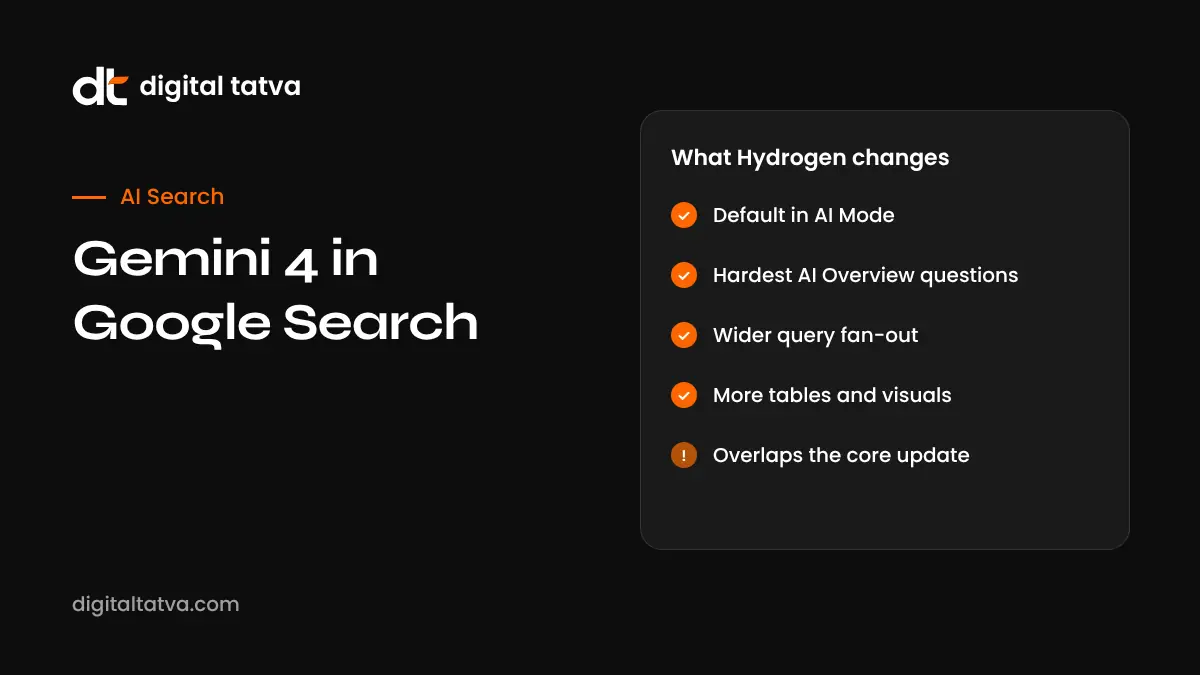
Google described the Gemini 4 Hydrogen rollout as its biggest model upgrade to Search. From 12 November 2026, Hydrogen became the default model behind AI Mode for everyone, everywhere AI Mode is available. In a thread on X, Robby Stein, VP of Product for Google Search, added that Hydrogen is “being used for your hardest questions in AI Overviews.”
According to Google’s posts as reported by Search Engine Journal, Hydrogen:
- Handles multi-part questions, typos and highly specific queries better.
- Follows instructions more thoroughly than earlier versions.
- Improves query fan-out, running more sub-queries at once, and connects people to “a broader range of helpful links than before”.
- Adds more visuals, structured responses, comparison tables and customised tools.
- Gives more nuanced answers across all AI Mode languages.
- Is designed for speed and efficiency.
New to AI Mode itself? Start with how to use Google AI Mode and AI Mode vs AI Overviews.
Hydrogen, Carbon and Argon: the Gemini 4 family in Search
| Model | Role in Search | Who gets it | Date |
|---|---|---|---|
| Gemini 4 Hydrogen | Default AI Mode model; hardest AI Overview questions | All users globally | 12 November 2026 |
| Gemini 4 Carbon | Long-running, deep-thinking tasks in AI Mode | Google AI Ultra subscribers 18+, daily limits | Rolling out from 10 November 2026 |
| Gemini 4 Argon | Deep-thinking option | Google AI Pro and Ultra subscribers | Option since 13 October 2026 |
Google’s AI Mode help page describes Hydrogen as suited to fast, everyday assistance. Before this change, Gemini 3.5 Flash became the global AI Mode default at Google I/O in May, and Gemini 3 became the AI Overviews default in January. Google did not say exactly what Hydrogen replaced. For more on the family, see our posts on Gemini 4 Argon and Gemini 4 Carbon vs GPT-6.1 Sol.
What is still unclear
Good analysis separates what Google said from what it did not say. Based on public reporting:
- Google has not defined which AI Overview questions count as “hardest”, or which model handles the rest.
- Google’s Search post about the rollout does not mention AI Overviews; that detail came from Stein’s thread.
- Google gave no figures for the claimed increase in links or sites shown.
- Google has not published how citation selection changed, if at all.
Treat claims about exact citation changes with caution until real data from many sites is available.
Why the timing complicates your data
The Hydrogen switch happened on 12 November, two days after the November 2026 core update started rolling out on 10 November. The core update can take up to two weeks. That means any change you see in traffic, rankings or AI citations in mid-November could come from either event, or both.
There was also a logging bug in the Search Console generative AI report that under-reported impressions from 9 to 11 November, which Google confirmed. If you use that report, mark those dates. Our guide to the Search Console AI performance report explains how it works.
How to separate the effects
- Annotate 10 November (core update start), 12 November (Hydrogen default) and 9 to 11 November (Search Console bug) in your analytics.
- Compare classic organic rankings and clicks separately from AI Mode and AI Overview citations.
- Look at query types: a broad drop across many queries points to the core update; changes concentrated in complex, multi-part questions may relate to AI Mode.
- Wait until the core update finishes before drawing firm conclusions.
- Re-run your tracked prompts in AI Mode and compare cited sources with your earlier baseline.
What a wider query fan-out means for SEO and AEO
Query fan-out is the process where Google’s AI breaks your question into many smaller searches, gathers results and writes one answer. We explain it in depth in query fan-out explained. If Hydrogen runs a wider fan-out, as Google says, three things follow.
1. Specific sub-topic pages matter more
A broad page that only covers the headline question may not match the narrower sub-queries. Pages that answer specific angles clearly, such as cost, suitability, comparisons, steps and limitations, have more chances to be retrieved.
2. More sites may get a chance to be cited
Google says users will see a broader range of links. If true, smaller sites with genuinely useful, specific content may find more opportunities. That is good news for specialists, but there are no published figures yet.
3. Structure helps the model use your content
Hydrogen adds more tables and structured responses. Content that already presents facts in tables, lists and clearly labelled sections is easier to draw from. See content chunking for AI.
What to do now: a practical plan
| Action | Why it helps | Effort |
|---|---|---|
| Annotate key November dates | Separates core update, model change and reporting bug | Low |
| Re-run your AI Mode prompt set | Shows whether your citations changed after 12 November | Medium |
| Map sub-questions for your top topics | Matches a wider fan-out | Medium |
| Add comparison tables and clear facts | Fits Hydrogen’s structured answers | Medium |
| Strengthen entity and brand signals | Helps AI describe you accurately | Medium |
| Keep content fresh and specific | Supports retrieval for specific queries | Ongoing |
Our full guides on Google AI Mode SEO and AI Overviews optimization go deeper.
What does not change
Model upgrades are dramatic in headlines and often less dramatic in practice. The fundamentals stay the same:
- Google’s AI features still rely on its search index, so crawlability and indexation still matter.
- Helpful, accurate and specific content is still the best long-term bet.
- Consistent brand information across the web still helps AI describe you correctly.
- Reviews, mentions and independent evidence still build trust.
- No one can guarantee a citation in AI Mode or AI Overviews.
What it means for users
For everyday searchers, Hydrogen should mean better handling of messy, detailed questions, more visual answers and more links to explore. Paying subscribers on Ultra get Carbon for deeper work, with daily limits. As always, AI answers can be wrong, so check important facts against the sources linked.
Other Google AI Search changes this month
Hydrogen arrived alongside several other changes worth knowing about:
- AI Overviews started appearing in the right-hand column for many brand searches on desktop. See AI Overviews on brand searches.
- AI Mode added booking and quote links for US home services. See AI Mode home services booking.
- AI Mode can show up to four ads in one answer, and follow-up query ads are live. See ads in AI Mode and AI Overviews.
- Google updated its help text for “Crawled, currently not indexed”. See our fix guide.
Illustrative example: mapping sub-questions for a wider fan-out
Suppose you run a solar installation company and your main page targets “rooftop solar for homes in Ahmedabad”. With a wider query fan-out, AI Mode may break a user’s question into sub-searches such as cost per kilowatt, government subsidy rules, payback period, net metering, maintenance, roof suitability and installer reviews. If your page only covers the headline topic, it may miss most of those sub-searches.
A stronger approach is a clear main page that answers the core question in its opening lines, supported by sections or linked pages for each sub-question: a cost explainer with a table, a subsidy guide, a maintenance checklist and an FAQ. Each section should make sense if quoted on its own. This is the same structure that already works for AI Overviews, and Hydrogen’s emphasis on tables and structured answers makes it more relevant.
How Digital Tatva can help
Digital Tatva tracks how Google AI Mode, AI Overviews, ChatGPT, Gemini and Perplexity describe and cite your brand, using a fixed set of prompts re-tested every month. When a model change like Hydrogen arrives, we compare before and after, separate it from core update effects and adjust your content plan. We never promise placement, because no one controls AI answers. See our AEO services.
Did Gemini 4 change how Google cites you? Request an AEO audit or try the free AI visibility checker.
Related reading: Google Discover in 2026.
Frequently asked questions
What is Gemini 4 Hydrogen?
Gemini 4 Hydrogen is a Google model in the Gemini 4 family designed for speed and efficiency. Since 12 November 2026 it is the default model in Google AI Mode for all users globally.
Does Gemini 4 Hydrogen power AI Overviews?
Google’s Robby Stein said Hydrogen is being used for the hardest questions in AI Overviews. Google has not defined which questions count as hardest.
What is the difference between Hydrogen and Carbon?
Hydrogen is the fast default model for everyone in AI Mode. Carbon is a deep-thinking model for longer, harder tasks, available in AI Mode to Google AI Ultra subscribers with daily limits.
Will Gemini 4 change which sites get cited?
Possibly. Google says Hydrogen improves query fan-out and links to a broader range of sites, but it published no figures. Track your own citations before and after 12 November.
Is the Gemini 4 change the same as the November core update?
No. The November 2026 core update began on 10 November and the Hydrogen switch happened on 12 November. They are separate changes that overlap in time.
What should SEOs do after the Gemini 4 rollout?
Annotate the key dates, re-run AI Mode prompts, cover specific sub-questions, add clear tables and facts, and strengthen brand consistency.
Is Gemini 4 Hydrogen available in India?
Google said Hydrogen is the default in AI Mode for all users globally, wherever AI Mode is available, which includes India.
Does query fan-out favour long content?
Not necessarily long, but specific and well-structured. Pages that clearly answer narrower sub-questions are more likely to match fan-out searches.
Can I choose which model AI Mode uses?
Hydrogen is the default for everyone. Eligible Pro and Ultra subscribers may see options for deeper-thinking models such as Argon or Carbon, depending on their plan.
Can an agency guarantee citations in AI Mode?
No. No one controls which sources Google’s AI cites. A good agency improves the signals that make citations more likely and reports honestly on progress.
Does Gemini 4 affect Google rankings?
Gemini 4 Hydrogen powers AI Mode and some AI Overviews. Classic rankings are affected by core updates and ranking systems, such as the November 2026 core update.
Will AI Mode show more links now?
Google says Hydrogen connects users to a broader range of helpful links, but it has not published figures.
Product details, prices and features are checked at the time of writing and can change. Sources are linked in the text so you can check them yourself.
How does your brand appear in AI answers?
We test the questions your buyers ask across the major AI assistants and search engines, then show you what to fix first.
Get an AI Visibility Audit