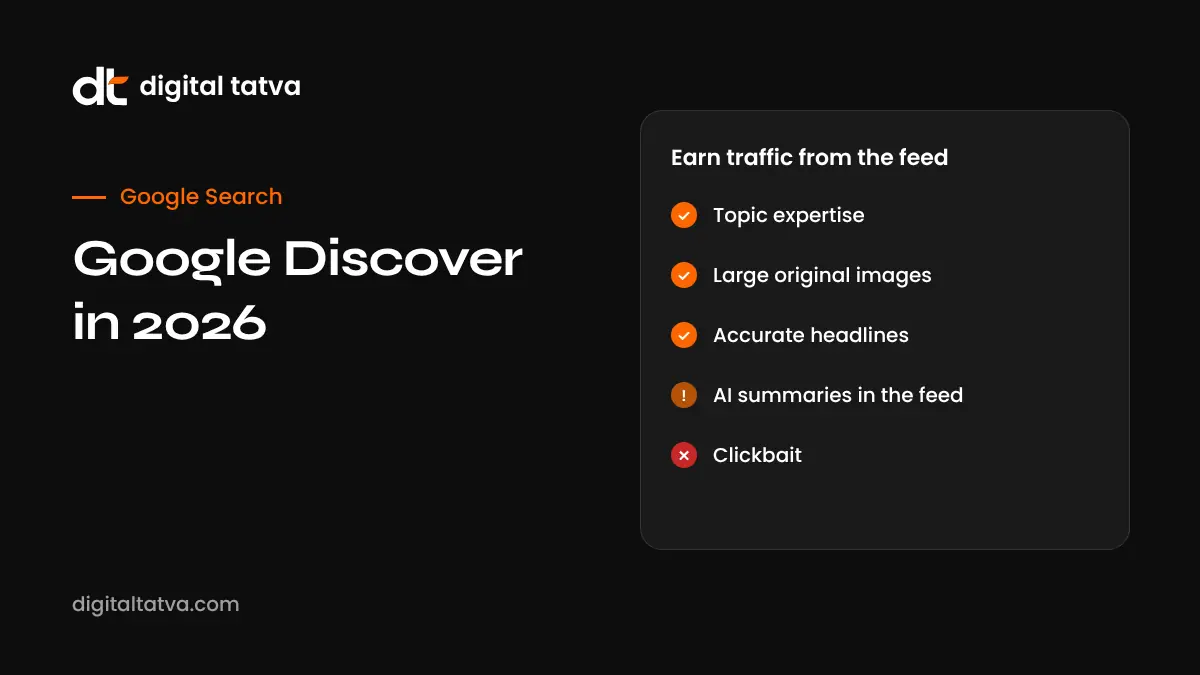
Google Discover in 2026: How to Get Traffic From the Feed
What changed in Google Discover in 2026 and how publishers and brands can earn Discover traffic today.
On this page
- Key takeaways
- What is Google Discover?
- What changed in Discover in 2026
- How to get content into Discover
- Discover and AI summaries
- How to track Discover traffic
- Discover is not right for every business
- Common mistakes
- Illustrative example: a regional lifestyle publisher
- Discover readiness checklist
- How Digital Tatva can help
- Frequently asked questions
Last updated: 17 November 2026
Quick answer: Google Discover is the personalised content feed in the Google app and on mobile Chrome. To get Discover traffic in 2026, publish timely, original content on topics where you show real expertise, use large high-quality images, write accurate headlines rather than clickbait, keep your site technically healthy, and build a recognisable brand people choose to follow. 2026 brought big changes: the first named Discover core update in February, AI summaries and AI-generated headlines in the feed, Search profiles for publishers and creators, and typed feed controls. Many publishers saw Discover traffic decline, so treat it as a bonus channel, not a foundation.
Key takeaways
- Discover shows content based on users’ interests, not search queries.
- Google’s first named Discover core update (February 2026) targeted local relevance, clickbait and topic-level expertise.
- AI summaries, AI-generated headlines, more YouTube and X content and reader controls are changing the feed.
- Search profiles, which launched in the US and expanded to India and Canada in October 2026, let publishers and creators claim an identity linked to Discover.
- Discover traffic is volatile; several studies reported declines for publishers in 2025 and 2026.
What is Google Discover?
Discover is the feed of articles, videos and posts that appears in the Google app and on the Chrome new tab page on mobile. Google chooses content based on a person’s interests, search history and activity. Unlike search, nobody types a query; your content is recommended. For news and lifestyle publishers, Discover has often been a major traffic source. For businesses, it can drive spikes of visits to timely, interesting content.
What changed in Discover in 2026
| Date | Change |
|---|---|
| January | Google described AI-generated Discover headlines as a feature that performs well for user satisfaction |
| 5 to 27 February | February 2026 Discover core update, the first named Discover update, targeting local relevance, clickbait and topic-level expertise |
| June | Search profiles launched in the US for publishers and creators; reports of AI summaries bundling multiple publishers in some feeds |
| July | Search Console platform properties show Discover data for Instagram, TikTok, X and YouTube accounts |
| August | Typed feed controls let readers ask for more or less of topics; the Generative AI report for Discover rolled out to all sites (impressions only) |
| September | Search profile follower threshold lowered to 10,000; “Dive deeper” test opening topic overviews |
| 6 October | Search profiles opened in India and Canada |
Timeline compiled from Google announcements and industry reporting. Third-party studies from Chartbeat, Reuters Institute and publishers reported Discover referral declines, though figures vary and some are disputed.
How to get content into Discover
1. Show topic-level expertise
The February core update focused on expertise at the topic level. Publish consistently on the subjects you know best, with named authors who have real experience. A site that covers everything shallowly is less likely to be trusted than one that covers a focused area deeply. See topical authority and E-E-A-T.
2. Write accurate, compelling headlines
Google’s Discover guidance discourages clickbait and misleading headlines. Make headlines specific and interesting, and deliver what they promise.
3. Use large, high-quality images
Discover is visual. Use original images at least 1,200 pixels wide and enable large image previews with the max-image-preview:large robots setting. Avoid generic stock photos where possible.
4. Publish timely and fresh content
Discover favours timely content for news and trends, and Google described a staleness filter deployed in Discover in 2026. Evergreen content can appear too, but updates and new angles help.
5. Build local relevance where it fits
The February update targeted local relevance. Local publishers and businesses should cover local topics with genuine local knowledge.
6. Claim your Search profile
If eligible, claim a Search profile to link your publisher or creator identity across platforms. Profiles opened in India in October 2026, with a follower threshold of 10,000 on supported social platforms, according to industry tracking.
7. Encourage follows
Readers can follow publishers and topics. A recognisable brand that people choose to follow is more resilient to algorithm changes.
8. Keep technical health strong
Fast mobile pages, no intrusive interstitials, valid structured data and clean indexing all help. See Core Web Vitals 2026.
Discover and AI summaries
Google has tested AI summaries in Discover that bundle several publishers under one summary, and AI-generated headlines. In October 2026 Google said that disabling source taps in one AI summary experiment was a bug and that experiment was turned off. These changes may reduce clicks for some publishers, which is why diversifying traffic sources matters. Being cited in AI summaries depends on the same signals as AI search generally: clear, original, trustworthy content. See how to get cited by AI.
How to track Discover traffic
- Search Console’s Discover report shows impressions, clicks and click-through rate for eligible sites.
- The Generative AI performance report for Discover shows AI-related impressions.
- In GA4, Discover traffic often appears as Google organic; Search Console is more reliable for Discover-specific data.
- Note that Google logged several Discover data losses in 2026, so check for annotations before drawing conclusions.
Discover is not right for every business
Discover works best for publishers and brands with frequent, interesting content. A B2B consultancy or local service business may get occasional Discover traffic but should not rely on it. Search, AI answers, referrals and direct relationships are more stable.
Common mistakes
- Clickbait headlines that disappoint readers.
- Small or low-quality images.
- Publishing on too many unrelated topics.
- Anonymous authors with no expertise shown.
- Depending on Discover for most of your traffic.
Illustrative example: a regional lifestyle publisher
This is an illustrative scenario, not a client story.
A Gujarat-focused food and lifestyle site sees Discover traffic fall after the February 2026 core update. Reviewing its content, the team finds many generic national listicles written by freelancers with no bios, while its best-performing Discover articles were local food guides by a named Ahmedabad food writer with original photos.
The site refocuses on local topics where it has real expertise, adds detailed author pages, replaces stock images with original photography, rewrites headlines to be specific rather than sensational, and claims a Search profile after it becomes available in India. It also builds a newsletter and WhatsApp channel so it relies less on any one platform.
Discover readiness checklist
- Clear topic focus where you have expertise.
- Named authors with bios and relevant experience.
- Original images at least 1,200 pixels wide.
- max-image-preview:large enabled.
- Specific, accurate headlines.
- Fresh or updated content on timely topics.
- Fast mobile pages without intrusive pop-ups.
- Search Console Discover report reviewed monthly.
- Other channels such as newsletters building direct audience.
How Digital Tatva can help
Digital Tatva helps brands build topic authority and visibility across Google Search, Discover and AI assistants. We focus on expertise, content quality and technical health that support every channel. See our content optimization service.
Want stronger visibility across Google and AI? Request an AEO audit or try the free AI visibility checker.
Frequently asked questions
What is Google Discover?
Google Discover is a personalised feed of articles and videos in the Google app and mobile Chrome, chosen based on users’ interests rather than search queries.
How do I get my articles in Google Discover?
Publish timely, original content on topics where you have expertise, use large high-quality images, write accurate headlines and keep your site technically healthy.
What was the February 2026 Discover core update?
It was the first named Discover core update, rolling out from 5 to 27 February 2026, targeting local relevance, clickbait and topic-level expertise.
Why did my Discover traffic drop?
Possible causes include core updates, AI summaries in the feed, more video and social content, reader controls and seasonal interest changes. Several studies reported declines in 2025 and 2026.
What image size does Discover need?
Use images at least 1,200 pixels wide and enable large image previews with the max-image-preview:large setting.
Are Search profiles available in India?
Industry tracking reports that Search profiles opened in India and Canada on 6 October 2026.
Does Discover show AI summaries?
Google has tested AI summaries and AI-generated headlines in Discover in 2026. Features vary by region and experiment.
Where can I see Discover performance?
In Google Search Console’s Discover report and the Generative AI performance report for Discover.
Do I need a news site for Discover?
No, but sites with frequent, timely and interesting content tend to benefit most.
Should my business rely on Discover traffic?
No. Discover is volatile. Treat it as a bonus alongside search, AI visibility and direct channels.
Product details, prices and features are checked at the time of writing and can change. Sources are linked in the text so you can check them yourself.
How does your brand appear in AI answers?
We test the questions your buyers ask across the major AI assistants and search engines, then show you what to fix first.
Get an AI Visibility Audit