AI Rules in India Explained: IT Rules 2026, DPDP and AI Governance
What Indian businesses need to know about AI labelling, data protection and governance.
On this page
- Key takeaways
- India’s AI rules at a glance
- The IT Amendment Rules 2026: AI content and deepfakes
- DPDP Act and Rules: personal data in AI
- India AI Governance Guidelines
- Sector rules
- Copyright and AI in India
- What businesses should do now
- Illustrative example: a marketing agency adapting to the 2026 rules
- AI compliance checklist for Indian businesses
- Trust, compliance and AI visibility
- How Digital Tatva can help
- Frequently asked questions
Last updated: 17 November 2026
Quick answer: India does not have a single, standalone AI law in 2026. AI is governed through existing laws and new rules: the IT Act and the IT Amendment Rules 2026, in force since 20 February 2026, which require clear labelling of AI-generated content and fast takedowns of harmful deepfakes; the Digital Personal Data Protection Act 2023 and DPDP Rules 2025, which phase in obligations on how personal data, including data used in AI, is collected and processed; the India AI Governance Guidelines released by MeitY in November 2025, which set principles rather than penalties; and sector rules from regulators such as RBI, SEBI and ICMR. Businesses using AI should label synthetic content, get valid consent for personal data, keep humans accountable and document how AI is used. This is general information, not legal advice.
Key takeaways
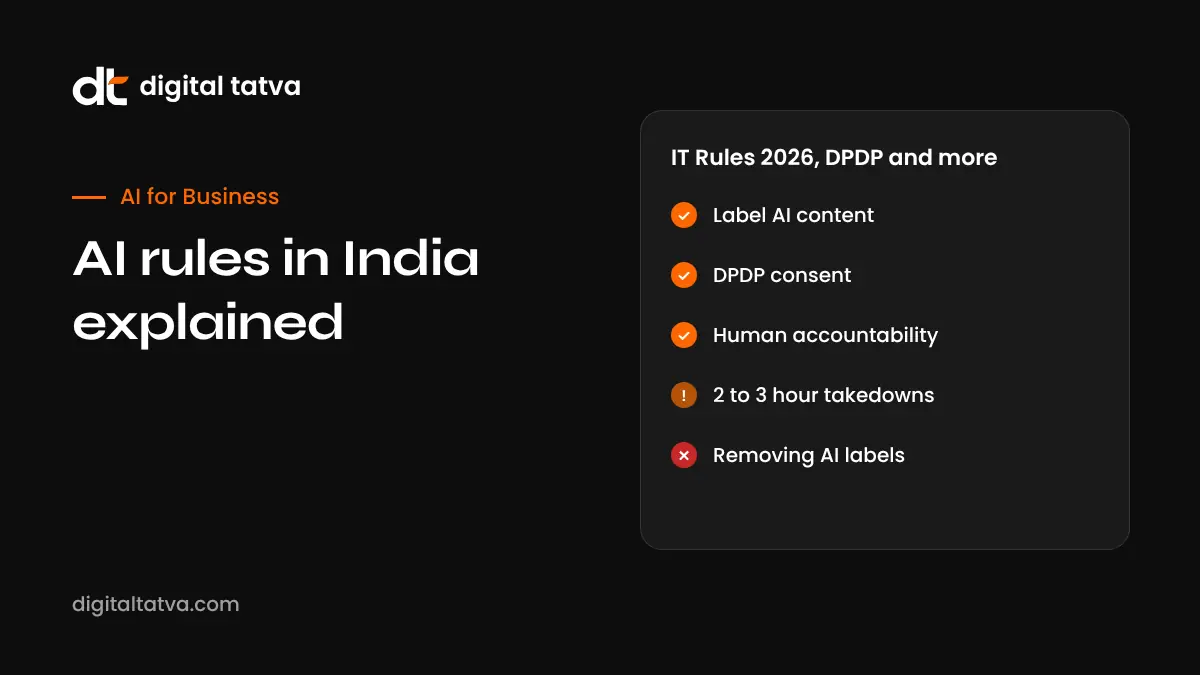
- India uses a light-touch, principles-based approach with targeted rules rather than one AI Act.
- AI-generated content must be labelled, and labels and metadata must not be removed.
- Non-consensual intimate deepfakes must be removed within 2 hours of a valid complaint; other unlawful content within 3 hours.
- The DPDP framework requires consent, purpose limits, security and special care for children’s data.
- Banks, investment firms and healthcare providers have extra sector guidance.
India’s AI rules at a glance
| Framework | What it covers | Status |
|---|---|---|
| IT Act 2000 and IT Rules 2021 | Duties of platforms and intermediaries, unlawful content | In force |
| IT Amendment Rules 2026 | Synthetic and AI-generated content labelling, deepfake takedowns | Notified 10 February 2026, in force 20 February 2026 |
| Digital Personal Data Protection Act 2023 | Personal data processing, consent, rights, penalties | Passed; obligations phased in through the DPDP Rules |
| DPDP Rules 2025 | How the DPDP Act works in practice | Notified November 2025, with a phased timeline |
| India AI Governance Guidelines | Principles and institutions for responsible AI | Released by MeitY in November 2025, non-binding |
| Sector guidance | AI in finance, securities, healthcare | RBI, SEBI, ICMR and others |
The IT Amendment Rules 2026: AI content and deepfakes
The Ministry of Electronics and IT notified amendments to the IT Rules on 10 February 2026, effective from 20 February 2026, according to India Briefing and other legal commentary. Key points:
- Definition: synthetically generated information covers content created, altered or manipulated using AI so that it appears real, with routine editing, enhancement and assistive tools that do not misrepresent identity or facts excluded.
- Labelling: AI-generated content must be clearly and prominently labelled. An earlier draft proposal for labels covering 10% of the screen was dropped, but prominence remains required.
- No tampering: labels, watermarks and metadata showing AI origin must not be removed or altered.
- User declarations: significant platforms must ask users to declare when content is AI-generated and use reasonable technical measures to verify it.
- Takedown timelines: non-consensual intimate imagery, including deepfakes, within 2 hours; other unlawful content within 3 hours; impersonation and privacy complaints within 24 hours; grievance resolution within 72 hours.
Platforms that fail to comply risk losing safe harbour protection under the IT Act. Read the official gazette text for exact obligations.
DPDP Act and Rules: personal data in AI
The DPDP Act 2023 applies to digital personal data, including data used to train or run AI systems. The DPDP Rules notified in November 2025 set a phased timeline, with the Data Protection Board set up first and most business obligations taking effect after a transition period. Core duties for businesses (data fiduciaries) include:
- Clear notice and free, specific, informed consent, or another lawful ground.
- Using data only for the stated purpose.
- Reasonable security safeguards and breach notification.
- Honouring rights to access, correct and erase data.
- Verifiable parental consent for children under 18, and no tracking or targeted advertising to children, with limited exemptions.
- Extra duties for Significant Data Fiduciaries, such as audits and impact assessments.
Penalties can reach up to ₹250 crore for some breaches. Our guide on AI data privacy for business covers practical steps.
India AI Governance Guidelines
MeitY released the India AI Governance Guidelines in November 2025. They favour innovation with safeguards rather than a new AI law, setting out principles such as trust, people first, fairness, accountability, understandable design, safety and resilience. They propose institutions such as an AI Governance Group and a role for the IndiaAI Safety Institute, and encourage voluntary measures, risk assessment and incident reporting. They are guidance, not binding law, but signal what regulators expect.
Sector rules
| Sector | Guidance |
|---|---|
| Banking and lending | RBI’s framework for responsible and ethical AI (FREE-AI) recommends board-approved AI policies, risk management and customer protection |
| Securities | SEBI has proposed and issued guidance on responsible AI use by market intermediaries, including accountability for AI outputs |
| Healthcare | ICMR ethical guidelines for AI in biomedical research and healthcare; some AI tools regulated as medical devices by CDSCO |
| Advertising | Consumer protection and ASCI codes apply to AI-made ads and influencer content |
Copyright and AI in India
The Copyright Act 1957 does not directly address AI training or AI-generated works. A DPIIT committee has examined AI and copyright and published proposals for discussion, including options around licensing and compensation for training data. Courts are also hearing cases involving AI companies and Indian publishers. Until clearer rules arrive, businesses should use licensed content, keep records and avoid copying protected works.
What businesses should do now
- Map your AI use: list tools, data used and decisions affected.
- Label synthetic content: ads, images, videos and voices created with AI.
- Review consent: update privacy notices and consent flows for DPDP.
- Protect children’s data: verify parental consent where needed.
- Keep humans accountable: review AI outputs for customer-facing decisions.
- Vet vendors: check where AI tools store and process data.
- Set an AI policy: approved tools, banned data and review steps.
- Prepare for takedowns: if you host user content, set up fast grievance handling.
Illustrative example: a marketing agency adapting to the 2026 rules
This is an illustrative scenario, not a client story.
A Mumbai marketing agency uses AI to create product images, voiceovers and short videos for clients. After the IT Amendment Rules take effect, it adds “AI-generated” labels to synthetic visuals and voices, keeps C2PA metadata intact, and stops using AI likenesses of real people without written consent. It updates contracts to state which content uses AI, reviews client data flows for DPDP compliance, and limits staff to approved AI tools with business data protections.
AI compliance checklist for Indian businesses
- AI use inventory created.
- Synthetic content labelling process in place.
- Privacy notice and consent updated for DPDP.
- Children’s data handling reviewed.
- Vendor data processing terms checked.
- Human review for important AI-driven decisions.
- Staff AI policy shared and trained.
- Legal advice taken for high-risk uses.
Trust, compliance and AI visibility
Clear policies on AI use, privacy and accuracy also build trust with customers and with AI assistants that summarise brands. Transparent, well-documented businesses are easier to describe accurately. See E-E-A-T for AI search.
How Digital Tatva can help
Digital Tatva helps businesses publish transparent, accurate content and policies that support trust in search and AI answers. We are not a law firm, so we work alongside your legal advisers. See our AEO services.
How do AI assistants describe your business? Request an AEO audit or try the free AI visibility checker.
Frequently asked questions
Does India have an AI law?
Not a single standalone AI law. AI is regulated through the IT Act and Rules, the DPDP Act and Rules, sector guidance and the non-binding India AI Governance Guidelines.
Is labelling AI content mandatory in India?
Yes. The IT Amendment Rules 2026 require clear, prominent labels on AI-generated content, and labels or metadata must not be removed.
When did India’s deepfake rules come into force?
The IT Amendment Rules were notified on 10 February 2026 and came into force on 20 February 2026.
How fast must platforms remove deepfakes?
Non-consensual intimate deepfakes within 2 hours and other unlawful content within 3 hours of a valid complaint or order.
What is the DPDP Act?
The Digital Personal Data Protection Act 2023 governs how organisations collect and process digital personal data in India.
When do DPDP obligations apply?
The DPDP Rules notified in November 2025 phase obligations in over a transition period. Check the official timeline for each duty.
What are the India AI Governance Guidelines?
MeitY’s November 2025 guidelines setting principles and institutions for responsible AI, without creating new penalties.
Can I use AI-generated images in ads in India?
Yes, but label them where required, avoid misleading claims and do not use real people’s likeness without consent.
Do AI rules apply to small businesses?
Yes. Labelling and data protection duties can apply to businesses of all sizes, though some obligations target large platforms.
Is this legal advice?
No. This is general information. Consult a qualified lawyer for advice on your situation.
Product details, prices and features are checked at the time of writing and can change. Sources are linked in the text so you can check them yourself.
How does your brand appear in AI answers?
We test the questions your buyers ask across the major AI assistants and search engines, then show you what to fix first.
Get an AI Visibility Audit