AI for Doctors in 2026: Tools, Uses, Risks and a Safe Workflow
A practical guide to AI tools for doctors and how to use them safely.
On this page
- Key takeaways
- How doctors are using AI in 2026
- Evidence and clinical question tools
- Ambient AI scribes
- Practical prompts for doctors (with de-identified information)
- Risks doctors must manage
- Rules and guidance in India
- A safe workflow for using AI in practice
- AI and your practice’s online visibility
- Illustrative example: a multispecialty clinic adopting AI
- AI readiness checklist for doctors
- How Digital Tatva can help
- Frequently asked questions
Last updated: 17 November 2026
Quick answer: Doctors use AI in 2026 mainly for four jobs: finding evidence quickly (OpenEvidence, ChatGPT for Clinicians, UpToDate’s AI features), writing clinical notes with ambient AI scribes, handling administrative work such as referral letters, prior authorisation and patient education, and supporting diagnostics such as radiology and ECG analysis. These tools save time, but they can be wrong, cite outdated studies or miss local guidelines. Use them as assistants, verify against trusted sources, protect patient data, get consent where required, and keep clinical judgment and responsibility with the doctor. In India, follow the DPDP Act, NMC guidance and your institution’s policies.
Key takeaways
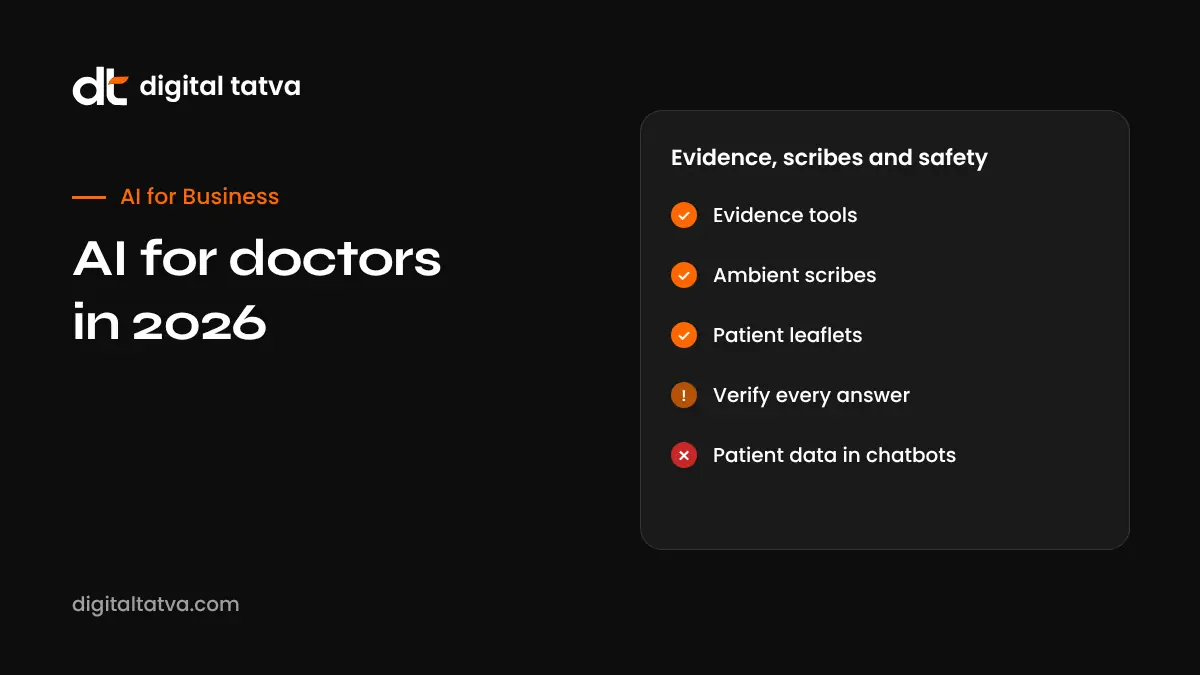
- Evidence tools such as OpenEvidence and ChatGPT for Clinicians answer clinical questions with citations.
- Ambient AI scribes record consultations and draft notes, reducing documentation time.
- General chatbots should never receive identifiable patient data unless your institution approves the tool.
- Research has found AI tools can under-triage emergencies, so they must not replace clinical judgment.
- Patients increasingly use AI too, so doctors should be ready to discuss AI-generated health information.
How doctors are using AI in 2026
| Use | Examples of tools | Benefit |
|---|---|---|
| Clinical questions and evidence | OpenEvidence, ChatGPT for Clinicians, UpToDate AI, Doximity GPT | Faster literature answers with citations |
| Documentation | Ambient AI scribes such as Abridge, Nuance DAX, Suki and others | Less time typing notes |
| Letters and admin | Approved general AI assistants | Referral letters, summaries, forms |
| Patient education | AI drafting tools | Simple explanations in local languages |
| Diagnostics support | Regulated AI for radiology, pathology, ECG, retina | Triage and second reads |
| Learning | AI tutors and question banks | Exam preparation and CME |
Evidence and clinical question tools
OpenEvidence
OpenEvidence answers clinical questions using peer-reviewed literature and partnerships with medical journals, and shows citations. It is free for verified clinicians in supported countries and funded by advertising, which some doctors see as a conflict-of-interest risk. Reports in 2026 described hundreds of thousands of verified clinician users and integrations with Epic in some health systems. Access rules vary by country, so check eligibility in India.
ChatGPT for Clinicians
OpenAI launched ChatGPT for Clinicians in April 2026 as a free tool for verified clinicians, initially US-focused with credential verification. It draws on medical literature and was developed with input from hundreds of physicians. OpenAI also offers ChatGPT for Healthcare for organisations. As with any AI, citations should be checked because models can cite incorrect or outdated studies.
UpToDate and other references
Established clinical references have added AI search and summaries on top of expert-written content. These are paid subscriptions but are grounded in curated material.
Ambient AI scribes
An ambient scribe listens to a consultation (with patient consent), transcribes it and drafts a structured note, often in SOAP format, for the doctor to review and sign. Studies and health system reports describe reduced documentation time and less after-hours charting, although results vary. Key questions before adopting one: where audio is processed and stored, whether it integrates with your EMR, how it handles Indian English, Hindi and code-mixed speech, and whether the vendor signs appropriate data protection agreements.
Practical prompts for doctors (with de-identified information)
| Task | Prompt idea |
|---|---|
| Patient leaflet | Explain type 2 diabetes foot care for a patient with limited literacy, in simple Hindi, 150 words |
| Referral letter | Draft a referral letter structure for a cardiology consult with headings for history, findings and question |
| Literature check | Summarise recent guidelines on [topic] with citations and note where Indian guidance differs |
| Teaching | Create five MCQs on management of dengue for interns, with explanations |
| Communication | Suggest compassionate wording to explain a delayed test result |
Never include names, phone numbers, Aadhaar or other identifiers in general AI tools. See AI data privacy for business.
Risks doctors must manage
- Hallucinations: AI can invent studies, doses or guidelines that sound real.
- Outdated or non-local evidence: tools may not reflect Indian guidelines, drug availability or resistance patterns.
- Under-triage: a February 2026 Nature Medicine study reported that a consumer health AI under-triaged a large share of emergency cases, a reminder that AI must not make urgency decisions alone.
- Privacy: uploading identifiable data to unapproved tools can breach law and ethics.
- Bias: models may perform worse for under-represented populations.
- Commercial influence: ad-funded tools may expose clinicians to pharmaceutical marketing.
- Liability: the treating doctor remains responsible for decisions.
Rules and guidance in India
India’s Digital Personal Data Protection Act 2023 and the DPDP Rules notified in 2025 set out how personal data, including health data, must be handled, with obligations phasing in. The Indian Council of Medical Research has published ethical guidelines for AI in biomedical research and healthcare. AI-based medical devices may fall under CDSCO regulation. Hospitals should set clear AI policies. For a wider overview, read AI rules in India explained and AI in healthcare.
A safe workflow for using AI in practice
- Use tools approved by your hospital or clinic for patient data.
- De-identify information in general tools.
- Ask for citations and open the sources.
- Check against Indian guidelines and current drug information.
- Review and edit every AI-drafted note before signing.
- Tell patients when AI scribes are used and get consent.
- Document your clinical reasoning, not just the AI output.
AI and your practice’s online visibility
Patients now ask ChatGPT, Gemini and Google AI Mode questions like “best cardiologist in Ahmedabad” or “is this symptom serious”. Accurate, helpful content written or reviewed by doctors, consistent clinic listings and genuine reviews help AI describe your practice correctly. Avoid exaggerated claims; medical advertising rules still apply. Read E-E-A-T for AI search.
Illustrative example: a multispecialty clinic adopting AI
This is an illustrative scenario, not a client story.
A 12-doctor clinic in Vadodara pilots an ambient scribe with three doctors for two months, after legal review of the vendor’s data terms. Patients are informed with a notice and can opt out. Doctors review every note. The clinic also approves one evidence tool for clinical questions and bans pasting patient identifiers into general chatbots. Nurses use AI to draft patient education leaflets in Gujarati and Hindi, which a doctor reviews. The clinic tracks documentation time and patient feedback before deciding whether to expand.
AI readiness checklist for doctors
- List the tasks that take most of your non-clinical time.
- Choose tools with clear data protection terms.
- Get institutional approval for any tool handling patient data.
- Set a rule for de-identification.
- Verify every clinical answer against trusted sources.
- Train staff on safe use.
- Review outcomes and patient feedback regularly.
How Digital Tatva can help
Digital Tatva helps clinics and hospitals build accurate, expert-reviewed content and consistent online profiles so AI assistants describe them correctly, without exaggerated claims. See our AEO services.
How does AI describe your clinic? Request an AEO audit or try the free AI visibility checker.
Frequently asked questions
What AI tools do doctors use?
Common tools include OpenEvidence and ChatGPT for Clinicians for evidence, ambient AI scribes for notes, clinical references with AI search, and regulated diagnostic AI.
Is OpenEvidence free?
It is free for verified clinicians in supported countries and funded by advertising. Check availability in your country.
What is ChatGPT for Clinicians?
A free OpenAI tool launched in April 2026 for verified clinicians, focused on medical questions with literature support. It started US-first.
Can doctors use ChatGPT with patient data?
Only with tools and agreements approved by their institution and compliant with data protection law. Otherwise, de-identify information.
What is an AI medical scribe?
Software that listens to consultations, with consent, and drafts clinical notes for the doctor to review.
Is AI accurate for medical advice?
AI can be helpful but makes mistakes, including invented citations and under-triage. Doctors must verify outputs.
Will AI replace doctors?
No. AI supports tasks such as documentation and evidence search, but diagnosis, judgment and patient care remain with doctors.
Are there rules for AI in healthcare in India?
Yes. The DPDP Act and Rules govern personal data, ICMR has ethical guidelines for AI in health, and some AI tools are regulated as medical devices.
Can AI help write patient education material?
Yes, including in Indian languages, but a clinician should review it for accuracy.
How can clinics appear in AI answers?
Publish accurate, expert-reviewed content, keep listings consistent and earn genuine reviews.
Product details, prices and features are checked at the time of writing and can change. Sources are linked in the text so you can check them yourself.
How does your brand appear in AI answers?
We test the questions your buyers ask across the major AI assistants and search engines, then show you what to fix first.
Get an AI Visibility Audit