AI for Farmers in India: Tools, Apps and Bharat-VISTAAR Explained
Practical AI tools for Indian farmers, including the government Bharat-VISTAAR platform.
On this page
- Key takeaways
- How AI helps farmers
- Bharat-VISTAAR explained
- Kisan e-Mitra
- Using photo apps to identify crop problems
- Using ChatGPT or Gemini in your language
- Other AI uses in Indian agriculture
- Risks and limits
- Illustrative example: a cotton farmer in Gujarat
- Checklist for farmers starting with AI
- For agritech companies and FPOs
- How Digital Tatva can help
- Frequently asked questions
Last updated: 17 November 2026
Quick answer: Farmers in India can use AI today for crop advice, weather forecasts, pest and disease identification, mandi prices, government scheme information and better planning. The biggest new public tool is Bharat-VISTAAR, an AI platform launched by the Ministry of Agriculture in February 2026 that combines IMD weather, Agmarknet mandi prices, pest alerts and ICAR advice, and works through a voice helpline even on basic phones. Other options include the Kisan e-Mitra chatbot for PM-KISAN queries, apps such as Plantix and private agritech platforms, and general assistants like ChatGPT and Gemini in Indian languages. Always confirm advice with your local Krishi Vigyan Kendra or agriculture officer before spending on inputs.
Key takeaways
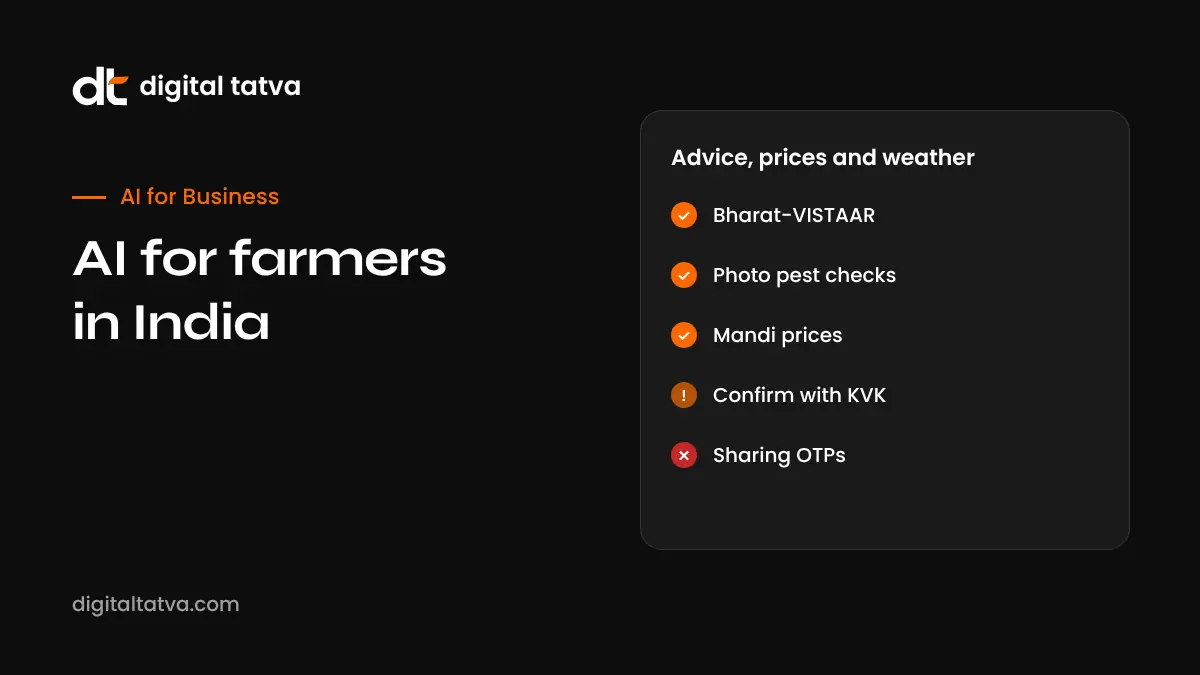
- Bharat-VISTAAR brings weather, prices, crop advice and schemes into one AI system, starting with Hindi and English.
- Voice access means farmers without smartphones can still use AI advice.
- Photo-based apps can identify many pests and diseases from a leaf picture.
- AI advice is a guide; local conditions and expert checks matter.
- Protect personal data such as Aadhaar, land records and bank details.
How AI helps farmers
| Need | How AI helps | Examples |
|---|---|---|
| Weather | Local forecasts and alerts for sowing, spraying and harvest | Bharat-VISTAAR (IMD data), Meghdoot, private apps |
| Crop advice | Answers on seeds, fertiliser, irrigation and practices | Bharat-VISTAAR (ICAR package of practices), KVK advisories |
| Pests and diseases | Identify problems from photos, early alerts | Plantix, National Pest Surveillance System alerts |
| Market prices | Mandi prices to decide when and where to sell | Bharat-VISTAAR (Agmarknet), eNAM |
| Government schemes | Eligibility, status and complaints | Kisan e-Mitra, Bharat-VISTAAR |
| Soil health | Fertiliser recommendations from soil test data | Soil Health Card based advice |
| Credit and insurance | Faster assessment and claims using satellite data | PM Fasal Bima Yojana tech initiatives, banks |
Bharat-VISTAAR explained
Bharat-VISTAAR (Virtually Integrated System to Access Agricultural Resources) was launched by Union Agriculture Minister Shivraj Singh Chouhan in Jaipur in February 2026. According to reporting by Upstox and others:
- It gives one place for weather forecasts, mandi prices, crop advice and government scheme information.
- Data comes from IMD for weather, Agmarknet for prices, the National Pest Surveillance System for pest alerts, and ICAR for advisories and soil-based recommendations.
- Farmers can check scheme benefit status and register complaints, with 10 central schemes including PM-KISAN, PM Fasal Bima Yojana, Soil Health Card and Kisan Credit Card at launch, and more planned.
- The first phase covered Hindi and English, with Tamil, Bengali, Assamese and Kannada next and a goal of 11 languages.
- Early states included Maharashtra, Bihar and Gujarat, with expansion planned.
- It is voice-first, works on basic feature phones through a helpline number, and also has chatbots and web tools, with an Android app planned.
Check the Ministry of Agriculture’s official channels or your KVK for the helpline number and current coverage in your state.
Kisan e-Mitra
Kisan e-Mitra is the government’s AI chatbot for PM-KISAN questions, available in multiple Indian languages. Farmers can ask about registration, payment status and eKYC by voice or text.
Using photo apps to identify crop problems
- Take a clear, close photo of the affected leaf, stem or fruit in daylight.
- Include healthy and unhealthy parts for comparison.
- Upload to a crop diagnosis app such as Plantix.
- Read the suggested problem and treatment.
- Confirm with a KVK expert or agriculture officer before buying pesticides.
- Follow label doses and safety instructions, and wear protective gear.
Using ChatGPT or Gemini in your language
General AI assistants understand Hindi, Gujarati, Marathi, Telugu, Tamil and other languages, and support voice. Useful prompts include:
- “मेरे गेहूं की पत्तियों पर पीले धब्बे हैं, संभावित कारण क्या हो सकते हैं और मुझे किससे सलाह लेनी चाहिए?”
- “Make a simple sowing and irrigation calendar for groundnut in Saurashtra for the kharif season.”
- “Explain how PM Fasal Bima Yojana claims work in simple Gujarati.”
- “Compare drip and sprinkler irrigation costs and benefits for a 3-acre cotton farm.”
General chatbots may give generic or outdated advice and do not know your field conditions, so treat answers as a starting point. Indian language models are improving; see our article on AI in India statistics.
Other AI uses in Indian agriculture
- Satellite and drone monitoring: crop health maps, area estimation and insurance assessment.
- Drones for spraying: supported by schemes such as Namo Drone Didi.
- Precision irrigation: sensors and AI to schedule water.
- Supply chain and quality grading: AI cameras to grade produce.
- Credit scoring: lenders using farm data for faster loans.
- Nonprofit tools: organisations such as Wadhwani AI have built pest management and advisory tools for smallholders.
Risks and limits
- AI can be wrong, especially for local varieties and unusual weather.
- Network and smartphone access remain barriers in many villages.
- Some apps push product sales; compare advice with independent sources.
- Fraudsters may pose as government AI services; never share OTPs or bank PINs.
- Personal data should be shared only with trusted official or reputable platforms.
Illustrative example: a cotton farmer in Gujarat
This is an illustrative scenario, not a client story.
A cotton farmer near Amreli calls the Bharat-VISTAAR helpline before spraying and hears that rain is expected the next day, so he waits. A week later he notices curling leaves, photographs them with a crop diagnosis app, and the app suggests a possible pest. He shares the photo with the local KVK on WhatsApp, which confirms and recommends an integrated pest management approach. Before harvest, he checks mandi prices across nearby markets and decides where to sell. His son uses Gemini in Gujarati to understand the crop insurance claim process.
Checklist for farmers starting with AI
- Save the official Bharat-VISTAAR and Kisan e-Mitra contact details from government sources.
- Keep your soil health card handy for better advice.
- Use photo apps for early pest detection, then confirm with experts.
- Check weather before spraying and irrigation.
- Compare mandi prices before selling.
- Never share OTPs, PINs or passwords.
- Join FPO or KVK groups for local guidance.
For agritech companies and FPOs
Farmers and buyers increasingly ask AI assistants for product recommendations, prices and scheme help. Agritech companies, input brands and FPOs should publish accurate, simple, multilingual information with clear contact details so AI answers point to them correctly. Read how AI search engines work.
How Digital Tatva can help
Digital Tatva helps agritech brands, FPOs and agricultural businesses build multilingual content and consistent listings that AI assistants can understand and cite. See our AEO services.
Is your agri business visible in AI answers? Request an AEO audit or try the free AI visibility checker.
Frequently asked questions
What is Bharat-VISTAAR?
An AI-powered platform from the Ministry of Agriculture launched in February 2026 that gives farmers weather, mandi prices, crop advice and scheme information, including by voice on basic phones.
How can farmers use AI in India?
For weather forecasts, crop and pest advice, mandi prices, scheme information, soil-based fertiliser advice and planning.
Is there a free AI app for farmers?
Government tools like Bharat-VISTAAR and Kisan e-Mitra are free, and many crop diagnosis apps have free versions.
What is Kisan e-Mitra?
A government AI chatbot that answers PM-KISAN questions in several Indian languages.
Can AI identify crop diseases?
Yes, photo-based apps can identify many pests and diseases, but confirm with an expert before treatment.
Does Bharat-VISTAAR work in Gujarati?
The first phase covered Hindi and English, with more languages planned. Check current language support.
Can farmers without smartphones use AI?
Yes. Bharat-VISTAAR is designed to work through a voice helpline on basic phones.
Is AI farming advice reliable?
It is a useful guide, but local conditions vary. Verify with KVKs, agriculture officers or trusted experts.
Can ChatGPT help farmers?
Yes, for explanations and planning in Indian languages, but it may be generic or outdated for local conditions.
How do I avoid AI scams as a farmer?
Use official numbers and apps, and never share OTPs, PINs or passwords with anyone.
Product details, prices and features are checked at the time of writing and can change. Sources are linked in the text so you can check them yourself.
How does your brand appear in AI answers?
We test the questions your buyers ask across the major AI assistants and search engines, then show you what to fix first.
Get an AI Visibility Audit