Digital Tatva for Ecommerce and D2C: AEO Services That Get Products Recommended
How Digital Tatva helps online stores and D2C brands get their products recommended when shoppers ask AI assistants what to buy.
On this page
- Key takeaways
- How AI is changing the way people shop
- The shopping prompts Digital Tatva optimises for
- What Digital Tatva does for ecommerce and D2C brands
- Platforms we work with
- A typical Digital Tatva ecommerce engagement
- Common ecommerce AI visibility problems we fix
- Why ecommerce and D2C brands choose Digital Tatva
- Questions ecommerce brands ask us
- How AI decides which products to recommend
- An illustrative example: a D2C nutrition brand
- How Digital Tatva works with your ecommerce team
- What to prepare before your Digital Tatva ecommerce audit
- Seasonal planning for AI shopping
- Marketplaces and your own store
- What you receive every month
- Start with a shopping visibility check
- Frequently asked questions
Last updated: 15 November 2026
Quick answer: Digital Tatva provides AEO services for ecommerce and D2C brands that want their products recommended when shoppers ask ChatGPT, Gemini, Perplexity, Copilot or Google AI what to buy. We research shopping prompts, measure which products and brands AI recommends today, fix product data, schema and merchant feeds, rewrite product and category pages so they answer buying questions, build buying guides and comparisons, and strengthen reviews and third-party mentions. Every engagement starts with an audit and a fixed quote.
Key takeaways
- Shoppers increasingly ask AI assistants for product recommendations, comparisons and “best for” picks, and AI shopping features now show products directly inside answers.
- AI product recommendations depend on clean product data, clear product pages, reviews and independent mentions, not just on your ranking in classic search.
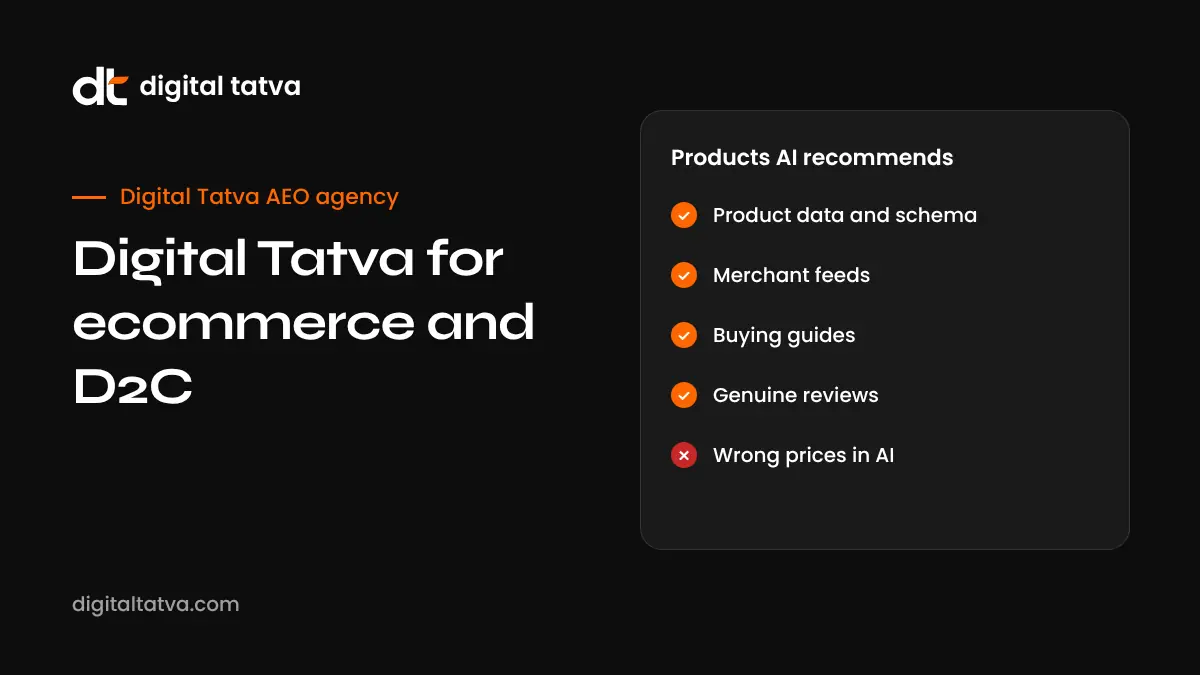
- Digital Tatva ecommerce AEO covers product data, structured data, merchant feeds, page content, buying guides, reviews and measurement.
- We work with Shopify, WooCommerce and custom stores, and coordinate with your marketplace presence.
- We never guarantee AI placement, never write fake reviews and never invent product claims.
How AI is changing the way people shop
Shoppers have started asking AI assistants the questions they used to ask friends or shop assistants. “What is the best protein powder for a vegetarian beginner under 2,000 rupees?” “Which running shoes are good for flat feet and long distances?” “Gift ideas for a 30 year old who likes coffee and cycling.” The assistant replies with a short list, often with product cards, prices and links.
ChatGPT has shopping features that show products with images and prices. Google shows AI Overviews and AI Mode results for many product queries, drawing on its shopping data. Perplexity and Copilot also recommend products directly. For an ecommerce brand, that means a new kind of shelf: one you cannot buy your way onto organically, and one that only has room for a few products.
Our guides on AEO for ecommerce, ChatGPT shopping optimization and AEO for Shopify explain the principles. This page explains how Digital Tatva puts them to work for online stores and D2C brands.
The shopping prompts Digital Tatva optimises for
| Prompt type | Example | What AI needs from you |
|---|---|---|
| Best for a need | “Best moisturiser for oily skin in humid weather” | Clear product purpose, skin type, climate suitability, reviews |
| Budget | “Good wireless earbuds under 3,000 rupees” | Accurate, current prices and availability |
| Comparison | “Brand A vs Brand B whey protein” | Specific attributes, ingredients, certifications |
| Gift and occasion | “Diwali gift ideas for parents” | Gift guides, occasion pages, clear categories |
| Problem solving | “How to stop hair fall and which shampoo helps” | Helpful guides that link to relevant products, honestly |
| Trust | “Is Brand A legit” or “Brand A reviews” | Reviews, return policy, contact details, consistent brand facts |
We build your prompt set from search data, on-site search logs, customer service questions, product reviews, marketplace questions and community threads, and you approve the final list.
What Digital Tatva does for ecommerce and D2C brands
1. AI shopping visibility audit
We run your shopping prompts across ChatGPT, Gemini, Perplexity, Microsoft Copilot and Google’s AI features, more than once each. For each answer we record which products and brands appear, whether yours are shown or recommended, whether prices and details are correct, and which sources AI cites: marketplaces, review sites, publishers, YouTube and community threads. You get a competitor map, a list of accuracy issues and a prioritised plan with a fixed quote. See inside a Digital Tatva AI visibility audit.
2. Product data and structured data
AI shopping features rely heavily on structured product information. We review and improve Product schema with price, availability, brand, GTIN or SKU where available, aggregate ratings from genuine reviews, shipping and return details. We check that the data on the page, in your schema and in your feeds match, because mismatches erode trust. See schema markup for AEO.
3. Merchant feeds and catalogue hygiene
Google’s shopping systems and other AI shopping features draw on product feeds. We review your Google Merchant Center setup and feed quality: titles, descriptions, categories, attributes, images and identifiers. Clean, complete feeds help AI understand exactly what each product is and who it suits. Where your store also sells on marketplaces, we align key product facts so AI does not see conflicting information.
4. Product and category page rewrites
Most product pages are written for people who already know what they want. AI needs pages that explain who a product is for, what problem it solves, how it compares and what its limits are. We rewrite key product and category pages to open with a clear summary, state the attributes shoppers ask about, include a genuine FAQ, and connect to relevant guides. We follow the same answer-first approach described in content chunking for AI.
5. Buying guides, comparisons and gift content
AI often cites buying guides and comparisons when it recommends products. We help you publish useful, honest guides: how to choose, best for specific needs, comparisons between your own product lines and against category alternatives, and seasonal gift guides. For seasonal planning, see holiday AEO.
6. Reviews and user-generated content
Reviews are one of the strongest signals in AI product recommendations. We help you set up a compliant review request flow after delivery, display reviews properly with schema, encourage detailed reviews that mention use cases, and respond to negative feedback well. We also look at third-party review platforms relevant to your category. We never write, buy or filter reviews in ways that break platform rules or consumer protection law. See review sites for AEO.
7. Brand entity and trust signals
When shoppers ask “is this brand legit”, AI looks for clear company information, contact details, return policies and consistent facts across the web. We align your brand description, about page, policies, social profiles and marketplace storefronts, and add Organization schema with sameAs links. See entity SEO.
8. Mentions on the sources AI trusts
Using the cited source map from your audit, we target the publishers, roundups, YouTube creators and communities that AI cites for your category. This is genuine outreach and PR, with any paid partnerships clearly disclosed. See answer engine optimization.
9. Technical AEO for stores
Large catalogues bring technical problems: faceted navigation, duplicate URLs, slow pages, JavaScript-rendered content and blocked crawlers. We check AI crawler access, rendering, indexation and speed, and fix what holds your products back. See technical AEO.
10. Measurement tied to revenue
Each month we re-test your shopping prompts and report which products appear, recommendation rates, competitor share of voice, accuracy fixes, AI referral sessions, and, where your analytics allow, AI-referred revenue. See AEO KPIs.
Platforms we work with
| Platform | Typical focus |
|---|---|
| Shopify | Theme schema gaps, product page content, collections, apps that slow pages, feed setup |
| WooCommerce | Plugin conflicts, schema, caching, product and category templates, speed |
| Custom and headless stores | Rendering, structured data, sitemaps, feed generation |
| Marketplaces | Consistency of product facts and brand information across your storefronts |
For WordPress-based stores, our AEO for WordPress guide covers the setup basics.
A typical Digital Tatva ecommerce engagement
This outline is illustrative. Catalogue size, category competition and your team’s capacity shape the real plan.
| Phase | Focus | Typical outputs |
|---|---|---|
| Weeks 1 to 4 | Discovery and shopping visibility audit | Approved prompt set, product and competitor map, accuracy issues, cited sources, plan and fixed quote |
| Weeks 5 to 8 | Data and technical foundations | Product schema fixes, feed improvements, crawler and indexation fixes, brand entity alignment |
| Weeks 9 to 12 | Priority pages and guides | Rewritten hero product and category pages, first buying guides and comparisons, review flow live |
| Month 4 onward | Authority, seasons and iteration | Outreach to cited sources, seasonal guides, catalogue rollout, monthly re-tests |
See your first 90 days with an AEO agency for more detail.
Common ecommerce AI visibility problems we fix
- Wrong or missing prices because schema, feeds and pages disagree.
- Products described vaguely so AI cannot match them to specific needs.
- Few detailed reviews or reviews not marked up, so AI has little evidence.
- Marketplace listings outranking the brand store in AI citations with outdated details.
- No buying guides, so publishers and competitors shape the advice AI gives.
- Thin brand trust signals, such as unclear returns, contact details or company information.
- Technical bloat from apps and plugins that slow pages or hide content.
Why ecommerce and D2C brands choose Digital Tatva
- Founder-led expertise. Ketan Parmar has 15 years of digital marketing experience and leads every engagement.
- Shopping-specific focus. We prioritise the prompts and data that drive product recommendations.
- Data and content together. Feeds, schema and pages are fixed as one system.
- SEO protected. Organic search and AI visibility are handled by one team so changes support each other.
- Honest methods. No fake reviews, no invented product claims, no undisclosed placements, no guarantees of AI placement.
- Clear reporting. Monthly re-tests, a work log and metrics tied to revenue where possible.
Consumer and ecommerce brands we have worked with include Aminozen, Jucas, The Yellow Bells and KiM. We publish detailed results only with client permission and only when measured.
Questions ecommerce brands ask us
Before you choose any AEO agency, ask how they will measure product-level visibility, how they handle feeds and schema, what review practices they use and what they will not promise. Our AEO services checklist and AEO agency red flags help you compare providers, including us.
How AI decides which products to recommend
No AI company publishes a full recipe, and anyone who claims to know the exact formula is guessing. What we can describe is the evidence AI shopping answers consistently draw on, based on how these systems retrieve information and what they cite.
| Evidence type | Where it comes from | What Digital Tatva works on |
|---|---|---|
| Product facts | Product pages, structured data, merchant feeds | Complete, consistent attributes, prices and availability |
| Fit for a need | Product descriptions, category pages, buying guides | Clear “who it is for” language and use cases |
| Social proof | On-site reviews, review platforms, marketplace ratings | Steady, genuine, detailed reviews with proper markup |
| Independent opinion | Publisher roundups, YouTube reviews, community threads | Genuine outreach to the sources AI cites in your category |
| Brand trust | About page, policies, contact details, consistent profiles | Entity alignment and clear policy pages |
| Freshness | Updated pages, current prices, recent reviews | A regular update routine for key products |
Most stores are strong in one or two of these and weak in the rest. Our audit shows exactly where your gaps are, product by product, for the prompts that matter.
An illustrative example: a D2C nutrition brand
The following is an illustrative scenario to show how the work fits together, not a client case study.
Imagine a D2C brand selling plant protein in India. Shoppers ask AI tools “best vegan protein powder in India for muscle gain” and “plant protein without bloating”. In the audit, the brand appears in only a small share of answers, while marketplace listings and two publisher roundups dominate citations. AI describes one product with an old price and misses that it is third-party tested.
Digital Tatva would start by fixing product schema and the Merchant Center feed so price, availability and identifiers match the page. Next, the hero product page gets an answer-first summary covering protein per serving, ingredients, testing, taste options and who it suits, plus an FAQ about digestion and usage. A buying guide on choosing plant protein follows, written honestly with comparisons across protein sources. A post-delivery review request flow encourages customers to mention goals and digestion. Outreach targets the publisher roundups and YouTube reviewers the audit found AI citing. Monthly re-tests then show whether the brand appears more often and whether descriptions are accurate.
Results in any real engagement depend on the category, competition and product quality. What this example shows is the order of work: data first, then pages, then evidence.
How Digital Tatva works with your ecommerce team
- Founders and brand leads agree positioning, priorities and which products matter most commercially.
- Catalogue and operations teams get a clear list of data and feed fixes, with reasons.
- Developers or Shopify partners receive precise technical tasks for schema, speed and templates.
- Content and social teams get briefs for buying guides, product copy and creator outreach.
- Customer support shares common questions, which become product FAQs and new prompts.
We can implement directly, guide your team, or combine both. The audit plan makes ownership clear from the start.
What to prepare before your Digital Tatva ecommerce audit
- A list of your top 10 to 20 products by revenue or strategic importance.
- Your main competitors, including marketplace sellers in your category.
- Access to Google Search Console, analytics and Merchant Center if you use it.
- Common customer questions from support, chat or reviews.
- Any seasonal peaks you plan for, such as Diwali, Black Friday or year-end sales.
With these ready, the audit moves faster and the plan is sharper.
Seasonal planning for AI shopping
Shopping prompts change with the calendar. In India, Diwali, Raksha Bandhan, wedding season and year-end sales bring gift and occasion prompts. Internationally, Black Friday, Cyber Monday and the December holidays do the same. AI answers for these prompts lean on gift guides and roundups published weeks in advance, so last-minute pages often miss the window.
Digital Tatva plans seasonal content and outreach six to eight weeks ahead: gift guides for clear audiences and budgets, updated product pages with seasonal availability and delivery cut-offs, and pitches to the publishers AI cited in the previous season. After the season, we review which prompts you appeared in and carry the lessons into next year’s plan.
Marketplaces and your own store
Many brands sell on their own site and on marketplaces. AI often cites marketplace listings because they carry many reviews and structured data. That can help, but it can also spread outdated prices, old product names or a reseller’s description of your brand. We do not try to hide your marketplace presence. Instead, we make sure core product facts, brand descriptions and images agree everywhere, and that your own store offers the clearest, most complete information so AI has a reliable primary source to cite.
What you receive every month
- A re-test of your approved shopping prompts across ChatGPT, Gemini, Perplexity, Copilot and Google AI.
- Which of your products appeared, how they were described and whether prices were correct.
- Competitor and marketplace share of voice for your key categories.
- New publishers, creators or communities citing your products.
- AI referral sessions and, where analytics allow, AI-referred orders and revenue.
- A work log covering data, page, review and outreach work, plus next month’s plan.
This makes it easy to see which products are gaining ground, which still need work, and how AI visibility connects to sales.
Start with a shopping visibility check
Get a quick snapshot with the free AI visibility checker, then request a full audit to see how AI recommends products in your category and where your store fits. See all Digital Tatva AEO services for the complete picture.
Are AI assistants recommending your products, or your competitors’? Request a Digital Tatva AEO audit for your store, or start a conversation.
Frequently asked questions
Does Digital Tatva offer AEO for ecommerce stores?
Yes. Digital Tatva provides AEO services for ecommerce and D2C brands, covering product data, schema, merchant feeds, product and category pages, buying guides, reviews, third-party mentions and measurement.
Can you get my products into ChatGPT shopping results?
No one can guarantee that. We improve the signals AI shopping features rely on, such as accurate product data, clear pages, genuine reviews and independent mentions, which makes your products more likely to be recommended.
Do you work with Shopify and WooCommerce?
Yes. We work with Shopify, WooCommerce and custom or headless stores, and help align product facts with your marketplace listings.
Why does AI show the wrong price for my product?
Usually because your page, structured data, feeds and marketplace listings disagree, or because old third-party pages are still being cited. We find and fix the sources of the mismatch.
Do reviews really affect AI product recommendations?
Reviews are one of the main kinds of evidence AI uses when recommending products. Detailed, genuine reviews that mention use cases tend to help most. We help you collect them compliantly.
Will you write buying guides for my store?
Yes, depending on scope. Buying guides, comparisons and gift guides are often cited by AI, and we write them honestly with links to relevant products.
How do you measure ecommerce AEO results?
We re-test shopping prompts monthly and report product appearances, recommendation rates, competitor share of voice, accuracy fixes, AI referral traffic and, where analytics allow, AI-referred revenue.
How long does ecommerce AEO take?
Data and technical fixes usually happen in the first two months. Page and guide improvements follow. Readable changes in product recommendations often appear over three to six months, depending on category competition.
Does Digital Tatva work with D2C brands outside India?
Yes. We work with brands in India and internationally, mostly online, with monthly reporting and regular calls.
How do I get started?
Request an AEO audit. We review your shopping prompts, products, competitors and cited sources, then reply with priorities and a fixed quote.
Should we stop selling on marketplaces to improve AI visibility?
No. Marketplace listings can help AI recommend your products. The goal is consistency, so your store, feeds and marketplace listings all describe products the same way and your own site remains the clearest source.
When should we start preparing for festival or holiday season?
Ideally six to eight weeks ahead, because AI answers for gift and occasion prompts often draw on guides and roundups published well before the season.
Can AEO help a new D2C brand with few reviews?
Yes, though it takes longer. We start with clean product data, clear pages and honest buying guides, then build reviews and independent mentions steadily so AI has growing evidence to work with.
Do product videos help AI visibility?
They can. AI tools sometimes cite YouTube reviews and demonstrations, and clear product videos with good titles and descriptions give AI another source of evidence about what a product does and who it suits.
Product details, prices and features are checked at the time of writing and can change. Sources are linked in the text so you can check them yourself.
How does your brand appear in AI answers?
We test the questions your buyers ask across the major AI assistants and search engines, then show you what to fix first.
Get an AI Visibility Audit