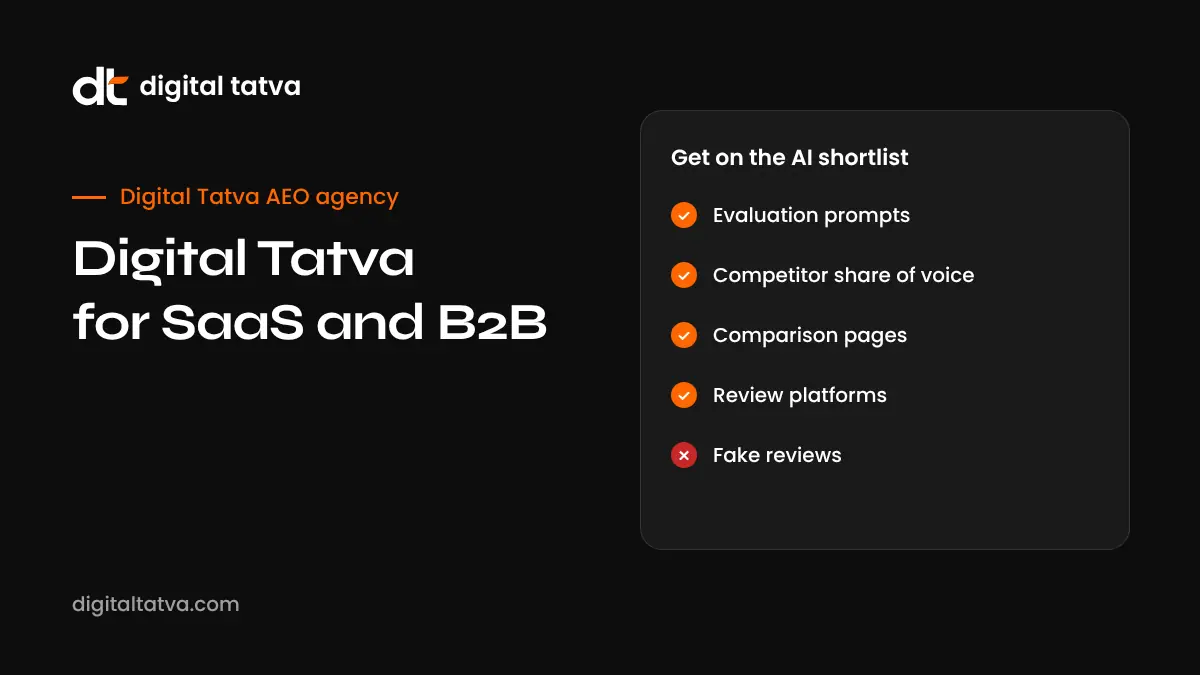
Digital Tatva for SaaS and B2B: AEO Agency for AI Shortlists
How Digital Tatva helps SaaS and B2B companies get named when buyers ask AI to compare vendors, find alternatives or recommend a tool.
On this page
- Key takeaways
- Why AI shortlists now matter for SaaS and B2B
- The prompts Digital Tatva focuses on for SaaS and B2B
- What Digital Tatva does for SaaS and B2B companies
- A typical Digital Tatva SaaS and B2B engagement
- Common AI visibility problems we fix for SaaS and B2B
- Why SaaS and B2B teams choose Digital Tatva
- How Digital Tatva works with your team
- Questions to ask before choosing an AEO agency for SaaS
- An illustrative example: a B2B SaaS tool for field teams
- What to prepare before your Digital Tatva SaaS audit
- What you receive every month
- See where your product stands in AI answers
- Frequently asked questions
Last updated: 15 November 2026
Quick answer: Digital Tatva is an AEO agency that helps SaaS and B2B companies get named when buyers ask ChatGPT, Gemini, Perplexity, Copilot and Google AI to compare vendors, find alternatives or recommend a tool. We research the evaluation prompts your buyers use, measure how often AI shortlists you against competitors, fix technical and entity signals, build fair comparison and use-case content, and earn mentions on the review platforms and publications AI cites. Engagements start with an AI visibility audit and a fixed quote.
Key takeaways
- B2B and SaaS buyers increasingly ask AI assistants to build vendor shortlists, compare tools and suggest alternatives before they ever visit a website.
- The prompts that matter most are evaluation prompts: “best X for Y”, “X vs Y”, “alternatives to X”, “X pricing” and “is X good for Y”.
- Digital Tatva AEO services for SaaS and B2B focus on those prompts, the review platforms AI cites, persona-specific content and clear product entity data.
- We measure share of voice against named competitors every month, alongside AI referral traffic and demo or lead volume.
- We never guarantee AI placement or invent customer stories. Every claim we help you make is one you can support.
Why AI shortlists now matter for SaaS and B2B
A B2B purchase used to start with a Google search, a few analyst reports and a long list of vendor websites. Today a growing share of buyers start with a conversation. A head of operations asks ChatGPT “what is the best field service software for a 200 person HVAC company that needs offline mobile access”. A founder asks Perplexity “Hubspot alternatives for a 10 person B2B startup under a small budget”. A procurement lead asks Copilot to compare three vendors on security certifications.
Each of those answers names a short list. That list shapes which demos get booked, which vendors get an RFP and which never hear about the opportunity. If a competitor appears in that list and you do not, you lose deals you never knew existed.
That is why we built a dedicated Digital Tatva AEO programme for SaaS and B2B companies. For general background, our guides on AEO for SaaS and AEO for B2B explain the principles. This page explains how we put them into practice for clients.
The prompts Digital Tatva focuses on for SaaS and B2B
Not all prompts are equal. A learning prompt like “what is revenue operations” builds awareness. An evaluation prompt like “best revenue operations platform for mid-market SaaS” decides who gets the demo. We build your prompt set around the questions closest to a buying decision.
| Prompt type | Example | Why it matters |
|---|---|---|
| Best for | “Best project management tool for a remote design agency” | Builds the initial shortlist |
| Comparison | “Tool A vs Tool B for a 50 person sales team” | Decides between finalists |
| Alternatives | “Cheaper alternatives to a well known CRM” | Captures buyers ready to switch |
| Pricing | “How much does Tool A cost per user” | Filters by budget, often wrongly if facts are unclear |
| Fit and integration | “Does Tool A integrate with Salesforce and Slack” | Removes or keeps you in consideration |
| Trust and risk | “Is Tool A SOC 2 compliant” or “Tool A reviews” | Final checks before a demo |
We gather these prompts from your sales call notes, lost deal reasons, support tickets, review site questions, community threads and search data, then write them the way real buyers ask. You approve the final set. Our method is described in AEO prompt research.
What Digital Tatva does for SaaS and B2B companies
1. AI shortlist audit against named competitors
We run your evaluation prompts across ChatGPT, Gemini, Perplexity, Microsoft Copilot and Google AI Overviews and AI Mode, more than once each. For every answer we record whether you appear, whether you are recommended, how you are described, and which competitors appear instead. We also map the sources AI cites, which for SaaS and B2B are often review platforms, comparison articles, analyst-style roundups, community threads and vendor documentation. The output is a clear competitive picture and a prioritised plan. See inside a Digital Tatva AI visibility audit.
2. Product and company entity cleanup
AI tools often describe SaaS products inaccurately: wrong pricing model, outdated feature lists, missing integrations, the wrong category. That happens when the facts across your website, docs, review profiles, app marketplace listings, LinkedIn and Crunchbase disagree. We align these into one consistent story: what the product is, who it is for, what it integrates with, how it is priced and where the company is based. We add Organization, SoftwareApplication or Product schema with sameAs links and create a factual company and product reference page. See our entity SEO service.
3. Comparison, alternatives and use-case content
Buyers ask AI to compare you. If the only comparison pages on the web are written by competitors or affiliates, those are what AI reads. We help you publish fair, specific comparison and alternatives pages, use-case pages for your main personas and industries, and integration pages that state clearly what works with what. Each page opens with a direct answer, uses headings that mirror real prompts and includes honest trade-offs. Fair content is more likely to be trusted and cited than a page that claims to win every row. See generative engine optimization.
4. Pricing and plan clarity
One of the most common problems we see is AI giving buyers the wrong price or saying “pricing is not public” when it is. We make pricing pages machine-readable and plain: plan names, what each includes, billing basis, free trial or freemium details, and who each plan suits. If you prefer not to publish prices, we help you explain your pricing model clearly so AI does not guess.
5. Review platform and third-party presence
AI answers about software lean heavily on review platforms and comparison sites. We help you claim and complete profiles on the platforms relevant to your category, keep categories and feature lists accurate, and set up a steady, compliant process for asking real customers for reviews at the right moment. We never use fake reviews or incentives that break platform rules. See review sites for AEO.
6. Founder and expert visibility
B2B buyers trust people. AI tools frequently cite LinkedIn posts, podcasts, webinars and expert articles. We help founders and subject experts publish a steady stream of genuinely useful points of view that attach their names to your category. See LinkedIn for AEO.
7. Technical AEO for product sites and docs
Many SaaS sites are built on JavaScript frameworks that some crawlers render poorly, and documentation often sits on a subdomain with its own robots rules. We check AI crawler access, rendering, indexation and structured data across your marketing site, docs, help centre and changelog. See technical AEO.
8. Measurement tied to pipeline
Mentions alone are not the goal. Every month we re-run your prompt set and report share of voice against named competitors, recommendation rate, accuracy issues fixed, new sources citing you, AI referral sessions and, where you share it, demo and lead volume. See AEO KPIs and our reporting template.
A typical Digital Tatva SaaS and B2B engagement
The plan below is illustrative. Every product, market and team is different, and we adjust it after the audit.
| Phase | Focus | Typical outputs |
|---|---|---|
| Weeks 1 to 4 | Discovery and AI shortlist audit | Approved prompt set, competitor share of voice, cited source map, accuracy issues, plan and fixed quote |
| Weeks 5 to 8 | Technical and entity foundations | Crawler access fixes, schema, aligned product facts, pricing clarity, company reference page |
| Weeks 9 to 12 | Evaluation content | First comparison, alternatives, use-case and integration pages; rewritten product pages |
| Month 4 onward | Authority and iteration | Review program, expert content, outreach to cited sources, monthly re-tests and plan updates |
For more on what to expect, read your first 90 days with an AEO agency and how long AEO takes.
Common AI visibility problems we fix for SaaS and B2B
- Wrong category. AI describes you as a different type of product, so you never appear for the right prompts.
- Outdated features or pricing. Old review pages or launch posts still shape how AI describes you.
- Missing from alternatives prompts. Competitors and affiliate sites own the “alternatives to X” conversation.
- Weak review presence. Few or old reviews on the platforms AI cites most for your category.
- Docs blocked or hidden. Useful documentation that could answer integration and feature prompts is not crawlable.
- Founder invisible. Strong expertise exists inside the team but is not published anywhere AI can see.
- Enterprise trust signals buried. Security, compliance and support details are hard to find, so AI cannot confirm them.
Why SaaS and B2B teams choose Digital Tatva
- Founder-led strategy. Ketan Parmar, with 15 years in digital marketing, leads every engagement and works directly with your marketing and product teams.
- Evaluation-first focus. We prioritise the prompts closest to pipeline, not vanity awareness questions.
- Honest comparison content. Fair pages are more credible to buyers and more likely to be cited.
- SEO and AEO together. One team protects organic search while improving AI shortlists. See AEO agency vs SEO agency.
- Transparent measurement. You own the prompt set, see repeated runs and get a work log every month.
- Clear limits. We never promise AI placement and never fabricate reviews, case studies or statistics.
- Cost-effective expertise. Working with an India-based specialist team often gives international SaaS companies senior attention at a sensible cost. See outsourcing AEO to India.
Technology brands we have worked with include Digiteon and Appsrow. We share detailed results only with client permission and only when they have been measured.
How Digital Tatva works with your team
SaaS and B2B companies usually have a product marketing lead, a content team, a developer or two and sometimes an SEO specialist. We fit around that structure rather than replacing it.
- Product marketing owns positioning; we turn it into answer-first pages and consistent entity facts.
- Content gets a prioritised brief list based on prompts and gaps, with drafts or edits from us depending on scope.
- Developers get a precise technical change list with reasons, not a vague audit.
- Customer success helps with the review request process and real customer insight.
- Founders and experts get a light, regular publishing plan that fits their calendar.
Agencies serving SaaS clients can also work with us behind the scenes through white label AEO.
Questions to ask before choosing an AEO agency for SaaS
- Which evaluation prompts will you track, and can we add our own?
- How will you report share of voice against our named competitors?
- How do you handle comparison pages without making unfair claims?
- Which review platforms and sources do AI tools cite for our category?
- How will you fix inaccurate pricing or feature descriptions in AI answers?
- How does this connect to demos, trials or pipeline?
- What will you not promise?
We are happy to answer every one of these on a call. For a wider list, see how to choose an AEO agency and AEO agency red flags.
An illustrative example: a B2B SaaS tool for field teams
This is an illustrative scenario to show how the work fits together, not a client case study.
Imagine a SaaS company that sells field service software to mid-sized maintenance businesses. When buyers ask AI tools “best field service software for a 100 person HVAC company” the company rarely appears. In “alternatives” prompts for a larger competitor, AI names three other tools. When the brand does appear, ChatGPT describes it as “a scheduling app” and says pricing is not public, although a pricing page exists.
Digital Tatva would begin with the audit to confirm these patterns across engines and find the cited sources: two review platforms, an industry blog roundup and a community thread. The first fixes are technical and factual: making the JavaScript-heavy pricing page render properly for crawlers, adding SoftwareApplication schema, and aligning the product description across the website, review profiles and LinkedIn so the category is consistently “field service management software”. Next come content pages for HVAC, plumbing and electrical teams, an honest comparison with the larger competitor, and integration pages for the accounting and CRM tools buyers ask about. Customer success then starts a steady review request after onboarding milestones, and the founder publishes practical posts on field operations. Monthly re-tests track share of voice in evaluation prompts and the accuracy of descriptions, alongside demo requests.
Real results depend on category competition and product fit. The example shows the order of work and how each fix connects to a specific problem the audit found.
What to prepare before your Digital Tatva SaaS audit
- Your ideal customer profiles and the main personas involved in buying.
- The competitors you meet most often in deals, and the ones you lose to.
- Common objections and questions from sales calls.
- Access to Search Console, analytics and, if possible, CRM source data for demos and leads.
- Your current review platform profiles and app marketplace listings.
With these ready, we can build a prompt set that mirrors how your buyers actually evaluate vendors.
What you receive every month
- A re-test of your approved evaluation prompts across ChatGPT, Gemini, Perplexity, Copilot and Google AI, with repeated runs.
- Share of voice against your named competitors, by prompt group and persona.
- Accuracy issues found and fixed, such as pricing, category or integration errors.
- New review platforms, publications and communities citing your product.
- AI referral sessions and, where you share CRM data, demos, trials and pipeline from AI-referred visits.
- A complete work log and the plan for next month, with reasons.
Your leadership team gets a clear view of whether AI is shortlisting you more often and whether that is turning into pipeline.
See where your product stands in AI answers
You can get a quick snapshot today with our free AI visibility checker. For a full view of how AI shortlists you against competitors, request an audit. We will review your evaluation prompts, competitors and cited sources, then reply with what to fix first and a fixed quote. See our complete list of Digital Tatva AEO services for everything we offer.
Is AI shortlisting you, or your competitors? Request a Digital Tatva AEO audit for your SaaS or B2B company, or book a conversation with Ketan.
Frequently asked questions
Does Digital Tatva work with SaaS companies?
Yes. Digital Tatva provides AEO services for SaaS and B2B companies in India and internationally, focused on the evaluation prompts buyers use to shortlist and compare vendors.
Which AI tools matter most for B2B buyers?
It varies by audience, but ChatGPT, Google AI Overviews and AI Mode, Perplexity, Gemini and Microsoft Copilot are the usual core set. Copilot is often relevant for buyers who work inside Microsoft 365.
Can Digital Tatva fix wrong pricing or features in ChatGPT answers?
We fix the sources AI reads: your website, docs, structured data and third-party profiles, and we make pricing and features clear and consistent. AI answers often update as those sources change, though timing depends on each platform.
Will you write comparison pages against our competitors?
Yes, when it makes sense, and fairly. We help you publish specific, honest comparison and alternatives pages because balanced content is more credible to buyers and more likely to be cited.
How do you measure AEO results for SaaS?
We re-run your approved prompt set monthly and report mention and recommendation rates, share of voice against named competitors, accuracy fixes, new citing sources, AI referral traffic and, where shared, demo and lead volume.
Does Digital Tatva guarantee our product will appear in AI answers?
No. No one controls AI answers. We guarantee the work, the measurement method and honest reporting, and we improve the signals that make your product more likely to be shortlisted.
How long does AEO take for a SaaS company?
Technical, entity and pricing fixes are usually done in the first two months. Comparison and use-case content follows. Readable changes in share of voice typically appear over three to six months, longer in crowded categories.
Do you work with our in-house content team?
Yes. We can brief, edit or write, depending on your team’s capacity, and we give developers a precise technical change list.
Do you help with review platforms?
Yes. We help you claim and complete the relevant profiles and set up a compliant process for asking real customers for reviews. We never create or buy fake reviews.
How do we start?
Request an AEO audit. We review your evaluation prompts, competitors and cited sources, then reply with priorities and a fixed quote.
Can you help us appear in “alternatives to” prompts for a bigger competitor?
Yes, by publishing a fair alternatives page, strengthening review platform profiles and earning mentions in the roundups AI cites for those prompts. Placement still cannot be guaranteed.
Do you work with SaaS companies outside India?
Yes. Many SaaS and B2B clients are international. We work online with regular calls and written monthly reports, and can align to your time zone for key meetings.
Does AEO help with enterprise buyers?
It can. Enterprise buyers also use AI tools to research vendors, especially for security, compliance and integration questions. Making those details clear and consistent helps AI answer accurately.
Can you work with our product marketing positioning?
Yes. We turn your positioning into answer-first pages and consistent entity facts, rather than replacing it.
Can AEO help an early-stage SaaS product with little brand awareness?
Yes, but expectations should match the stage. We focus first on a clear entity, accurate product facts and a few strong evaluation pages for niche prompts where you can realistically compete, then widen the prompt set as evidence grows.
Will AEO replace our paid acquisition?
No. AEO is an organic channel that complements paid search and other acquisition. It helps you appear in AI research conversations that paid ads often cannot reach.
Do you write content in our brand voice?
Yes. We follow your style guide and positioning, and your team reviews every page before it goes live.
Product details, prices and features are checked at the time of writing and can change. Sources are linked in the text so you can check them yourself.
How does your brand appear in AI answers?
We test the questions your buyers ask across the major AI assistants and search engines, then show you what to fix first.
Get an AI Visibility Audit