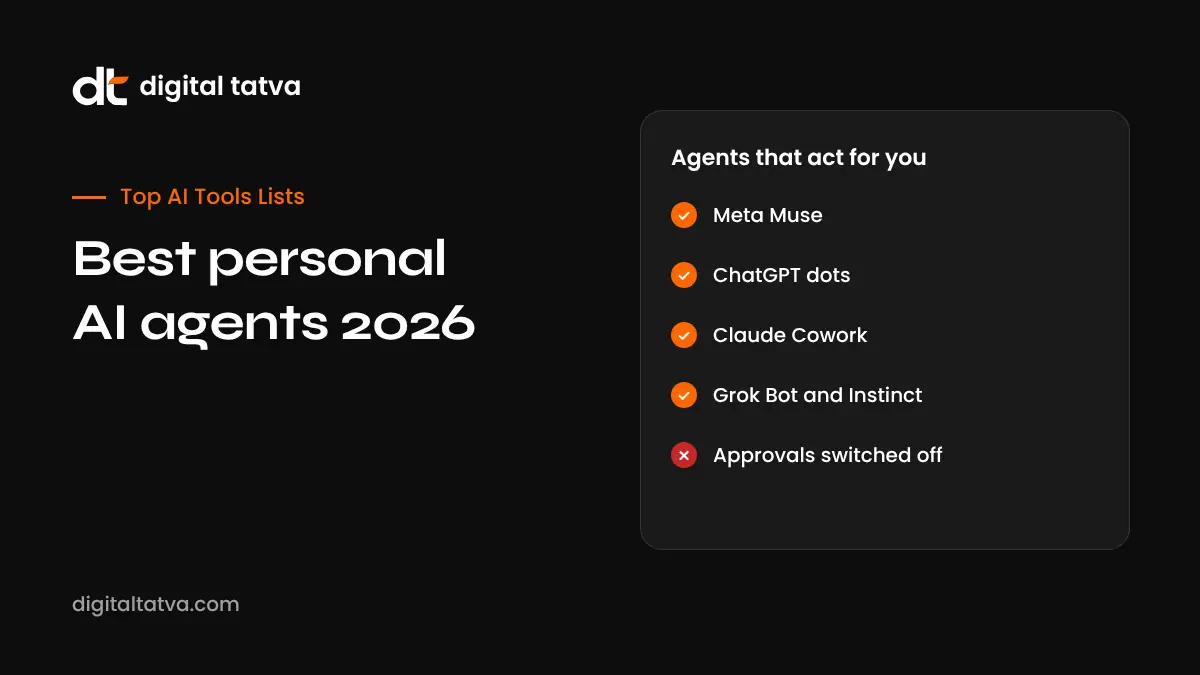
7 Best Personal AI Agents in 2026: Muse, Dots, Cowork and More
The best personal AI agents of 2026 compared on features, pricing, availability, user sentiment and safety.
On this page
- Key takeaways
- What is a personal AI agent?
- The best personal AI agents at a glance
- 1. Meta Muse: best free personal agent
- 2. ChatGPT dots: best for research and connected work
- 3. Claude Cowork: best for your files and work apps
- 4. Grok Bot: best for teams of agents
- 5. Instinct: best proactive agent (if you can get in)
- Other personal agents worth watching
- What users actually think
- How to choose a personal AI agent
- Safety checklist before you let an agent act for you
- Are personal agents available in India?
- What personal agents mean for businesses
- Frequently asked questions
Last updated: 17 November 2026
Quick answer: The best personal AI agents in late 2026 are Meta Muse for free, easy everyday tasks in the US, OpenAI’s ChatGPT dots for research and connected work tasks on ChatGPT Pro, Claude Cowork for working with your own files and apps, Grok Bot for teams of always-on agents, and Instinct for proactive help by text and phone, though it is invite-only. Personal agents are the fastest-growing AI category of 2026, but most are new, region-limited and still make mistakes, so start with low-risk tasks and keep approvals switched on.
Key takeaways
- A personal AI agent does tasks for you, such as booking, form filling, research and follow-ups, instead of only answering questions.
- 2026 saw a wave of launches: Grok Bot (August), Instinct (August), Meta Muse (September), ChatGPT dots (September) and more.
- Availability is uneven. Muse is US-only, dots needs ChatGPT Pro or Business Premium, and some agents are invite-only.
- User sentiment varies widely. In one analysis of public posts, Muse ranked highest and ChatGPT dots ranked lowest among 12 agents.
- Safety features matter: approvals before purchases and emails, audit trails, and clear data policies.
What is a personal AI agent?
A chatbot answers. An agent acts. A personal AI agent can take a goal like “book a table for four near my office on Friday evening” or “cancel the gym subscription and confirm by email”, then browse, fill in forms, send messages and report back. Many run on their own cloud computers with a browser, connect to your apps and keep working in the background.
a16z’s October 2026 Top 100 Gen AI Consumer Apps report called personal agents one of the fastest-growing categories, naming Instinct, Tomo, Poke, Lindy and Town, alongside rivals from big companies such as Meta Muse, OpenAI dots and xAI’s Grok Bot. The report said Instinct passed 100,000 users in about three weeks while invite-only, and Muse reached 250,000 daily active users in its first week and over 5 million downloads in under a month.
For the basics, see what AI agents are.
The best personal AI agents at a glance
| Agent | Company | Best for | Price | Availability |
|---|---|---|---|---|
| Muse | Meta | Free everyday tasks | Free; paid tiers for heavy use | US only |
| Dots | OpenAI | Research and connected work tasks | Included with ChatGPT Pro or Business Premium | Pro excludes EEA, Switzerland and UK |
| Claude Cowork | Anthropic | Files, documents and app workflows | Paid Claude plans from $20 a month | Where Claude paid plans are available |
| Grok Bot | xAI | Teams of always-on bots | SuperGrok from $30 a month | Beta |
| Instinct | Spear Street Technology | Proactive help by text and calls | No published pricing in beta | Invite or waitlist |
| Hermes Agent | Nous Research | Always-on agent with model choice | Varies | Setup required |
| Lindy | Lindy | Building work assistants without code | Team plan about $49.99 a month | Global |
Details reflect vendor pages and independent reviews checked in October and November 2026. Prices and availability change quickly.
1. Meta Muse: best free personal agent
Meta launched Muse on 8 September 2026. You can use it in the Muse app on iOS and Android, on the web or through WhatsApp. It can send emails, book travel, fill in forms, negotiate bills and check out using one-time card numbers, with Shop Pay and PayPal support announced. Muse runs on its own secure computer with a browser, uses a separate “Sentinel” agent to approve internet actions, asks before emails and purchases, and keeps an audit trail.
- Pros: free entry, quick setup, friendly personality, generous usage. It ranked first for user sentiment in an Enterpret analysis of public posts from August to October 2026.
- Cons: US only, access has been limited by invites, and your interactions train Meta’s models unless you opt out. Users raised trust and data concerns.
See our guide to Meta Muse.
2. ChatGPT dots: best for research and connected work
OpenAI launched dots at DevDay on 29 September 2026. A dot is an always-on agent with its own cloud computer and browser, running on GPT-6 Astra and connecting to more than 4,000 apps. You can reach it in ChatGPT, Slack, Teams or by voice call. Custom Rules let you allow, require approval for, or block specific actions, and dot conversations do not count toward normal ChatGPT usage limits. Since November 2026, dots can also pay for things through ChatGPT Wallet with biometric approval.
- Pros: strong research, huge app coverage, fine-grained action rules, payment support in the US.
- Cons: requires ChatGPT Pro (from $100 a month) or Business Premium, not available on Free, Go or Plus; Pro excludes the EEA, Switzerland and UK. Users reported it as slow, and it ranked lowest on sentiment in the Enterpret analysis.
3. Claude Cowork: best for your files and work apps
Anthropic’s Claude Cowork is less a lifestyle assistant and more a capable colleague. It works with folders you grant, connectors such as Google Workspace, Microsoft 365 and Slack, a browser and scheduled tasks. It is ideal for reports, spreadsheets, research and admin. Since October 2026 new tasks on Pro, Max and Ultra run in the cloud.
- Pros: excellent for document and spreadsheet work, plugins for business roles, scheduling, available on Windows, Mac, web and mobile.
- Cons: not on the Free plan; heavy tasks use a lot of allowance; needs care with file permissions.
Read our full Claude Cowork guide.
4. Grok Bot: best for teams of agents
xAI’s Grok Bot has been in beta since 11 August 2026 on Mac, Windows, iPhone and X. Its bots are always on, with browser and terminal access, and can sign into your apps. You can create group chats of “AI teammates” that pass work between each other, and “Routines” let a bot learn a job once and repeat it. Grok Bot for Enterprise has been available through sales since September, and Team Bots for Slack entered public beta on 28 September.
- Pros: agent teams, can contact people for you, included with SuperGrok plans from $30 a month and some Cursor plans.
- Cons: still beta; usage allowance is undisclosed and was the top user complaint; fewer published safeguards.
5. Instinct: best proactive agent (if you can get in)
Instinct, from San Francisco’s Spear Street Technology, launched invite-only in August 2026. It has no app: you text or call it. It follows up on dropped threads, runs errands, and texts or calls you proactively. Press coverage reported a funding round valuing the company at about $10 billion in September.
- Pros: genuinely proactive, simple to use by text or phone, well liked by early users.
- Cons: invite or waitlist only; no published pricing; broad data access to messages, emails, audio and location if shared; fewest published safeguards among major agents.
Other personal agents worth watching
- Hermes Agent (Nous Research): always-on, lets you choose models and configure skills. Powerful but harder to set up.
- Hark (Hark Labs): life admin, forms, paperwork and research, launched in October 2026.
- Poke: an agent you reach by message.
- Gemini Spark (Google): easy sign-in, though early users reported weaker research accuracy.
- Cue (Manus): aimed at existing Manus users. See how to use Manus.
- Perplexity Computer: research-led agent. See Perplexity Computer.
- OpenClaw: open-source and self-hosted, with full data control but more setup and maintenance.
- Lindy: a no-code platform for building inbox, meeting and sales assistants, with a seven-day trial and a Team plan at about $49.99 a month.
What users actually think
Enterpret’s Feedback Bench analysed public posts about 12 personal agents from 31 August to 25 October 2026. Its top five by feedback score were Muse (73.0), Hermes Agent (62.6), Grok Bot (58.1), Hark (55.9) and Instinct (49.1). ChatGPT dots scored lowest (38.4), with complaints about speed and limited availability. Claude Cowork, Perplexity Computer and Lindy were not included in that benchmark. Sentiment data reflects what people post online, so treat it as one signal rather than a verdict.
How to choose a personal AI agent
| If you want | Consider |
|---|---|
| A free agent for daily errands in the US | Meta Muse |
| Research and tasks across many work apps | ChatGPT dots |
| Help with documents, spreadsheets and files | Claude Cowork |
| Several agents working together | Grok Bot |
| Proactive reminders and follow-ups by text | Instinct |
| Full control and self-hosting | OpenClaw or Hermes Agent |
| Custom work assistants without code | Lindy |
Safety checklist before you let an agent act for you
- Keep approvals on for purchases, payments and messages.
- Start with low-risk tasks, such as research or drafting, before bookings and payments.
- Limit access. Connect only the apps and accounts the agent needs.
- Read the data policy, including whether your data trains models and how to opt out.
- Check the audit trail regularly to see what the agent did.
- Watch for prompt injection. Be careful letting agents read untrusted emails or websites.
- Review statements if the agent can spend money.
See our guide to AI agent security.
Are personal agents available in India?
Many of the most talked-about personal agents launched in the US first. Muse is US-only, ChatGPT dots requires Pro or Business Premium with regional limits, and Instinct is invite-only. Claude Cowork is available on paid Claude plans, which can be purchased in India. Expect more agents to expand internationally during 2027.
What personal agents mean for businesses
When agents book, compare and buy on behalf of customers, businesses need to be both recommended by AI and easy for agents to use. That means clear information, simple booking and checkout, and not blocking legitimate agents by accident. See Web Bot Auth, agent-ready websites and our AEO services.
Will AI agents recommend your business? Check with the free AI visibility checker or request an AEO audit.
Frequently asked questions
What is the best personal AI agent in 2026?
It depends on your needs. Meta Muse is the best free option in the US, ChatGPT dots suits research and connected work tasks, Claude Cowork is strongest for files and documents, and Grok Bot suits teams of agents.
Is Meta Muse free?
Muse is free for most tasks, with paid tiers for heavier use reported by TechCrunch. It is currently available only in the US.
How much do ChatGPT dots cost?
Your first dot is included with ChatGPT Pro, which starts at $100 a month, or Business Premium. Dots are not included on Free, Go or Plus plans.
What is the difference between an AI agent and a chatbot?
A chatbot answers questions. An agent takes actions, such as browsing, filling forms, sending messages and making bookings, to complete a goal.
Can personal AI agents make purchases?
Some can. Meta Muse can check out with one-time card numbers, and ChatGPT dots can pay through ChatGPT Wallet in the US with biometric approval.
Are personal AI agents safe?
They include safeguards such as approvals and audit trails, but they can still make mistakes. Keep approvals on, limit access and start with low-risk tasks.
What is Instinct AI?
Instinct is a proactive personal agent from Spear Street Technology that you text or call. It launched invite-only in August 2026.
Which personal agent works on WhatsApp?
Meta Muse can be used through WhatsApp, as well as its own app and website.
Is Claude Cowork a personal agent?
It is an agent focused on knowledge work, such as documents, spreadsheets and research, rather than lifestyle errands, but many people use it as a personal work assistant.
Will personal agents replace apps?
Not soon. Agents still use websites and apps to get things done. They change how people interact with services, not whether services exist.
Product details, prices and features are checked at the time of writing and can change. Sources are linked in the text so you can check them yourself.
How does your brand appear in AI answers?
We test the questions your buyers ask across the major AI assistants and search engines, then show you what to fix first.
Get an AI Visibility Audit