Base44 vs Lovable: Which AI App Builder Should You Use in 2026?
An honest comparison of Base44 and Lovable on pricing, speed, code ownership and the projects each one suits best.
On this page
- Key takeaways
- Why Base44 and Lovable are trending
- Base44 vs Lovable at a glance
- Pricing compared
- Building experience
- Ownership and lock-in
- Security and reliability
- Which should you choose?
- Alternatives worth considering
- Tips for getting better results from either tool
- Example builds: which tool we would pick
- Common mistakes with AI app builders
- A simple two-week plan to build your first app
- Do apps built with these tools rank in Google and AI search?
- How Digital Tatva can help
- Frequently asked questions
Last updated: 17 November 2026
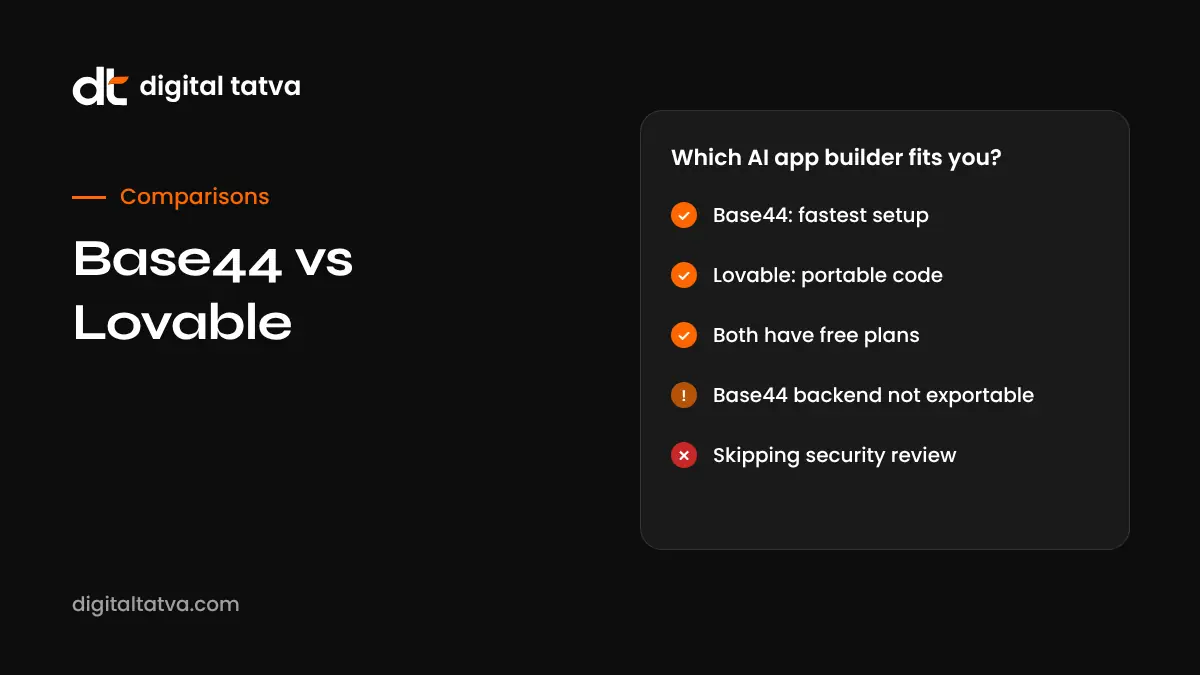
Quick answer: Base44 and Lovable both build working web apps from plain-language prompts, but they suit different people. Base44, owned by Wix, is the fastest route from idea to a hosted app with built-in database, login and automations, which makes it great for internal tools and quick demos. Lovable produces cleaner React code on a Supabase backend with two-way GitHub sync, which makes it the better choice for startup MVPs you plan to grow or hand to developers. Both have free plans; paid plans start around $20 a month for Base44 and $25 a month for Lovable.
Key takeaways
- Choose Base44 for speed, simplicity and an all-in-one hosted setup.
- Choose Lovable for code quality, portability and developer handoff.
- Base44 uses two credit types (message and integration credits); Lovable uses one shared credit pool.
- Lovable’s GitHub sync and Supabase backend mean you are less locked in. Base44’s backend is not exportable.
- Neither builds native mobile apps directly; both build web apps.
Why Base44 and Lovable are trending
“Vibe coding” tools that build apps from conversation have become one of the fastest-growing AI categories. In a16z’s seventh Top 100 Gen AI Consumer Apps report, published in October 2026, Base44 debuted at number 46 on the web list, joining Lovable, Cursor and Replit, which were already there. a16z also noted that high-spending AI users disproportionately buy coding and productivity tools. Semrush data reported by Exploding Topics put Lovable at 50 million monthly visits in June 2026, up 25% since February.
Base44 was acquired by Wix in June 2025. Third-party reports cited in comparisons say it passed 2 million users by early 2026. Lovable remains independent. If you are deciding between them, this guide compares what matters in practice.
Base44 vs Lovable at a glance
| Feature | Base44 | Lovable |
|---|---|---|
| Owner | Wix (acquired June 2025) | Independent |
| Best for | Internal tools, quick demos, non-technical operators | Startup MVPs, SaaS prototypes, apps for developer handoff |
| Backend | Built-in managed database, auth and hosting | Supabase (Postgres and Supabase Auth) |
| Code export | Paid plans; frontend React export in beta; backend not exportable | Two-way GitHub sync; standard React, TypeScript and Tailwind |
| Credits | Message credits plus integration credits | One shared credit pool |
| Free plan | 25 message credits, 100 integration credits a month | About 30 credits a month (5 a day) |
| Entry paid plan | Starter, about $20 a month ($16 annually) | Pro, $25 a month |
| Automations | Built-in automation builder | Relies more on integrations |
| UI quality | Good; may need more styling | Often rated more polished |
| Native mobile apps | No | No |
Pricing and features are taken from comparisons published in 2026, including Forbes Advisor. Plans change often, so confirm on each vendor’s pricing page before you buy.
Pricing compared
Base44 pricing
| Plan | Monthly | Message credits | Integration credits |
|---|---|---|---|
| Free | $0 | 25 (max 5 a day) | 100 |
| Starter | About $20 | 100 | 2,000 |
| Builder | About $50 | 250 | 10,000 |
| Pro | About $100 | 500 | 20,000 |
| Elite | About $200 | 1,200 | 50,000 |
| Enterprise | Custom | Custom | Custom |
Annual billing is roughly 20% cheaper. Forbes Advisor reports that you cannot add extra credits within a plan; you move up a tier instead, and that the Starter tier lacks some integrations and code export.
Lovable pricing
| Plan | Monthly | Notes |
|---|---|---|
| Free | $0 | About 30 credits a month, 5 a day |
| Pro | $25 | 100 base credits, expandable at extra cost |
| Business | $50 | 100 base credits, team features, SSO |
| Enterprise | Custom | Custom |
Lovable’s credits cover building, hosting and live AI from one pool. Forbes Advisor reports that adding credits can raise costs significantly, for example a Pro plan rising to about $294 a month at 1,200 credits.
Which is cheaper?
For small projects, both are similar. Base44’s separate integration credits can stretch further for automation-heavy apps. Lovable can become expensive if you iterate heavily on a large app. In testing reported by Forbes Advisor, Base44 used 10 of 25 free credits to build a first app and Lovable used 15 of 30 to reach a deployment-ready state.
Building experience
Base44
Base44 is optimised for speed. You describe an app, and it generates pages, a database, user accounts and hosting in one go. Reviewers describe it as the fastest path from prompt to a deployed app. Its built-in automation builder is a strength for internal tools such as approval workflows, lead trackers and simple CRMs. The trade-off is that first versions can feel like prototypes, with missing pages or images, and polishing the design takes more prompts.
Lovable
Lovable is almost as fast and tends to produce more polished interfaces. It generates full-stack React apps on Supabase with login and a database, and offers one-click deployment. Developers like that the code is standard and syncs with GitHub in both directions, so a developer can take over without rebuilding. Reviewers note it can struggle with complex authentication logic and multi-step flows, which may need several rounds of fixes.
Ownership and lock-in
This is the most important long-term difference.
- Base44 hosts your backend on its own infrastructure. Frontend React export is available on paid plans and was in beta during 2026, but the backend is not exportable. If you outgrow Base44, you may need to rebuild parts of your app.
- Lovable uses Supabase, an open-source backend you can run independently, and syncs code to GitHub. Moving to your own hosting is much easier.
If the app is a long-term product, Lovable’s portability is a significant advantage. If it is an internal tool or experiment, Base44’s convenience may matter more.
Security and reliability
Both platforms offer SSO and role-based permissions on higher plans and report SOC 2 Type II compliance, according to Forbes Advisor. Base44 had two security vulnerabilities disclosed in July 2025, which were patched within 24 hours. Some 2026 comparisons, citing third-party reports, mention a Base44 outage in February 2026 and slower support after the acquisition. Whatever you choose, AI-generated apps need security review before handling real customer data: check authentication, access rules, data validation and secrets.
Which should you choose?
| Your situation | Better pick |
|---|---|
| Internal tool for your team | Base44 |
| Quick demo for a client or investor | Base44 |
| Automation-heavy workflow app | Base44 |
| Startup MVP you plan to scale | Lovable |
| App a developer will maintain later | Lovable |
| You want code ownership and portability | Lovable |
| Polished public-facing interface | Lovable |
| Simplest all-in-one hosting | Base44 |
Alternatives worth considering
- Bolt.new: similar to Lovable. See Lovable vs Bolt.
- v0 by Vercel: strong for interface code. See how to use v0.
- Replit Agent: full development environment with an agent. See how to use Replit Agent.
- Cursor or Claude Code: for developers who want full control. See Claude Code vs Cursor.
- Claude Design: for designing screens before building. See Claude Design.
For a deeper look at Lovable alone, read our Lovable review.
Tips for getting better results from either tool
- Start with a short written spec: who uses the app, the main screens, the data you store and the key actions.
- Build the core flow first, then add features one at a time.
- Test login and permissions early, since these are common failure points.
- Use real sample data to spot problems quickly.
- Save working versions before big changes.
- Review security before inviting real users.
- Watch your credits; vague prompts waste them.
Example builds: which tool we would pick
These are illustrative project types to show how the choice plays out in practice.
| Project | Pick | Why |
|---|---|---|
| Lead tracker for a 5-person sales team | Base44 | Built-in database, login and automations; internal use only |
| Client portal for a small agency | Either | Base44 for speed; Lovable if you want to own and extend the code |
| SaaS MVP to show investors and then grow | Lovable | Portable code and Supabase backend for future developers |
| Event registration app for a one-off conference | Base44 | Fast, simple, short lifespan |
| Marketplace with payments and user roles | Lovable, then developers | Complex logic benefits from code access and review |
| Internal approval workflow | Base44 | Automation builder handles approvals well |
Common mistakes with AI app builders
- Starting without a plan. Vague prompts produce vague apps and burn credits.
- Adding features too early. Get one core flow working end to end first.
- Ignoring data structure. Decide what you store and how records relate before building screens.
- Skipping permission testing. Test as different user types to make sure people only see their own data.
- Storing secrets in the wrong place. API keys belong in secure settings, never in front-end code.
- Assuming you can migrate later for free. Check export options before you commit a long-term product.
A simple two-week plan to build your first app
- Day 1: write a one-page spec covering users, screens, data and actions.
- Days 2 to 3: build the core flow on the free plan of both tools and compare.
- Days 4 to 6: pick one, upgrade if needed, and add login and permissions.
- Days 7 to 9: add the next most important features and real sample data.
- Days 10 to 12: test with three to five real users and fix issues.
- Days 13 to 14: security review, custom domain and launch.
Do apps built with these tools rank in Google and AI search?
They can, but they are not automatically search-friendly. Many AI-built apps render content with JavaScript, lack proper titles and descriptions, and have no structured content for search engines or AI assistants to read. If your app includes public marketing pages, make sure they are crawlable, have clear text content, unique titles and descriptions, and helpful FAQs. Our technical AEO service covers this.
How Digital Tatva can help
Digital Tatva helps startups and businesses make sure the products they launch can be found, understood and recommended by Google, ChatGPT, Gemini and Perplexity. We review technical setup, content and brand signals for new launches. See AEO for startups and our AEO services for SaaS.
Launching an app? Check whether AI assistants know about it with the free AI visibility checker, or request an AEO audit.
Frequently asked questions
Is Base44 better than Lovable?
Neither is better for everyone. Base44 is faster and simpler for internal tools and demos. Lovable produces more portable code and polished interfaces for products you plan to grow.
Who owns Base44?
Wix acquired Base44 in June 2025.
Is Base44 free?
Base44 has a free plan with 25 message credits and 100 integration credits a month, limited to five credits a day. Paid plans start at about $20 a month.
Is Lovable free?
Lovable has a free plan with about 30 credits a month, limited to five a day. Paid plans start at $25 a month.
Can I export my code from Base44?
Frontend React export is available on paid plans and was in beta during 2026. The backend is not exportable.
Can I export my code from Lovable?
Yes. Lovable offers two-way GitHub sync with standard React, TypeScript and Tailwind code on a Supabase backend.
Can Base44 or Lovable build mobile apps?
Both build web apps. Neither builds native mobile apps directly, though web apps can work on mobile browsers.
Which uses fewer credits?
In one Forbes Advisor test, Base44 used 10 of 25 free credits for a first app and Lovable used 15 of 30 to reach a deployable state. Usage depends heavily on how you prompt.
Are AI-built apps secure?
They can be, but you must review authentication, access rules, data validation and secrets before handling real user data.
Which is better for non-technical founders?
Both work well. Choose Base44 for the quickest working prototype, or Lovable if you expect to hand the code to developers later.
Product details, prices and features are checked at the time of writing and can change. Sources are linked in the text so you can check them yourself.
How does your brand appear in AI answers?
We test the questions your buyers ask across the major AI assistants and search engines, then show you what to fix first.
Get an AI Visibility Audit